

A coach-focused DISC profile is a DISC assessment calibrated and worded for coaching roles. It gives you immediate, usable language to sharpen feedback, adapt your communication style, and build stronger cohesion among your staff. The right next step is simple: take a coach-specific assessment yourself, or review a sample coach report before you invest in certification.
TL;DR:
- Coach-specific DISC profiles emphasize understanding natural versus adapted styles, which is crucial for managing high-stress coaching situations.
- The assessment measures four key behaviors: dominance, influence, steadiness, and conscientiousness, translating them into recognizable coaching actions.
- Practical use includes tailoring feedback, structuring staffing roles, and developing scripts for coaching conversations based on behavioral insights.
- Certified coaching programs should include supervised debrief practice and reusable materials, not just CEU credits, to develop real facilitation skills.
- Affordable, coaching-specific DISC tools like the CoachDISC Profile streamline staff management and are more effective when used regularly in live coaching contexts.
Table of Contents
- Who Coach-Focused DISC Profiles Are Built For
- What a Coach DISC Report Actually Measures
- How Coaches Actually Use DISC in Practice
- Certification and Training Paths Worth Considering
- What to Expect Inside a Coach DISC Report
- Choosing a DISC Tool: A Coach's Checklist
- Why Coaching-Specific Expertise Matters Here
- DISC as a Coaching Tool, Not an HR Formality
- Getting Started With DISC Assess for Your Coaching Staff
- Sources
- FAQ
Who Coach-Focused DISC Profiles Are Built For
You do not need a front office or an athletic department to benefit from DISC. Head coaches, assistant coaches, coach developers, sport psychologists, and team managers all use these profiles the same way: to see their own behavioral tendencies clearly enough to adjust them on purpose. A head coach who runs hot under pressure and an assistant who freezes up in conflict are not flaws to fix. They are patterns to recognize and manage.
Coach-specific DISC tends to show up at a few natural checkpoints in a coaching career or program:
- Onboarding a new coach onto a staff, so everyone understands each other's default communication style before friction starts.
- Performance reviews, where behavioral context explains why a coach coaches the way they do, not just what results they produced.
- Coach education programs, which use DISC as a shared vocabulary across cohorts.
- Resolving staff friction, especially when two coaches keep clashing over the same recurring issue.
Profiling coaches and athletes side by side adds another layer entirely. A DISC profile built for leadership development helps a coaching staff see where their natural style lines up, or collides, with the athletes they are trying to reach.
What a Coach DISC Report Actually Measures
Every DISC framework rests on four dimensions: Dominance, Influence, Steadiness, and Conscientiousness. A coach-worded report translates those letters into behavior you recognize on the field or in the locker room, not abstract personality theory.
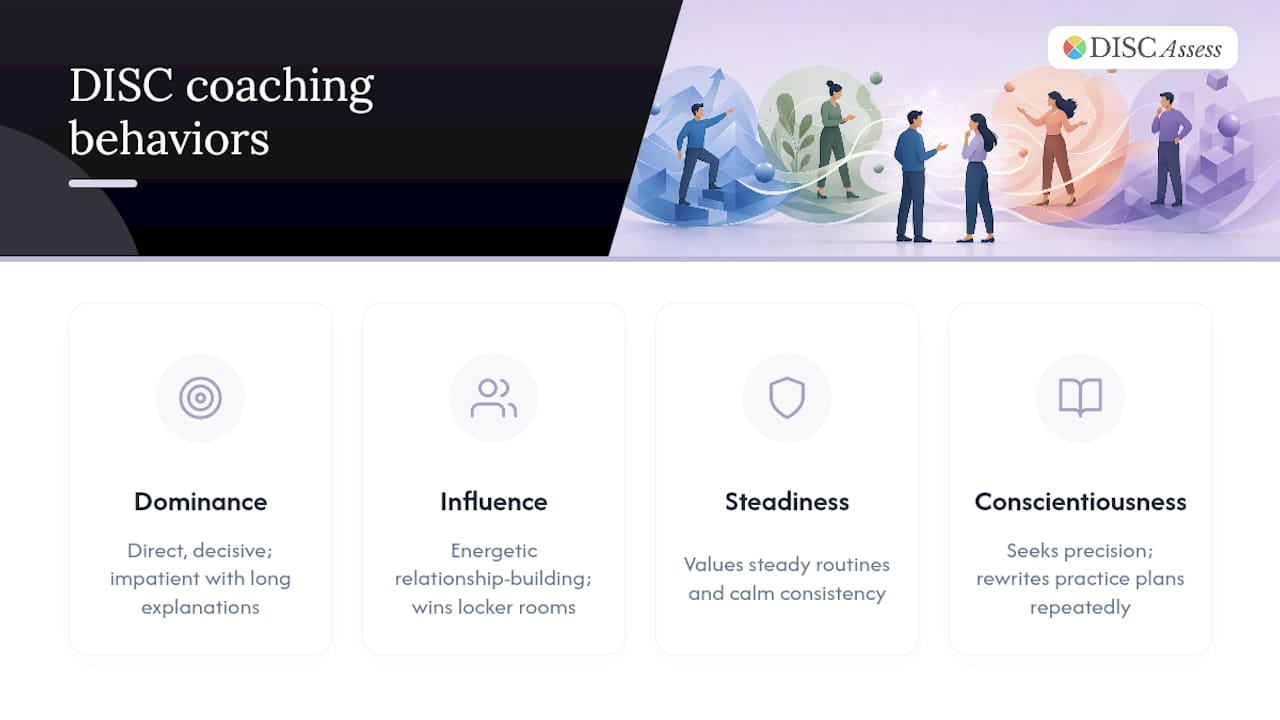
A high-D coach tends to be direct, decisive, and impatient with long explanations. They coach fast and expect fast answers. A high-I coach leans into energy and relationship building. They win locker rooms with enthusiasm but can lose the room when things get serious. A high-S coach values steady routines and calm consistency. Change unsettles them more than it does their peers. A high-C coach wants precision, benefiting from resources like the football basic techniques guide that help refine throwing, catching, and kicking skills. They will rewrite a practice plan five times before it feels right.
Here is where most generic workplace DISC tools fall short for coaching: they never explain natural versus adapted style. Your natural style is how you behave when nothing is pressing on you. Your adapted style is how you behave under game-day pressure, in front of a losing locker room, or during a heated recruiting call. The gap between the two matters more in coaching than in almost any other profession, because coaches operate under public, high-stakes stress constantly.

Pro Tip: Ask a coach to describe how they act in a blowout loss versus a routine Tuesday practice. The size of that gap tells you more about their stress response than the DISC letters alone ever will.
Sport-specific tools like the CoachDISC Profile are used across professional, college, and Olympic programs precisely because they translate D, I, S, and C into coaching behavior instead of office behavior. Most coach reports present this visually through a DISC graph, a behavioral diamond showing where you fall across all four dimensions, and a condensed one-page summary built for quick reference between practices.
How Coaches Actually Use DISC in Practice
DISC only earns its place in your coaching toolkit if it changes what you say and how you say it. That happens at two levels: inside individual sessions, and across the whole staff.
At the session level, DISC reshapes how you frame feedback. A high-D athlete or assistant wants the bottom line first, details second. A high-S staffer needs advance notice before a hard conversation, not a surprise ambush. Some coaches now pair a DISC profile with an AI interpretation layer to translate behavioral results into session strategy faster, especially useful when you are prepping for a difficult conversation with limited turnaround time.
At the team level, DISC informs who you pair together, how you structure development sessions, and where staff roles should shift. A coaching staff loaded with high-D personalities will move fast but may miss the steady follow-through a high-S coordinator provides.
Four micro-scripts worth keeping on hand for debriefs:
- Opening a tough conversation with a high-D athlete: "Here's the issue, here's what I need to see differently, here's the timeline."
- Slowing down with a high-S coach during change: "I know this shift feels sudden. Here's why we're making it, and here's the runway you have to adjust."
- Redirecting a high-I personality mid-meeting: "I love the energy. Let's land on the one action item before we move on."
- Pushing a high-C coach past analysis paralysis: "This plan is 90 percent there. Let's commit and adjust live if we need to."
These scripts are not gimmicks. They are the practical payoff of understanding a coaching staff you have worked with for years without a shared behavioral vocabulary. Communication breakdowns on coaching staffs tend to repeat the same handful of patterns, and naming those barriers explicitly is often the fastest way to stop them from recurring.
Certification and Training Paths Worth Considering
Not every coach needs a certification. Plenty of value comes from simply reading a well-built coach report and applying the language above. But if you are running a coach development program, training a staff, or building a coaching practice around behavioral assessment, certification changes what you are able to offer clients.
Look for a few concrete signals when comparing programs:
- CEU-eligible courses that carry recognized continuing education credit, which matters if you already hold a coaching or counseling credential.
- Supervised debrief practice, not just a slide deck. Debriefing a report live is a skill, and it is one most new practitioners underestimate.
- Reusable facilitator materials you can bring into your own sessions rather than build from scratch.
- Group and team access, since most coaching work happens at the staff level, not one profile at a time.
Certification programs for coaches are commonly marketed with CEUs and facilitator resources, but a CEU badge alone does not guarantee practical skill. The programs worth paying for are the ones that put you in front of a real debrief scenario before they hand you a certificate. Ask any provider directly how much of the course is supervised practice versus passive content, and weigh the investment against how often you will realistically use the credential with real coaching clients.
What to Expect Inside a Coach DISC Report
A well-built coach DISC report is not a single page of letters. Some coach-focused offerings run to a genuinely in-depth format. A 40-page CoachDISC Profile is one example, paired with a condensed one-page summary and optional observer or 360 feedback.
Here is the anatomy you should expect and how to use each part:
- Executive summary: your dominant style at a glance, useful for a five-minute review before a staff meeting.
- Strengths section: behaviors that work in your favor, worth reinforcing rather than second-guessing.
- Development tips: coach-worded suggestions for the specific behaviors most likely to trip you up.
- Stress response section: how your style shifts under pressure, the single most useful part for game-day self-awareness.
- One-page quick reference: built for practical, on-field use, according to Coach DISC reporting practices.
Group and 360 features add observer feedback from staff or athletes, which often reveals a gap between how you think you come across and how your team actually experiences you.
| Report section | Best used for |
|---|---|
| Executive summary | Quick staff meeting prep |
| Development tips | Personal coaching plan |
| Stress response | Game-day self-management |
| Group/360 feedback | Staff cohesion planning |
Turn the report into a plan rather than a filing cabinet document: pick one development tip for the next 30 days, one communication adjustment for 60, and revisit the stress-response section at the 90-day mark once you have lived through at least one high-pressure situation.
Choosing a DISC Tool: A Coach's Checklist
Skip any tool that was clearly written for office HR departments and lightly relabeled for sports. Coach-specific wording is not a cosmetic detail. It is the difference between a report that tells you to "collaborate cross-functionally" and one that tells you how to open a hard conversation with a slumping starter.
Run any option through this checklist before buying:
- Does the report use coaching language, not generic workplace phrasing?
- Does it include team or group reporting, not just individual profiles?
- Is the pricing model built for how you actually buy, one assessment versus a staff-wide package?
- Are debrief resources included, or will you need to build your own facilitation guide?
- Does the provider show real coaching examples rather than vague validation claims?
Watch for red flags: no coaching-specific examples anywhere on the provider's site, no option for group or team reporting, and marketing language that claims validity without explaining what was actually measured. If you are equipping a whole staff, a group admin tool built for running assessments at scale will save you far more time than buying profiles one at a time. Decide upfront whether you need a single assessment, a group package for a coaching staff, or a facilitator membership if you plan to run DISC sessions regularly across multiple teams or cohorts.
Why Coaching-Specific Expertise Matters Here
Most DISC content online is written for HR departments hiring office staff, not for coaches managing locker room dynamics under a scoreboard clock. Tres has written specifically on why DISC belongs in coaching conversations rather than hiring decisions, laying out the validity case for coaching-specific DISC use in more depth than a general workplace guide ever will.
That distinction shapes how DISC Assess builds its tools. Instant reports mean you are not waiting days for results before a staff meeting. Group admin features let a head coach manage an entire staff's profiles from one dashboard instead of juggling individual PDFs. Workshop assets give you facilitation material without writing your own from scratch. For a small coaching staff or a nonprofit sports program without an HR budget, an affordable, easy-to-use tool is not a lesser option. It is often the only realistic one.
DISC as a Coaching Tool, Not an HR Formality
Most DISC content still treats the assessment as something you administer once and file away. That framing fails coaches specifically, because coaching is a live, high-pressure, repeated-interaction profession. A profile that sits in a drawer after week one has done nothing for you.
The conventional advice, "take the assessment, read your type, move on," undersells what coach-specific DISC can actually do. The real value shows up in the stress-response section, in the natural-versus-adapted gap, and in the specific phrasing you use with a struggling athlete or a frustrated assistant coach. Certification, similarly, gets oversold as a credential and undersold as a practical skill. A CEU badge means little if you never practiced debriefing a real report under supervision.
If you take one thing from this guide, prioritize the stress-response and debrief-practice angle over the certificate itself. A coach who can read a report and adjust a Tuesday-practice conversation in real time is more valuable to a staff than one who can recite the four letters from memory.
— Tres
Getting Started With DISC Assess for Your Coaching Staff
The platform is designed to support coaching workflows with ease of use and practical tools. If you are coaching solo, the Individual Assessment gives you an instant report you can read before your next staff meeting. If you are running a full coaching staff, the Group Admin Account lets you manage every profile from one dashboard instead of chasing paperwork, and an Unlimited Membership makes sense if you are onboarding new staff throughout the year rather than all at once.
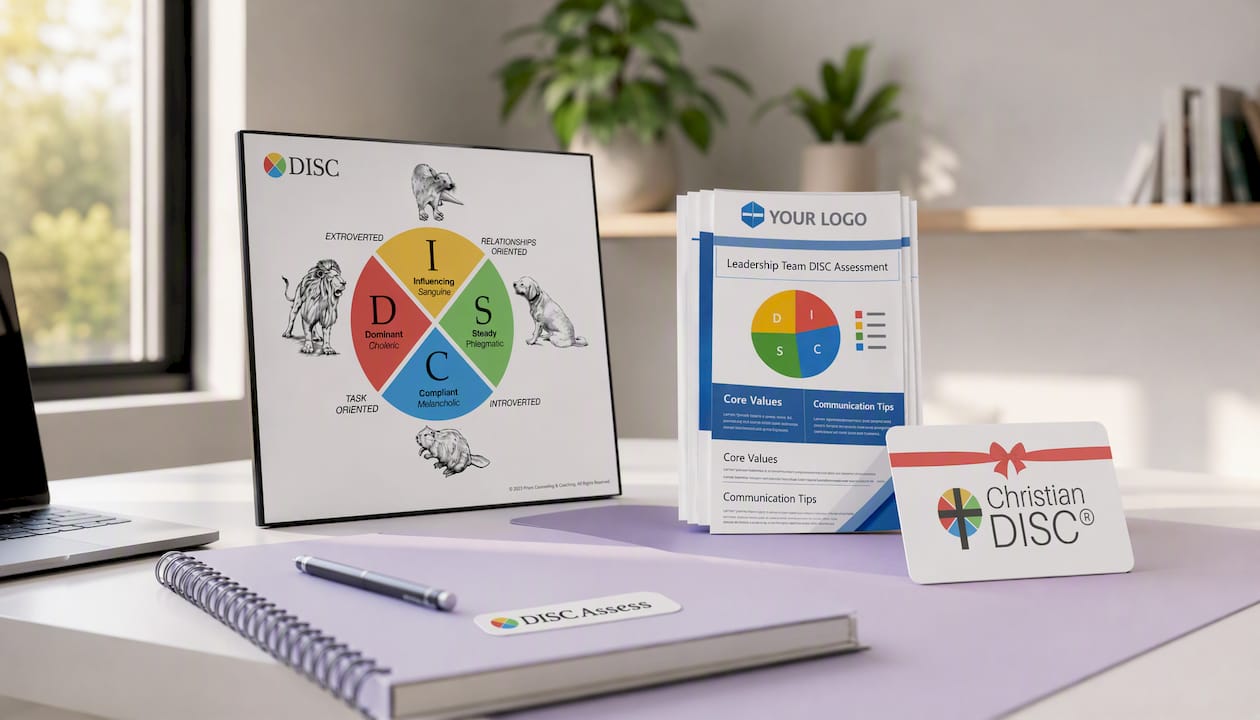
Coach developers running recurring workshops should look at Live Group Training options built for staff-wide sessions, and pair that with the workshop guide to structure your own debrief. Ready to buy a single report or a faith-based version for a ministry-affiliated program? The assessment store lists both the Classic and Christian DISC options with report included. Start with one assessment, read the stress-response section closely, and decide from there whether your staff needs a group package.
Sources
FAQ
How Is DISC Used in Coaching?
Coaches use DISC to understand their own behavioral tendencies and adapt communication with athletes and staff, especially around feedback timing and phrasing. It works best paired with a coaching action plan rather than treated as a one-time personality label. A well-built CoachDISC Profile is designed specifically for this coaching context rather than general office use.
What Is the Rarest DISC Personality Type?
Because DISC measures a blend of four traits rather than assigning one fixed category, no single "rarest" type has a universally agreed-upon answer, and results vary by population sampled. Most coaches get more value from focusing on their own natural-versus-adapted gap than chasing rarity statistics.
Is DISC Certification Worth It for Coaches?
Certification is worth it when the program includes supervised debrief practice and reusable facilitator materials, not just a CEU badge. A certification program built for coaches should teach you to run a real debrief conversation, since that practical skill matters more than the credential itself.
What Was Donald Trump's DISC Personality Type?
There is no verified, publicly documented DISC assessment result for Donald Trump from a recognized DISC provider. Any type attributed to him online is speculation, not an official assessment outcome, and should not be treated as a sourced fact.
How Much Does a Coach DISC Assessment Cost?
Pricing depends on whether you are buying a single report or equipping a whole staff. Discassess offers an Individual Assessment for $29 and a Classic DISC Assessment with report for $49, with group and membership options available for staffs managing multiple coaches.