

DISC profiles are defined as a behavioral framework that categorizes human behavior into four styles: Dominance, Influence, Steadiness, and Conscientiousness. Coaches and business leaders use disc profiles leadership development coaching to build self-awareness, improve team communication, and shape more effective leadership habits. 70% of Fortune 500 companies use DISC for leadership development, which confirms its credibility as a practical, proven tool. DISC goes well beyond a personality quiz. When applied with intention, it becomes a compass for ongoing behavioral growth and team transformation.
What tools and preparation make DISC-based leadership coaching work?
Preparation separates a productive DISC coaching engagement from a forgettable one. Before any coaching conversation begins, leaders and coaches need the right assessment, the right report, and a clear plan for how to use both.
Standard DISC assessments take about 10–15 minutes to complete and deliver detailed profiles covering behavior patterns, stress responses, and communication preferences. That brevity is a strength. Leaders can complete the assessment without disrupting their workday, and coaches receive rich, immediately usable data.

Not all assessments are equal. Validated assessments with detailed narrative reports give coaches far more to work with than casual online tests. A thorough report covers a leader's natural style, their adapted style under pressure, and specific communication tendencies. That depth is what makes the coaching conversation meaningful.
The essential tools for DISC-based leadership coaching include:
- Validated DISC assessment with a full narrative report (not just a four-quadrant chart)
- Style guides that explain how each DISC type communicates, motivates, and responds to conflict
- Coaching frameworks such as the GROW model, which structures development conversations around Goals, Reality, Options, and Will
- Debrief templates that connect behavioral insights to specific leadership challenges
- Team-level reports when coaching a group rather than an individual
Strategic DISC Debrief sessions lasting 60–90 minutes are standard practice for contextualizing results to a leader's real organizational challenges. A debrief is not a report review. It is a guided conversation that translates behavioral data into personal growth commitments.
Pro Tip: Schedule the debrief within 48 hours of the leader receiving their report. The insights are freshest then, and the motivation to act is highest.
| Preparation Step | Purpose |
|---|---|
| Validated assessment | Delivers accurate, detailed behavioral data |
| Full narrative report | Provides context beyond a four-quadrant summary |
| GROW model framework | Structures coaching conversations toward clear goals |
| Strategic Debrief session | Connects DISC data to real leadership challenges |
| Team-level DISC reports | Enables group coaching and communication planning |
How do you apply DISC profiles step by step in leadership coaching?
The coaching process begins with the assessment, but the real work starts at interpretation. A leader who scores high in Dominance, for example, may drive results effectively but struggle to slow down and listen. The coach's job is to name that gap clearly and help the leader see it as a growth edge, not a flaw.
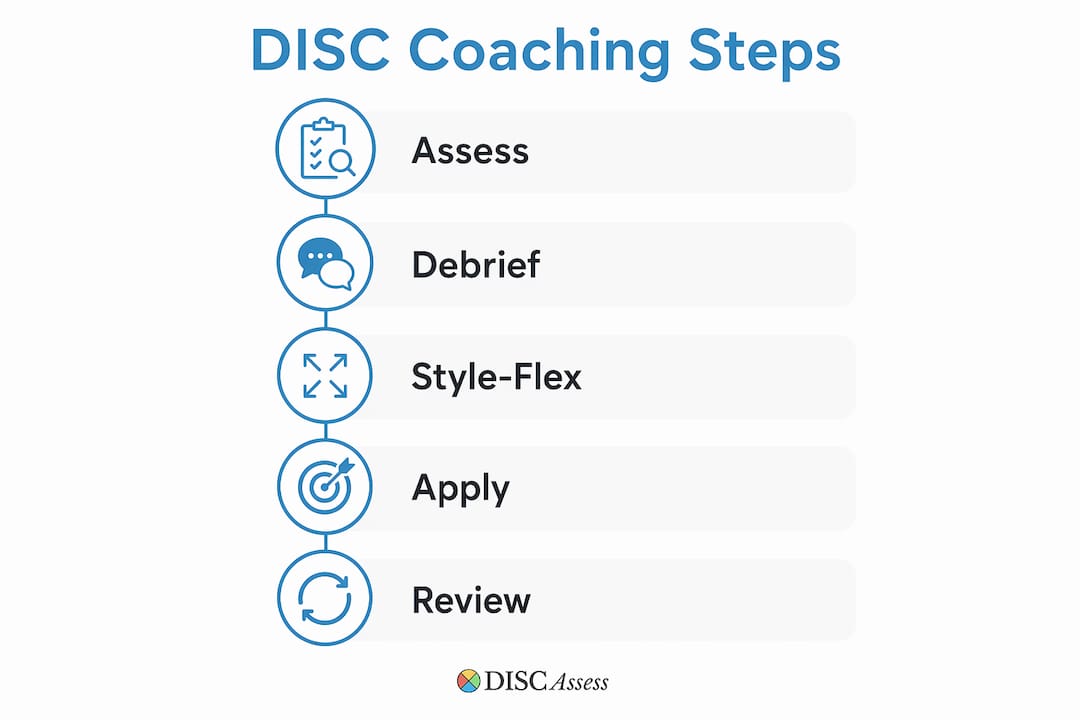
Follow this sequence for a structured DISC leadership coaching engagement:
- Administer the assessment. Use a validated tool that produces a full narrative report. Discassess offers individual and group assessment options designed for coaches and leadership teams without requiring HR certification.
- Review the report together. Walk the leader through their natural style, adapted style, and key behavioral tendencies. Ask reflective questions rather than lecturing.
- Run a Strategic Debrief. Effective DISC coaching integrates behavioral insights into ongoing leadership strategy, not just self-awareness. Use the debrief to connect the leader's DISC profile to their current role demands and team dynamics.
- Map the gap. Experienced DISC coaches identify the distance between a leader's default behavioral style and the demands of their current role. That gap becomes the coaching agenda.
- Teach style-flexing. The power of DISC lies in enabling leaders to adapt their approach based on the needs of each team member. A high-Dominance leader learns to slow down with a high-Steadiness colleague. A high-Conscientiousness leader learns to express enthusiasm with an Influence-driven team.
- Create a "How to Work With Me" profile. One-page DISC profiles give team members a simple, practical reference for how to communicate with their leader. This tool reduces friction and builds trust quickly.
- Integrate DISC into the GROW model. Use the leader's DISC profile to inform every stage of the GROW conversation. Their behavioral tendencies shape how they set goals, perceive reality, generate options, and commit to action.
- Set behavioral practice goals. End each coaching session with one specific behavioral experiment the leader will try before the next session. Concrete practice accelerates growth.
Pro Tip: When coaching a high-Conscientiousness leader, frame style-flexing as a data-driven experiment rather than a personality change. They respond better to evidence than to encouragement alone.
Leaders who use DISC to tailor their feedback and coaching conversations increase trust and engagement significantly. That outcome is the goal of every step in this process.
What common challenges arise in DISC leadership coaching?
The most damaging mistake in DISC leadership coaching is treating the profile as a fixed personality label. A leader who hears "you're a D" and stops there has missed the point entirely. DISC measures behavioral preferences, not permanent traits. Behavior shifts with context, stress, and intention.
Coaches face several recurring challenges when applying behavioral profiles in coaching:
- Superficial use. Leaders complete the assessment, read the report, and file it away. Without a debrief and ongoing application, DISC produces awareness but no change.
- Resistance to style-flexing. Some leaders interpret adapting their style as being inauthentic. Coaches must reframe flexing as a skill, not a compromise. The goal is not to abandon your natural style but to expand your range.
- One-time event thinking. Effective leadership coaching requires embedding behavioral practice into daily work, not just isolated sessions. DISC insights fade without reinforcement.
- Team skepticism. Some team members distrust behavioral frameworks. Coaches should introduce DISC as a communication tool, not an evaluation system. Framing matters enormously.
- No feedback loop. Without measuring behavioral change over time, coaches cannot demonstrate coaching impact. Use 360-degree feedback, manager observations, or follow-up assessments to track progress.
"DISC is not a ceiling. It is a starting point. The leader who understands their behavioral tendencies and chooses to grow beyond them is the leader who builds teams that thrive. The profile describes where you are, not where you are going."
Addressing these challenges requires coaches to stay curious and patient. When a leader resists style-flexing, explore the underlying belief. When a team dismisses DISC, slow down and build psychological safety before pushing application. The limitations of DISC are real, and acknowledging them builds credibility with skeptical audiences.
How can coaches use DISC to accelerate team development?
DISC becomes most powerful when it moves from individual coaching to team-level application. A team where every member understands their own profile and their colleagues' profiles communicates with far less friction and far more intention.
Team-level DISC coaching produces three clear outcomes. First, it surfaces complementary strengths. A team with a mix of Dominance and Steadiness styles, for example, balances urgency with stability. Second, it reduces conflict by naming behavioral differences as style gaps rather than character flaws. Third, it creates a shared language for feedback and collaboration that persists long after the coaching engagement ends.
Pro Tip: Run a team DISC workshop before a major organizational change. Knowing each member's stress response in advance helps the team navigate uncertainty with more grace and less friction.
Coaches can also use DISC for workplace teams to identify emerging leaders. A team member with a high-Influence style who also shows Conscientiousness tendencies may be a natural candidate for a coaching or mentoring role. DISC data makes those conversations more objective and less political.
| Application | Individual Coaching | Team Development |
|---|---|---|
| Primary focus | Leader self-awareness and style-flexing | Communication norms and role alignment |
| Key tool | Strategic Debrief and GROW model | Team DISC workshop and shared profiles |
| Outcome | Behavioral adaptability | Reduced conflict and stronger collaboration |
| Timeline | Ongoing coaching sessions | Structured program with follow-up |
Embedding DISC into organizational systems such as communication norms and change management processes ensures that behavioral insights translate into lasting culture change. That is the difference between a training event and a leadership development program. Coaches who help organizations build DISC into their hiring, onboarding, and performance conversations create compounding returns on the initial investment.
Key Takeaways
DISC profiles deliver their greatest leadership impact when coaches move beyond assessment to structured debrief, style-flexing practice, and team-level integration.
| Point | Details |
|---|---|
| DISC is a behavioral tool, not a label | Treat profiles as dynamic starting points for growth, not fixed personality categories. |
| Debrief sessions drive real change | A 60–90 minute Strategic Debrief connects DISC data to specific leadership challenges and goals. |
| Style-flexing is the core skill | Leaders who adapt their approach to each team member build trust and improve performance. |
| Team-level application multiplies impact | Shared DISC profiles reduce conflict and create a common language for collaboration. |
| Embed DISC into daily practice | Coaching works best when behavioral insights are reinforced through ongoing systems, not one-time events. |
Why strategic debriefing is the real turning point in DISC coaching
I have seen leaders walk out of a DISC assessment feeling boxed in. They read "high D" and hear "you are aggressive." That reaction tells me the assessment was delivered without context, and the coaching opportunity was lost before it began.
The Strategic Debrief is where everything changes. When I sit with a leader and we map their behavioral profile against the actual demands of their role, something shifts. They stop defending their style and start getting curious about it. That curiosity is the foundation of every meaningful leadership change I have witnessed.
Style-flexing is the skill I return to most often with executive coaching clients. The leaders who grow fastest are not the ones who change who they are. They are the ones who expand what they can do. A high-Dominance leader who learns to pause and ask questions does not become less decisive. They become more trusted.
My strongest recommendation for coaches is to resist the temptation to use DISC as a one-session tool. The leaders who benefit most are the ones whose coaches weave behavioral insights into every conversation, every goal-setting session, and every team challenge. DISC works best as a lens, not a lesson.
— Tres
Discassess makes DISC leadership coaching accessible
Coaches and leaders who are ready to apply these strategies need assessments that are validated, affordable, and easy to deploy. Discassess, backed by over a decade of experience through Prism Counseling & Coaching, provides exactly that.
Whether you are coaching a single executive or developing an entire leadership team, Discassess offers group assessment packages and individual assessments with full narrative reports. No certification is required. No complex setup. You get professional-level DISC tools designed for coaches, small businesses, and nonprofits who want real results without the enterprise price tag. Start with one leader or bring your whole team. The resources are ready when you are.
FAQ
What are the four DISC behavioral styles in leadership?
The four DISC styles are Dominance, Influence, Steadiness, and Conscientiousness. Each style reflects distinct behavioral tendencies that shape how leaders communicate, make decisions, and respond to pressure.
How long does a DISC leadership assessment take?
A standard DISC assessment takes about 10–15 minutes to complete and delivers a detailed profile covering behavior, stress responses, and communication preferences immediately after.
What is style-flexing in DISC leadership coaching?
Style-flexing is the practice of adapting your natural behavioral approach to meet the needs of a team member or situation. It builds trust, improves communication, and is considered the core skill of effective DISC-based leadership development.
How does DISC integrate with the GROW coaching model?
The GROW model structures coaching conversations around Goals, Reality, Options, and Will. DISC profiles inform each stage by revealing how a leader's behavioral tendencies shape their goal-setting, self-perception, and commitment to change.
Can DISC profiles be used for team development, not just individual coaching?
Yes. Team-level DISC application creates a shared language for communication, surfaces complementary strengths, and reduces conflict by framing behavioral differences as style gaps rather than personal flaws.
Recommended
- DISC for Workplace Teams: A Manager's Practical Guide
- DISC Personality Assessment | Prism Counseling & Coaching - DISC Assess | Affordable, Professional DISC Assessments for Small Businesses
- The Appeal of DISC: Why People Love Using This Popular Personality Assessment - DISC Assess | Affordable, Professional DISC Assessments for Small Businesses
- DISC Assess | Affordable, Professional DISC Assessments for Small Businesses - All Articles