

DISC for workplace teams is a behavioral assessment framework that identifies four core communication and work styles to help managers reduce friction, build shared language, and improve how teams collaborate. The four styles are Dominance (D), Influence (I), Steadiness (S), and Compliance (C). Unlike personality tests, DISC measures observable behavior patterns, making it practical for coaching, communication, and team development rather than hiring decisions. Tools like Everything DiSC and platforms like Discassess have made DISC assessments widely accessible for teams of every size. When managers understand what is DISC for workplace teams, they gain a concrete framework for turning communication differences into strengths.
What are the four DISC styles and how do they show up at work?
Each DISC style reflects a distinct pattern in how people communicate, make decisions, and respond to pressure. DISC measures how people tend to communicate, respond to stress, approach tasks, and interact with colleagues. Every person uses all four styles to some degree, but most people have one or two dominant preferences that shape their default behavior.
Understanding each style helps managers predict how team members will engage with tasks, conflict, and leadership.
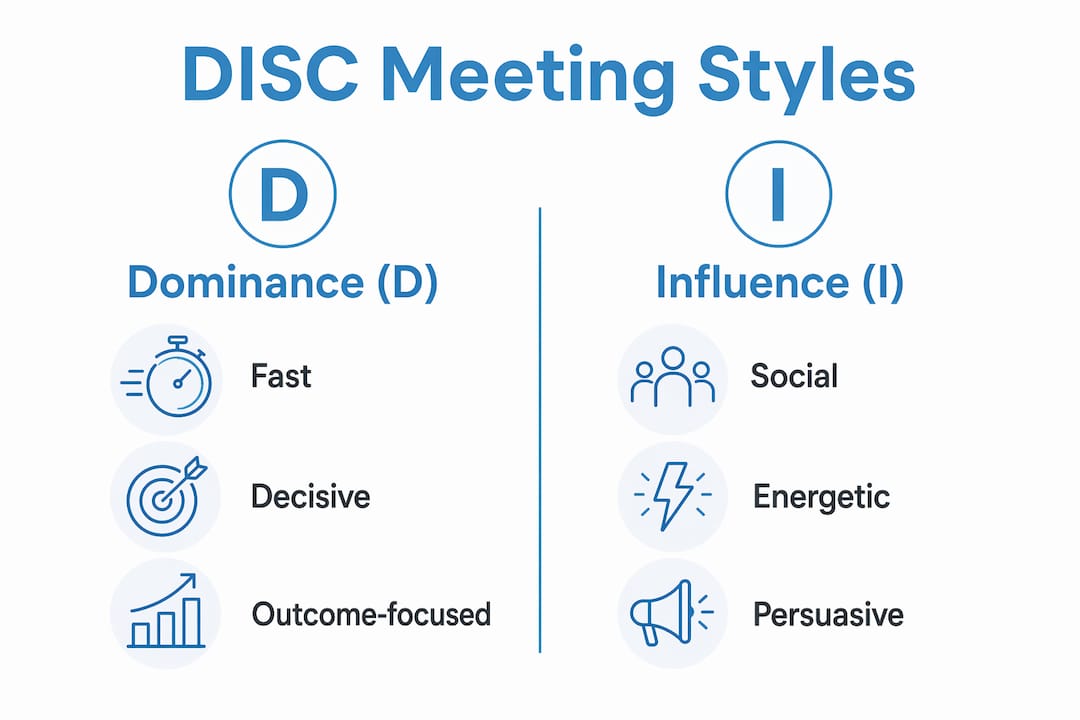
- Dominance (D): Direct, results-focused, and fast-moving. D-style team members prefer brief communication, clear goals, and decision-making authority. They thrive under challenge but can come across as blunt or impatient.
- Influence (I): Expressive, enthusiastic, and people-oriented. I-style team members energize group settings and excel at persuasion and collaboration. They can struggle with follow-through and detailed work.
- Steadiness (S): Supportive, consistent, and loyal. S-style team members are the stabilizers on any team. They prefer harmony and predictability, and they resist sudden change.
- Compliance (C): Detail-oriented, analytical, and quality-driven. C-style team members ask the hard questions and hold high standards. They can slow decisions down when they need more data than the situation requires.
Pro Tip: Never reduce a team member to a single letter. DISC describes tendencies, not fixed traits. A person with a high D score can still show strong S behaviors when the situation calls for patience and support.
The real value of a team DISC profile overview comes from seeing the full picture of your team's behavioral mix. A team heavy in D and I styles will move fast but may overlook details. A team heavy in S and C styles will be thorough and stable but may resist bold decisions. Knowing your team's composition lets you plan accordingly.

How do teams use DISC for better meetings and communication?
Meetings are where DISC pays off most visibly. DISC reduces interpersonal friction by giving teams a shared vocabulary and structured communication protocols, including customizing meetings based on each style's preferences. When you know your team's behavioral mix, you can design meetings that actually work for everyone in the room.
Here is how each style experiences a typical meeting and what they need from you as the manager:
- D-style team members want meetings to start on time, stay on topic, and end with clear decisions. Skip the warm-up and get to the point.
- I-style team members want energy, interaction, and a chance to contribute ideas. Build in discussion time and acknowledge their input publicly.
- S-style team members want advance notice of the agenda and time to process before being asked for opinions. Surprise agenda items create anxiety for S styles.
- C-style team members want data, context, and logical structure. Send pre-reads before the meeting and allow time for questions.
Frameworks like TAPP/TRAIN, developed for DISC-informed meeting management, help teams structure agendas that address all four styles without making meetings feel like a personality exercise. The goal is practical efficiency, not a therapy session.
| Style | Meeting preference | Communication tip |
|---|---|---|
| Dominance (D) | Fast, decisive, outcome-focused | Lead with the bottom line |
| Influence (I) | Interactive, energetic, collaborative | Allow open discussion time |
| Steadiness (S) | Structured, predictable, low-pressure | Share agendas in advance |
| Compliance (C) | Data-driven, logical, detailed | Provide written context beforehand |
Pro Tip: When you share DISC results in a team meeting, frame the conversation around communication preferences, not character judgments. Ask team members to share one thing they wish colleagues understood about how they work best.
Managers using DISC profiles can tailor how they communicate and respond, improving both efficiency and team unity. This is the core benefit of learning how teams use DISC for better meetings: you stop guessing what people need and start designing for it.
How to apply DISC insights for role alignment and conflict resolution
DISC creates a neutral framework for discussing team behavior, which makes it especially useful when addressing conflict. By focusing on behaviors rather than personality, DISC allows teams to address working style differences without blame. That shift from "you're difficult" to "our styles create friction here" changes everything about how a conflict conversation unfolds.
Role alignment is equally powerful. When you match tasks and responsibilities to behavioral preferences, people perform better and feel more engaged. Consider these practical applications:
- Assign project leadership to D-style team members when speed and decisiveness matter most.
- Put I-style team members in client-facing, presentation, or recruitment roles where energy and persuasion drive results.
- Rely on S-style team members for roles requiring consistency, follow-through, and team support, such as onboarding coordination or internal training.
- Assign C-style team members to quality assurance, compliance, data analysis, or any role where accuracy is non-negotiable.
DISC also helps managers identify pressure points before they become problems. A team with no C-style representation may rush decisions without enough analysis. A team with no D-style energy may struggle to close projects and move forward. Knowing these gaps lets you compensate proactively.
DISC is a common reference point for navigating interpersonal situations, not a ranking tool. Managers should never use DISC profiles to label team members as better or worse performers. The framework exists to improve fit and communication, not to sort people into tiers. When embedded into onboarding, leadership development, and regular feedback cycles, DISC becomes a living resource rather than a one-time exercise. You can learn more about applying DISC with employees through practical guides designed for managers without HR backgrounds.
How do coaches and managers facilitate effective DISC team sessions?
A DISC team session works best when it follows a clear structure and creates psychological safety for honest conversation. Facilitated team sessions convert individual profiles into lasting communication tools when the facilitator builds shared language rather than just presenting results.
Here is a practical sequence for running an effective DISC team session:
- Administer assessments in advance. Have every team member complete their DISC assessment online before the session. This gives the facilitator time to review the team DISC map and identify patterns.
- Open with context, not scores. Start the session by explaining what DISC measures and what it does not measure. Emphasize that no style is better than another.
- Share individual profiles in pairs or small groups. Peer-to-peer sharing builds empathy faster than a group presentation. Ask each person to share one strength and one challenge their style creates for the team.
- Map the team's behavioral composition. Display the full team DISC map so everyone can see the group's collective strengths and gaps. This visual is often the most memorable part of the session.
- Create communication agreements. End the session with concrete commitments. For example, D-style team members agree to pause before responding in conflict, and C-style team members agree to flag concerns in writing rather than delaying decisions.
Embedding DISC into operational systems like meetings, feedback cycles, and hiring makes communication a business advantage rather than a soft skill. Teams that use DISC within structured frameworks such as EOS or Level 10 Meetings report stronger operational consistency over time. The best use of DISC is ongoing integration into team practices, not a one-time workshop. Coaches and managers who revisit DISC insights quarterly keep the framework alive and relevant as teams grow and change. Discassess supports this ongoing use with group management tools and printable profiles that make it easy to reference DISC insights between formal sessions. You can also explore how DISC appeals to diverse teams across different organizational contexts.
Key Takeaways
DISC for workplace teams works because it replaces guesswork about communication with a shared behavioral language that managers can apply directly to meetings, role assignments, and conflict resolution.
| Point | Details |
|---|---|
| DISC measures behavior, not personality | Use DISC for communication and coaching, not for hiring or ranking team members. |
| Team composition reveals gaps | A DISC team map shows where your group is strong and where it needs balance. |
| Meetings improve with style-aware design | Tailor agendas to D, I, S, and C preferences to reduce friction and increase engagement. |
| Conflict becomes less personal | DISC language shifts difficult conversations from blame to behavioral difference. |
| Ongoing use drives lasting results | Revisit DISC insights quarterly rather than treating it as a one-time assessment. |
Why DISC changed how I think about team leadership
I used to believe that good communication came down to clarity. If you said something clearly enough, people would understand and respond well. DISC showed me that clarity is only half the equation. The other half is delivery, and delivery depends entirely on who is receiving the message.
The first time I mapped a team's DISC profiles before a planning session, I noticed something I had missed for years. The conflict between two team members was not about competence or attitude. One was a high D who wanted decisions made fast, and the other was a high C who needed more data before committing. Neither was wrong. They were just operating from completely different behavioral defaults.
The caution I would offer any manager is this: do not let DISC become a label. I have seen teams where people start saying things like "that's just her C coming out" as a way to dismiss concerns rather than address them. That is a misuse of the framework, and it erodes trust quickly. DISC is a starting point for curiosity, not a conclusion.
The managers who get the most from DISC are the ones who treat it as a living practice. They reference it in one-on-ones, revisit it when new team members join, and use it to design better feedback conversations. That kind of consistent, humble application is where DISC earns its place in your leadership toolkit.
— Tres
Discassess makes DISC practical for your whole team
Discassess is a Phoenix-based DISC platform built for managers, coaches, and small business teams who want professional results without the complexity of enterprise-level systems.
Whether you are running a five-person nonprofit or a cross-functional department, Discassess offers individual assessments, group assessment packages, and an admin portal that lets you manage your entire team's results in one place. The platform is backed by Prism Counseling & Coaching, with over a decade of applied DISC experience. Reports are clear, practical, and ready to use in your next team session without requiring certification or HR expertise. If you are ready to give your team a shared language for communication, take a DISC assessment through Discassess today.
FAQ
What is DISC for workplace teams?
DISC for workplace teams is a behavioral assessment framework that categorizes team members into four communication styles: Dominance, Influence, Steadiness, and Compliance. Managers use it to improve communication, reduce conflict, and align roles to behavioral strengths.
How does a DISC team map work?
A DISC team map displays the behavioral profiles of all team members in a single visual, showing the group's collective strengths and gaps. It helps managers identify where the team is balanced and where it may need support.
Can DISC be used for hiring decisions?
DISC measures observable behavior patterns and is best used for communication and coaching rather than pre-employment screening. Using DISC as a hiring filter risks misapplication and may not reflect a candidate's full capabilities.
How often should a team revisit DISC results?
Teams benefit most from revisiting DISC insights quarterly or whenever significant changes occur, such as new hires, restructuring, or shifts in team goals. Ongoing use keeps the framework relevant rather than treating it as a one-time exercise.
What is the difference between an individual DISC profile and a team DISC profile overview?
An individual DISC profile shows one person's behavioral tendencies across the four styles. A team DISC profile overview combines all individual profiles to reveal the group's overall behavioral composition, communication patterns, and potential pressure points.
Recommended
- DISC Assess | Affordable, Professional DISC Assessments for Small Businesses - DISC Personality Assessment | Prism Counseling & Coaching
- DISC Assess | Affordable, Professional DISC Assessments for Small Businesses - DISC Personality Assessment | Prism Counseling & Coaching
- How to Use the DISC Personality Assessment with Employees - DISC Assess | Affordable, Professional DISC Assessments for Small Businesses
- DISC Personality Assessment | Prism Counseling & Coaching - DISC Assess | Affordable, Professional DISC Assessments for Small Businesses