

The six most common coaching client communication barriers are personality friction, resistance-as-protection, short-range questioning and listening, unclear expectations and scope creep, process and tech friction, and leaders' weak communication skills. Each one is recognizable before it becomes a crisis. Watch for repeated vague agreements that never convert to action, tasks that stall without explanation, and unread message counts that keep climbing. Research summarized by Coachful found that 91% of employees report their leaders lack critical communication skills, and 69% of managers feel uncomfortable communicating with their teams. That gap is exactly where coaching either takes root or quietly fails. Discassess and the International Coaching Federation both point to personality alignment as the fastest lever for closing it.
- Personality friction: Different DISC styles read the same words differently.
- Resistance-as-protection: Clients protect status, certainty, or autonomy before they protect progress.
- Short-range listening: The coach plans the next question while the client is still speaking.
- Unclear expectations: Scope creep begins the moment deliverables go unwritten.
- Process/tech friction: Unread emails and missing documents stall execution, not motivation.
- Leaders' weak communication skills: Many managers were never taught to coach; they default to directing.
Table of Contents
- How to spot common coaching client communication barriers
- Why these barriers persist beyond the first session
- Practical interventions, scripts, and a session checklist
- How DISC assessments fit into a practical small-team workflow
- How to measure progress and a 90-day timeline
- Key Takeaways
- What most coaches miss about communication barriers
- Discassess gives small teams a clear path forward
How to spot common coaching client communication barriers
Each barrier leaves a fingerprint. Knowing what to look for cuts diagnosis time from weeks to a single session.
Personality friction
Observable signals include a client who consistently reinterprets your questions, a team member who goes quiet after direct feedback, or a D-style leader who reads a C-style's detailed questions as stalling. The coach-athlete research from Human Kinetics found that dissimilarity in personality traits leads to incompatibility and ineffective interactions. The coach-side mistake here is assuming shared vocabulary means shared meaning.

Resistance-as-protection
Watch for sudden topic changes, over-agreement without follow-through, or a client who becomes unusually quiet after a challenge. Resistance rarely signals unwillingness. It signals that something important, usually status, certainty, or autonomy, feels threatened. Coaches worsen this by pushing harder or offering premature solutions.
Short-range questioning and listening
The cue is a session that feels productive but produces no new insight. The coach asks questions they already know the answer to, or fills silence within two or three seconds. Coaching research recommends holding silence for 5–10 seconds to allow deeper thinking. Planning your next line while the client speaks is the single most common habit that reduces psychological safety.
Unclear expectations and scope creep
Repeated renegotiation of goals, surprise deliverables, and "I thought you meant..." conversations are the tell. Project management findings consistently link scope creep to poor requirements gathering and misaligned communication. The coach-side mistake is verbal-only agreements that neither party writes down.
Process and tech friction
Clients who miss follow-up emails, forget to upload documents, or simply stop responding are often experiencing tool fatigue, not disengagement. Industry analysis shows that unread emails and missing documents are primary workflow disruptors across professional services. Multiple logins and disconnected platforms increase drop-off substantially.
Leaders' weak communication skills
A leader who gives feedback only as criticism, avoids difficult conversations, or defaults to directives in every session is not being difficult. They were likely never taught another way. Nine named coaching barriers include arrogance, not listening, and negativity, all of which are skill deficits, not character flaws.
Why these barriers persist beyond the first session
Barriers in coaching relationships rarely resolve on their own because they are rooted in mechanism, not mood.
Personality friction persists because different DISC styles literally process language differently. A high-I client hears an open question as an invitation to explore. A high-C client hears the same question as a request for a precise answer. When the coach does not adjust, the client stops trusting the process without knowing why.
Resistance-as-protection deepens when coaches rescue clients from discomfort too quickly. Effective coaching tolerates productive discomfort and follows a sequence of recognition, then meaning-making, then agreement. Skipping to solutions short-circuits the client's own problem-solving capacity.
Short-range questioning compounds because it is invisible to the coach. You feel engaged. The client feels interrogated. The gap between those two experiences widens every session until the client disengages entirely.
Tool fatigue is a UX failure masquerading as client resistance. When clients must juggle multiple platforms for a single engagement, adoption drops. The fix is consolidation, not more follow-up messages.
Practical interventions, scripts, and a session checklist
For each barrier, three interventions: an in-session script, a session structure change, and a between-session workflow.
Personality friction
- In-session: "I want to make sure I'm communicating in a way that works for you. Would you prefer I give you the big picture first, or the details?"
- Structure change: Review the client's DISC profile before every session and prepare one style-specific prompt.
- Between sessions: Send a brief written summary matched to their style (bullet points for D/C, narrative for I/S).
Resistance-as-protection
- In-session (safety-first framing): "There's no wrong answer here. I'm curious what feels most true for you right now."
- Structure change: Open every session with a low-stakes check-in before moving to challenge.
- Between sessions: Use a micro-agreement: one small, specific action the client names themselves.
Short-range listening
- In-session: After the client speaks, pause. Count silently to seven before responding. Then reflect: "What I'm hearing is... Is that close?"
- Structure change: Shift from question-heavy sessions to reflection-heavy ones. Listening and questioning form the operating system of coaching; reflections keep the client in the driver's seat.
- Between sessions: Record one session per month and count how often you speak before the client finishes.
Unclear expectations
- In-session: "Before we close, let's write down exactly what you're committing to, the action, the deadline, and how you'll let me know."
- Structure change: Add a written scope summary to your intake process.
- Between sessions: Send a one-sentence confirmation of the agreed action within 24 hours.
Process/tech friction
- In-session: "What's the easiest way for you to send me that document? Let's set that up now."
- Structure change: Consolidate all communication to one channel per client.
- Between sessions: Use a single admin portal to track documents, agreements, and follow-ups.
Leaders' weak communication skills
- In-session: "On a scale of 1–10, how confident do you feel delivering that message? What would move it one point higher?"
- Structure change: Dedicate 10 minutes per session to communication skill rehearsal.
- Between sessions: Assign one specific conversation to practice before the next session.
Pro Tip: Hold silence for at least 5–10 seconds after a client finishes speaking. Most coaches break silence within 2–3 seconds, which cuts off the deeper thinking that produces real insight. Discomfort with silence is a coach problem, not a client problem.
Reusable session checklist
| Field | Notes |
|---|---|
| Barrier flags observed | (e.g., vague agreement, silence, missed task) |
| DISC style note | Client's dominant style and one prompt adjustment |
| Micro-agreement | Specific action + deadline, client's own words |
| Follow-up channel | Single agreed channel for between-session contact |
How DISC assessments fit into a practical small-team workflow
A five-step workflow that pairs DISC outputs with the interventions above keeps coaching grounded in data, not guesswork.
- Team baseline: Run a group DISC assessment before the first coaching session. Map each member's dominant style.
- Individual briefing: Share each person's report privately. Use the Discassess Individual Classic DISC report_with_Report.html) as the starting point for a 15-minute one-on-one conversation.
- Session prep notes: Before each session, pull the client's DISC profile and write one style-specific prompt and one potential friction point.
- In-session language cues: Match your pacing and framing to the client's style. D-styles want directness; S-styles need safety before challenge.
- Post-session tracking: Log micro-agreements and follow-up channel in the admin portal. Review completion rates before the next session.
For a team of five to eight people, the full baseline takes roughly two hours, including report review. Implementation effort is low to medium, and no certification is required to start. DISC profiles in leadership coaching offer conversation prompts that translate directly into step three above.
How to measure progress and a 90-day timeline
Six metrics worth tracking:
- Action completion rate: Percentage of micro-agreements completed before the next session.
- Unread-message ratio: Number of unread coaching messages divided by total sent.
- Average reply time: How quickly clients respond to follow-up prompts.
- Session commitment score: Client's self-rated confidence (1–10) at session close.
- Checklist adherence: Percentage of sessions where the four-field checklist was completed.
- Execution NPS: A single question after 30 days: "How likely are you to follow through on what we agreed?"
| Timeline | Focus | Expected signal |
|---|---|---|
| Days 1–30 | Run baseline DISC, set micro-agreements, consolidate tools | Completion rate rises; reply time shortens |
| Days 30–60 | Apply style-specific prompts, practice silence, refine checklist | Commitment scores improve; fewer scope conversations |
| Days 60–90 | Reassess DISC if friction persists, escalate to live training if needed | Execution NPS stabilizes; unread-message ratio drops |
Repeat DISC checks when a team adds new members, after a significant role change, or when friction returns after a period of improvement. Escalate to live group training when individual coaching alone has not shifted team-level patterns within 60 days.
Key Takeaways
Personality friction and leaders' underdeveloped communication skills are the two most persistent coaching client communication barriers, and both respond directly to DISC-informed preparation and structured follow-through.
| Point | Details |
|---|---|
| Start with intake flags | Note barrier signals before session one to avoid diagnosing mid-session. |
| Set written micro-agreements | Verbal commitments stall; one written action plus a deadline doubles follow-through. |
| Use DISC notes in prep | One style-specific prompt per session reduces personality friction before it starts. |
| Hold silence 5–10 seconds | Waiting longer than feels comfortable produces deeper client responses every time. |
| Discassess for small teams | The DISC Group Package gives small teams a baseline, individual reports, and an admin portal in one purchase. |
What most coaches miss about communication barriers
The conventional wisdom says communication barriers are about vocabulary, clarity, or active listening technique. Those matter, but they are downstream of something more foundational: personality alignment. When a coach and client operate from different DISC styles without knowing it, every well-crafted question lands slightly off. The client does not feel misunderstood in a way they can name. They just feel a little less safe each session, until they stop engaging deeply.
The other blind spot is rescue behavior. Coaches who move too quickly to solutions, who fill silence, who soften every challenge, are not being kind. They are depriving clients of the productive discomfort that builds real capacity. The sequence matters: recognition first, then meaning-making, then agreement. Skipping to agreement feels efficient and produces nothing durable.
What actually works is simpler than most training programs suggest. One written micro-agreement per session. One style-specific prompt prepared in advance. Seven seconds of silence after the client speaks. These are not dramatic interventions. They are small, consistent disciplines that compound over 90 days into measurable change. The communication style assessment coaching framework reinforces exactly this kind of structured, repeatable approach for team leaders.
Discassess gives small teams a clear path forward
Small business owners and team leaders do not need a complex HR system to fix coaching communication issues. They need a clear baseline, individual reports their people can actually use, and one place to track follow-through. Discassess delivers all three without a certification requirement or a long-term contract.
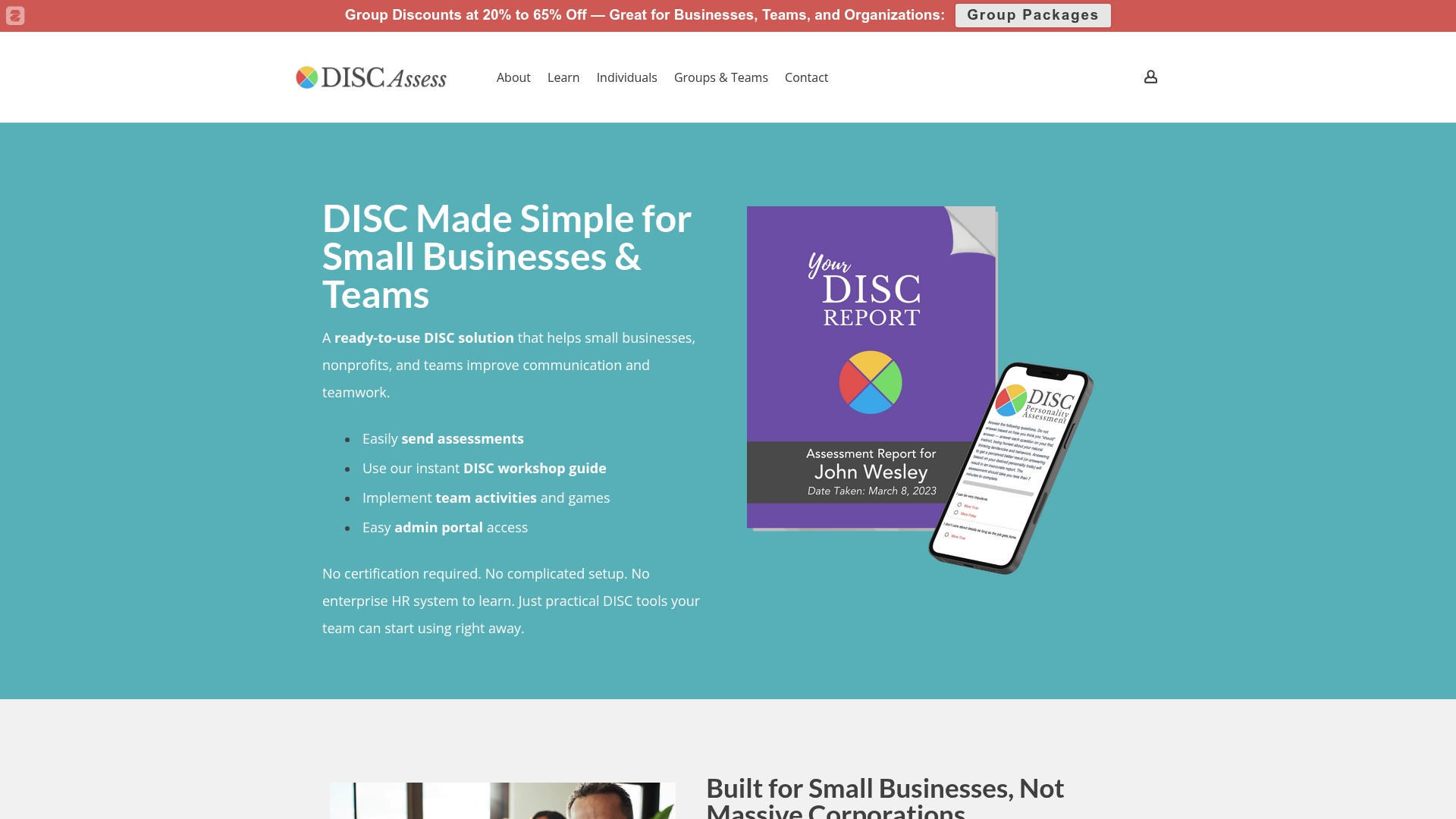
The DISC Group Package includes an Admin Account and Assessment Credits, giving you a team-wide baseline and a portal to track progress in one purchase. For coaches who work with clients one at a time, the Individual Classic DISC Personality Assessment delivers an instant, detailed report that feeds directly into the session prep workflow above. Organizations that want to brand the experience for their own clients can explore the White Label DISC System.
Start with a single team baseline this week. Run the group package, review one report before your next session, and write one micro-agreement at the close. That is the whole first step. See the group options at Discassess and take it from there.