

Effective staff communication is the foundational driver of team productivity, clarity, and engagement. Staff communication improvement strategies are the deliberate practices managers and teams use to reduce misunderstanding, close role clarity gaps, and build a culture where people feel heard. Workers lose an average of 3.2 hours weekly due to poor communication. That is nearly a full workday gone every two weeks. Managers account for 70% of variance in team engagement, and only 47% of employees strongly agree they understand what is expected of them at work. These numbers point to a clear opportunity. The strategies below are practical, research-backed, and built for small businesses that want real results without complex systems.
1. Staff communication improvement strategies start with channel clarity
The single highest-leverage change any team can make is matching the communication channel to the message type. A quick question belongs in chat. A complex decision belongs in a meeting. A policy update belongs in documentation. When teams ignore this principle, messages get buried, responses are delayed, and people feel frustrated.
Channel mismatch creates noise that erodes trust over time. When urgent requests arrive in email and casual updates flood meeting agendas, the whole system breaks down. Communicating from the receiver's perspective prevents many of these failures before they start.
- Chat tools (like Slack or Microsoft Teams): best for quick questions, real-time coordination, and informal updates
- Email: best for formal records, external communication, and non-urgent internal announcements
- Meetings: best for decisions, brainstorming, and relationship building
- Documentation platforms: best for processes, policies, and reference material
Pro Tip: Build a one-page channel guide for your team. List each tool, its purpose, and the expected response time. Post it where everyone can see it. This single document eliminates most channel confusion.
2. Set a communication rhythm your team can rely on

Consistency matters more than frequency. Teams that communicate on a predictable schedule feel more secure and stay better aligned than teams that communicate in bursts. A reliable rhythm also reduces the anxiety that comes from not knowing when the next update is coming.
Weekly team stand-ups work well for most small teams. They keep everyone aligned without consuming the workday. One-to-one meetings between managers and direct reports should happen at least twice a month. These conversations surface concerns before they become problems.
- Weekly team stand-ups: 15–20 minutes, focused on priorities and blockers
- Bi-weekly one-to-ones: structured conversations between manager and each team member
- Monthly all-hands: broader updates on goals, wins, and company direction
- Weekly digest emails: batch non-urgent updates into one message with a summary and estimated read time
Batching non-urgent content into weekly digests respects attention and reduces interruption. That means fewer context switches and more focused work time for your team.
3. Limit all-company emails to protect message impact
All-company emails lose their power when they arrive too often. When every message feels urgent, nothing feels urgent. Limiting all-company emails to four per year for universal topics reduces overload and increases the impact of each message. That is a best practice worth adopting, even for small teams.
For everything else, use targeted updates. Send department-specific messages to the people who need them. This approach respects your team's attention and signals that you value their time. When a true all-company message does go out, people will read it.
4. Train managers in active listening and feedback
Managers account for 70% of engagement variance, which means manager communication skills are not a soft priority. They are the primary lever for team performance. Most managers were never formally trained in how to listen, give feedback, or set clear expectations.
Active listening means giving full attention, reflecting back what you hear, and asking clarifying questions before responding. Constructive feedback means being specific, timely, and focused on behavior rather than character. Both skills can be taught and practiced.
- Introduce microlearning modules on active listening and feedback delivery (10–15 minutes per session)
- Use role-play scenarios to practice difficult conversations in a safe setting
- Apply communication scorecards to track consistency and improvement over time
- Review expectations explicitly during team meetings, not just during onboarding
Microlearning and communication scorecards outperform traditional long-form training in building lasting communication habits. Short, repeated practice beats a single all-day workshop every time.
Pro Tip: Give managers a simple feedback template: "I noticed [behavior], it had [impact], and I'd like to see [change]." This structure makes feedback specific and less personal, which makes it easier to deliver and receive.
5. Use structured one-to-ones to catch disengagement early
One-to-one meetings are the most underused tool in small business communication. Most managers treat them as status updates. The real purpose is to understand how each person is doing, what is blocking them, and what they need to grow. Structured one-to-one coaching conversations uncover disengagement early and focus on individual priorities for improvement.
A good one-to-one agenda has three parts: what is going well, what is getting in the way, and what support does the person need. The manager's job in this conversation is mostly to listen. When team members feel genuinely heard, they stay engaged and communicate more openly with the whole team.
6. Build a focused multi-channel communication strategy
Small businesses often make one of two mistakes: they rely entirely on email, or they adopt too many tools at once. Both approaches fail. A focused mix of 4–6 core communication channels maximizes message reach. Email-only reliance reduces frontline message reach by 50%. That gap is significant for any team with field workers, part-time staff, or remote members.
The goal is not to use every tool available. The goal is to use the right tools consistently.
| Channel type | Best use case | Key benefit |
|---|---|---|
| Async messaging (chat) | Daily coordination and quick questions | Fast, low-friction communication |
| Video meetings | Decisions, team alignment, and sensitive topics | Tone and context preserved |
| Formal records and external communication | Documented and searchable | |
| Documentation platform | Processes, policies, and reference material | Scales communication without repetition |
| Task management tool | Project updates and accountability | Reduces status-update meetings |
Avoid app overload by setting clear norms around which tool is used for what. When everyone knows the rules, communication becomes predictable and efficient.
7. Make documentation a communication channel
Most small businesses treat documentation as an afterthought. It is actually one of the most powerful communication tools available. Documentation written for outsiders eliminates repetition, scales communication, and reduces the need for redundant discussions. When a process is written clearly enough for someone new to follow it, your whole team benefits.
Good documentation answers the questions people ask repeatedly. It covers onboarding steps, common workflows, decision-making criteria, and team norms. When this information lives in a shared, searchable place, managers spend less time answering the same questions and more time leading.
8. Create safe spaces for two-way feedback
Communication is not a broadcast. It is a conversation. Teams that only receive information from the top down become passive and disengaged. Building safe spaces for upward feedback, peer feedback, and open questions is a core employee engagement technique that strengthens the whole communication culture.
Psychological safety is the foundation here. Team members need to believe that speaking up will not result in punishment or embarrassment. Leaders build this by responding to feedback with curiosity rather than defensiveness, and by acting on what they hear.
- Anonymous suggestion channels: give team members a low-risk way to share concerns
- Open-door policies with structure: set specific times for open conversations rather than vague availability
- Team retrospectives: regular sessions where the whole team reflects on what is working and what is not
9. Measure communication effectiveness with pulse surveys
You cannot improve what you do not measure. Quarterly pulse surveys give managers a clear picture of how communication is landing across the team. These surveys should be short (5–10 questions), focused on specific behaviors, and followed by visible action.
Leadership communication is a top driver of engagement worldwide, and driver analysis helps identify which specific communication behaviors have the most impact on your team. That means you can prioritize the changes that matter most rather than guessing.
Share survey results with your team. Transparency about what you heard and what you plan to do about it builds trust faster than almost any other practice. Teams that see their feedback acted on communicate more openly in the future.
10. Simplify workflows to reduce communication friction
Engagement issues often stem from confusing workflows, not just poor communication habits. When processes are unclear or unnecessarily complex, people compensate by over-communicating, asking redundant questions, and holding unnecessary meetings. Simplifying workflows reduces this friction at the source.
Audit your most common workflows once a quarter. Ask your team where they feel stuck or confused. Then redesign those processes to be clearer and more direct. Fewer steps, clearer ownership, and better documentation reduce the communication load on everyone.
11. Embed communication as a daily leadership discipline
High-performing organizations embed communication into daily leadership routines rather than treating it as a periodic event. This means managers check in briefly every day, not just during scheduled meetings. It means leaders model the communication behaviors they want to see. It means feedback is continuous, not annual.
For small business leaders, this does not require a formal program. It requires intention. Start each day with a brief team check-in. End each week with a short written update. Respond to team messages promptly. These small habits, practiced consistently, build a communication culture that sustains itself.
Key takeaways
The most effective staff communication improvement strategies combine clear channel standards, consistent rhythms, manager skill-building, and measurement into a daily leadership practice.
| Point | Details |
|---|---|
| Match channels to message type | Use chat for quick questions, meetings for decisions, and documentation for processes. |
| Limit all-company emails | Send no more than four per year to protect message impact and team attention. |
| Train managers deliberately | Microlearning and feedback scorecards build lasting communication skills more effectively than long-form training. |
| Measure with pulse surveys | Quarterly surveys plus visible follow-up action build trust and surface communication gaps early. |
| Simplify workflows first | Confusing processes drive unnecessary communication; fix the workflow before adding more tools. |
Why documentation is the most overlooked communication strategy
I have worked with dozens of small teams over the years, and the pattern is almost always the same. Leaders invest in meetings, email tools, and communication training, and then wonder why the same questions keep coming up. The answer is almost always missing documentation.
Most teams document nothing. Or they document things in a format only the original author can understand. Writing processes and policies as if a brand-new team member will read them is a discipline that pays off every single week. It is not glamorous work, but it is the kind of communication investment that compounds over time.
The other thing I have come to believe strongly is that communication quality matters far more than communication quantity. I have seen teams that hold daily stand-ups and still feel disconnected. I have seen teams that meet once a week and feel deeply aligned. The difference is almost always whether the communication is honest, specific, and followed by action.
If you are a small business leader, the most practical thing you can do today is pick one workflow that causes repeated confusion and write it down clearly. Then share it with your team and ask for their input. That single act models the communication culture you are trying to build. Learning how to use DISC assessments with employees can also help you understand why some team members communicate the way they do, which makes your documentation and feedback far more effective.
— Tres
How Discassess helps your team communicate better
Understanding why your team communicates the way it does is the first step toward lasting improvement. Discassess is a Phoenix-based DISC assessment platform built specifically for small businesses, nonprofits, and teams who want practical tools without the complexity of enterprise HR systems.
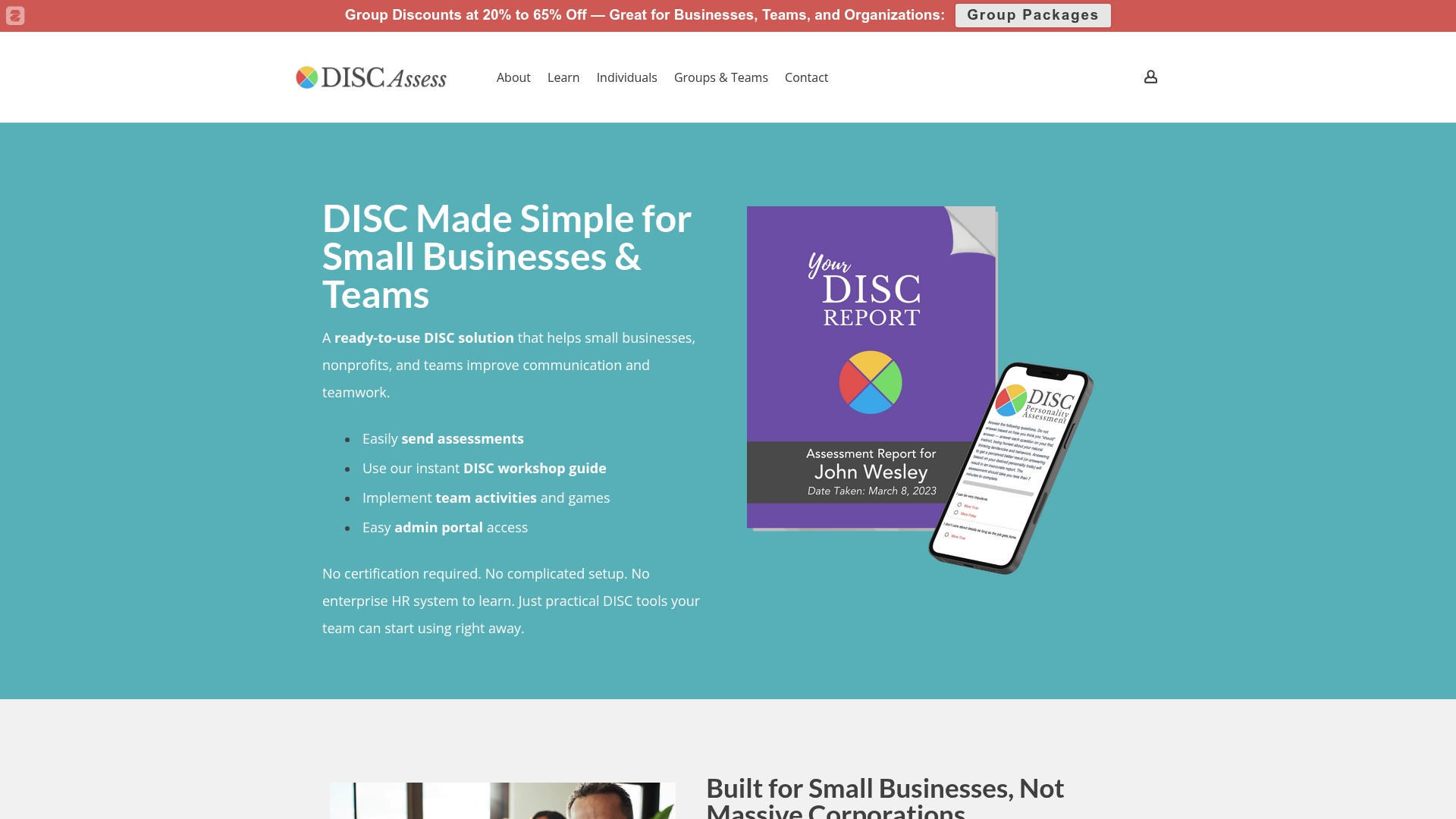
When managers understand each team member's DISC communication style, they can tailor feedback, set clearer expectations, and reduce friction in everyday interactions. Discassess offers individual assessments, group packages, and an admin portal that makes it easy to manage your whole team in one place. You can explore a demo account to see how DISC insights translate into real communication improvements for your team. For teams ready to go deeper, group assessment packages make it affordable to assess everyone at once.
FAQ
What are the most effective staff communication improvement strategies?
The most effective strategies combine channel clarity, consistent meeting rhythms, manager skill-building, and regular pulse surveys. Matching the right tool to the right message type reduces noise and improves response rates across the team.
How much productivity do teams lose from poor communication?
Workers lose an average of 3.2 hours per week due to poor communication. Over a year, that adds up to more than two full work weeks of lost productivity per person.
How often should managers hold one-to-one meetings with staff?
Managers should hold structured one-to-one meetings at least twice a month. These conversations are the most effective tool for catching disengagement early and building individual trust.
What is the best way to measure communication effectiveness?
Quarterly pulse surveys with 5–10 focused questions give the clearest picture of how communication is landing. Sharing results and acting on them publicly builds the trust needed for honest future feedback.
How does DISC help improve team communication?
DISC assessments reveal each person's natural communication style, which helps managers adapt their approach to each team member. Discassess offers accessible DISC personality assessments designed for small teams who want immediate, practical results.
Recommended
- DISC Assess | Affordable, Professional DISC Assessments for Small Businesses - DISC Personality Assessment | Prism Counseling & Coaching
- DISC Assess | Affordable, Professional DISC Assessments for Small Businesses - DISC Personality Assessment | Prism Counseling & Coaching
- How Political Campaigns Can Use the DISC with Staff and Volunteers - DISC Assess | Affordable, Professional DISC Assessments for Small Businesses
- How Small Businesses Owners Can Utilize the DISC - DISC Assess | Affordable, Professional DISC Assessments for Small Businesses