

Start with the natural versus adapted gap, then check the highest-dimension intensity and overall profile shape. Those two readings tell you more about a client in ninety seconds than the rest of the report combined, and they set up the two moves worth making the moment you open a report with a client.
First, ask a validation question: "Does this feel like you at your best, or you under pressure?" Second, suggest one micro-experiment tied to whatever dimension shows the most strain, something small enough to test before your next session.
- Check the natural (baseline) and adapted (current) graphs before anything else
- Note the highest-scoring dimension and whether it stands alone or blends with a second
- Ask your validation question out loud, in the client's own words
- Propose one focused micro-experiment tied to the gap you found
Key Takeaways
Effective DISC coaching starts with the natural-adapted gap and intensity index, then converts every dimension and blend into specific, testable behaviors rather than letter labels.
| Point | Details |
|---|---|
| Read the gap first | Compare natural and adapted graphs before anything else; a wide gap signals role strain worth exploring directly. |
| Check intensity, not just position | An extreme score drives behavior more predictably than a mild score in the same dimension. |
| Turn letters into behavior | Say "you tend to move fast" instead of "you're a High D" when discussing results with clients. |
| Close every session with a measurable follow-up | Set one specific behavior, frequency, and check-in point tied to the report's biggest signal. |
| Match the tool to the coaching need | Discassess offers a Custom Couples Report, a Custom Group Report with Video Analysis, and a Pro Group Package for ongoing team coaching. |
Table of Contents
- How to Interpret DISC Reports for Coaching Clients
- A Step-by-Step Method for Reading Any DISC Report
- Coaching Moves for Each DISC Style and Common Blends
- Structuring a DISC Coaching Session From Start to Finish
- Where DISC Interpretation Goes Wrong
- How DISC Assess Fits Into a Coach's Toolkit
- Connecting DISC Results to Goals and Development Plans
- What DISC-Informed Coaching Interventions Actually Look Like
- Handling Skepticism About DISC Results
- Combining DISC With Other Coaching Assessments
- What the Report Can't Tell You
- Getting Started With DISC Assess for Your Coaching Practice
- Sources
How to Interpret DISC Reports for Coaching Clients
Coaches who work with DISC regularly develop a reading order, because reports from different vendors bury the same signals in different places. Once you know where to look, interpreting DISC assessment results takes minutes, not a full session.
Most reports lead with a four-quadrant chart, which plots the client somewhere across Dominance, Influence, Steadiness, and Conscientiousness. This is the fastest visual for spotting a single dominant style. A 12-slice circle (sometimes called a wheel) breaks the same data into finer segments, which matters when a client sits near a boundary between two styles rather than squarely inside one. Profile graphs, usually bar charts, show the actual intensity of each of the four dimensions side by side, and this is where you catch blends the quadrant chart tends to flatten.
Every credible DISC report separates natural style from adapted style. The natural graph reflects how the client behaves without conscious effort, while the adapted graph shows how they believe they need to show up in their current role or environment. DISC reports typically present both natural and adapted styles alongside quadrant and profile graph visuals, and reading them side by side is the single habit that separates a surface-level DISC session from one that actually moves the client.
Intensity matters as much as position. A dimension scoring in the extreme range behaves differently than one sitting just above the midline, even when both charts label the client "High D." A single-elevated profile, where one letter dominates and the rest sit low, produces more predictable behavior than a blended profile with two or three dimensions close together.
Report anatomy, at a glance:
- Four-quadrant: fastest read for a single dominant style
- 12-slice or wheel: better for clients near a boundary between styles
- Profile graph (bar chart): shows true intensity and reveals blends
- Natural vs adapted: the baseline against the coping strategy
- Metadata fields: context prompts, environmental notes, and often a suggested development goal you can borrow directly for your session plan
Pro Tip: Screenshot the profile graph before the session and mark where natural and adapted lines diverge most. That single visual gives you a built-in agenda item.
A Step-by-Step Method for Reading Any DISC Report
Work the report in a fixed order every time, so you form a hypothesis in minutes rather than getting lost rereading the narrative pages.
- Identify the highest dimension. This is the client's dominant lens for how they approach tasks, people, pace, and rules.
- Look for a secondary. If a second dimension sits within roughly ten to fifteen points of the first, you're coaching a blend, not a pure style.
- Measure the intensity index. A dimension in the extreme zone drives behavior more consistently than one hovering near the midline; treat mild elevations as tendencies, not fixed traits.
- Evaluate the natural to adapted gap. A small gap means the client's default style matches what their environment rewards. A large gap usually signals sustained effort, and large natural-adapted divergences often point to role strain or prolonged adaptation worth exploring directly.
- Check for public versus private profile differences, if the report includes them. Some clients present one way to colleagues and shift considerably in private, which is itself useful coaching material.
Turning letters into language your client recognizes is the real skill. A D-I blend usually shows up as someone who moves fast and persuades loudly, comfortable taking a room but impatient with process. An I-S blend often reads as warm and relationship-driven but slower to confront conflict directly. An S-C blend tends to produce careful, steady work paired with real discomfort around sudden change. A D-C blend frequently drives high standards and blunt feedback, sometimes at the cost of patience with people who need more encouragement.
When you find a wide gap between natural and adapted graphs, useful follow-up questions include: "What would happen if you showed up here the way you do at home?" and "Whose expectations are you adapting to most right now?" If the client's answers contradict what the report shows, or if the gap seems extreme, triangulate with a specific recent example or, where available, 360 feedback before you build coaching plans around the report alone.
Coaching Moves for Each DISC Style and Common Blends
Different DISC personality coaching moves work for different primary styles, and the report tells you which lever to pull first.
- High D clients respond to autonomy and challenge. Frame goals as decisions they own, not tasks assigned to them. Try a decision experiment: have them make one call this week without seeking approval first, then debrief what happened. Open with: "Where do you feel boxed in right now?"
- High I clients run on visibility and social energy. A communication rehearsal, practicing a specific upcoming conversation out loud in session, works better than abstract planning. Open with: "Who do you most want to feel understood by this month?"
- High S clients need safety and predictable rhythm before they'll risk change. Build a gradual change plan with small, sequenced steps rather than one big shift. Open with: "What would make this change feel safe enough to try?"
- High C clients want structure and measurable criteria. A checklist experiment, breaking one ambiguous goal into explicit, checkable steps, gives them traction fast. Open with: "What does 'done well' actually look like here?"
For blends, the coaching move is about balance rather than pure style work. A D-I client usually needs help slowing down enough to listen before persuading. An I-S client benefits from practicing direct requests instead of hoping harmony will resolve tension on its own. An S-C client often needs permission to act before every variable is controlled. A D-C client tends to grow fastest by practicing warmth alongside high standards, since both dimensions push toward results over relationship.
Pro Tip: Never say "you're a High D" to a client. Say "you tend to move fast and want the direct route" instead. The behavior is coachable; the label is not.
Structuring a DISC Coaching Session From Start to Finish
A single DISC-focused session runs cleanly in sixty to ninety minutes when you follow a fixed sequence rather than reacting to whatever page the client lands on first.
- Minutes 0 to 10: Normalize the report. Say something like, "This measures behavior, not worth or intelligence, and it can shift with context." This single sentence prevents most defensiveness before it starts.
- Minutes 10 to 25: Walk the natural and adapted graphs together, asking your validation question early.
- Minutes 25 to 45: Identify the primary style or blend and connect it to one current, specific challenge the client raised before the session.
- Minutes 45 to 65: Run one practice activity, either a short role-play of an upcoming conversation or a behavior experiment tied to the gap you found.
- Minutes 65 to 80: Set a measurable follow-up, specific enough to check next session, not a vague intention.
- Minutes 80 to 90: Confirm what you'll both track and how.
The follow-up matters more than the report itself. Translating feedback into a specific, measurable habit is what separates development that sticks from development that fades, so avoid closing a DISC session on insight alone. Ask the client to name one behavior, one frequency, and one way you'll both know it happened.
Where DISC Interpretation Goes Wrong
DISC measures behavioral tendencies, not fixed identity or aptitude, and it's designed for development conversations rather than as a validated predictor of job performance. Using it as a hiring pass or fail misapplies the tool.
- When a client rejects their results, resist arguing the report. Ask what specifically feels wrong, then test it against a recent concrete example.
- Group reports and shared coaching notes require explicit consent, particularly when facilitator materials circulate to a team or organization.
- Profiles shift with role and context, so treat any single report as a snapshot, not a permanent verdict, and revisit results periodically rather than filing them away.
How DISC Assess Fits Into a Coach's Toolkit
Discassess builds its reports around exactly the signals coaches need: clear natural versus adapted graphs, profile visuals that surface blends at a glance, and language written for coaching conversations rather than HR filing.
Three packages map directly onto common coaching situations. The Custom Couples Report works when you're coaching partners together and need a single document that compares both natural and adapted styles side by side. The Custom Group Report + Video Analysis suits small teams or cohorts, pairing the written profile with recorded walkthrough content you can assign before a session. The Pro Group Package fits coaches running an ongoing program for a church staff, nonprofit board, or leadership cohort that needs recurring assessments without repurchasing each time.
- Group management tools let you pull every client's profile from one dashboard instead of chasing individual PDFs
- Ready-made report formats cut prep time before a session, since the charts you need are already built
- An admin portal keeps records organized across a growing coaching caseload
Coaches consistently need one thing above all: a report they can open five minutes before a session and immediately know what to ask.
Connecting DISC Results to Goals and Development Plans
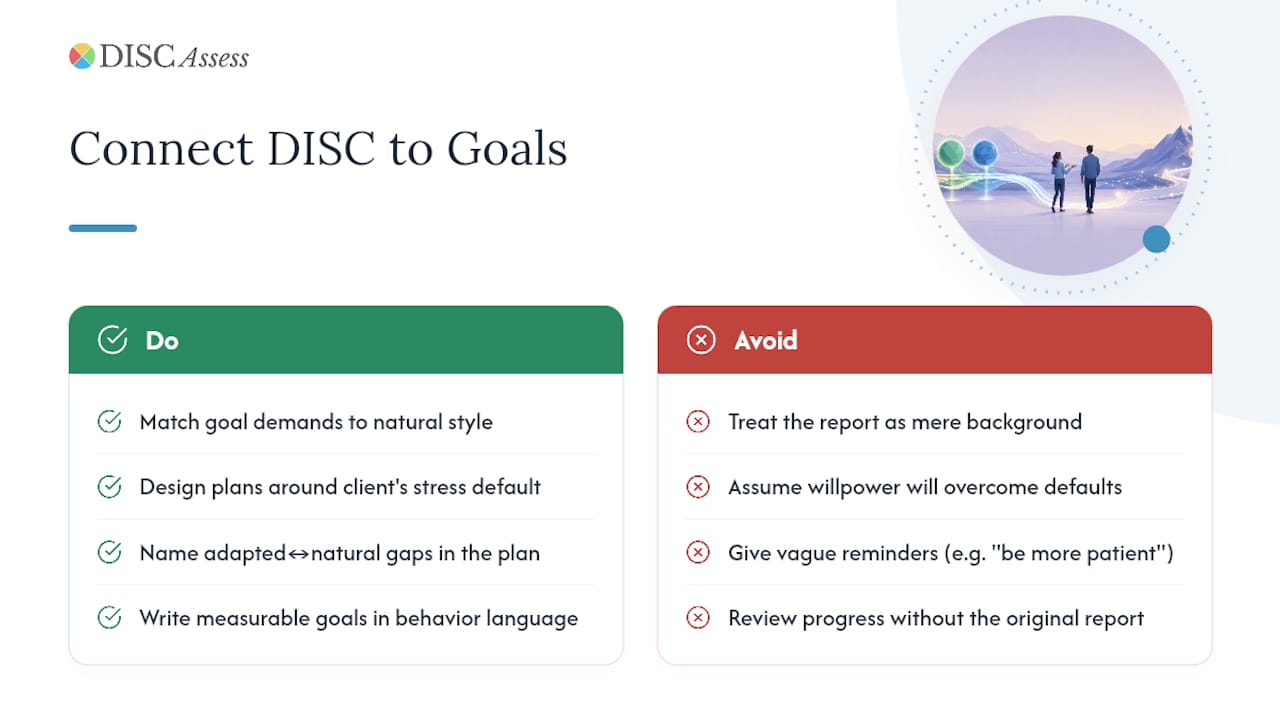
A DISC report becomes useful the moment it shapes a specific goal, not before. Coaches who treat the report as background context rather than raw material for planning waste its best feature.
Start by matching the goal's demands to the client's natural style. A client with a High S natural profile who's setting a goal around faster decision-making needs a plan built around small, sequenced risk, not a single leap. A High D client setting a goal around patience or listening needs practice reps, not a reminder to "be more patient." The natural profile tells you what the client will default to under stress; build the plan to account for that default rather than assume willpower alone will overcome it.
The adapted profile matters here too. If a client's adapted score on Conscientiousness is far higher than their natural score, their current role is likely demanding more structure than comes easily to them. That's worth naming directly in a development plan, since it explains fatigue that otherwise looks like a motivation problem.
Write goals in the client's own behavioral language, not letter labels. "Speak up in the first ten minutes of a meeting twice this month" works better than "increase your I." Tie each goal to the specific dimension or gap that generated it, so progress reviews can reference the original report instead of starting from scratch.
What DISC-Informed Coaching Interventions Actually Look Like
A High D client, several sessions into an executive coaching engagement, keeps describing team turnover as "people who can't keep up." The report shows an extreme D with a low S, and the natural-to-adapted gap is minimal, meaning this behavior isn't a mask. The coaching move here isn't to soften the client's drive. It's a decision experiment: delegate one high-stakes call fully to a direct report for two weeks, then debrief what surfaced. The client discovers the team wasn't slow, it was untrained in decisions the client had never actually let go of.
A different case: an I-S blend client preparing for a promotion interview freezes every time the conversation turns to self-promotion. The adapted profile shows Influence suppressed well below the natural score, a sign the client has learned to downplay visibility in their current environment. A communication rehearsal, practicing the exact opening line for the interview out loud across two sessions, closes most of that gap by the actual date.

A third example: a High C operations manager rejects the coaching goal of "delegating more" outright, insisting quality will suffer. Rather than arguing, the coach runs a checklist experiment: the manager writes an explicit checklist for one task, hands it to a direct report, and reviews the result against the checklist rather than against gut feeling. The structure the C dimension craves becomes the bridge to the delegation the coach was after all along.
Handling Skepticism About DISC Results
Some clients push back the moment they see their report, and the instinct to defend the tool is the wrong move. Defending DISC turns the session into a debate about a chart instead of a conversation about the client.
Ask what specifically feels off. Most objections land on one dimension, not the whole profile, and naming it precisely gives you something concrete to test rather than a vague complaint to argue with.
Bring in a recent, specific example and hold it against the disputed score. If a client insists they're not a High D but describes cutting off a colleague mid-sentence to move a decision forward twice in one week, let the example do the work rather than the label. Where it's available, 360 feedback or input from a manager or spouse adds a second data point without turning you into the arbiter of whether the report is "right."
Some resistance is really discomfort with adapted-versus-natural gaps, not the dimensions themselves. A client who sees a wide gap may feel exposed rather than skeptical. Naming that distinction, "this isn't saying you're faking anything, it's showing where you're working hardest," often dissolves resistance faster than any data point could.
Combining DISC With Other Coaching Assessments
DISC answers behavioral questions well: how someone moves, decides, and communicates under normal and adapted conditions. It answers motivational and values-based questions poorly, which is exactly where other tools earn their place in a coaching engagement.
Values assessments and motivational inventories fill in the "why" behind a DISC dimension. A High D client might be driven by competition, legacy, or simple impatience with inefficiency, and DISC alone won't tell you which. Pairing a behavioral tool with a values-based one gives you both the how and the why in the same engagement.
The Enneagram is a common pairing with DISC, since it addresses underlying motivation and fear patterns that behavioral tools weren't built to measure. Coaches running longer engagements sometimes layer in 360 feedback tools as well, which catch the gap between self-report and how colleagues actually experience the client.
The sequencing matters. Introduce DISC first, since it's fast to explain and immediately practical, then bring in a values or motivation tool once the client trusts the process. Running two unfamiliar frameworks in the same session usually overwhelms more than it clarifies.
What the Report Can't Tell You
The best DISC session I've seen didn't hinge on a rare profile or an unusual blend. It hinged on a coach who spent thirty seconds on the natural-adapted gap and built the entire hour around one question that gap raised. That's the pattern worth copying: the report is a prompt generator, not an answer key.
Where conventional DISC coaching advice falls short is in treating the four letters as a vocabulary to teach rather than a set of hypotheses to test. Clients don't need to learn what "High D" means. They need one behaviorally specific observation that makes them feel accurately seen, followed by one small experiment they can run before the next session.
Prioritize the gap and the intensity index before anything else. A mild score in the extreme zone tells you less than a moderate score paired with a wide natural-adapted split. Coaches who spend the first fifteen minutes explaining the wheel instead of asking about the gap are burning the session's most valuable window on the report's least useful feature.
Getting Started With DISC Assess for Your Coaching Practice
Choosing the right Discassess product comes down to who's in the room. A single client working through career transitions or interpersonal friction fits a standard individual assessment. Two people coaching through a relationship or working partnership fit the Custom Couples Report, which puts both natural and adapted profiles on one shared page instead of two separate documents you have to compare manually.
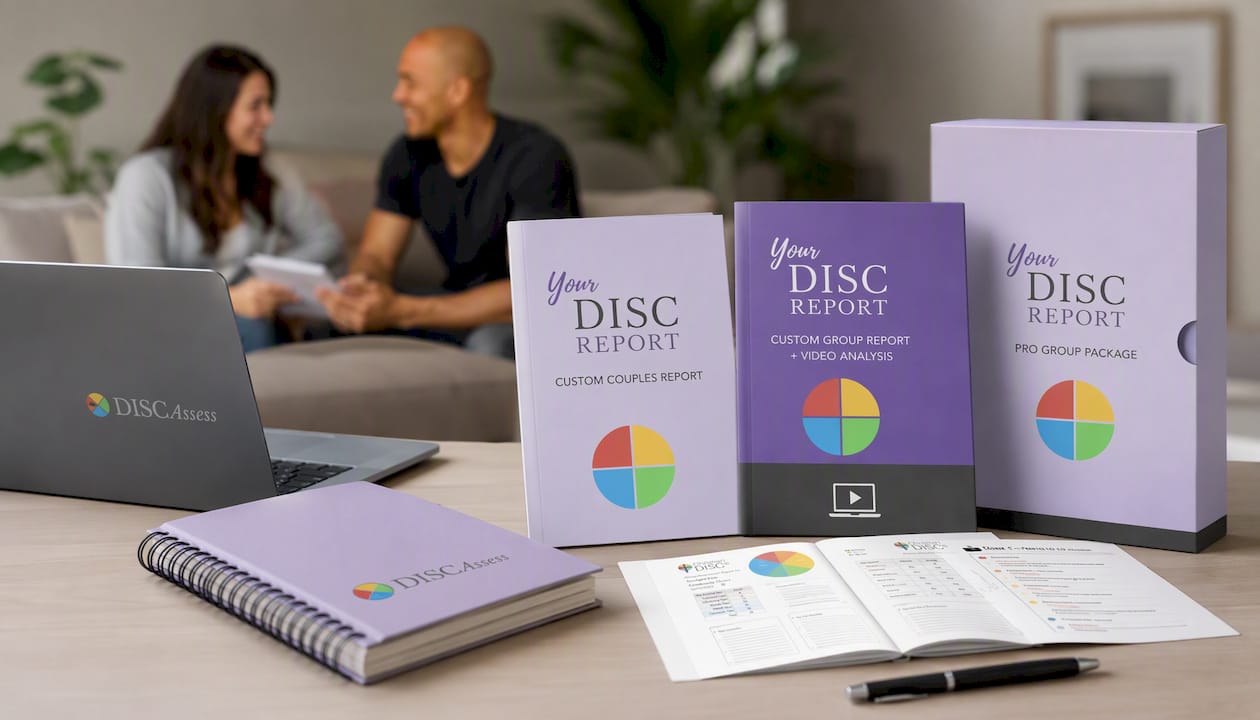
Once you're coaching a full team, cohort, or board, the math shifts. The Custom Group Report + Video Analysis gives you a facilitator-ready packet plus recorded walkthrough content, which cuts prep time significantly when you're facilitating for six or more people at once. If that team coaching work is ongoing rather than a one-time engagement, the Pro Group Package removes the friction of repurchasing assessments every quarter for a growing roster of clients or staff.
Unlike DISC providers built around certification requirements and enterprise procurement, Discassess gets you an instant, coaching-ready report without extra credentials or a drawn-out sales process. Request a sample report on Discassess before your next session and see exactly which chart your client's results will produce.
Sources
- DISC analysis: what it measures, how to read your results, and what it misses
- The Complete Guide to DISC personality testing
- Great managers master a specific habit (Gallup)