

For quick team results, reach for DISC. For deep individual growth, the Enneagram is your tool. When you have the time and client readiness, use both in sequence — and that combination tends to produce the most lasting change.
Here is how that plays out in practice:
- Team workshop or one-day offsite: DISC gives every participant a shared language for behavior within 30 minutes. It is nonthreatening, immediately applicable, and easy to debrief without a clinical background.
- Long-term executive or leadership coaching (6–12 months): The Enneagram maps the why behind patterns that DISC surfaces. It is where identity work, recurring blind spots, and genuine growth conversations live.
- Short individual engagement (4–8 sessions): Start with DISC to build rapport and set communication goals. Layer in Enneagram concepts if the client is ready and the engagement extends.
Your immediate next step: before your next client intake, ask two questions — "How long is this engagement?" and "Is the client seeking behavior change or identity-level growth?" Those two answers will guide nearly every tool decision you face.
Table of Contents
- What does DISC actually measure?
- How do DISC and Enneagram compare for coaching?
- When should you use DISC, Enneagram, or both?
- How to use DISC and Enneagram in actual coaching sessions
- Ethics, validity, and certification: what coaches need to know
- What should your next 30 days look like?
- Key Takeaways
- Which tool actually changes people?
- Discassess makes DISC easy to bring into your practice
- Sources and further reading
What does DISC actually measure?
DISC is an observable behavior framework built around four axes: Dominance (D), Influence (I), Steadiness (S), and Conscientiousness (C). It does not measure personality in the clinical sense. It maps how a person tends to act in a given environment, particularly under pressure or in social and task-oriented situations.
A standard DISC report gives you:
- A behavioral profile showing the client's primary and secondary style
- Communication preferences (how they prefer to receive information and feedback)
- A team map when multiple participants complete the assessment together
- Suggested phrasing coaches and managers can use to connect more effectively with each style
The practical strength of DISC in coaching is its speed and accessibility. Most clients can complete the assessment quickly, and the report is immediately readable without specialized training to interpret. That makes it ideal for team workshops, role-fit conversations, and communication alignment work where you need shared language fast.
A note on psychometric standing: DISC is widely used in organizational settings, but its empirical validation is more limited than dimensional models like the Big Five, which have decades of peer-reviewed research behind them. Use DISC as a practical coaching tool and communication framework, not as a clinical diagnostic. Its value is in the conversation it opens, not in the precision of its categories.
How do DISC and Enneagram compare for coaching?
The table below compares the two models across the dimensions that actually matter when you are selecting a tool for a specific engagement.
| Dimension | DISC | Enneagram |
|---|---|---|
| What it measures | Observable behavior (D/I/S/C styles) | Core motivations, fears, and desires (9 types) |
| Depth | Behavioral surface; what you do | Motivational core; why you do it |
| Best for | Team workshops, communication alignment, role clarity | Deep individual coaching, leadership identity, long-term growth |
| Speed and scalability | Fast assessment, suitable for groups | Slower; typing takes multiple sessions to confirm |
| Training required | Minimal; most reports are self-explanatory with brief coach orientation | Significant; responsible use requires formal study of types, centers, and levels |
| Psychometric validity | Moderate; widely used but limited peer-reviewed backing compared to Big Five | Limited; no standardized psychometric test; validity depends heavily on practitioner skill |
| Coaching outcomes | Communication, conflict style, role fit, team dynamics | Identity growth, recurring pattern disruption, leadership development, spiritual formation |
| Ethical limits | Should not be used for hiring without validated, disclosed process | Should not be used for hiring; avoid labeling clients by type in ways that feel fixed |
A few practical notes on where each model fits client scenarios:
- A client struggling to communicate with a direct-style manager benefits from a DISC debrief in one session.
- A leader who keeps self-sabotaging despite strong skills needs Enneagram work to surface the fear underneath.
- A nonprofit team preparing for a strategic planning retreat can use DISC to map communication styles before the room gets heated.
- An executive in a year-long coaching engagement who wants to understand why they avoid conflict needs the Enneagram's levels of health to track real change.
Neither model is inherently superior. The question is always: what does this client need, at this stage of their growth?
When should you use DISC, Enneagram, or both?
The decision comes down to four questions you can run through at intake:
- How long is the engagement? Under 3 months → DISC. Six months or more → Enneagram or both.
- Is this group or individual work? Groups of 5 or more → DISC first. One-on-one → either, depending on depth needed.
- How open is the client to self-reflection? Clients who want practical, task-focused results → DISC. Clients who want to understand themselves at a deeper level → Enneagram.
- What is the primary outcome? Communication and team dynamics → DISC. Identity, recurring patterns, leadership growth → Enneagram.
Concrete scenarios:
- 1-day team offsite: DISC. Participants get a shared vocabulary, a team map, and communication strategies they can use Monday morning.
- 6-month executive coaching engagement: Start with DISC in session 1 to build rapport and establish behavioral language. Introduce the Enneagram around session 3–4 once trust is established and the client is ready for deeper inquiry.
- 4-session individual coaching sprint: DISC for sessions 1–2 (behavioral goals, communication plan). Enneagram concepts in sessions 3–4 if the client wants to go deeper.
- Nonprofit leadership team development: DISC for the group workshop, then optional individual Enneagram sessions for senior leaders who want to continue.
Pro Tip: Use DISC as the entry point for nearly every new client relationship. It is nonthreatening, produces immediate insight, and builds the trust you need before introducing the Enneagram's more personal questions. Practitioners often use DISC to establish shared language, then introduce the Enneagram for deeper individual work — a sequencing pattern that Enneagram Certified describes as a natural coaching progression.
A short intake checklist you can adapt:
- Engagement length (weeks/months)?
- Group size (team vs. individual)?
- Client's stated goal (behavior change vs. self-understanding)?
- Client's prior experience with personality tools?
- Openness to reflective, values-level conversation?
- Budget and session count available?
How to use DISC and Enneagram in actual coaching sessions
Combined pathway example
A six-month executive coaching engagement might look like this: DISC in session 1 for behavioral baseline and communication goals; Enneagram introduced in session 4 after trust is established; DISC revisited in session 8 to measure behavioral shifts; Enneagram levels of health tracked in sessions 9–12 to assess identity-level growth. The two tools reinforce each other because DISC shows what changed and the Enneagram explains why it was hard to change in the first place.
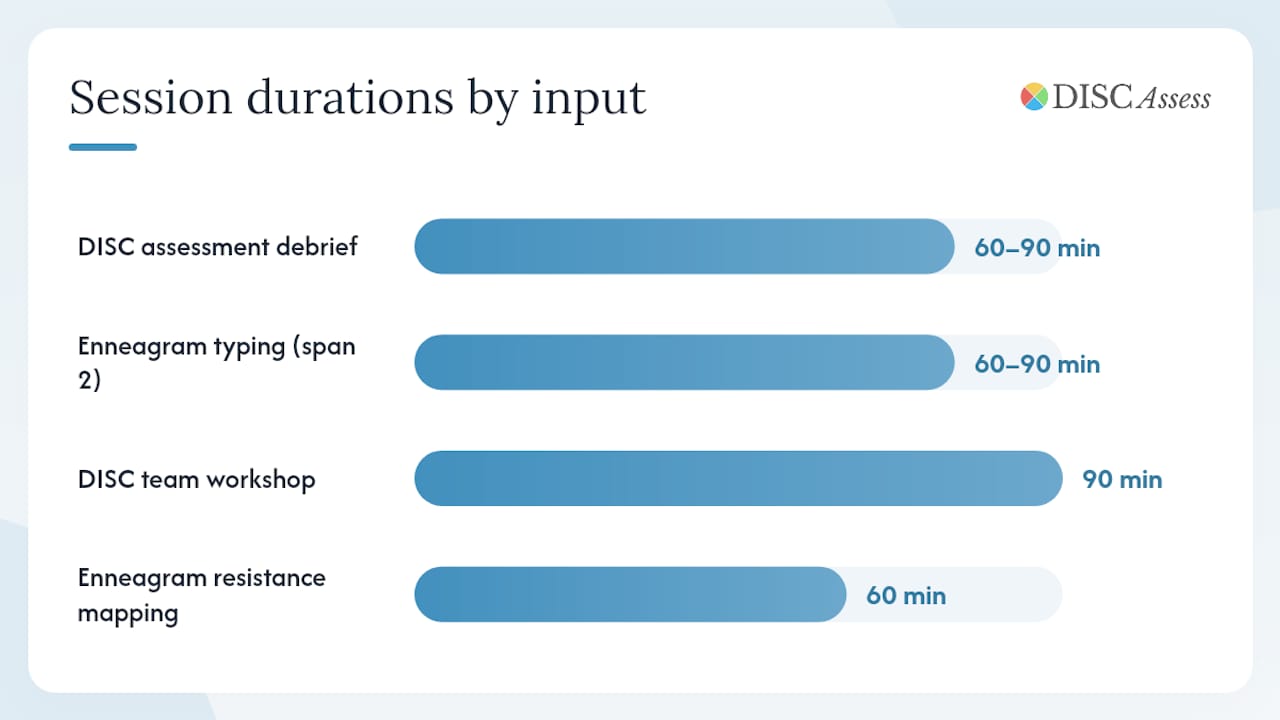
| Session input | Expected output | Approximate time |
|---|---|---|
| DISC assessment + report | Behavioral profile, communication plan | 60–90 min debrief |
| Enneagram typing conversation | Working type, center, core fear identified | 60–90 min (may span 2 sessions) |
| DISC team map workshop | Shared language, role clarity, conflict style awareness | 90 min group session |
| Enneagram resistance mapping | Stuck pattern identified, growth experiment designed | 60 min individual session |
Coaching wording prompts:
- DISC intro: "This tool helps us understand how you prefer to communicate and how others might experience you."
- Enneagram intro: "This model helps us explore what motivates you at a deeper level — not just what you do, but why."
- Confidentiality note: Always clarify before any assessment that results are shared only with the client unless the client explicitly consents to sharing with a manager or team.
- Red flag: If a client becomes distressed during Enneagram typing (shame, grief, or significant emotional activation), pause the typing process and return to core coaching presence. The model is a tool, not the session's purpose.
Pro Tip: Great Enneagram coaching starts with great questions, not explanations. Resist the urge to teach the model. Ask instead: "What feels true here?" and "What feels off?" The client's response to the type description is often more useful than the description itself.
Ethics, validity, and certification: what coaches need to know
Hiring use caution
Neither DISC nor the Enneagram is validated for employment selection decisions. Using them to screen candidates creates legal and ethical risk, particularly under EEOC guidelines, and neither tool has the predictive validity research required for high-stakes hiring decisions. If an organizational client asks you to use assessment results in a hiring process, redirect to validated selection tools and document your recommendation clearly.
Certification and training
- Enneagram: The International Enneagram Association (IEA) maintains professional standards and a directory of accredited trainers. Responsible Enneagram coaching typically requires 40–60 hours of study before working with clients, and many practitioners pursue formal certification through IEA-accredited programs.
Psychometric standing
Both tools have limitations that coaches should acknowledge honestly. As noted earlier, the Big Five personality traits framework has substantially stronger empirical backing than typology systems. DISC has moderate organizational validity for communication and team work but limited peer-reviewed psychometric research. The Enneagram has even less standardized psychometric evidence; its value in coaching rests on practitioner skill and the quality of the reflective process, not on test-retest reliability scores. Present both tools to clients as frameworks for self-reflection, not as scientifically definitive assessments.
Pro Tip: Document your assessment process in your coaching agreement. Include the tool used, its purpose, how results will be stored, and the client's consent to use results within the coaching relationship. This protects both you and your client and reflects the professional standards the IEA recommends.
What should your next 30 days look like?
The clearest path forward: pick one tool, run one pilot, and measure what changes.
Final verdict: Use DISC for any engagement where speed, group scale, or communication alignment is the primary goal. Use the Enneagram when a client is ready for identity-level work and the engagement is long enough to support it. When both are available, sequence them — DISC first, Enneagram second.
Three next steps for the next 30 days:
- Week 1: Choose one current or upcoming client engagement and decide which tool fits based on the intake checklist above. If it is a team, start with DISC. If it is an individual in a long engagement, consider introducing the Enneagram after session 2.
- Week 2: Draft a one-paragraph client consent statement that explains what the assessment measures, how results will be used, and who will see them. Use it in every assessment engagement going forward.
- Week 3–4: Complete at least one training resource. For DISC, work through the Discassess training materials. For the Enneagram, explore an IEA-accredited program or a foundational course from a certified trainer.
What to measure in your pilot:
- Client-reported clarity on communication style (pre/post self-rating)
- Number of specific behavioral commitments made in the debrief session
- Coach-observed behavior change at the next session check-in
- Client satisfaction with the assessment experience (simple 1–5 rating)
- Whether the assessment opened new coaching conversations that would not have emerged otherwise
Key Takeaways
DISC and Enneagram serve different coaching depths: use DISC for fast behavioral results and the Enneagram for sustained identity-level growth, and sequence them when the engagement allows.
| Point | Details |
|---|---|
| DISC for speed and groups | DISC delivers a shared behavioral language in one session, making it ideal for team workshops and short engagements. |
| Enneagram for depth | The Enneagram maps core motivations and recurring patterns, best suited to long-term individual or leadership coaching. |
| Sequence both tools | Start with DISC to build rapport and behavioral goals, then introduce the Enneagram for deeper identity work as trust grows. |
| Ethics apply to both | Neither tool should be used for hiring decisions; always obtain informed consent and keep results confidential. |
| Discassess for DISC delivery | Discassess offers instant reports, group packages, and an Add Certification option to support coaches running DISC-based engagements. |
Which tool actually changes people?
The honest answer is neither tool changes anyone on its own. What changes people is the quality of the conversation the tool makes possible. DISC opens a door that many clients would not walk through if you led with deeper psychological models. It feels safe, practical, and immediately useful. That safety is not a limitation — it is a gift, because it creates the trust that deeper work requires.
The Enneagram, used well, does something DISC cannot: it helps a client recognize that their most frustrating patterns are not character flaws but protective strategies that made sense at some point and now cost more than they give. That reframe is often where real growth begins. Enneagram coaching functions as a diagnostic lens that helps coaches interpret resistance and recurring session patterns rather than merely labeling traits — and that distinction is what separates a good debrief from a genuinely transformative coaching conversation.
What I see coaches get wrong most often is treating these tools as endpoints. A client learns they are a "High D" or a "Type 3" and the coach moves on. The type is not the insight. The insight is what the client does with the awareness of their pattern, especially when it is inconvenient. Your job is to keep the conversation alive long after the report is filed.
A few phrases worth borrowing:
- "This is a starting point, not a verdict."
- "What feels most true about this description — and what feels like it misses you?"
- "Where do you see this pattern showing up in a relationship that matters to you right now?"
Discassess makes DISC easy to bring into your practice
Coaches who want to add DISC to their practice without a complicated setup will find Discassess built for exactly that. The platform delivers instant reports, a clean admin portal for managing client groups, and purchasing options that scale from a single assessment to a full organizational package — no enterprise contract required.
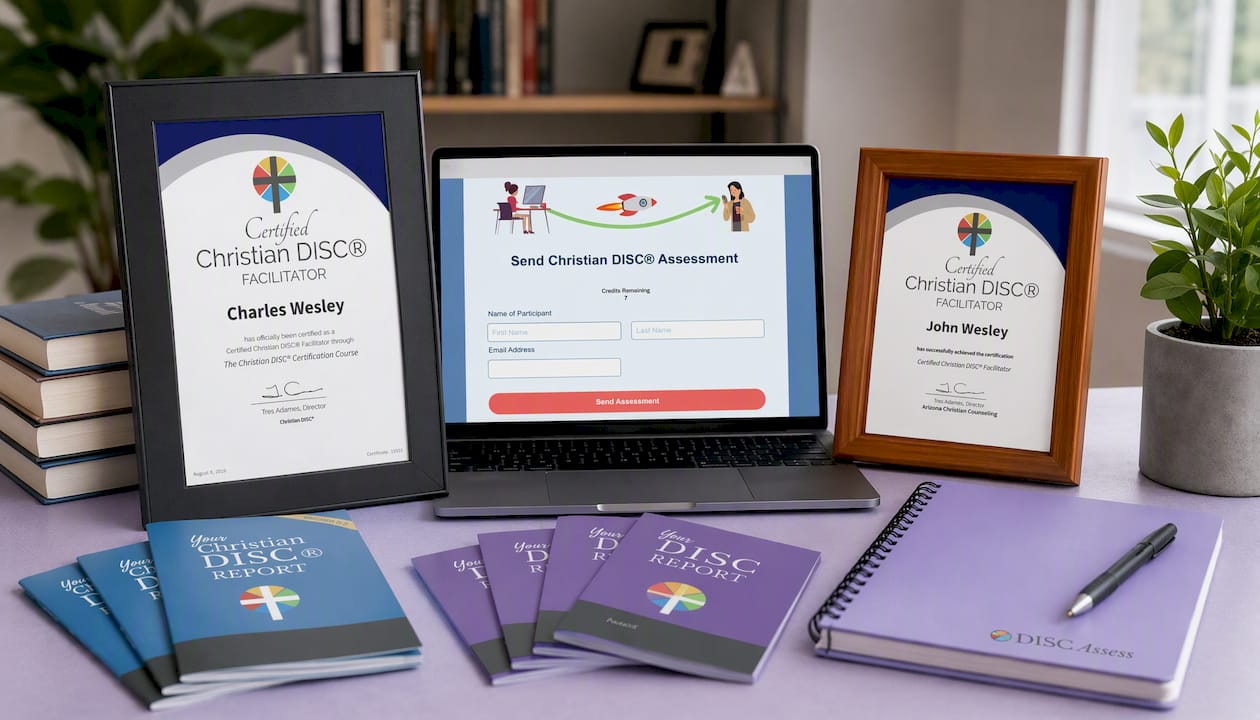
The Pro Group Package is designed for coaches running team workshops or cohort-based programs, giving you everything you need to manage multiple participants and generate group maps in one place. For coaches who want to present a formal credential to organizational clients, the Add Certification option adds a recognized training layer to your DISC practice. Pricing is transparent, onboarding is immediate, and the training resources are included so you can debrief your first group with confidence. Start your pilot with a Classic DISC Assessment_with_Report.html) today and see how quickly it opens the conversations your clients have been waiting to have.
Sources and further reading
- Enneagram vs DISC Assessment: Key Differences Explained | Enneagram Certified
- Enneagram Can Help You Become a Better Coach in 2026
- Coaching with the Enneagram: Supporting Clients Through Uncertainty with Clarity and Compassion - CoachBrilliant
- International Enneagram Association
- DISC assessment — Wikipedia
- Why Great Enneagram Coaching Starts with Great Questions — Enneagram Entrepreneur
- Big Five personality traits — Wikipedia
This article is general educational information for coaching professionals, not clinical or legal advice. Confirm current certification requirements and ethical standards with the relevant professional body or a qualified supervisor before implementing assessment-based coaching services.
Recommended
- DISC Profiles in Leadership Development Coaching
- DISC for Workplace Teams: A Manager's Practical Guide
- DISC Personality Assessment | Prism Counseling & Coaching - DISC Assess | Affordable, Professional DISC Assessments for Small Businesses
- How the DISC Compares to 3 Other Popular Personality Assessments - DISC Assess | Affordable, Professional DISC Assessments for Small Businesses