

Coaches should treat DISC assessments as a living session tool woven through the coaching relationship, not a one-time report handed to a client and forgotten. The data from the profile matters far less than what happens in the room right after the client reads it. Pair the assessment with a focused debrief, a goal-linked behavior experiment, and a follow-up rhythm, and you get faster, more measurable change than a report alone will ever produce.
Here is the shorthand version you can apply before your next session:
- Pre-assessment. Send the DISC report at least two days ahead, with a short note on what to expect and why you're using it.
- Focused debrief. Spend the first 20 to 30 minutes of the session unpacking the results, not the whole hour.
- Goal-linked experiment. Tie one behavior change to a real, upcoming interaction the client already has on their calendar.
- Scheduled follow-up. Check in at the next session, and again two weeks later, on whether the behavior actually happened.
Pro Tip: If a client is nervous about being "typed," open the debrief by asking what they noticed that felt accurate before you say anything about the model yourself. Ownership beats explanation.
A concrete next step: before your next scheduled session, pull a client's existing DISC report (or run a fresh one) and draft three questions tied to a real conversation they're facing this week, such as a performance review or a tense client call. That single move turns an abstract personality framework into rehearsal for something that actually matters to them.
Key Takeaways
DISC assessments produce measurable behavior change only when a structured debrief and a follow-up plan connect the report to a real, upcoming interaction in the client's life.
| Point | Details |
|---|---|
| Never hand over a bare report | Pair every DISC assessment with a focused debrief and one behavior experiment tied to a real interaction. |
| Match the model to the moment | Use GROW for goal-heavy sessions and CLEAR for relationship or conflict-focused debriefs. |
| Track early, simple metrics | Log target-behavior frequency and client self-ratings weekly during the first 30 days. |
| Protect trust with consent | Contract clearly on data ownership, confidentiality, and how results will be shared before you administer anything. |
| Run assessments on Discassess | Use group packages, offline bundles, and credit refills to manage instant reports and admin work without added overhead. |
Table of Contents
- What Are the Benefits of Using DISC in Client Coaching?
- How Do You Structure a DISC Coaching Session Step by Step?
- How Should You Coach D, I, S, and C Styles Differently?
- Which Coaching Format Fits Which Client Situation?
- What Should You Charge and How Should You Package DISC Coaching?
- Which Debrief Methods Turn DISC Results Into Real Change?
- What Tools and Templates Make DISC Coaching Easier to Run?
- How Do You Start Offering DISC Coaching the Right Way?
- A Coach's View on Why the Debrief Matters More Than the Report
- Get Your Coaching Practice Running on DISC Assess
- Sources
What Are the Benefits of Using DISC in Client Coaching?
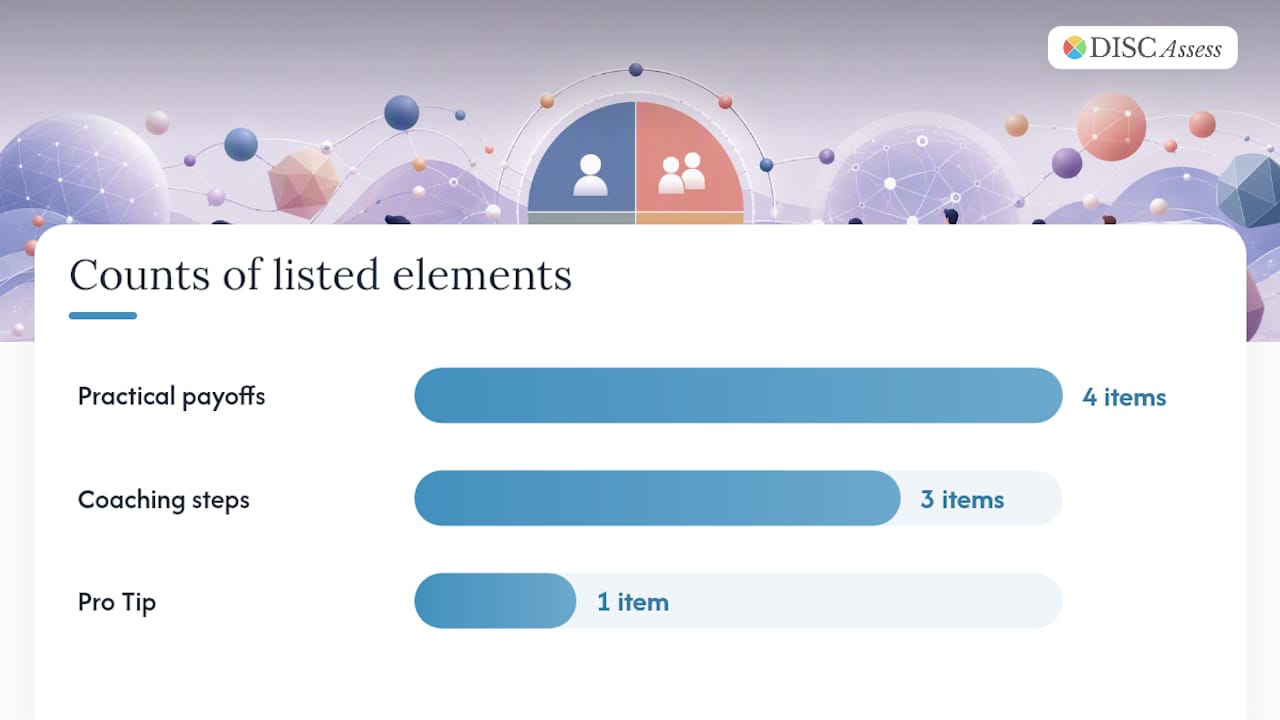
Coaches who build DISC into their sessions consistently report four practical payoffs, and none of them require the client to memorize a model.
- Faster rapport. Clients feel understood within the first debrief because the language matches how they already describe themselves.
- Clearer behavior-change targets. Instead of "communicate better," you get something specific: "pause before responding to a High D's rapid-fire questions."
- Easier measurement. Behavior tied to a named style is easier to track than a vague improvement goal.
- Better team alignment. When multiple team members share results, conflict often traces back to style friction rather than personal dislike, which reframes the whole conversation.
The mechanism behind fewer interpretation errors is straightforward: DISC only becomes useful when a coach connects the abstract score to a real workplace moment. A three-step DiSC coaching process of identification, reflection, and adaptation tends to work best when it's paired with concrete context, like 360 feedback or an actual meeting the client just sat through, rather than the report in isolation. Guided reflection tied to specific action steps also shows up in the behavioral literature as a meaningful driver of short-term change, which is exactly what a good debrief is designed to produce.
Pro Tip: Avoid the trap of labeling clients by their style ("you're such a High D"). A style score describes a tendency under certain conditions, not a fixed identity. Say "your results suggest a preference for direct, fast-paced communication" instead of "you're a D," and the client stays curious rather than defensive.
How Do You Structure a DISC Coaching Session Step by Step?
A well-run DISC session follows a sequence, not a script. Here's the order that consistently produces the clearest outcomes in a standard 60 to 90 minute block.
- Pre-assessment (before the session, 10 to 15 minutes of prep on your end). Contract with the client on how the results will be used, get explicit consent for how the report will be stored or shared with an employer, and send the individual report several days ahead so the client isn't reading it cold in front of you.
- Opening frame (5 minutes). Remind the client this is a tendency map, not a verdict, and ask what stood out to them first.
- Debrief core (20 to 30 minutes). Ask three high-impact questions: "Where did this feel most accurate?" "Where did it surprise you?" and "Who in your life or work operates very differently from this?" Then map the results directly onto one upcoming interaction, such as a specific meeting or conversation on their calendar this week.
- Goal-setting (15 to 20 minutes). Run the GROW sequence, goal, reality, options, will, to convert insight into a single behavior experiment. If the session is more about a strained relationship than a performance goal, the CLEAR model (contracting, listening, exploring, action, review) often fits better because it keeps the relational dynamic front and center.
- Commitment and close (5 to 10 minutes). Get a specific, dated commitment. "I'll try this" is not a commitment. "I'll pause for three seconds before answering my manager's next rapid question, starting Tuesday's stand-up" is.
Pro Tip: When a report shows a blended profile, two styles close in score, don't force the client to pick one. Ask instead: "In high-pressure moments, which side shows up first, and which shows up once you've had time to think?" That question usually reveals the pattern better than the raw numbers do.
How Should You Coach D, I, S, and C Styles Differently?
Each DISC style responds to a different rhythm of questioning, pacing, and accountability. Treat these as starting points, not a script to read off the page.
- D (Dominance). Core motivators are results, control, and speed. Coaching prompts that land: "What's the fastest path to the outcome you actually want here?" Resistance shows up as impatience with reflection questions, so keep the GROW sequence tight and outcome-focused. A one-minute intervention: ask them to name the one relationship where their speed is costing them influence, right now, out loud.
- I (Influence). Core motivators are recognition, connection, and enthusiasm. Prompts that land: "Who needs to hear this idea from you directly, this week?" Resistance often looks like enthusiasm without follow-through, so anchor commitments to a specific person and date, not a vague intention. A one-minute intervention: have them draft the first sentence of a hard conversation they've been avoiding.
- S (Steadiness). Core motivators are stability, harmony, and loyalty. Prompts that land: "What would it look like to voice disagreement without it feeling like conflict?" Resistance shows up as agreeing in the room and reverting after. CLEAR fits well here because the listening and exploring phases build the safety S-styles need before they'll commit to action. A one-minute intervention: script one sentence that states a boundary plainly, no cushioning.
- C (Conscientiousness). Core motivators are accuracy, competence, and data. Prompts that land: "What information would actually change your mind here?" Resistance looks like over-analysis that delays action indefinitely. Set a decision deadline inside the goal-setting phase. A one-minute intervention: ask them to make a call with 80% of the information they'd normally want.
A phrase that helps almost any style "flex" in the moment: "What does this person need from me right now that's different from what I'd naturally give?" The most common misinterpretation coaches make is assuming a style score predicts behavior in every context. It doesn't. A High D executive may be a low-key S at home. Style shows preference under typical conditions, not a fixed script.
Which Coaching Format Fits Which Client Situation?
DISC supports several distinct coaching formats, and matching the right format to the client's actual need matters more than the assessment itself.
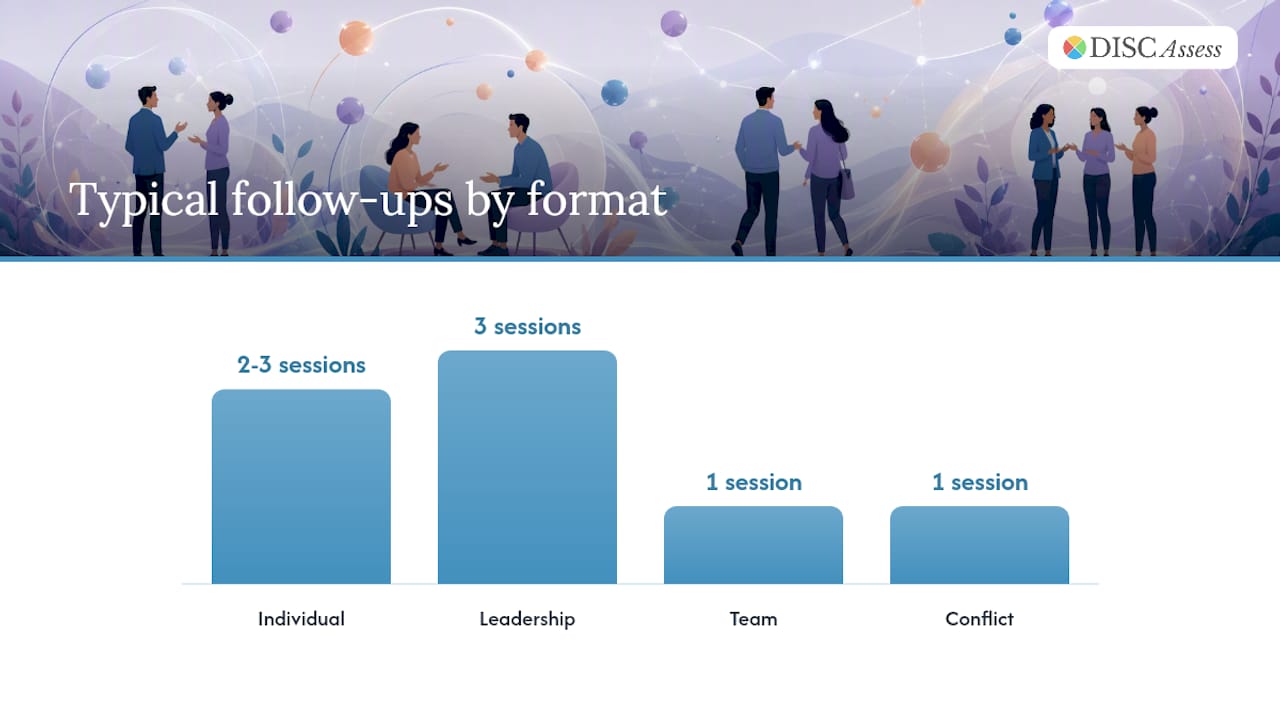
Individual coaching uses DISC to build self-awareness and communication precision, usually across a debrief plus three to five follow-up sessions. Leadership development pairs the individual's profile with feedback from direct reports, since a leader's blind spots often only surface once others' perceptions enter the room. Team coaching maps every member's style on a shared grid, which turns abstract "communication issues" into a visible pattern the group can actually name. Conflict resolution sessions use DISC specifically to depersonalize friction: two people clashing over pace or detail-orientation are having a style collision, not a character dispute.
| Use Case | Primary Goal | Core Deliverable | Typical Follow-Up |
|---|---|---|---|
| Individual coaching | Build self-awareness and flex specific behaviors | Personal debrief + one behavior experiment | Two to three check-ins over 4-6 weeks |
| Manager/leadership development | Close gaps between self-view and team perception | Profile paired with peer or 360 feedback | Monthly check-ins over a quarter |
| Team coaching | Reduce friction from style differences | Team style map + shared communication agreements | One follow-up session after 30 days |
| Conflict resolution | Depersonalize a specific interpersonal dispute | Joint debrief comparing both profiles | Single follow-up within two weeks |
Coaches working inside organizations often extend this into broader leadership development coaching work, and the same style-mapping approach shows up in manager-focused team guides built specifically for that audience.
What Should You Charge and How Should You Package DISC Coaching?
Pricing a DISC-based offer gets easier once you stop selling "an assessment" and start selling a structured outcome. Three package tiers cover most client needs:
- Single debrief. One assessment plus a 60-minute session focused entirely on interpretation and one behavior commitment. This mirrors the standard commercial format many providers use: an online assessment paired with a 60-minute personalized debrief that delivers practical, session-ready recommendations.
- Three-session package. Assessment, debrief, and two follow-up sessions spaced two to three weeks apart, priced to reflect the extended accountability, not just added hours.
- Team workshop. A half-day or full-day session for six to twelve participants, using a group package of assessments plus a facilitated mapping exercise, priced per participant with a facilitation fee layered on top.
When you write the proposal, present the mechanics plainly rather than burying them in jargon. If you're running assessments for a team, a DISC Group Package with an admin account and assessment credits lets you buy credits once and issue them across the group as people join, which reads cleanly on an invoice line item.
- Name the number of assessments included, not just "a DISC assessment."
- State the session count and length explicitly, since ambiguity here is the most common client objection.
- Offer a refill option for assessment credits if the engagement grows beyond the original scope, so you're not renegotiating the whole contract for one extra person.
A simple offer template: "This package includes [X] DISC assessments, a [length]-minute debrief for each participant, and [number] follow-up sessions over [timeframe], with a written summary of commitments after each debrief."
Which Debrief Methods Turn DISC Results Into Real Change?
The debrief is where most of the value gets made or lost, and three coaching models pair with DISC particularly well, each for a different reason.
GROW fits goal-heavy debriefs because it forces a client from insight straight into a defined action, which matters since DISC results alone tend to generate reflection without commitment. CLEAR fits relationship-focused work, especially conflict resolution, because its listening and exploring phases build trust before the client is asked to change anything. Motivational interviewing fits clients who are ambivalent or skeptical about the whole exercise, since it meets resistance with open questions rather than persuasion.
A sample debrief sequence you can adapt directly: "What's your first reaction to this report?" followed by "Where does this show up most in your current role?" then "What's one interaction this week where flexing this would matter?" and finally "What will you try, and how will we both know if it worked?" That last question is the accountability hook, and skipping it is the single most common reason DISC debriefs fail to change anything.
Measurement doesn't need to be complicated. Track a small set of behavior-linked indicators in the first 30 days, frequency counts of the target behavior, a quick client self-rating each week, and one observation from a peer or manager if the engagement allows it, since concise, early metrics tend to sustain momentum better than a single end-of-engagement survey.
| Metric | Frequency | What It Tells You |
|---|---|---|
| Target behavior count | Weekly self-log | Whether the committed action is actually happening |
| Client self-rating (1-10) | Each session | Whether confidence in the new behavior is rising |
| Peer or manager observation | Once at 30 days | Whether the change is visible to others, not just the client |
Insight fades quickly without reinforcement. A "Return and Learn" approach that resurfaces DISC prompts right before a real interaction, a one-page flex cue before a hard meeting, for instance, works directly against the forgetting curve rather than relying on a single debrief months earlier to stick.
What Tools and Templates Make DISC Coaching Easier to Run?
Running DISC sessions well depends on the platform underneath as much as the coaching skill on top of it. Before committing to a provider, confirm it offers instant reports, an admin portal for managing multiple clients, purchasable group credits, and printable formats for in-person work.
For session templates: a 1:1 debrief needs the individual report, three prepared questions, and a one-page behavior commitment sheet. A small group session (four to eight people) needs individual reports plus a shared style map you build live in the room. A full workshop needs printed or offline assessment bundles ready before participants arrive, since Wi-Fi and login friction kill momentum fast in a room of twelve people.
An admin checklist worth keeping on hand when onboarding a new client group:
- Confirm the number of participants before purchasing credits, and buy a small buffer rather than exactly matching headcount.
- If you're running an in-person workshop without reliable internet access, offline assessment bundles let you administer the assessment on paper and enter results later.
- Keep a running log of who has completed their assessment versus who still needs a reminder, since incomplete data before a group session creates awkward gaps in the room.
Pro Tip: Send a two-minute prep worksheet the day before any debrief, asking the client to jot down one recent interaction that felt hard. Clients who arrive with a real example in hand give sharper answers than clients reacting cold to the report for the first time.
How Do You Start Offering DISC Coaching the Right Way?
Before you sell a single DISC package, a short contracting and consent process protects both you and the client.
- Define scope of work. Spell out exactly what's included: number of assessments, session count, deliverables, and who owns the report data once the engagement ends.
- Confirm consent and confidentiality. State plainly whether results will be shared with an employer, kept strictly between you and the client, or aggregated anonymously for a team summary.
- Set data handling expectations. Tell clients how long you retain their report and what happens to it if they end the engagement early.
- Consent language should specify that the assessment is a self-report tool, not a diagnostic instrument, and that results describe tendencies, not fixed traits.
- If a client works in a regulated industry (healthcare, education, government), confirm your engagement doesn't overlap with any employer policy on personality testing before you begin.
Becoming a certified DiSC practitioner isn't a legal requirement to use the tool, but it matters for a specific segment of clients: HR departments, larger organizations, and skeptical executives often ask directly about credentialing before they'll approve a coaching budget. Presenting a credential upfront, rather than defensively after a client asks, tends to shorten that conversation considerably.
A Coach's View on Why the Debrief Matters More Than the Report
Most of the skepticism coaches hear about DISC comes from a legitimate place: clients have sat through a personality quiz before, gotten a color and a paragraph, and never heard about it again. That experience trains people to expect DISC to be shallow, and honestly, used that way, it is.
What changes the outcome isn't a better assessment. It's what happens in the twenty minutes after the client reads their results. A coach who takes a High C client's report and immediately asks "where did this cost you clarity in a recent decision" gets a completely different session than one who just walks through the four quadrants. In one anonymized case that pattern shows up often: a manager scored high on Steadiness, assumed that meant she was simply "too nice," and left one debrief session with a single reframed sentence, "steadiness isn't the absence of a boundary, it's patience about when to set it," that she used in a real conversation with a difficult direct report the following week.
That's the whole argument for building DISC into the ongoing coaching relationship rather than treating it as a one-time diagnostic. The report is a mirror. The coaching is what teaches the client to actually use it. If you're skeptical, try the smallest possible version of this yourself: pick one current client, pull an existing profile if you have one, and spend fifteen minutes next session asking only the three questions from the debrief sequence above. Watch what happens to the specificity of their answers.
Get Your Coaching Practice Running on DISC Assess
Most of what slows coaches down isn't the coaching, it's the administrative friction of buying assessments one at a time, tracking who's completed what, and reformatting reports for a room full of clients. Discassess was built to remove that friction specifically for small practices and independent coaches, not large HR departments with dedicated administrators.
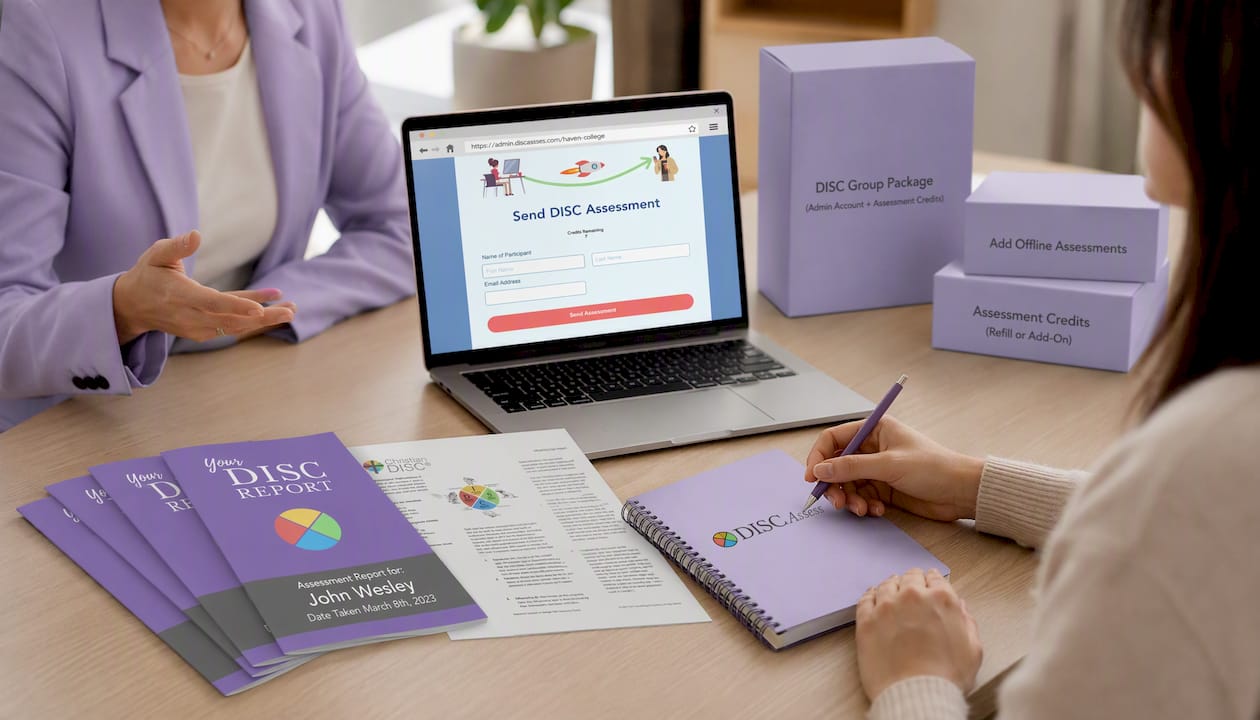
The platform delivers instant reports the moment a client finishes, so you're never waiting days for a report to debrief against. A DISC Group Package with an admin account and assessment credits lets you manage every client or team member from one dashboard instead of juggling separate purchase links. If you run in-person workshops where Wi-Fi is unreliable, offline assessment bundles keep the session moving without login delays, and assessment credit refills mean you never have to renegotiate a whole new order just because your client roster grew by three people.
If you've got a session on the calendar this week, start by picking up an admin account and a small batch of credits so your next client's report is waiting before they sit down.
Sources
- Coaching Methods and Techniques - Co-Active Training Institute
- How to use the DiSC Assessment for Coaching
- How does coaching support the Ebbinghaus forgetting curve? — Kingsford Coaching
- Everything DiSC® – Personal Assessment with 1:1 Coaching Feedback