

A DISC assessment for leadership development is a validated behavioral tool that identifies how leaders communicate, make decisions, and respond under pressure. The four DISC styles — Dominant, Influential, Steady, and Conscientious — map directly onto real leadership behaviors that affect team trust, conflict resolution, and performance. Organizations using DISC report measurable gains across five pillars: first-time manager development, executive presence, cross-functional leadership, succession planning, and senior leader coaching. For small business leaders and team managers, this kind of structured self-knowledge is not a luxury. It is the foundation of every effective leadership conversation you will ever have.
How do DISC assessments enhance leadership skills and team dynamics?
DISC assessments build leadership effectiveness by making invisible behavioral patterns visible. Most leaders know they have blind spots. Few know exactly what those blind spots cost them in trust, productivity, and team cohesion. DISC gives you a specific, named framework to work with rather than a vague sense that something is off.
The core benefit is self-awareness. DISC helps leaders recognize their natural behavioral tendencies and the blind spots that come with them. A leader who scores high in Dominance may drive results but unintentionally shut down team input. Knowing that pattern is the first step to changing it.
Adaptive communication is the second major gain. When you understand your own style and can read the styles of your team members, you stop communicating in the way that feels natural to you and start communicating in the way that lands for them. That shift alone reduces friction and builds the kind of trust that holds teams together through hard seasons.

DISC also strengthens what researchers call emotional intelligence, the ability to read, regulate, and respond to emotions in yourself and others. Behavioral insight is the foundation of relatable, adaptive leadership. Leaders who complete DISC coaching report improved stakeholder management and stronger performance in hybrid and cross-functional team environments.
Key benefits small business leaders consistently experience include:
- Clearer communication across different personality types on the same team
- Faster conflict resolution because team members understand each other's default responses
- Stronger coaching conversations grounded in specific behavioral data rather than general impressions
- Better succession planning by identifying which team members are ready to lead and in what contexts
Pro Tip: Run your DISC assessment before your next performance review cycle. The behavioral data gives you a concrete starting point for development conversations that feel fair and specific rather than subjective.
What are the four DISC leadership styles?
No single DISC style is best for leadership. Effective leaders adapt their approach to meet team and situational demands. Each of the four styles brings genuine strengths and predictable growth areas.
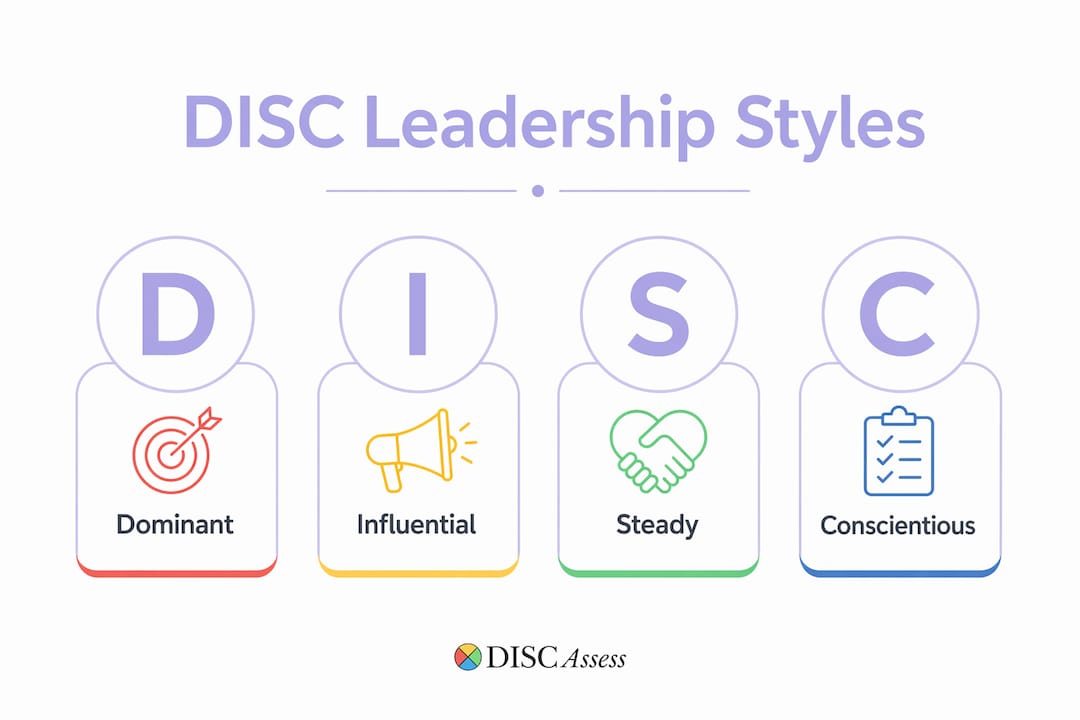
Understanding your primary style helps you lead from your strengths while staying alert to where you naturally fall short. The table below captures the core leadership profile for each style.
| DISC Style | Leadership Strengths | Common Blind Spots | Growth Focus |
|---|---|---|---|
| Dominant (D) | Decisive, results-driven, direct | Can appear dismissive or impatient | Slow down to listen; invite team input |
| Influential (I) | Energizing, collaborative, persuasive | May avoid difficult conversations | Follow through on commitments; add structure |
| Steady (S) | Reliable, empathetic, team-focused | Resists change; avoids conflict | Build comfort with necessary disruption |
| Conscientious (C) | Analytical, accurate, process-oriented | Overthinks; struggles to delegate | Trust the team; accept good enough |
The Dominant leader moves fast and expects others to keep up. That speed produces results in a crisis but can leave quieter team members feeling unheard. The Influential leader builds energy and buy-in naturally but may struggle to deliver hard feedback or hold people accountable.
The Steady leader is the team's anchor. People trust them because they are consistent and genuinely care about the group. The challenge is that Steady leaders often absorb conflict rather than address it, which creates slow-burning tension. The Conscientious leader produces high-quality work and sets rigorous standards, but their need for accuracy can slow decisions and frustrate team members who want to move forward.
The real power of DISC is not in knowing your type. It is in learning to adapt your leadership style when the situation calls for something different from your default. A Dominant leader who learns to pause and ask questions becomes dramatically more effective with Steady and Conscientious team members. That flexibility is what separates good managers from genuinely great leaders.
How to integrate DISC into a leadership development plan
Implementing DISC systematically helps small business leaders tailor coaching, improve succession planning, and build cohesive teams. The key word is "systematically." A one-time assessment without follow-through produces little lasting change. A structured process produces real growth.
-
Administer assessments across your leadership team. Start with yourself and your direct reports. Use a platform like Discassess that provides detailed reports without requiring HR certification or technical expertise. Group packages make this affordable for small teams.
-
Review results in a facilitated debrief. Do not hand people a report and walk away. Schedule a conversation where each person shares one strength and one growth area from their profile. This builds psychological safety and models the vulnerability that good leadership requires.
-
Map team dynamics using combined profiles. Once you have individual results, look at the group as a whole. A team of all Dominant styles will move fast but clash constantly. A team heavy in Steady styles will be harmonious but slow to change. Knowing the composition helps you improve team dynamics before problems surface.
-
Tailor coaching to each style. A Conscientious team member needs data and time to process feedback. An Influential team member needs encouragement and relational connection. Coaching that ignores style differences wastes time and creates frustration on both sides.
-
Revisit DISC data quarterly. Behavior shifts with context, stress, and growth. Checking in on DISC insights every quarter keeps development conversations grounded in current reality rather than a snapshot from six months ago.
Pro Tip: Use your team's DISC profiles to assign project roles intentionally. Put your Dominant leaders on initiatives that need fast decisions. Put your Conscientious leaders on quality-control tasks. Matching roles to natural strengths reduces friction and increases output.
Small business leadership grows strongest when assessment insights are paired with hands-on coaching and clear communication strategies. DISC gives you the map. Coaching is how you learn to read it.
What challenges should leaders consider when using DISC?
DISC is a powerful tool, but it works best when leaders approach it with realistic expectations. The most common mistake is treating DISC results as fixed labels rather than behavioral tendencies that shift with context and growth.
DISC is most effective when used alongside continuous coaching and honest self-reflection, not as a standalone personality verdict. A leader who says "I'm a D, so I'm just direct" is using DISC as an excuse rather than a development tool. The goal is growth, not justification.
Watch for these specific pitfalls:
- Overgeneralization. DISC describes tendencies, not destiny. A high-C leader can learn to make faster decisions. A high-I leader can develop follow-through. Do not let a profile become a ceiling.
- One-and-done thinking. A single assessment session does not produce lasting change. Leadership development requires repeated practice, feedback, and reflection over time.
- Ignoring context. A leader may show different behavioral patterns under stress than they do in a calm environment. DISC captures a snapshot, not the full picture.
- Skipping emotional intelligence work. DISC identifies behavioral patterns. It does not automatically build the empathy and self-regulation skills that effective leadership requires. Pair DISC with emotional intelligence training for the best results.
Honest self-reflection is the ingredient that makes DISC work. If a leader completes the assessment while trying to appear a certain way rather than answering truthfully, the results lose their value. Encourage your team to answer based on how they actually behave, not how they wish they did.
Key Takeaways
DISC assessment for leadership development works because it turns invisible behavioral patterns into specific, named insights that leaders can act on immediately.
| Point | Details |
|---|---|
| DISC builds self-awareness | Leaders identify behavioral strengths and blind spots that directly affect team trust and performance. |
| Adaptive communication is the core skill | Understanding your style and your team's styles reduces friction and builds lasting trust. |
| No style is superior | Each DISC style leads effectively when the leader learns to flex toward situational needs. |
| Systematic integration matters | One-time assessments produce little change; quarterly review and coaching create real growth. |
| Avoid labeling | Treat DISC results as behavioral tendencies, not fixed personality verdicts, to keep development moving forward. |
What I have learned from watching DISC change leaders
I have seen DISC assessments surprise leaders who thought they already knew themselves well. The most common reaction after a debrief is not "that's me" but "I had no idea that's how I come across." That gap between intention and impact is where real leadership growth lives.
The leaders who get the most from DISC are not the ones with the most impressive profiles. They are the ones who take the results seriously enough to change something specific. A Dominant leader who starts asking one more question before making a decision. A Steady leader who finally addresses a conflict they have been avoiding for months. Small shifts, repeated consistently, produce the kind of team culture that retains good people.
Small business leaders often tell me they do not have time for formal leadership development. DISC fits that reality because it is practical and repeatable. You do not need a full training program to use it well. You need a reliable assessment, a willingness to reflect, and a commitment to apply what you learn in real conversations. DISC profiles in leadership coaching work precisely because they connect behavioral insight to the daily moments where leadership actually happens.
The spiritual dimension matters here too. Growing as a leader is part of growing as a person. Understanding how God made you to think, communicate, and relate to others is not just professionally useful. It is part of becoming more of who you are called to be.
— Tres
Discassess makes DISC accessible for small business leaders
Discassess is built specifically for small business leaders and team managers who want professional-grade DISC tools without the complexity or cost of enterprise platforms.
The DISC Group Package gives your entire leadership team access to detailed assessments and reports through a single admin account. You can manage results, track development, and run group debriefs without needing an HR department or outside certification. For leaders who want to go deeper, the DISC Admin Account provides ongoing access to assessments and group management tools designed for teams of any size. Discassess, backed by Prism Counseling & Coaching, has helped leaders across small businesses and nonprofits apply DISC insights in practical, repeatable ways that actually stick.
FAQ
What is a DISC assessment for leadership development?
A DISC assessment for leadership development is a behavioral tool that identifies a leader's natural communication style, decision-making tendencies, and blind spots across four styles: Dominant, Influential, Steady, and Conscientious. Leaders use the results to build self-awareness and adapt their approach to different team members and situations.
How often should leaders retake a DISC assessment?
Most leadership coaches recommend revisiting DISC results every six to twelve months, or after a significant role change. Behavioral tendencies shift with stress, growth, and new responsibilities, so periodic reassessment keeps development conversations current and relevant.
Can DISC assessments improve team dynamics in small businesses?
Yes. When an entire team completes DISC assessments together, managers can map communication gaps, assign roles that match natural strengths, and address conflict patterns before they escalate. Group assessment packages make this practical and affordable for small teams.
Is DISC accurate enough to use for succession planning?
DISC is a reliable tool for identifying behavioral readiness for leadership roles, but it works best alongside performance data and direct observation. Organizations that use DISC for succession planning treat it as one input among several rather than the sole deciding factor.
What is the difference between DISC and other personality assessments?
DISC focuses specifically on observable behavioral tendencies in work and relational contexts, making it more directly applicable to leadership and team dynamics than broader personality frameworks. Its four-style model is straightforward enough for leaders to apply in daily conversations without ongoing specialist support.
Recommended
- DISC Profiles in Leadership Development Coaching
- DISC for Workplace Teams: A Manager's Practical Guide
- DISC Personality Assessment | Prism Counseling & Coaching - DISC Assess | Affordable, Professional DISC Assessments for Small Businesses
- DISC Assess | Affordable, Professional DISC Assessments for Small Businesses - All Articles