

DISC assessments are typically administered through an online assessment link that participants complete in about 10 to 20 minutes, with scoring generated automatically. The right approach uses the report as a springboard for a facilitated debrief, not a verdict. Follow this workflow with the right assessment tools, and you get a repeatable process your team can trust for development conversations, not hiring decisions.
TL;DR:
- Using a DISC assessment effectively depends on thorough preparation, including verifying tools, participant logistics, and timing, to avoid a failed session.
- Facilitation of a group debrief with comparison reports and action planning is crucial for translating results into meaningful team behavior changes.
- Certification matters mainly for external trainers and coaches; internal managers usually do not need certification due to self-explanatory reports.
- Interpretation should focus on patterns across the profile and differences between natural and adapted styles, not on high or low scores alone.
- Prioritize developing a facilitation plan before assessment deployment, as an insightful debrief drives long-term behavior change far more than the assessment itself.
Table of Contents
- Quick Checklist Before You Administer a DISC Assessment
- Step-by-Step Workflow to Administer, Score, and Debrief DISC
- What Certification and Training Options Actually Matter
- How to Interpret DISC Results Without Overstepping
- How Discassess Supports Trainers and Facilitators
- An Editorial Take on Running DISC Well
- Where to Start: Products That Match Your Rollout
- Sources
Quick Checklist Before You Administer a DISC Assessment
Before you send a single invitation, confirm you have the right tools in place. A rushed setup is the most common reason a DISC session falls flat, not the assessment itself.
- Account and credits: an active admin account with allocated assessment credits or a group package sized to your headcount.
- Participant logistics: a clean email list, confirmed device access, any accessibility accommodations, and a short privacy notice explaining how results will be used.
- Materials: a facilitator guide, one sample report to preview, a slide deck for the debrief, and an action planning template for the close.
- Timing: completion typically runs 8 to 15 minutes per person, with a full team debrief needing 60 to 90 minutes once everyone has finished.
Pro Tip: Send your invitation 48 hours before you need results, not the morning of. That buffer absorbs the inevitable "I missed the email" and still leaves you time to preview the group report before the room fills up.
Step-by-Step Workflow to Administer, Score, and Debrief DISC
Running a DISC session well comes down to five phases. Skip one, and you feel it in the debrief.
1. Prepare. Set up your admin account, upload your participant list, and choose the correct assessment profile for your context (workplace, ministry, or general use). Allocate credits from your group package, then preview a sample report before you send anything live. This single habit, confirming the report format matches your session goals, catches configuration mistakes before they become a room full of confused participants.
2. Invite. Write a short, plain invitation: what the assessment is, how long it takes, and why you're asking. Vendor support pages consistently recommend a structured reminder schedule rather than one email and hope. Decide upfront whether results stay anonymous for group aggregation or are tied to names for individual coaching, and say so in the invite. Ambiguity here creates distrust fast.
3. Administer. Give participants a quiet stretch of time, whether they're completing the assessment remotely or in a supervised session at your office. The instruction that matters most: answer based on natural tendencies, not what you think looks good, because there are no right or wrong answers. Note any language or accessibility needs before the session, not during it.
4. Score. Scoring is automatic once a participant submits, so your job shifts to quality control. Skim for:
- Straight-line answer patterns that suggest a participant rushed through without engaging.
- Missing sections that produce an incomplete profile.
- Duplicate submissions from someone testing the link twice.
Set a simple retake policy in advance. If someone's results look inconsistent, ask them to redo it rather than presenting a shaky profile as fact.
5. Debrief. This is where the real value lives. A facilitated group session using comparison reports helps a team see where styles complement each other and where friction is likely to show up in meetings or deadlines. Ask each person to name one strength they bring and one blind spot they're working on. Close by tying two or three specific behavior commitments to actual work processes, because reporting without action rarely changes anything.
What Certification and Training Options Actually Matter
Certification isn't a universal requirement for running DISC well, and understanding when it matters saves you money and confusion.
- Vendor-specific certification programs teach you a particular provider's report format and administration rules, useful if you're delivering paid workshops under that brand.
- Train-the-trainer formats focus on facilitation skill: how to run the room, not just how to read a graph.
- SHRM or ICF-accredited continuing education applies mainly to HR professionals and coaches who need credit hours toward an existing credential.
Internal managers running a report for their own team often don't need certification at all, since manager-ready reports are built to be self-explanatory. Coaches and consultants selling DISC-based services to outside clients benefit far more from formal training, since it signals credibility to a paying client. When you evaluate a program, look for hands-on practice with real sample reports, not just slide decks, plus some form of follow-up support after you're certified. Search for terms like "DISC facilitator training" or "DISC train-the-trainer certification" to find current options.
How to Interpret DISC Results Without Overstepping
DISC measures behavioral tendencies across four axes: Dominance, Influence, Steadiness, and Conscientiousness. Most reports also distinguish a natural graph (instinctive style under normal conditions) from an adapted graph (how someone shifts behavior under perceived pressure).
- Read for patterns across the whole profile, not a single high or low score in isolation.
- A wide gap between someone's natural and adapted graphs often signals workplace stress worth a private conversation.
- Use comparison reports when designing project teams, since they show where two people's styles are likely to clash or click.
- DISC works well for communication, onboarding, and coaching. It should never serve as the sole basis for a hiring decision, and job-relatedness needs separate documentation if any assessment factors into a selection process.
- Avoid labeling people by a single letter. "She's a D" flattens a nuanced profile into a stereotype, and it undercuts the entire point of using the tool for growth.
If you want more background on how the four styles show up in practical settings, this breakdown of DISC styles in coaching contexts offers straightforward, situational examples worth reviewing before your first session.
How Discassess Supports Trainers and Facilitators
Discassess builds its admin tools around one goal: cutting the friction between "I want to run an assessment" and "we're sitting in a debrief with real answers." Core features include:
- Admin accounts with straightforward participant management.
- Group packages and refillable assessment credits sized for teams of any scale.
- An admin portal for tracking completions and pulling group reports.
- Downloadable facilitator materials built for non certified users leading their first session.
Pro Tip: Pull your group comparison report the moment everyone finishes, not the night before your workshop. It gives you time to plan your discussion prompts around the actual mix of styles in the room instead of a generic script.
Sample reports and case examples are available on request for trainers evaluating the platform before a full rollout.
An Editorial Take on Running DISC Well
The industry's biggest blind spot isn't the assessment. It's what happens in the fifteen minutes after people see their results. Plenty of guides obsess over question wording and scoring algorithms, as if precision at that stage guarantees insight later. It doesn't. A technically flawless report handed to a team with no facilitation plan produces exactly one outcome: mild curiosity, followed by nothing.
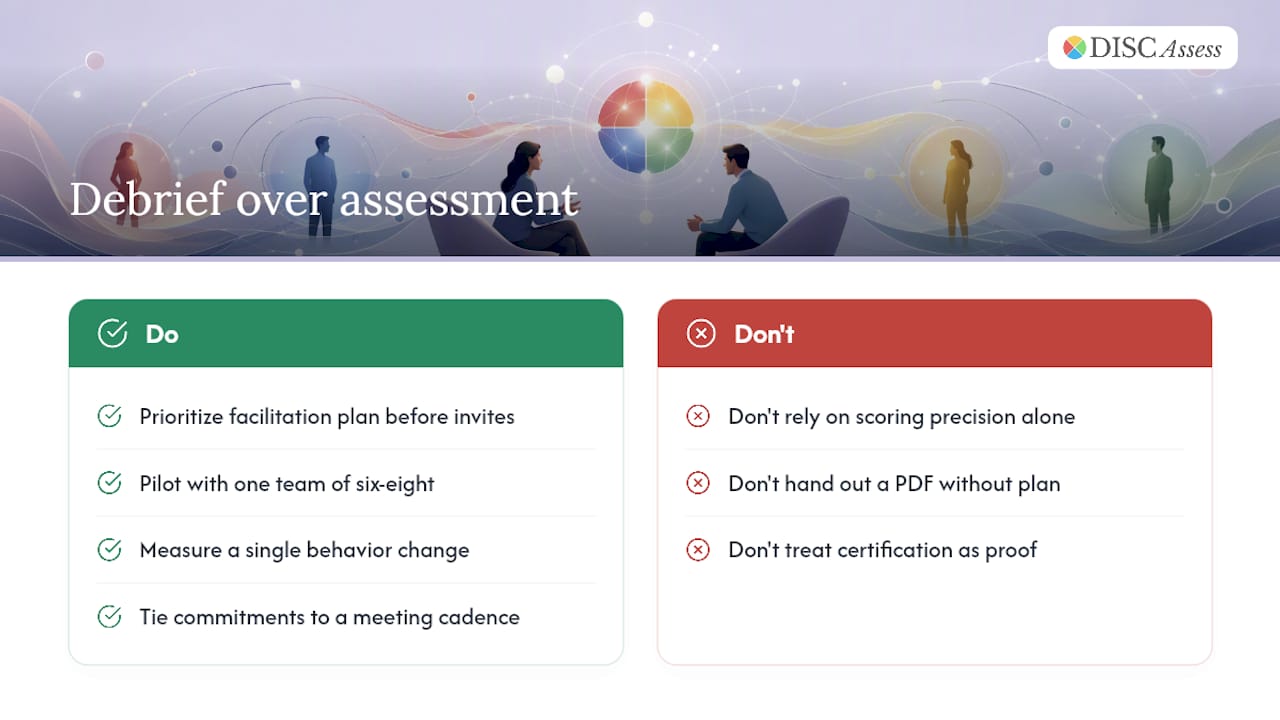
What the research on this topic keeps circling back to is the debrief, not the data collection. Teams that walk away from a DISC session with two or three specific behavior commitments, tied to an actual meeting cadence or handoff process, see the assessment pay off. Teams that just get a PDF forget it inside a month.
If you take one thing from this guide, prioritize the facilitation plan before you even send the first invitation. Piloting with one team of six to eight people, then measuring a single behavior change over six to eight weeks, tells you far more about whether DISC is working than any certification badge does.
— Tres
Where to Start: Products That Match Your Rollout
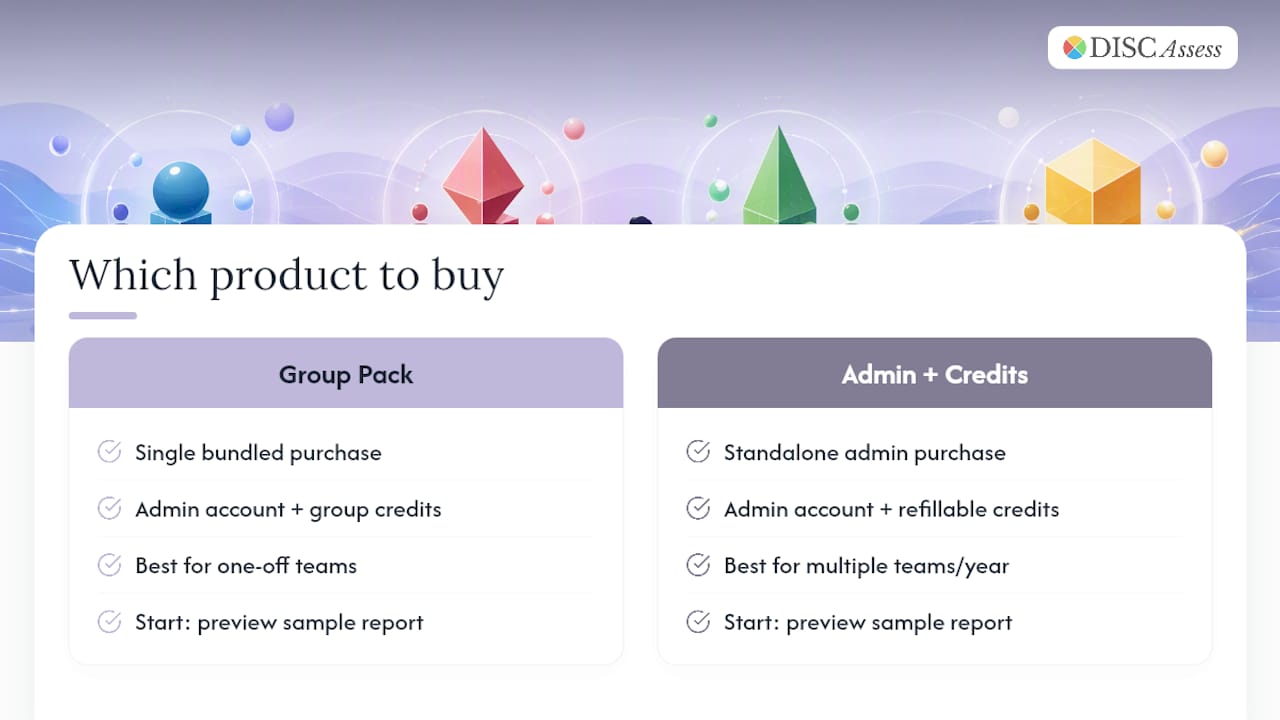
If you're running a one-off session for a single team, the DISC Group Package bundles an admin account with a set of assessment credits sized for that group, so you're not managing two separate purchases. If you're the kind of trainer or L&D lead who runs DISC across multiple teams throughout the year, pairing a standalone Admin Account with Assessment Credits that refill as you need them gives you more flexibility than buying a fixed group bundle every time.
After purchase, you get access to the admin portal, a sample report to preview before your first live send, and downloadable facilitator materials, so you're not building your debrief slides from scratch. Your first move once you're in: preview that sample report, confirm the profile matches your context, then upload your first participant list.
Whether you manage one team or a dozen, Discassess gives you a straightforward path to run this well. Start by exploring the group package options and set up your first session this week.
Sources
- DiSC Personality Assessments FAQ - Hone Admin Support
- Optimizeteamwork
- How to Administer and Score DISC Assessments - Personality Test