

DISC shows solid reliability for short-term profiling. Independent research finds median alpha coefficients around .72 to .87, meaning scores stay consistent when people retake it. Construct and predictive validity are weaker, especially for hiring decisions. Use DISC for coaching, team communication, and self-awareness. Skip it as a standalone hiring tool, and ask any vendor for independent peer-reviewed evidence, not just internal reports.
TL;DR:
- The assessment measures four dimensions—Dominance, Influence, Steadiness, and Conscientiousness—that overlap heavily with the Big Five traits.
- Use DISC primarily for coaching, team communication, and self-awareness, not for making hiring, promotion, or selection decisions.
- Vendors often lack independent, peer-reviewed evidence linking DISC scores to job outcomes, raising legal and ethical concerns in employment contexts.
- Programs like Discassess focus on development use cases, offering tools for individuals and small organizations to improve self-awareness without risking legal exposure.
Table of Contents
- What Does DISC Actually Measure?
- How Reliable Is the DISC Test, Really?
- Does DISC Predict Job Performance?
- Where DISC Belongs (and Where It Doesn't)
- How Discassess Supports Responsible DISC Use
- A Straight Answer on How We'd Recommend Using DISC
- Where to Start With DISC Assess
- Sources
What Does DISC Actually Measure?
DISC sorts behavioral tendencies into four dimensions: Dominance, Influence, Steadiness, and Conscientiousness. William Moulton Marston sketched the original theory in 1928, describing how people respond to their environment along two axes: active versus passive, and favorable versus unfavorable. Modern commercial instruments took that rough sketch and built proprietary scoring systems, forced-choice item formats, and circumplex models around it.
That gap between Marston's psychological theory and today's assessments matters. Marston never built a test. The instruments bearing his framework's name today come from decades of separate vendor development, each with its own item bank, scoring algorithm, and validation approach.
Vendors typically market DISC around a few core promises:
- Faster insight into how a colleague communicates and makes decisions
- A shared vocabulary for team dynamics and conflict styles
- Quick, low-cost profiling compared to longer clinical instruments
- Practical framing for leadership coaching and facilitation
Those are reasonable claims for a communication tool. They are a different matter entirely when someone tries to stretch DISC into predicting job performance, which is where the evidence gets thinner.
How Reliable Is the DISC Test, Really?
Reliability asks a narrow question: does the instrument produce consistent scores over repeated use? On that specific measure, DISC performs reasonably well.
Vendor-reported figures for Everything DiSC show a median coefficient alpha near .87 and test-retest correlations around .86 in the company's own research report. Independent researchers looking at large user samples through Cloverleaf's construct validity analysis found alphas ranging from .60 for Conscientiousness up to .80 for Dominance, a wider spread but still within an acceptable range for a workplace screening tool.
A few things shape those numbers:
- Forced-choice formats (pick which statement fits you best) tend to produce different reliability patterns than Likert scales, since they force trade-offs rather than independent ratings.
- Shorter retest intervals produce higher correlations than longer ones, so a six-month gap between assessments will show more drift than a six-week gap.
- Reliability applies to the scale, not to any single individual's day-to-day mood or context.
Here's the distinction that trips people up: reliability tells you the instrument is consistent, not that it's measuring the right thing. A bathroom scale that's off by five pounds every single time is highly reliable and completely invalid for tracking real weight. DISC's reliability numbers are genuinely solid. What comes next is where the harder questions live.
Does DISC Predict Job Performance?
This is where vendor enthusiasm and independent scrutiny start pulling in different directions.
Peer-reviewed and independent analyses generally find that DISC dimensions overlap heavily with combinations of Big Five traits rather than standing as four independent, orthogonal constructs. Dominance tracks closely with low Agreeableness and high Extraversion, as illustrated by the Big Five personality framework. Conscientiousness in DISC resembles the Big Five trait of the same name closely enough that some researchers question whether DISC is measuring anything the Big Five doesn't already capture, just with different labels.
Formal test reviews echo that concern. Germany's TBS-DTk review system, for instance, found that at least one popular DISC-based instrument (Persolog) met reliability benchmarks but fell short on validity evidence, particularly for job-related outcomes, according to the broader DISC assessment literature review.
The scientific validity of the DISC assessment has not been demonstrated, and psychologists question its predictive validity for workplace outcomes.
That's not a fringe opinion. It's the consistent thread running through independent test critiques and practitioner-facing research summaries alike. Vendors counter with their own circumplex analyses and scale-intercorrelation studies showing internal coherence. Both things can be true at once: a model can hang together internally while still lacking outside evidence that it predicts who will succeed in a role.
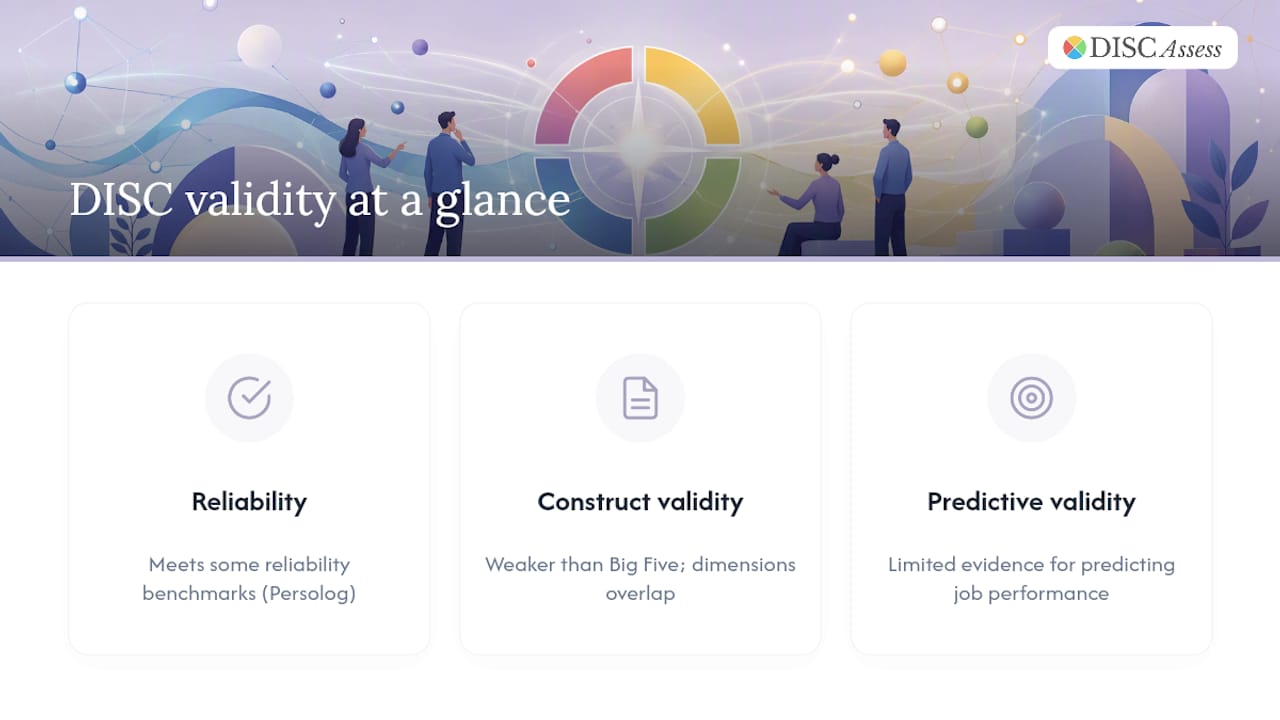
Independent syntheses tend to land in the same place: DISC has acceptable reliability, weaker construct validity than the Big Five, and limited evidence for predicting actual job performance. That's a coaching tool's résumé, not a selection tool's.
Where DISC Belongs (and Where It Doesn't)
Used well, DISC earns its keep. Used carelessly, it creates legal exposure and false confidence. The line between the two is narrower than most managers assume.
Lower-risk, high-value uses include:
- Team debriefs where the goal is opening conversation about work style differences, not ranking people.
- Communication workshops that help colleagues adjust tone and pacing for each other.
- Coaching and self-awareness work, where the person being assessed interprets their own results rather than being judged by someone else.
- Volunteer and nonprofit team-building, where the stakes are relational rather than financial. Nonprofit staff development programs frequently lean on DISC for exactly this reason.
What DISC should never do alone is decide who gets hired or promoted. Using a personality instrument without demonstrated job-relatedness in an employment decision creates real EEOC exposure in the United States, particularly if the tool produces different outcomes across protected groups without evidence tying scores to job performance. Our own guidance on DISC and hiring walks through this in more depth.
Before applying any personality instrument to a consequential decision, ask the vendor these questions: Do you have independent, peer-reviewed validity studies, not just internal reports? What's the evidence of job-relatedness for this specific role category? What are the effect sizes, not just statistical significance? Has this instrument been reviewed by researchers outside your company?
For actual hiring decisions, evidence-based alternatives carry stronger track records. Big Five instruments, structured behavioral interviews, and validated cognitive ability tests all have deeper peer-reviewed support for predicting job performance than typology-based tools like DISC.
Pro Tip: If a vendor's only proof of validity is their own research report, treat that as marketing, not evidence. Ask what independent, peer-reviewed studies exist outside the company that built the test.
How Discassess Supports Responsible DISC Use
Discassess builds its tools around the coaching and development use cases where DISC's evidence base is strongest, not around selection decisions where it isn't. Two core products anchor that approach.
The Christian DISC® Certification equips coaches, pastors, and facilitators to administer and interpret DISC through a faith-integrated lens, useful for discipleship, staff development, and small group leadership. The Individual Classic DISC Personality Assessment gives one person a fast, self-guided profile with an instant report, ideal for personal growth or a single coaching session.
Both sit inside a platform built for practical, low-risk implementation:
- An admin portal for managing group results without technical overhead
- Immediate, easy-to-read reports rather than dense clinical output
- Group packages sized for small teams, church staffs, and nonprofit boards
- Training resources that support facilitators, not just end users
Backed by more than a decade of experience through Prism Counseling & Coaching, Discassess fits organizations that want a straightforward, affordable way to build self-awareness without an HR department behind them.
A Straight Answer on How We'd Recommend Using DISC
DISC earns its place in development work. It has no business anchoring a hiring decision on its own, and treating a coaching tool as a selection instrument is where most of the legal and ethical trouble starts.
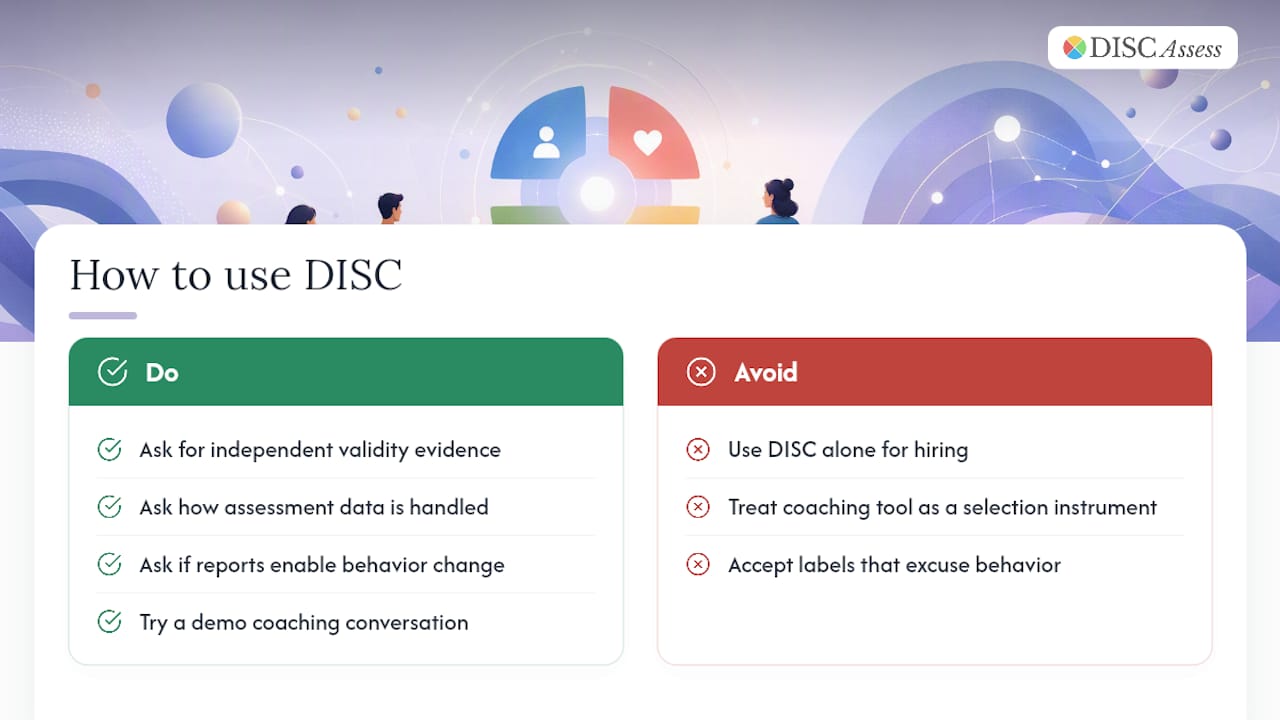
If you're evaluating any DISC vendor, ask for their independent validity evidence before their sales deck. Ask what happens to the data after the assessment. Ask whether the report format actually helps people change behavior or just hands them a label to hide behind. Those three questions filter out most of the noise in this market quickly.
Discassess built its entire model around the use cases the evidence actually supports: coaching, team communication, self-awareness, and discipleship contexts. If you want to see how that looks in practice, a demo conversation is a low-pressure way to find out whether it fits your team.
— Tres
Where to Start With DISC Assess
If you've read this far, you already know DISC works best as a growth tool, not a gatekeeping one, and that's exactly the lane Discassess builds for. Whether you're a solo coach, a church staff, or a small nonprofit board, there's a purchase path sized to what you're actually trying to do.
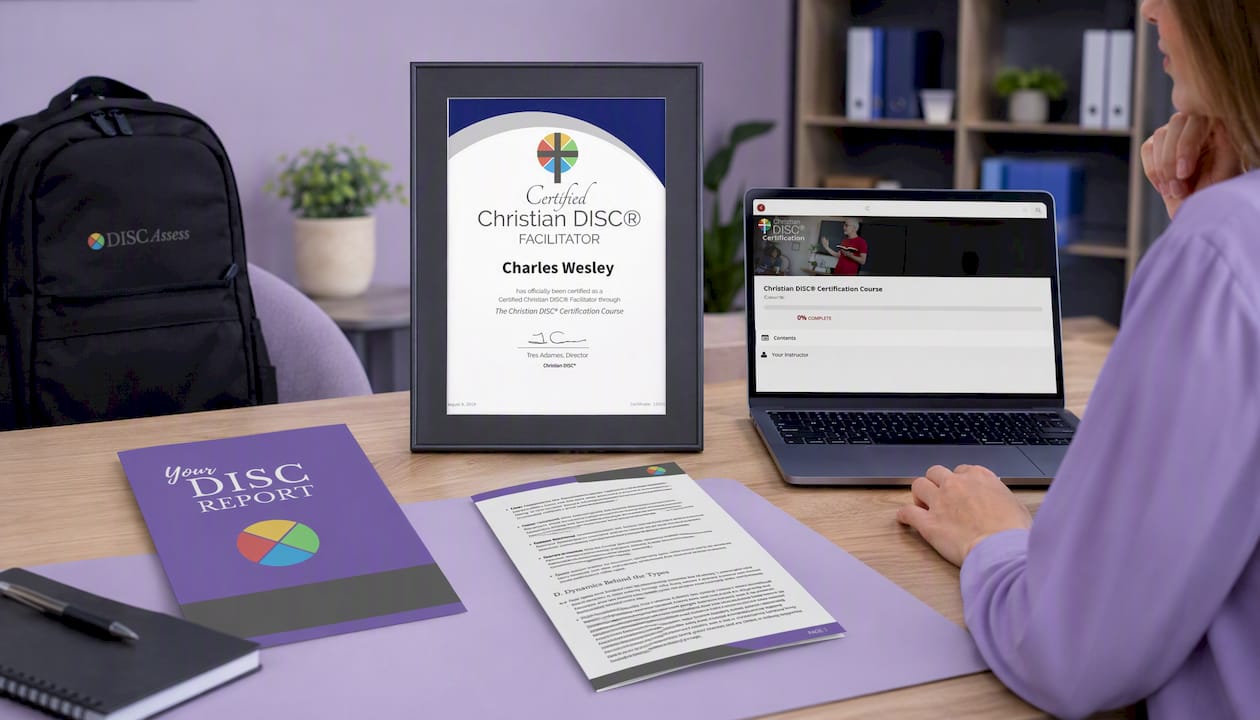
For one person exploring their own tendencies, the Individual Classic DISC Personality Assessment delivers a full report in minutes with no ongoing commitment. Coaches, pastors, and ministry leaders who want to administer and interpret DISC for others should look at the Christian DISC® Certification, which builds the credential alongside the assessment access. Teams running a staff retreat, a volunteer training day, or an ongoing coaching practice can step up to group packages or an unlimited membership, both scaled for organizations that need repeat access without repeat sticker shock.
Every path here is built for development and facilitation work, the exact context where DISC's evidence holds up. If your team is ready to build shared language around how people communicate and grow, start with the assessment that matches your role: individual, certified facilitator, or team leader.
Sources
Read vendor reports for their internal data, but weigh them against independent, peer-reviewed critiques before trusting a validity claim at face value.