

Use DISC for hiring at the finalist stage, not as a pre-employment screener. That is the direct answer, and it holds up under both legal scrutiny and practical experience: DISC measures behavioral tendencies, not qualifications, and the EEOC requires that anything used to screen candidates be job-related and consistently applied. Behavioral style and job competence are two different questions, and DISC only answers one of them.
The right sequence is simple. Screen for skills and experience first. Narrow to your finalists. Then bring in a DISC assessment to sharpen your interview questions and prepare a stronger onboarding plan.
- Run resume and skills screening as your first filter, always.
- Administer DISC only after you have a finalist pool of qualified candidates.
- Use the results to shape interview probes and a 90-day onboarding plan, not to eliminate candidates.
Key Takeaways
DISC works best in hiring when it is applied only to finalists, benchmarked against real top performers, and documented as one factor among several rather than a screening gate.
| Point | Details |
|---|---|
| Sequence matters | Screen for skills and experience first, then run DISC only on finalists. |
| Legal risk lives in inconsistency | Apply DISC the same way to every finalist for a role and keep documentation on file. |
| DISC informs, it doesn't decide | Pair results with skills tests, structured interviews, and reference checks before making a call. |
| Training prevents misuse | A short session on what each dimension predicts (and doesn't) stops most common errors. |
| Discassess fits small-team workflows | Its admin portal, group packages, and unlimited membership plan match the finalist-stage playbook this article describes. |
Table of Contents
- What Does DISC Measure in Hiring, and What Does It Miss?
- When Should DISC Enter Your Hiring Process?
- What Does the EEOC Require for Behavioral Assessments in Hiring?
- How Do You Build a Compliant DISC Hiring Playbook?
- How Discassess Supports Small Teams Using DISC Responsibly
- What Ethical Risks Come With Interpreting DISC Results?
- How Does DISC Compare to MBTI and the Big Five?
- How Should You Train Hiring Managers to Use DISC Correctly?
- What Happens When Companies Over-Rely on DISC?
- The Case for Using DISC Well, Not Using It More
- Get Your Hiring Team Assessment-Ready With Discassess
- Sources
What Does DISC Measure in Hiring, and What Does It Miss?
DISC sorts behavioral tendencies into four dimensions: Dominance, Influence, Steadiness, and Compliance. A high-D person tends to be direct and results-focused. A high-I person leans persuasive and outgoing. High-S individuals value consistency and steady pacing. High-C candidates gravitate toward accuracy and structured process. These patterns predict how someone is likely to communicate and approach work, which is genuinely useful once you already know they can do the job.
What DISC does not measure matters just as much:
- Technical skill or job-specific competence
- Cognitive ability or intelligence
- Mental health status or clinical traits
- Personal values, ethics, or integrity
- Past performance or work history
The most common misuse is treating DISC as a pass/fail filter, rejecting a candidate because their profile does not match a preferred style. Research on personality-based measures shows they predict behavior only modestly on their own, which is exactly why pairing DISC with job-specific evaluation matters more than the profile itself.
When Should DISC Enter Your Hiring Process?
DISC adds the most value once you already know a candidate can do the job. Running it earlier just adds noise, and running it as an elimination step invites legal risk. Practitioner guidance is consistent on this point: DISC belongs after the shortlist, not in the initial funnel.
At the finalist stage, DISC serves two distinct purposes:
- Selection support: generate targeted interview questions and flag potential friction points with the team or manager.
- Onboarding and development: brief the hiring manager on communication style and build a 90-day plan around it.
A typical small-team timeline looks like this: two weeks of resume and phone screening, then DISC administered to two or three finalists in the final week before offers go out. Most small businesses handle this affordably, often for less than the cost of a single extra interview round, and get results back the same day.
What Does the EEOC Require for Behavioral Assessments in Hiring?
The EEOC's guidance on employment tests sets three conditions for any selection tool: it must be job-related, consistent with business necessity, and applied the same way to every candidate in a given role. DISC fails this test the moment you use it to screen out candidates rather than to inform interviews after qualifications are confirmed.
A single inconsistency in how you apply an assessment is often the detail that turns a routine hiring decision into a discrimination complaint.
Build your compliance approach around these steps:
- Validate your benchmark against real top performers in the role, not assumptions about an "ideal" personality.
- Apply the assessment to every finalist for that position, without exception.
- Document why DISC was used, how results were weighed, and what other factors drove the final decision.
- Consult employment counsel if you are unsure whether a use case crosses into screening territory.
Watch the ADA boundary carefully. DISC is a behavioral preference tool, not a clinical or medical instrument, and treating it as either invites a different category of legal exposure. Keep results separate from any conversation about accommodations, and never let a DISC score substitute for a documented performance or conduct issue.
How Do You Build a Compliant DISC Hiring Playbook?
A defensible process follows the same four steps every time, regardless of company size.
- Define the role's behavioral requirements first. Profile two or three current top performers in the role and build a benchmark from their DISC results, so you are comparing candidates to real performance, not a guess.
- Apply DISC uniformly to every finalist. No exceptions for a candidate you already favor or one you have doubts about. Consistency is the whole point.
- Document the reasoning. Store each report in the candidate file along with a note on how it informed interview questions and how other factors, like experience and reference checks, drove the final call.
- Hand the profile to the hiring manager with a short onboarding brief: communication style, likely stressors, and two or three coaching points for the first 90 days.
Sample interview probes mapped to each dimension help make this concrete:
- D: "Tell me about a time you pushed back on a decision you disagreed with."
- I: "How do you keep a quiet meeting moving?"
- S: "Describe how you handled a sudden change in priorities."
- C: "Walk me through how you double check your own work under a deadline."
Pro Tip: Ask the same DISC-mapped question to every finalist for the role, and write the answer down before you look at the assessment report. Comparing your own notes to the profile afterward tells you whether the tool is confirming something real or just confirming what you wanted to hear.
How Discassess Supports Small Teams Using DISC Responsibly
Small businesses and nonprofits rarely have a dedicated HR department to build benchmarks or manage paperwork for a dozen finalists a year, and Discassess was built with exactly that gap in mind. The platform gives you an admin portal to manage assessments across candidates and teams, group management tools for handling multiple finalists at once, and detailed reports written in plain language rather than clinical jargon.
- Individual assessments for a single finalist, or group packages for a whole hiring season.
- An unlimited membership plan for organizations that hire regularly throughout the year.
- Backing from Prism Counseling & Coaching, with over a decade of behavioral assessment experience.
| Point | Details |
|---|---|
| Documentation reduces risk | Store each report with interview notes to show DISC informed, but did not decide, the hire. |
| Membership fits repeat hiring | An unlimited plan suits organizations running finalist assessments several times a year. |
| Group tools save admin time | The admin portal lets one person manage assessments across several finalists at once. |
Pro Tip: If you are hiring for more than one role this year, a group package or unlimited membership almost always costs less per assessment than buying them one at a time.
What Ethical Risks Come With Interpreting DISC Results?

The biggest ethical risk in DISC hiring is not the tool itself. It is the interpreter reading their own preferences into someone else's profile. A hiring manager who is high-D can unconsciously favor other high-D candidates, mistaking a shared communication style for genuine competence. That bias is easy to miss because it feels like intuition rather than prejudice.
A second risk is cultural flattening. DISC was normed on Western workplace communication patterns, and a candidate whose cultural background shapes a quieter or more indirect style can read as "low influence" on paper when the reality is simply a different professional norm. Treating that as a red flag rather than a difference in style is where good intentions turn into discriminatory practice.
Confirmation bias compounds both problems. Once a hiring team has decided they like a candidate, a DISC report gets read to support that conclusion rather than test it. The same happens in reverse: a borderline candidate's profile gets picked apart for reasons to say no. The fix is procedural, not philosophical. Score interview answers before reviewing the DISC report, require every interviewer to write down a rationale independent of the profile, and never let one person's read of a report override a structured evaluation. Ethical use of DISC depends less on the assessment and more on the discipline of the people applying it.
How Does DISC Compare to MBTI and the Big Five?
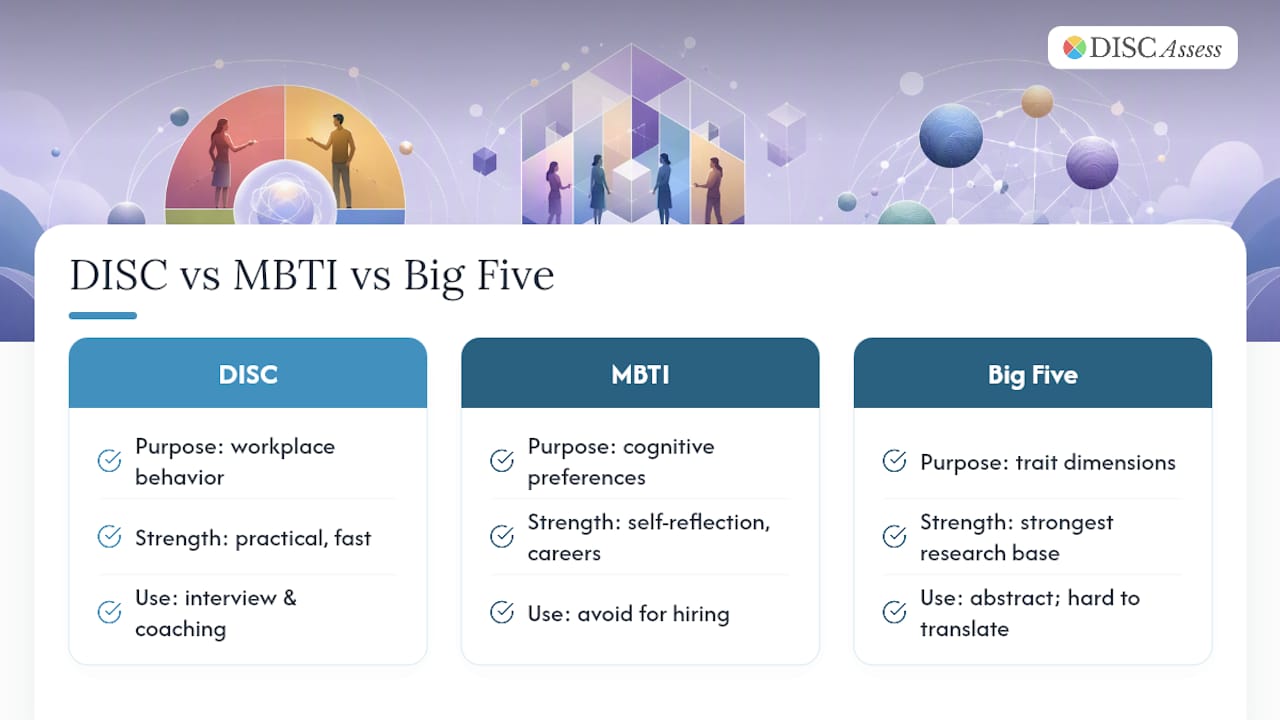
DISC, the Myers Briggs Type Indicator, and the Big Five all describe personality, but they were built for different jobs. DISC is designed around observable workplace behavior, which is why it translates cleanly into interview questions and communication coaching. MBTI sorts people into 16 fixed types based on cognitive preferences, and it was designed for self-reflection and career exploration, not selection decisions. Most employment law specialists advise against using MBTI results in hiring for that exact reason.
The Big Five (openness, conscientiousness, extraversion, agreeableness, and neuroticism) carries the strongest academic research base of the three and correlates more consistently with job performance in peer-reviewed studies. But it is also more abstract and harder for a hiring manager to translate directly into an interview question or a coaching conversation.
DISC's advantage for small teams is practical, not scientific: it is fast to administer, easy to explain to a candidate in five minutes, and it maps directly onto observable workplace behavior like pace, directness, and risk tolerance. None of the three should ever function as a standalone hiring gate. Each one, DISC included, works best paired with a skills assessment or structured interview that actually tests the competencies the job requires.
How Should You Train Hiring Managers to Use DISC Correctly?

Most DISC misuse in hiring does not come from bad intentions. It comes from untrained managers treating a behavioral snapshot as a verdict on someone's fitness for the job. Training fixes this faster than any policy memo.
Start with a short session, thirty to forty five minutes is usually enough, that covers three things: what each dimension actually predicts, what it explicitly does not predict, and the specific interview questions your organization has approved for each profile type. Managers who understand that a low-S score means "prefers variety" rather than "unreliable" make better decisions and write better documentation.
Pair every training session with real examples from your own hiring history, anonymized, showing a profile alongside the actual interview notes and outcome. Abstract training slides rarely stick. A manager who sees how a high-C finalist's report lined up with (or diverged from) their actual performance in the interview remembers the lesson.
Require every manager who reviews a DISC report to complete this training before they see their first live report. It is the single cheapest safeguard against the two most common failures: treating the profile as a screening gate and reading personal bias into an ambiguous result.
What Happens When Companies Over-Rely on DISC?
Over-reliance on DISC shows up in a predictable pattern: a company starts using it thoughtfully at the finalist stage, gets comfortable with it, and slowly lets it creep earlier into the funnel until it is functioning as an informal screen. That drift is where the legal and quality problems both start. Critics of DISC in hiring are direct about this risk, noting that the assessment was never built to function as a pre-employment screener, and using it that way can produce both weaker hires and disparate impact exposure.
The quality risk is subtler than the legal one. A team that hires only for behavioral "fit" tends to homogenize over time, filtering out the friction that often produces better decisions. A team of five high-D go-getters can move fast and miss details nobody flagged, because nobody on the team was wired to flag them.
The balanced approach treats DISC as one input among several: skills testing, structured interviews, work samples, and reference checks all carry more weight for the actual hire/no-hire decision. DISC's job is to make the interview sharper and the onboarding smoother, not to cast the deciding vote.
The Case for Using DISC Well, Not Using It More
The conventional advice on personality assessments in hiring tends to split into two unhelpful camps: treat DISC as scientific proof of fit, or dismiss it entirely because it is not a predictive tool. Both miss the actual value, which sits in a narrower lane than either camp wants to admit.
DISC's real strength is translation. It takes a fuzzy, hard-to-interview-for question, "how will this person actually operate on my team", and turns it into concrete language a hiring manager can use in a conversation and a new hire can use to understand themselves. That is worth something real, even though it says nothing about whether the candidate can do the job.
What gets underestimated is how much the process around DISC matters more than the tool itself. A benchmarked, documented, uniformly applied DISC step protects a small business better than an expensive assessment used carelessly ever could. Prioritize the discipline of when and how you use it. The dimension letters are the easy part.
— Tres
Get Your Hiring Team Assessment-Ready With Discassess
Discassess gives small businesses and nonprofits a way to run this playbook without hiring a consultant or learning a certification framework first. The platform's individual assessments, group packages, and admin portal let a single office manager or hiring lead run finalist assessments, store reports, and hand results to managers, exactly the workflow this article walks through.
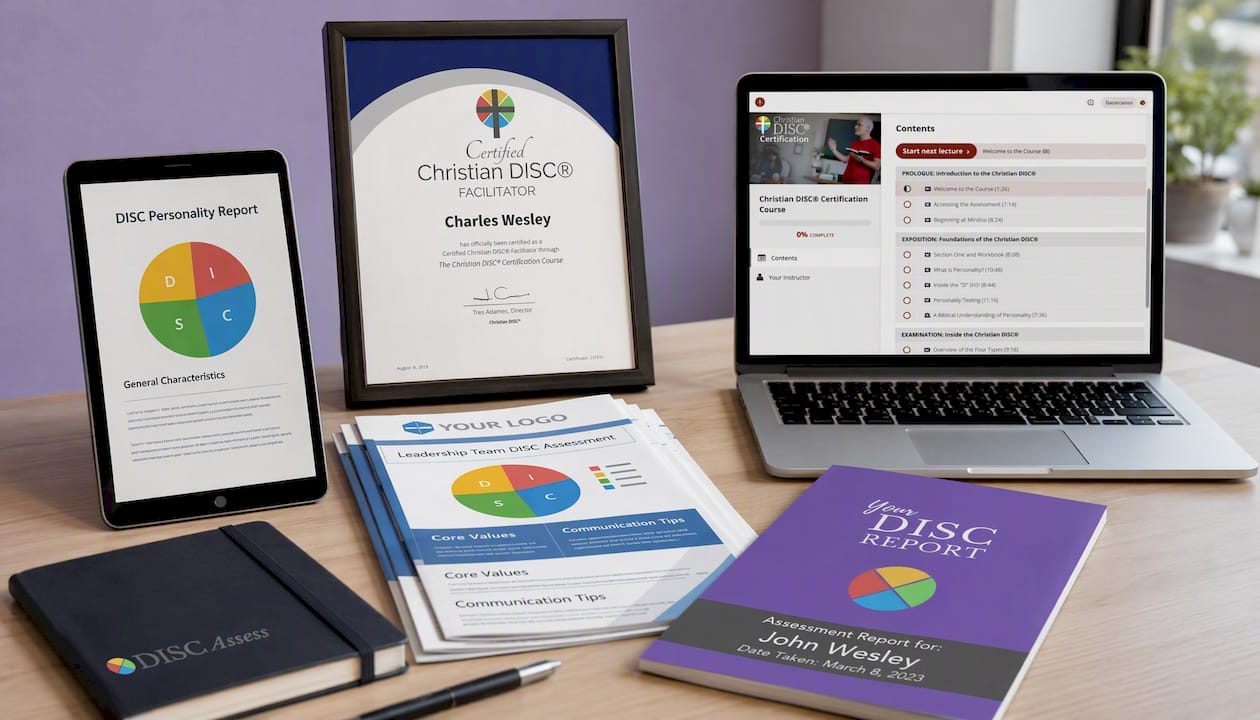
For organizations that want a faith-integrated framework built on the same DISC foundation, the White Label DISC System offers a branded, ready-to-deploy option, while the Christian DISC® Certification Course trains a staff member to administer and interpret results with theological grounding. Organizations hiring throughout the year should look at Go Unlimited, an unlimited membership that removes the per-assessment cost calculation entirely.
Start with a single finalist assessment on your next open role, or explore the full article library for onboarding templates you can pair with your first report.
Sources
- EEOC: Employment Tests and Selection Procedures (guidance)
- Peer-reviewed literature (PMC6692168) on personality assessments and predictive validity
- PrevueHR: Why The DISC Assessment Should NOT Be Used In The Hiring Process
- Assessments24x7: DISC for Hiring Without Legal Risk