
A DISC personality assessment gives you practical, workplace-focused behavior data that helps you judge role fit — but it works best as one input in a broader readiness check, not as a standalone career prescription. The most useful first step: take a DISC assessment, save your individual report, then run a short readiness matrix covering financial runway, skills transferability, and motivation quality before making any decisions. Backed by Prism Counseling & Coaching, Discassess makes that process accessible for small teams and coaches who want to support career-change conversations without a complex HR infrastructure.
Table of Contents
- What does a DISC assessment actually reveal about career fit?
- How to use DISC in a career-change decision: a step-by-step workflow
- Common mistakes when using personality data for career moves
- How small-business leaders and coaches run DISC for career-change support
- What should you look for in a DISC provider?
- Key Takeaways
- Why DISC is more useful than most career-change guides admit
- Start your career-change evaluation with a DISC assessment built for small teams
- Useful sources for deeper reading
What does a DISC assessment actually reveal about career fit?
DISC measures four observable workplace behavior dimensions: Dominance (how you handle problems and assert yourself), Influence (how you relate to and persuade others), Steadiness (your pace preference and consistency), and Conscientiousness (your attention to accuracy and process). Those dimensions map directly to role demands in ways that matter for a career-change evaluation.
- High D profiles tend to thrive in leadership, entrepreneurship, and problem-solving roles that reward decisiveness.
- High I profiles energize in sales, coaching, and relationship-facing work where communication is central.
- High S profiles sustain performance in operations, support, and coordination roles that value reliability.
- High C profiles excel in technical, analytical, and compliance-driven work where precision matters.
What DISC does not measure is equally important. It does not assess skills mastery, domain knowledge, long-term career interests (that is the territory of RIASEC/Holland Codes), or financial readiness. It is a behavioral snapshot, not a job certification. Results also depend on honest self-reporting — there is no "right" profile, and approaching the assessment candidly is what makes the output useful.
One insight worth holding onto: moving away from a painful job without a researched destination is a high-risk driver for failed pivots. Use DISC to clarify what environment energizes you, not as the sole trigger for a decision. When personality and role genuinely mismatch, the person often works against their natural tendencies — and that increases stress even when they can technically perform the job. Research on personality-career alignment links strong alignment with higher engagement and lower early-tenure turnover.
Pro Tip: Review your DISC report with a specific role in mind, not in the abstract. Ask: "Does this role's daily demands match the environment where my profile says I do my best work?"
How to use DISC in a career-change decision: a step-by-step workflow
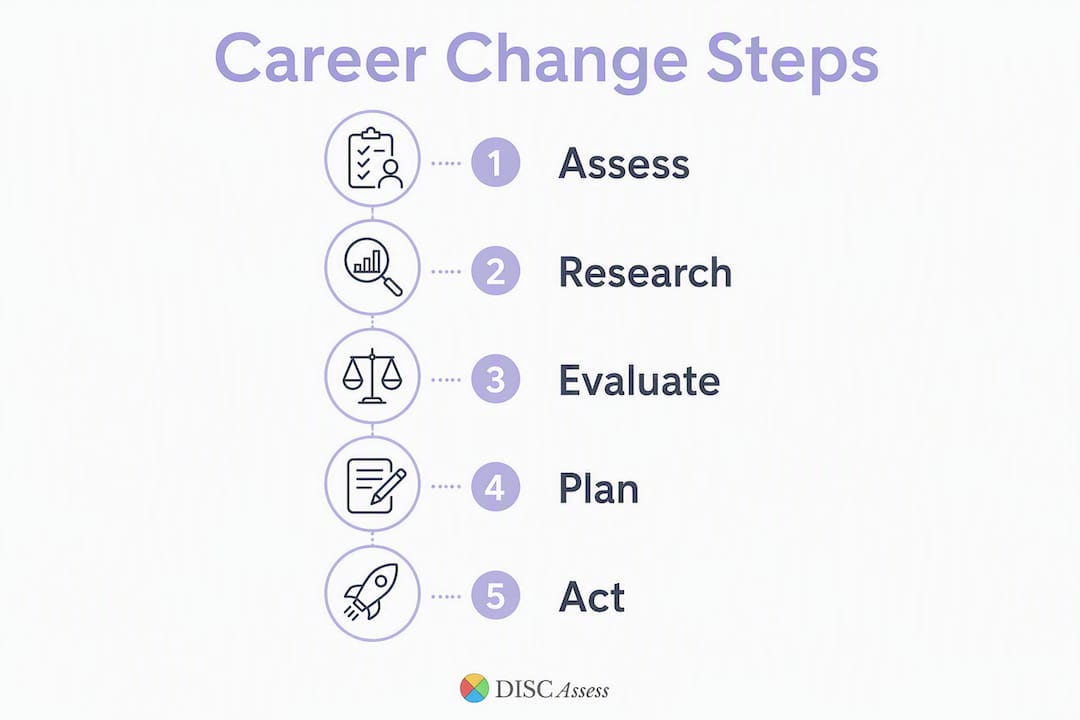
This five-step process moves from assessment to a grounded decision, and it works whether you are guiding yourself or coaching a team member through an internal role change.
-
Take the DISC assessment honestly and save your report. Your individual report is the foundation. The Individual Classic DISC Personality Assessment from Discassess delivers an instant, detailed report you can reference throughout the process.
-
Map your DISC profile to role demands. List six key demands of the target role (communication style, pace, decision authority, detail level, collaboration intensity, and accountability structure). Rate each on a simple 1–3 fit scale against your DISC output. This short mapping exercise surfaces mismatches before they become expensive.
-
Run a readiness check. DISC tells you about behavioral fit; readiness tells you whether now is the right time. A weighted readiness model breaks the check into five dimensions:
| Readiness Dimension | Typical Weighting |
|---|---|
| Financial runway | 25% |
| Skills transferability | 20% |
| Motivation quality | 20% |
| Market demand | 18% |
| Support network | 17% |
-
Design low-risk pilots. Informational interviews, a one-month freelance project, or shadowing someone in the target role all generate real data. Most serious career changers spend several months in planning before the active job search begins; pilots use that window productively.
-
Integrate DISC with interest and skills tools. Pairing DISC with a RIASEC interest assessment and a skills inventory gives you a convergent picture. When multiple tools point in the same direction, confidence in the direction rises. A decision support engine that models financial scenarios and flags cognitive biases adds another layer of quality to the final call.
Pro Tip: High DISC fit with low readiness scores is a signal to gather information, not to resign. Schedule a re-assessment only after 3–6 months of exploratory work — your behavioral tendencies may clarify as you get closer to the new environment.
Common mistakes when using personality data for career moves
The most frequent errors are predictable, which means they are also avoidable.
- Treating DISC as a career prescription. DISC describes how you work, not what you should do. A high C score does not mean you must become an accountant.
- Ignoring financial runway. Changers with longer runway make higher-quality choices because they are not selling the pivot short under pressure.
- Acting on "away" motivation alone. Wanting to escape a bad manager or a toxic culture is valid, but it is not a destination. Confirm you are moving toward something researched.
- Over-relying on raw fit scores without readiness. A decision matrix that separates score from readiness reduces pivot failure. High fit plus low readiness should trigger a slow-down, not a leap.
- Failing to pilot the new role. Paper research and informational interviews are not substitutes for doing the actual work, even part-time.
Red flags that warrant pausing the pivot: high DISC fit score with low readiness ratings, no bridge income plan, fewer than three informational interviews completed, and no market validation that the target role is hiring.
Pro Tip: Run a quick pre-mortem before deciding: "If this pivot fails in 12 months, what was the most likely cause?" A structured decision matrix surfaces sunk-cost biases and overly optimistic assumptions before they cost you.

How small-business leaders and coaches run DISC for career-change support
Implementation does not require a large HR team. A practical rollout for a small team or coaching cohort looks like this:
- Week 1–2: Individuals complete the DISC Personality Assessment and receive instant reports. Discassess's admin portal lets a team leader or coach manage multiple assessments from one dashboard.
- Week 3: Group workshop using aggregate reports to identify team-wide patterns and discuss role-fit implications.
- Week 4–6: One-on-one coaching follow-ups where each person maps their DISC profile to current or target role demands.
- Ongoing: Role-mapping exercises and skills inventory pairing for promotion or internal transfer decisions.
Small-team use cases go beyond career change. Coaches use DISC results to redesign role descriptions, align communication styles across departments, and support staff through internal transitions. For nonprofit staff development, the same workflow applies with an added emphasis on mission alignment.
Prism Counseling & Coaching's backing means Discassess's facilitator guides and coaching materials are grounded in real counseling practice, not just assessment theory. On the practical side: always obtain informed consent before administering assessments, keep individual reports confidential unless the employee chooses to share, and frame results as a growth conversation rather than an evaluation. Psychological safety is what makes the data useful.
What should you look for in a DISC provider?
A quick checklist for small teams and coaches evaluating providers:
- Validated DISC model with clear behavioral dimension definitions.
- Instant individual reports delivered without manual processing.
- Group and admin tools for managing multiple users and cohorts.
- Facilitator resources that support workshops without requiring certification.
- Transparent, small-team pricing with single-use, bundle, and membership options.
- Privacy controls that keep individual results confidential from peers.
- Accessible customer support for teams without dedicated HR staff.
Discassess meets each item on that list. The platform offers both the Individual Classic DISC Personality Assessment and the standard DISC Personality Assessment as immediate-access online products, with group packages and unlimited membership subscriptions for organizations that run assessments regularly. The small-team focus means no enterprise contract, no certification requirement, and no steep learning curve.
Key Takeaways
DISC gives you the clearest picture of behavioral fit when paired with a readiness check — high fit alone is never sufficient reason to resign.
| Point | Details |
|---|---|
| Take DISC honestly | Candid self-reporting is what makes the output usable; there is no "right" profile. |
| Run a readiness check | Score financial runway, skills, motivation quality, market demand, and support network with appropriate weightings. |
| Pilot before committing | Informational interviews and short freelance projects generate real data during the 6–18 month planning window. |
| Pair DISC with RIASEC | Combining behavior (DISC) and interest (RIASEC) tools gives a convergent, more durable career direction. |
| Discassess for small teams | Instant reports, group admin tools, and Prism Counseling & Coaching backing make Discassess a practical starting point. |
Why DISC is more useful than most career-change guides admit
Most career-change advice treats personality assessments as either magic answers or useless noise. Neither is accurate. DISC occupies a specific, genuinely useful lane: it tells you how you are wired to work, which environments will energize you, and where friction is likely to build. That is not everything, but it is not nothing either.
What gets underestimated is the motivation quality question. A person fleeing a difficult workplace will often score high fit on a new role simply because anything looks better than where they are. The readiness check is what catches that distortion. When you separate "I want to leave" from "I am ready to arrive," the decision quality improves considerably.
The teams and coaches who get the most from DISC are the ones who treat it as a conversation starter, not a verdict. They use the report to ask better questions, design smarter pilots, and give employees language for what they already sense about themselves. That is the real value of a well-run assessment process.
Start your career-change evaluation with a DISC assessment built for small teams
Discassess offers the clearest on-ramp for small teams and coaches who want to use DISC without a complex setup. Instead of waiting months for a consultant or investing in enterprise software, you can have an individual report in hand today, at a price point that makes piloting with a small cohort genuinely practical.
The Individual Classic DISC Personality Assessment is the right starting point for a single person evaluating a career move. For leaders supporting a team through role transitions, the group packages and unlimited membership options let you scale without per-seat sticker shock. Every assessment comes with an instant, detailed report and is backed by Prism Counseling & Coaching's decade of practical experience. If you are ready to move from uncertainty to a grounded decision, take the assessment and run your readiness check today.
Useful sources for deeper reading
These resources support the readiness framework and assessment guidance throughout this article:
- Should You Change Careers? A Realistic Framework — Timeline and planning guidance for serious career changers
- Best Personality Tests for Career Change — JobCannon's comparison of DISC, Big Five, and RIASEC for career decisions
- Personality Tests for Career Changers — Yale Careers' guidance on honest self-reporting and assessment use