

Personality assessments improve collaboration by giving teams a shared, value-neutral language to understand why people think, communicate, and work differently. The DISC model, recognized by organizational psychologists and applied by the Society for Human Resource Management, is one of the most widely used frameworks for this purpose. When team members see behavioral differences as predictable and complementary rather than personal, friction drops and performance rises. This guide walks team leaders through the evidence, the psychology, and the practical steps to make personality insights work every day.
How personality assessments improve collaboration: what the evidence shows
The business case for personality assessments is concrete and measurable. Organizations using validated personality assessments reduce employee turnover by an average of 65% compared to relying solely on resumes and interviews. That number reflects a fundamental shift: when you understand how a person is wired before placing them on a team, you reduce the mismatch that drives early exits.
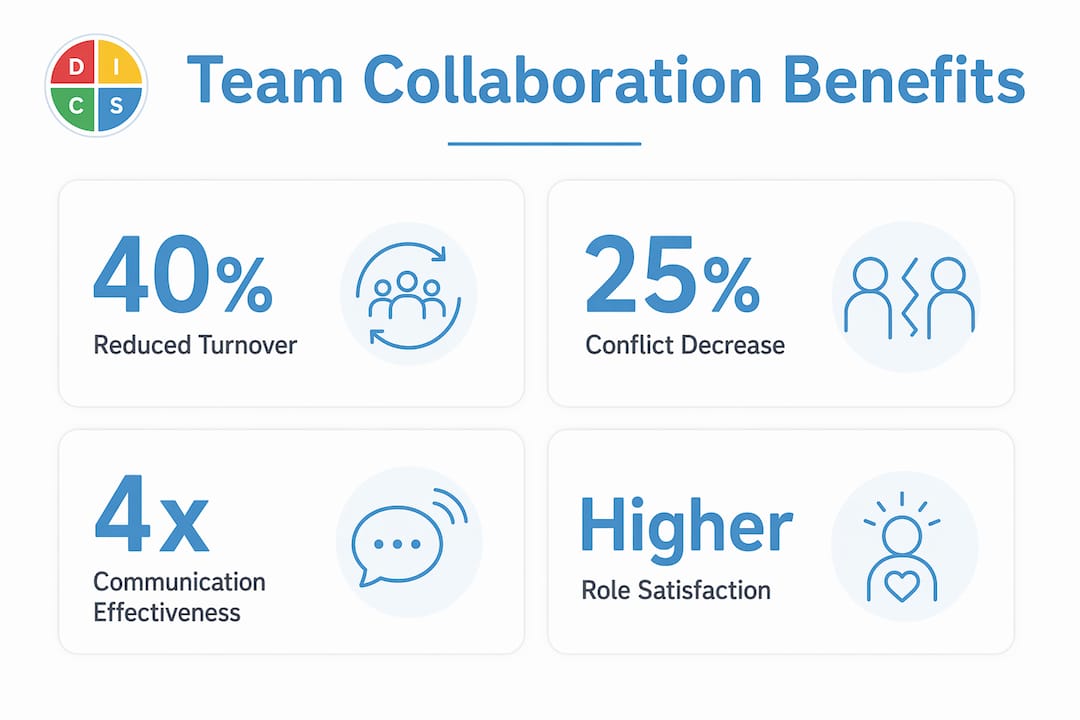
Role alignment is where the gains compound. Personality-based role alignment reduces turnover by up to 40% and boosts overall team performance. Replacing an employee costs between 50% and 200% of their annual salary, so even modest improvements in retention produce significant financial savings.
The predictive power of assessments also improves when you layer in cognitive measures. Combining personality assessments with cognitive measures reduces turnover prediction error by 18% compared to personality measures alone. This matters for team leaders who want to move beyond gut instinct and build a repeatable hiring and placement process.
Key outcomes supported by research:
- Turnover reductions of 32%–52% within 6–12 months of implementing validated assessments
- Up to 40% lower turnover when personality profiles guide role placement
- 18% better prediction accuracy when personality data is paired with cognitive screening
- Replacement costs of 50%–200% of annual salary, making accurate alignment a financial priority
Pro Tip: Start with a baseline. Before rolling out assessments, document your current turnover rate and conflict frequency. That gives you a real comparison point six months later.
How do personality assessments create a shared language for teams?
The most underrated benefit of personality profiling is not the data itself. It is the conversation the data makes possible. Personality assessments establish a shared language that reframes behavioral differences as value-neutral and complementary rather than personal conflicts. When a team member understands that a colleague's bluntness reflects a Dominance style rather than hostility, the emotional charge disappears.
"Teams with high personality diversity outperform homogeneous teams when they leverage differences for balancing innovation and execution." — research on team composition
This insight reshapes how leaders think about hiring and team building. A team full of detail-oriented, high-Conscientiousness members will produce accurate work but may struggle to generate bold ideas. Add a high-Openness, high-Extraversion member and you get creative tension that, when managed well, produces better outcomes. Personality diversity is an organizational asset that enables teams to balance innovation with execution when differences are leveraged intentionally.
Common misconceptions worth correcting:
- "Conflict means incompatibility." Personality differences predict friction points, not failure. Knowing them in advance lets teams design around them.
- "Quiet members are disengaged." High-Introversion profiles often process deeply before speaking. Mistaking reflection for disengagement costs teams their best thinkers.
- "Agreeable people are pushovers." High-Agreeableness predicts cooperation quality. Conscientiousness and agreeableness scores predict cooperation quality and reduce interpersonal conflict.
The critical caveat: assessments must be developmental, not evaluative. Personality assessments used as pass/fail evaluations cause employees to answer dishonestly, which undermines trust and invalidates results. Frame every assessment as a growth tool, not a judgment.
Pro Tip: When sharing results with your team, lead with your own profile. Vulnerability from the leader signals safety for everyone else.
What are the best practices for integrating assessment insights into daily workflows?
A personality assessment that lives in a file drawer changes nothing. Integrating personality insights into daily team workflows prevents insights from fading and maximizes their practical impact. The goal is to make personality awareness a living part of how your team operates, not a one-time workshop memory.
Here is a practical sequence for embedding insights into your team's rhythm:
- Start at project kickoff. Before assigning roles, review each member's profile. Match high-Dominance members to decision-heavy tasks and high-Conscientiousness members to quality control and documentation.
- Build communication agreements. Use assessment results to co-create norms. For example, agree that high-Introversion members get agenda items 24 hours before meetings so they can prepare.
- Reference profiles in one-on-ones. When coaching a team member through a conflict, return to their profile. Ask how their natural tendencies may be showing up in the situation.
- Revisit profiles quarterly. People grow. A team member who scored low on Extraversion two years ago may have developed new communication habits. Reassessment keeps the data current and the conversation alive.
- Use technology to surface insights in real time. AI-powered platforms can dynamically surface personality insights in real time to assist team leaders with communication and conflict resolution. This moves personality data from a static report to an active decision-support tool.
For nonprofit and volunteer teams, this integration is especially valuable. DISC assessments in volunteer settings help coordinators match people to roles that fit their natural strengths, which improves both retention and satisfaction. Personality-based volunteer matching reduces the frustration that comes from placing an introverted, detail-focused person in a high-energy, public-facing role.
Pro Tip: Create a one-page "team personality map" that shows each member's primary style. Post it where the team can see it. It becomes a reference point during conflict and a reminder during planning.
How can team leaders use personality profiles to optimize role alignment?
Role alignment is the point where personality data produces its clearest return. Predictive hiring models that incorporate personality traits are up to 10 times more accurate than unstructured screening for forecasting job success. That accuracy gap is the difference between a team that clicks and one that constantly grinds.

The DISC framework maps naturally to common team roles:
| Personality style | Natural role fit | Collaboration strength |
|---|---|---|
| Dominance (D) | Leadership, decision-making | Drives momentum and resolves ambiguity |
| Influence (I) | Stakeholder management, sales | Builds relationships and energizes groups |
| Steadiness (S) | Operations, support, mediation | Maintains consistency and calms conflict |
| Conscientiousness (C) | Quality control, analysis, compliance | Catches errors and upholds standards |
This is not a rigid assignment system. It is a starting point for honest conversations about where each person will thrive. When leaders use DISC assessments with employees, they gain a structured way to discuss communication preferences, conflict triggers, and growth edges without making it personal.
The financial logic is straightforward. A misaligned hire who leaves after eight months costs the organization real money and team momentum. A well-aligned team member who stays and grows pays dividends in institutional knowledge, trust, and output. Personality profiling is one of the most cost-effective tools a team leader has for getting alignment right from the start.
Key Takeaways
Personality assessments improve collaboration most when they are used as ongoing developmental tools, not one-time evaluations, giving teams a shared language that turns behavioral differences into collective strengths.
| Point | Details |
|---|---|
| Turnover drops with alignment | Personality-based role matching reduces turnover by up to 40% and cuts replacement costs significantly. |
| Shared language reduces conflict | Assessments reframe behavioral differences as value-neutral, lowering interpersonal friction across teams. |
| Diversity is an asset | Teams with high personality diversity outperform homogeneous teams when differences are leveraged intentionally. |
| Integration sustains impact | Embedding insights into meetings, one-on-ones, and project kickoffs keeps personality data active and useful. |
| Developmental framing is non-negotiable | Assessments used as evaluations produce dishonest answers and erode the trust they are meant to build. |
What I have learned from watching teams use personality data well and poorly
Working with teams across different sectors, I have seen personality assessments produce genuine transformation and I have seen them collect dust. The difference is almost never the quality of the assessment. It is the mindset of the leader who introduces it.
The teams that grow are the ones where the leader treats the assessment as a mirror, not a verdict. They share their own results first. They return to the data when conflict arises instead of letting tension fester. They build team agreements around what the profiles reveal, and they revisit those agreements when the team changes.
The teams that stagnate run a workshop, feel good for a week, and then go back to old patterns. Personality insights have a half-life if they are not reinforced. One-off events do not change behavior. Repeated, low-stakes references to personality data do.
The pitfall I see most often is leaders using assessments to explain away problems rather than address them. "Oh, that's just how she is" is not a use of personality data. It is an excuse dressed up in psychological language. The goal is growth, not categorization. When you use a profile to understand a person's tendencies and then coach toward their development, you are using the tool correctly.
The teams I have watched thrive are the ones that treat personality awareness as a shared practice, something woven into how they talk, plan, and resolve disagreements every week.
— Tres
Personality assessments made practical with Discassess
Discassess, backed by Prism Counseling & Coaching, offers affordable, professional DISC assessments built specifically for small businesses, nonprofits, and teams that want real results without a complex rollout.
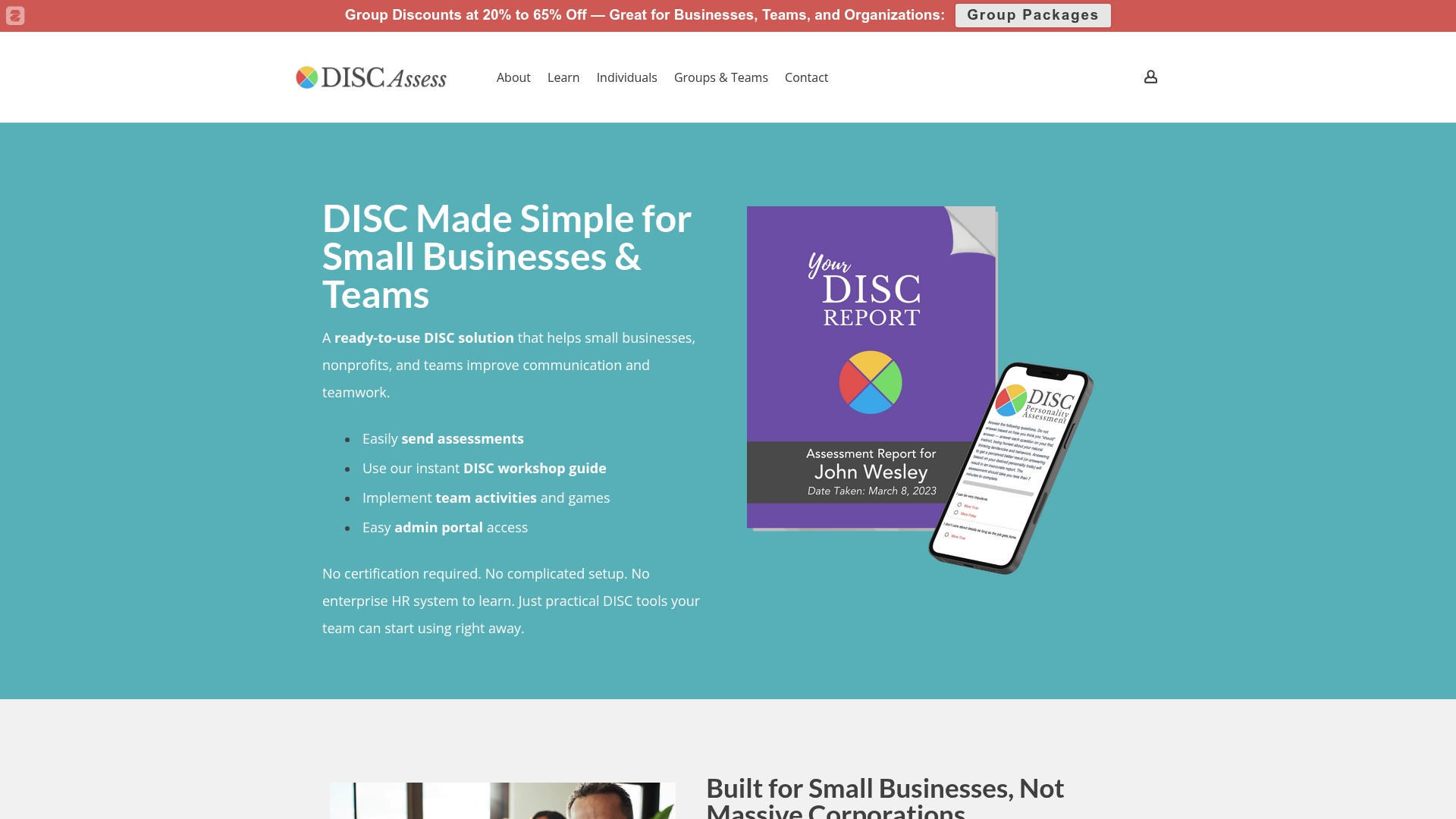
The platform gives team leaders access to detailed reports, group management tools, and printable profiles that make it easy to apply personality insights right away. Whether you are working with a staff of five or coordinating a volunteer team of fifty, Discassess has group packages and individual options that fit your size and budget. You can take the DISC assessment today and have results in hand within minutes. For teams ready to go deeper, live group training sessions help leaders apply DISC insights to real communication challenges. No certification required. No technical background needed.
FAQ
What is personality-based role alignment?
Personality-based role alignment is the practice of matching team members to positions that fit their natural behavioral tendencies. Research shows this approach reduces turnover by up to 40% and improves overall team performance.
How do personality profiles reduce workplace conflict?
Personality profiles give teams a shared language to interpret behavioral differences as predictable and complementary rather than personal. When team members understand each other's communication styles, friction decreases and cooperation improves.
Why should personality assessments be developmental rather than evaluative?
When assessments are used as pass/fail evaluations, employees answer dishonestly to score well, which invalidates the results and damages trust. Framing assessments as growth tools produces honest responses and meaningful data.
How do personality assessments help volunteer teams?
Personality-based volunteer matching places people in roles that fit their natural strengths, which reduces frustration and improves retention. Nonprofits that use DISC assessments with volunteers report better communication and more consistent engagement.
How often should teams revisit personality assessments?
Quarterly reviews are a practical standard for active teams. People grow and change, so reassessment keeps the data current and gives the team a regular touchpoint for honest conversation about communication and collaboration.
Recommended
- How the DISC Compares to 3 Other Popular Personality Assessments - DISC Assess | Affordable, Professional DISC Assessments for Small Businesses
- When the DISC is not the Right Fit: Understanding the Limitations of This Personality Assessment - DISC Assess | Affordable, Professional DISC Assessments for Small Businesses
- DISC Assess | Affordable, Professional DISC Assessments for Small Businesses - All Articles
- The Appeal of DISC: Why People Love Using This Popular Personality Assessment - DISC Assess | Affordable, Professional DISC Assessments for Small Businesses