

For most U.S. nonprofits, the most practical starting lineup of nonprofit staff development personality tools looks like this:
- DISC for team communication, onboarding, and shared behavioral language
- CliftonStrengths (Gallup) for strengths-based role alignment and growth conversations
- Big Five / OCEAN when psychometric validity and unbiased trait measurement matter most
- MBTI or Enneagram for reflective team conversations and individual self-awareness
- Hogan, SDI, or TKI for leadership pipeline work and conflict-readiness
None of these tools does its best work as a one-time report. The most effective approach is to tie each assessment to a competency-based development plan and the 70/20/10 model recommending on-the-job learning, coaching and mentoring, and formal training in proportions that emphasize actionable stretch assignments and manager check-ins, not just a folder on a shared drive.
Your practical next step: pick one use case (onboarding or a leadership check-in), run a 6–8 week pilot with one or two teams, and schedule quarterly development conversations from day one.
Table of Contents
- Which personality tools should nonprofits use for staff development?
- How do you choose the right assessment for your nonprofit?
- How do personality tools fit into real nonprofit workflows?
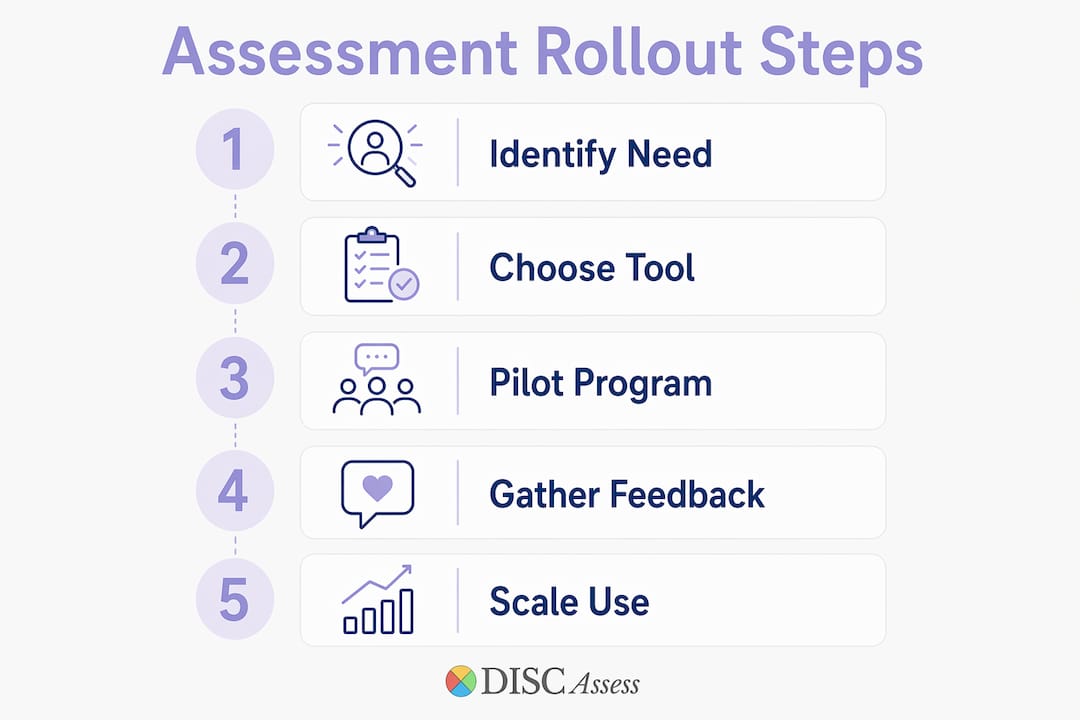
- What does a realistic rollout look like for a small nonprofit?
- What are the ethical limits and privacy risks of personality assessments?
- Discassess: a practical DISC option for small U.S. nonprofits
- Key Takeaways
- Why the "right tool" question misses the point
- Discassess makes your first DISC pilot straightforward
- Useful sources and further reading
Which personality tools should nonprofits use for staff development?
The seven instruments below cover the full range of nonprofit staff development needs. Each summary includes what it measures, the most common nonprofit application, and the honest trade-offs that affect adoption.
-
DISC measures four behavioral styles: Dominance, Influence, Steadiness, and Conscientiousness. It is the most widely used tool for onboarding and team communication because it produces immediately readable reports and a shared vocabulary that managers can apply in the next meeting. DiSC is frequently cited as practical for reducing ramp-up time and improving collaboration in small-team contexts. Group reports make it easy to map a whole department's communication styles at once. Pro: low admin burden, no certification required for basic use. Con: measures behavioral preference, not ability or values.
-
CliftonStrengths (Gallup) identifies 34 talent themes and ranks them for each individual. It is best used for role-alignment conversations, succession planning, and growth-oriented one-on-ones. Pro: strengths-based framing is motivating and mission-aligned. Con: per-user cost adds up quickly for large teams.
-
Big Five / OCEAN (Openness, Conscientiousness, Extraversion, Agreeableness, Neuroticism) is the most research-validated personality framework in academic psychology. Use it when you need defensible, unbiased trait measurement — especially for leadership selection or grant-funded program evaluations. Pro: strongest psychometric validity. Con: reports can feel abstract without a skilled facilitator.
-
MBTI assigns one of 16 personality types based on four preference dichotomies. It is most useful for reflective team workshops and individual self-awareness, though its test-retest reliability is debated in the research literature. Pro: widely recognized, easy to discuss. Con: type labels can oversimplify and should never drive hiring decisions.
-
Enneagram maps nine motivation and identity patterns. Coaches and leadership developers favor it for deep self-reflection and understanding why someone behaves a certain way under stress. Pro: rich motivational insight. Con: less standardized psychometric backing than Big Five.
-
Hogan Assessments (HPI, HDS, MVPI) are built specifically for leadership prediction. The Hogan Development Survey identifies derailers — behaviors that emerge under pressure and can undermine leadership effectiveness. Pro: strong predictive validity for managerial roles. Con: higher cost and requires certified administration.
-
SDI (Strength Deployment Inventory) and TKI (Thomas-Kilmann Conflict Mode Instrument) focus on motives and conflict-handling styles, respectively. Both are practical for mediation training, team conflict-readiness sessions, and manager coaching. Pro: highly targeted and immediately applicable. Con: narrow scope means they work best alongside a broader assessment.
Pro Tip: Before purchasing any instrument, request a sample report and ask the vendor how the output connects to observable workplace behaviors. A report that lists traits without behavioral anchors is hard for managers to use.
How do you choose the right assessment for your nonprofit?
The right tool depends on what problem you are actually trying to solve. Matching the instrument to the use case before comparing vendors saves time and budget.
Match instrument to use case:
- Onboarding and role fit: DISC or Big Five
- Team communication and conflict: DISC, SDI, or TKI
- Leadership pipeline and succession: Hogan or CliftonStrengths
- Coaching and self-awareness: Enneagram or MBTI
- Hiring and selection: Big Five (with legal counsel review — see ethics section)
Comparison dimensions to weigh:
| Dimension | What to evaluate |
|---|---|
| Best for | Team dynamics, leadership, hiring, or coaching |
| Validity / research support | Peer-reviewed backing vs. practitioner consensus |
| Ease of administration | Self-serve platform vs. certified facilitator required |
| Group reporting | Can you export team-level data? |
| Cost / licensing | Per-user, group package, or admin account model |
| Actionability | Does the report suggest specific development activities? |
| Time to rollout | Days (DISC) vs. weeks (Hogan certification) |
Vendor vetting checklist:
- Data storage location and retention policy
- Informed consent process for participants
- Certified facilitator availability or internal admin training
- Sample reports available before purchase
- Ability to export anonymized group-level metrics
- Alignment to your existing competency model
Pro Tip: Start with one clear problem — communication friction, role misalignment, or a leadership gap — and evaluate only the instruments that demonstrably address it. A low-cost pilot with one team tells you more than any vendor demo.

How do personality tools fit into real nonprofit workflows?
Assessments earn their value when they plug into existing development structures rather than sitting as standalone events. The 70/20/10 model gives you the architecture: 70% on-the-job learning, 20% coaching and mentoring, 10% formal training.
Common nonprofit use cases:
- Onboarding (Day 30): New hires complete a DISC assessment. The manager reviews the report in a 30-minute one-on-one and uses it to frame communication preferences and role expectations. This shortens the adjustment period and gives both parties a shared language from the start.
- Team communication workshops: A half-day session using DISC group reports helps a program team identify where communication styles clash and agree on norms. DISC for workplace teams provides a practical manager guide for facilitating exactly this kind of session.
- Leadership 1:1 coaching: A development director uses CliftonStrengths results to anchor quarterly coaching conversations, identifying which strengths are underused and which stretch assignments would build new ones.
- Succession planning: A leadership cohort of five senior managers completes the Hogan HDS to surface derailers. Monthly coaching sessions address the top two derailers for each person over six months.
- Conflict-resolution sessions: Two teams with recurring friction complete the TKI. A facilitated session maps each person's default conflict style and introduces alternative approaches for high-stakes disagreements.
How assessments feed professional development plans (PDPs):
Bridgespan recommends co-creating PDPs tied to defined competencies and on-the-job opportunities. Assessment results give you the diagnostic data to make that conversation specific. A DISC report showing high Steadiness and low Dominance, for example, points toward stretch assignments that build comfort with direct feedback — not a generic "leadership training" course.
70/20/10 in practice:
- 70% (on-the-job): Stretch assignments chosen based on assessment gaps — leading a cross-functional meeting, managing a difficult donor conversation, or piloting a new program component.
- 20% (coaching/mentoring): Manager check-ins that reference assessment results, peer feedback circles, or an external coach for senior leaders.
- 10% (formal training): A half-day workshop, an online course, or a facilitated assessment debrief.
Pro Tip: Vault Consulting notes that nonprofits can grow staff capability without major budget increases by embedding learning into day-to-day work and strengthening managers as coaches. The assessment is the starting point, not the destination.

What does a realistic rollout look like for a small nonprofit?
A phased approach keeps the process manageable and gives you data to refine before scaling.
Phase 1: Pre-launch (Weeks 1–3)
- Define the purpose: what problem are you solving and which competencies does it connect to?
- Secure executive sponsorship. A VCU scholarly thesis on nonprofit leadership development confirms that development efforts stall without active senior leadership integrating assessments into culture and operations.
- Select your vendor and review data privacy terms.
- Choose your pilot team (8–15 people is a workable size).
Phase 2: Pilot (Weeks 4–10)
- Administer assessments and collect results.
- Hold facilitated debriefs — either with a certified facilitator or a trained internal admin.
- Co-create PDPs for each participant, linking results to competency gaps.
- Collect participant feedback at week 10.
Phase 3: Full rollout (Months 3–9)
- Scale admin accounts and integrate assessments into onboarding and quarterly check-ins.
- Train managers to read and use reports in development conversations.
- Track metrics quarterly.
Roles and responsibilities:
- Executive sponsor: Keeps the initiative visible and resourced
- HR / project owner: Manages vendor relationship, scheduling, and data
- Certified facilitator or trained admin: Runs debriefs and group sessions
- Data steward: Oversees privacy, access controls, and anonymized reporting
Ballpark cost expectations:
| Licensing model | Typical use case | Notes |
|---|---|---|
| Single-use credits | Individual assessments, pilots | Lowest entry cost; no admin portal |
| Group package | Teams of 5–25 | Includes admin account and bulk credits |
| Admin account | Ongoing, multi-team use | Best for organizations running assessments quarterly |
| Certification / training | Hogan, MBTI, some CliftonStrengths | Adds cost; required for some instruments |
HR software for nonprofits like PerformYard can reduce administrative burden for small teams and make tracking PDP completion, goals, and review cycles practical once you scale beyond the pilot.
Metrics to track:
- PDP completion rate (quarterly)
- Manager check-in cadence (are they happening?)
- Internal engagement scores
- Retention rates for assessed cohorts vs. non-assessed cohorts
- Time-to-productivity for new hires who received an assessment at onboarding
What are the ethical limits and privacy risks of personality assessments?
Personality tools are powerful precisely because they surface things people do not always say aloud. That power requires guardrails.
Common pitfalls to avoid:
- Using assessment results in hiring decisions without legal review — this carries discrimination risk under Title VII and the ADA
- Treating assessments as one-off events rather than ongoing development inputs
- Conflating development conversations with performance reviews, which destroys psychological safety
- Labeling people by their type in ways that limit growth opportunities ("She's a high S — she won't want that role")
Ethical guardrails:
- Obtain informed consent before administering any assessment
- Make participation voluntary where possible, especially for existing staff
- Use results for development, not punishment or performance documentation
- Be transparent about who sees the data and how it will be used
Data privacy checklist:
- Where is data stored, and in which country?
- What is the vendor's data retention policy?
- Who has access to individual results — manager, HR, or both?
- Does the vendor offer anonymized group-level reporting?
- What contract clauses govern data deletion and breach notification?
Training and certification: DISC and CliftonStrengths can be administered by a trained internal admin with no formal certification. MBTI, Hogan, and some Big Five instruments require certified facilitators. The cost-benefit calculation usually favors internal training for DISC and external certification for Hogan-level work.
If you plan to use any personality assessment as part of a hiring process, consult HR legal counsel before administering it to applicants.
Pro Tip: GCN's guidance on nonprofit talent retention recommends keeping development conversations separate from performance reviews. When staff know their assessment results will not affect their annual review, they engage more honestly — and that honesty is where real growth begins.
Discassess: a practical DISC option for small U.S. nonprofits
Discassess is a Phoenix-based DISC platform backed by Prism Counseling & Coaching, built specifically for small teams, nonprofits, and individual users who want a usable assessment without a corporate-scale budget or a certification requirement.
What makes it a good fit for nonprofits:
- Simple, self-serve administration — no technical background required
- Group management features that let an admin send, track, and review assessments across a team
- Detailed, readable reports with practical communication and development guidance
- Multiple purchasing options that match different team sizes and budget cycles
Available options:
- DISC Group Package (Admin Account + Assessment Credits): the best starting point for a nonprofit running a 6–10 week pilot with a team of 5–25. The admin account lets you manage all participants in one place and access group-level reports.
- White Label DISC System: for organizations that want to brand the assessment experience for their staff or volunteers — useful for larger nonprofits or those offering DISC as part of a leadership program.
- Individual Classic DISC Assessment: single-use access with a full report — the lowest-friction entry point for a leader who wants to try DISC before committing to a group package.
How to get started:
- Choose your pilot team (one department or a leadership cohort of 5–10 people).
- Purchase a group package or admin account and set up your portal.
- Send assessments and collect results within the first two weeks.
- Schedule a facilitated debrief in week three — use the report's communication guidance as the agenda.
- Co-create a simple PDP for each participant, linking their DISC profile to one or two competency goals.
- Schedule a 30-day follow-up check-in to review progress.
For nonprofits that want DISC applied to volunteers as well as staff, Discassess's group management features handle mixed participant pools without additional complexity.
Key Takeaways
The most effective nonprofit staff development programs pair personality tools with competency-based PDPs, the 70/20/10 model, and quarterly manager check-ins — not one-off reports.
| Point | Details |
|---|---|
| Start with one use case | Pilot DISC or CliftonStrengths with one team before scaling to the full organization. |
| Link results to PDPs | Use assessment output to diagnose competency gaps and select specific stretch assignments. |
| Protect psychological safety | Keep development conversations separate from performance reviews to encourage honest growth. |
| Track simple metrics | Monitor PDP completion rate, manager check-in cadence, and retention of assessed cohorts quarterly. |
| Discassess for small nonprofits | The DISC Group Package gives small U.S. nonprofits an affordable, self-serve starting point with group reporting. |
Why the "right tool" question misses the point
Most nonprofit leaders spend too much time comparing assessment instruments and not enough time building the manager capability to use them. A DISC report sitting in an email inbox does nothing. The same report discussed in a 20-minute manager check-in, linked to a stretch assignment, and revisited 90 days later does quite a lot.
The real differentiator in nonprofit staff development is not which tool you choose — it is whether your managers know how to hold a development conversation. Assessments give them a vocabulary and a starting point. But the conversation itself, the one that separates growth from stagnation, requires a manager who is curious, consistent, and willing to make time for it. That is a cultural investment, not a software purchase.
What I have seen work consistently is this: pick the simplest tool your team will actually use, run a small pilot, and build the habit of quarterly check-ins before you worry about upgrading to a more sophisticated instrument. A well-used DISC report beats an unused Hogan every time. And when those check-ins become a normal part of how your organization operates, you will find that staff start asking for development conversations rather than waiting to be invited.
Discassess makes your first DISC pilot straightforward
If your nonprofit is ready to move from reading about personality tools to actually running one, Discassess offers the lowest-friction path to a real DISC pilot. The DISC Group Package gives you an admin account, bulk assessment credits, and group reporting in one purchase — no certification required, no long-term contract, and no need for an HR department to manage it.
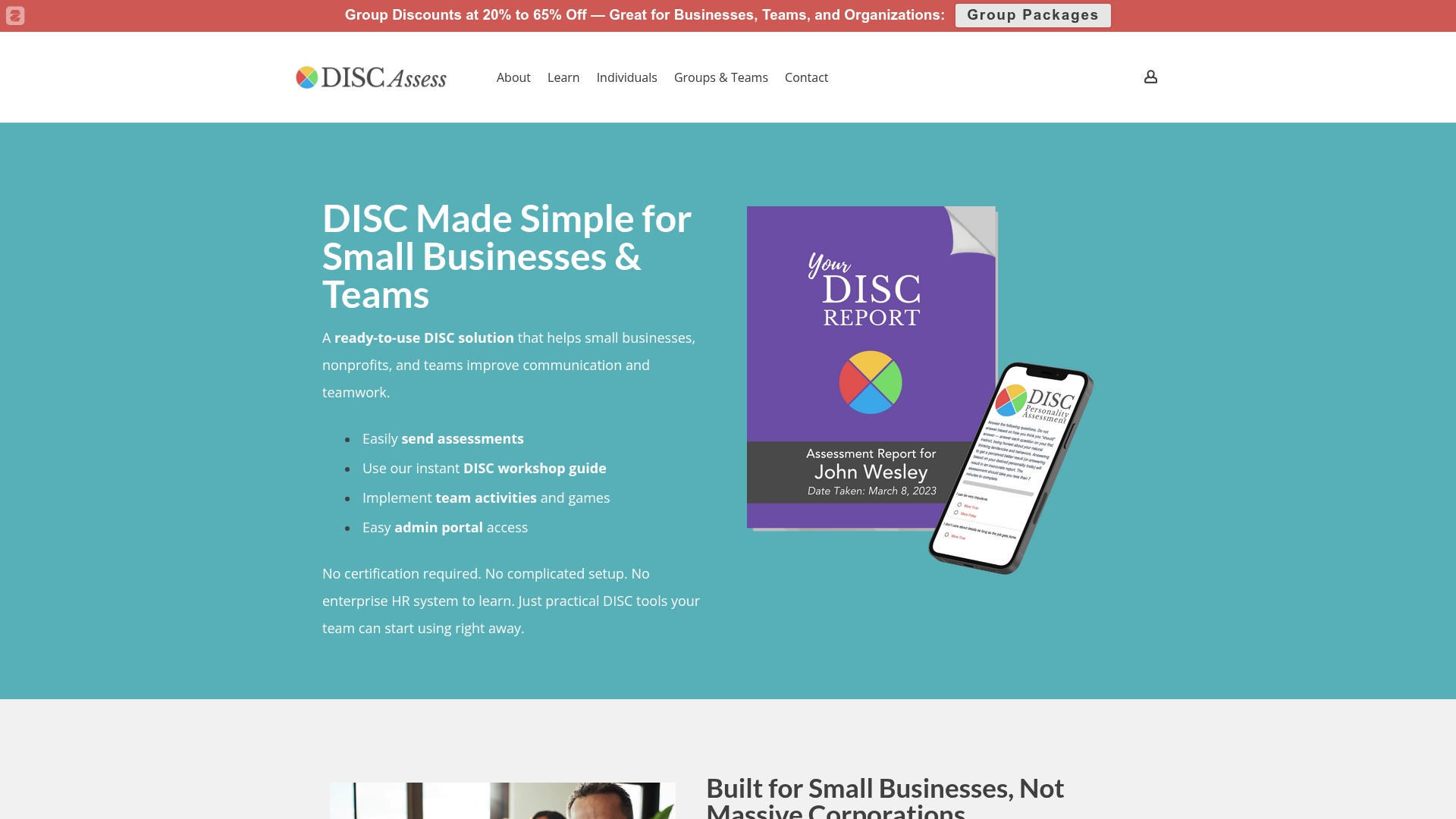
For a single leader or a small leadership team exploring DISC for the first time, the Individual Classic DISC Assessment is a $20-or-less entry point with a full report. Organizations that want to brand the experience for staff or volunteers can explore the White Label DISC System. Visit the Discassess groups page to compare options and purchase the package that fits your team size and timeline.
Useful sources and further reading
These resources support implementation planning, competency model development, PDP templates, and privacy practices for U.S. nonprofits.
- Bridgespan: How to Build Competency-Based Professional Development Plans — Start here for competency frameworks and PDP co-creation guidance. Includes practical steps for linking assessments to organizational strategy.
- Bridgespan Nonprofit Leadership Development Toolkit (PDF) — Ready-to-use templates: sample competency banks, a 70/20/10 development plan template, and rollout guidance. Download this before your pilot.
- Training Industry: The 70/20/10 Model — Concise explanation of the model and how to apply it to PDP design. Useful for training managers who are new to structured development.
- GCN: What Nonprofits Can Do to Retain Talent — Practical cadence guidance: monthly or quarterly check-ins, separation of development from performance reviews, and low-cost implementation steps.
- Vault Consulting: Nonprofit Employee Development — Low-cost capacity-building examples, manager-as-coach emphasis, and onboarding integration strategies.
- PerformYard: HR Software for Nonprofits — Consult this when you are ready to automate review cycles, track PDP completion, and generate reporting for leadership.
- Nonprofit Risk Management Center: Employee Professional Development Plans — Practical checklist for building PDPs, including how to handle skills self-assessments and budget constraints.
- VCU Scholar's Compass: Nonprofit Leadership Development (Thesis) — Academic source for the leadership sponsorship argument; useful when making the case to your board or executive director.
- Discassess blog — Ongoing practical guides on DISC application, team communication, and leadership development for small organizations.
- Simchon Productions: Why Nonprofits Need Brand Identity Films — Relevant for communications and development staff whose competency model includes public-facing storytelling and donor engagement skills.
| Source | Best for |
|---|---|
| Bridgespan Toolkit (PDF) | Competency banks and 70/20/10 PDP templates |
| GCN talent retention guide | Check-in cadence and development culture |
| Nonprofit Risk Management Center | PDP checklists and budget-conscious planning |
| PerformYard | Tracking PDP completion and automating review cycles |
| VCU thesis | Leadership sponsorship evidence for board presentations |