

Personality assessments are systematic tools that measure behavioral traits and work styles to help small business owners build stronger, more cohesive teams. Understanding why personality assessments matter for small business goes beyond the hiring process. The DISC model, Big Five personality framework, and similar behavioral science tools give you a shared language for understanding how each person on your team communicates, processes conflict, and responds to leadership. Used correctly, these tools do not screen candidates out. They help you get the most from the people already on your team.
How personality assessments improve team communication
Strong team communication does not happen by accident. Personality insights create a shared language for discussing how people prefer to give feedback, receive direction, and handle disagreement. That shared language is what makes real collaboration possible, especially in small businesses where every person's contribution carries significant weight.
The DISC model, for example, categorizes behavioral tendencies into four types: Dominance, Influence, Steadiness, and Conscientiousness. When a team member understands that their colleague is a high-S (Steadiness) type, they know to slow down, offer reassurance, and avoid abrupt changes. That single insight can prevent weeks of unnecessary friction.

Personality profiles also help with delegation. A small business owner who knows their team's behavioral tendencies can assign tasks that match each person's natural strengths. A high-D (Dominance) type thrives with autonomy and results-focused goals. A high-C (Conscientiousness) type does best with clear processes and detailed expectations.
Here is where personality data becomes especially practical for small teams:
- Conflict resolution: Understanding that two team members have opposing communication styles reframes conflict as a style difference, not a character flaw.
- Leadership awareness: Owners can recognize how their own behavioral style affects the team and adjust accordingly.
- Onboarding: New hires integrate faster when the team already has a shared vocabulary for discussing work styles.
- Meeting structure: Knowing who needs time to process versus who thinks out loud helps you run more productive meetings.
Pro Tip: Share assessment results during a team meeting and ask each person to name one way their style shows up at work. This single exercise builds more mutual understanding than most team-building activities.
Why personality tests work better after hiring, not before
The most common mistake small business owners make is using personality assessments as hiring filters. Personality tests measure style, not job capability. A candidate who scores as introverted or highly analytical is not less qualified. They simply operate differently, and that difference can be an asset in the right role.
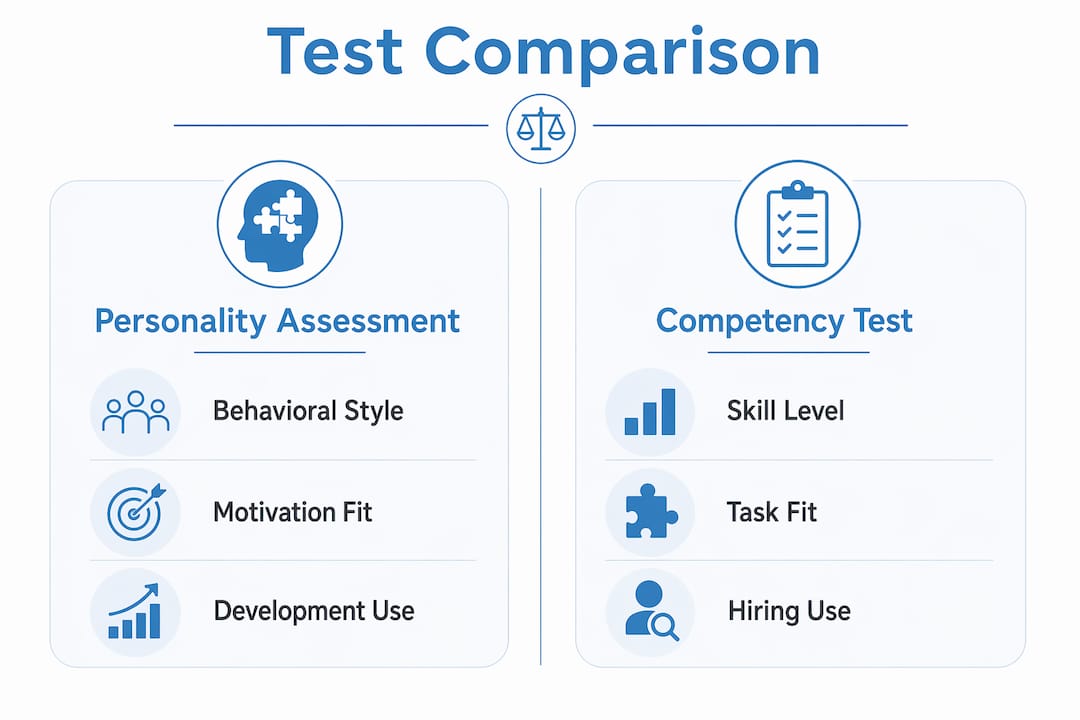
80–90% of HR experts recommend competency tests for hiring decisions and personality tests for development. That split exists for a good reason. Competency tests measure whether someone can actually do the job. Personality tests reveal how they will do it and how they will work with others once they are in the role.
Social fluency during interviews creates another risk. Likability can be mistaken for merit, and a charming candidate may outperform a more qualified but reserved one simply because they feel comfortable in the room. Research shows that conscientiousness predicts job performance more reliably than extraversion across most occupations. That finding alone should shift how you weigh personality during interviews.
| Factor | Personality assessment | Competency test |
|---|---|---|
| What it measures | Behavioral style and work preferences | Specific skills and job-related abilities |
| Best used for | Post-hire development, team dynamics | Hiring decisions and role qualification |
| Risk of misuse | Bias, exclusion of capable candidates | Narrow focus if used alone |
| Ideal timing | Onboarding, leadership development | Pre-hire screening |
Pro Tip: Use a competency test to decide who gets the job. Use a personality assessment on day one to decide how to manage, motivate, and integrate that person into your team.
How to choose affordable personality assessment tools
The personality assessment industry is worth over $5 billion, yet price does not equal quality. Many costly proprietary assessments are driven by licensing fees and paywalls, not scientific rigor. Peer-reviewed tools often match or exceed commercial assessments in validity. For small business owners watching their budget, that is genuinely good news.
When evaluating any assessment tool, look for these qualities:
- Scientific validity: The tool should be grounded in peer-reviewed research, not just branded marketing. Ask whether the assessment has been validated across diverse populations.
- Short completion time: Most quality assessments take 5–15 minutes and deliver instant digital reports. Longer assessments do not automatically produce better data, and they reduce completion rates.
- Clear, usable reports: Results should be readable by a non-HR professional. If you need a certification to interpret the output, the tool is not built for small business use.
- Data privacy: Confirm how the provider stores and uses employee data. For small businesses, this is a legal and ethical responsibility, not just a preference.
- Affordable pricing: Look for individual assessments, group packages, or unlimited membership options. Paying per assessment adds up quickly for growing teams.
The DISC model stands out as one of the most accessible and widely used frameworks for small businesses. Tools built on the DISC model, like those offered through Discassess, are designed specifically for teams without dedicated HR departments. They prioritize simplicity and immediate usability over complexity.
Pro Tip: Before committing to any assessment platform, ask whether a free or demo version is available. A free DISC assessment lets you evaluate report quality and usability before spending a dollar.
Real-world benefits: employee satisfaction and retention
Personality assessments directly improve employee satisfaction when managers use the data to personalize their leadership approach. 82% of employees want employers to see them as individuals, not just role-fillers. Assessment data gives managers a concrete way to do exactly that.
Consider a small retail business with five employees. The owner uses DISC profiles to learn that two team members are high-S types who value consistency and dislike sudden changes. When a scheduling shift becomes necessary, the owner communicates the change early, explains the reason, and offers a transition period. Both employees feel respected. Neither looks for another job.
Here is how personality data supports retention in practical terms:
- Tailored motivation: Managers learn what drives each person. High-I (Influence) types respond to recognition and social connection. High-C types respond to accuracy and mastery.
- Reduced misunderstandings: Most workplace conflict stems from style differences, not bad intentions. Assessments reframe friction as a communication gap, not a personal failure.
- Growth alignment: When you understand someone's natural tendencies, you can offer development opportunities that fit how they actually learn and grow.
- Stronger onboarding: New team members who receive assessment results on day one integrate faster and feel seen from the start.
Personality tools are most powerful post-hire when combined with strong interviewing and ongoing coaching. The assessment is not a verdict. It is a starting point for a better conversation between you and your team.
Key Takeaways
Personality assessments deliver the most value for small businesses when used after hiring, not as screening filters, because they reveal how people work best together rather than whether they can do the job.
| Point | Details |
|---|---|
| Use assessments post-hire | Personality tools support onboarding, development, and conflict resolution, not candidate screening. |
| DISC model is accessible | The DISC framework gives small teams a shared language for communication and leadership without requiring HR expertise. |
| Conscientiousness predicts performance | Research shows conscientiousness is the most reliable personality predictor of job success across most roles. |
| Affordability is achievable | Peer-reviewed tools often match costly proprietary assessments in validity, making quality accessible on a small business budget. |
| Personalization improves retention | Using assessment data to tailor management approaches helps employees feel seen, reducing turnover. |
What I have learned from watching small businesses use assessments
Small business owners tend to fall into one of two traps with personality assessments. They either ignore them entirely, assuming they are only for large corporations, or they treat results as fixed labels that define what a person can and cannot do. Both approaches miss the point.
The most effective owners I have seen use assessment results as conversation starters. They share their own profile first, which signals vulnerability and invites honest dialogue. They revisit results during one-on-one meetings, not just during onboarding. They ask questions like, "Does this still feel accurate to you?" That kind of ongoing engagement turns a one-time report into a living tool.
The other mistake I see regularly is using personality data to justify a hiring decision that was already made on gut feeling. That is backwards. The assessment should inform how you lead someone, not rationalize why you chose them. When you separate those two functions, the tool becomes genuinely useful.
My honest advice: pair every assessment with at least one structured conversation about the results. A report sitting in a folder helps no one. A report discussed openly with a team member builds trust, improves communication, and gives that person a sense that their individuality matters to you. That is worth more than any hiring algorithm.
— Tres
Discassess makes personality assessments practical for small teams
Small business owners often assume professional-grade personality assessments are out of reach financially. Discassess was built specifically to change that assumption.
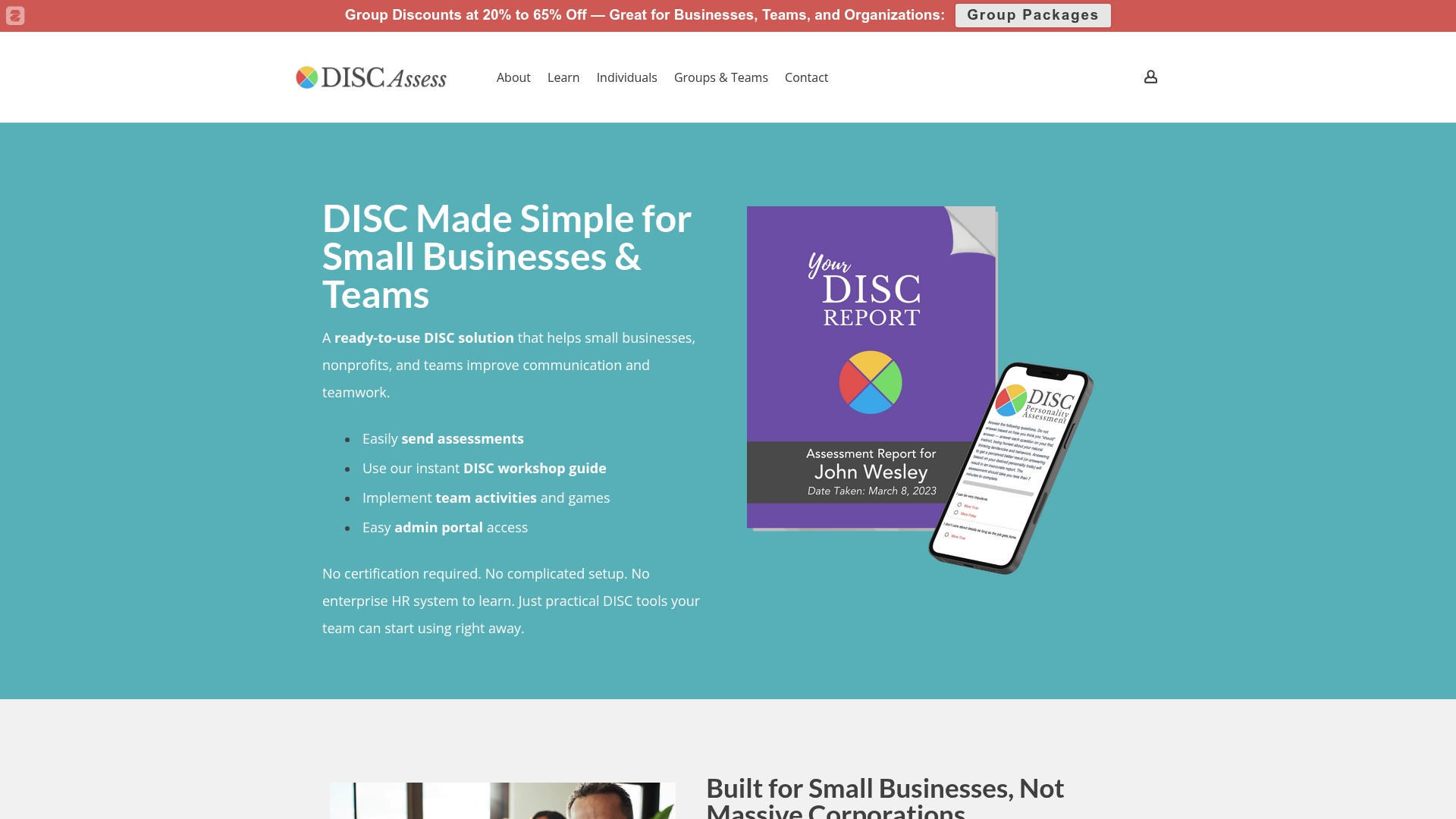
Backed by Prism Counseling and Coaching with over a decade of experience, Discassess offers DISC assessments designed for teams without HR departments or large training budgets. You get printable profiles, group management tools, and detailed reports that are readable without a certification. Whether you are assessing a team of three or thirty, the platform scales to your needs. You can explore the full platform through a demo admin account before committing, or have your team take a DISC assessment today and see the results for yourself.
FAQ
What are personality assessments used for in small businesses?
Personality assessments measure behavioral traits and work styles to improve team communication, conflict resolution, and leadership development. They are most effective when used after hiring, not as screening tools.
Is the DISC model reliable for small business teams?
The DISC model is one of the most widely used and accessible behavioral frameworks available. It gives small teams a shared language for understanding communication preferences without requiring HR expertise or certification.
How long does a personality assessment take to complete?
Most quality assessments take 5–15 minutes and deliver instant digital reports. Short completion times improve participation rates and produce more accurate results than lengthy, fatigue-inducing formats.
Can personality assessments help reduce employee turnover?
Yes. When managers use personality data to tailor motivation, communication, and growth opportunities, employees feel recognized as individuals. That sense of being seen is a proven factor in job satisfaction and retention.
Are affordable personality assessments scientifically valid?
Price does not determine quality. Peer-reviewed tools frequently match or exceed costly proprietary assessments in scientific validity. Small business owners should prioritize tools grounded in research over those with high price tags driven by licensing fees.
Recommended
- DISC Assess | Affordable, Professional DISC Assessments for Small Businesses - All Articles
- Blog - DISC Assess | Affordable, Professional DISC Assessments for Small Businesses
- When the DISC is not the Right Fit: Understanding the Limitations of This Personality Assessment - DISC Assess | Affordable, Professional DISC Assessments for Small Businesses
- How the DISC Compares to 3 Other Popular Personality Assessments - DISC Assess | Affordable, Professional DISC Assessments for Small Businesses