

Personality is the single most consistent predictor of how team members communicate, make decisions, and handle conflict together. The role of personality in team building goes far beyond hiring for "culture fit." It shapes daily interactions, determines who speaks up in meetings, and explains why two equally skilled employees can clash or collaborate with equal intensity. Research confirms that personality composition predicts performance, particularly when teams balance traits like Conscientiousness and Agreeableness. Understanding those differences is not a soft skill. It is a leadership discipline.
What personality frameworks matter most for team building?
Two frameworks dominate applied team building: the Big Five model and the DISC model. Each serves a different purpose, and knowing when to use which one gives you a real advantage.
The Big Five, also called the OCEAN model, measures five broad traits:
- Openness reflects curiosity and comfort with new ideas. High scorers drive creative problem-solving.
- Conscientiousness measures reliability and follow-through. High Conscientiousness is the strongest single-trait predictor of team execution quality.
- Extraversion describes social energy and assertiveness. Extraverts tend to dominate verbal communication.
- Agreeableness captures cooperation and empathy. Teams high in Agreeableness resolve conflict faster.
- Neuroticism reflects emotional stability. High Neuroticism under pressure can erode team trust quickly.
The DISC model takes a behavioral approach, grouping tendencies into four styles: Dominance (results-focused, direct), Influence (relationship-focused, expressive), Steadiness (process-focused, patient), and Conscientiousness (detail-focused, analytical). DISC does not measure personality depth the way Big Five does. Instead, it gives teams a shared, practical language for daily communication.
| Framework | Best Use Case | Core Strength |
|---|---|---|
| Big Five (OCEAN) | Research-backed hiring and role design | Predicts long-term performance and fit |
| DISC | Team communication and conflict resolution | Builds shared behavioral language fast |

Both frameworks help leaders map team member strengths and identify gaps before they become friction points. The most effective teams use DISC for day-to-day communication and Big Five data for role design decisions.
Pro Tip: Run a DISC assessment before a major project launch, not after conflict appears. Knowing styles in advance prevents misreads from becoming grudges.
Why does personality diversity strengthen teams?
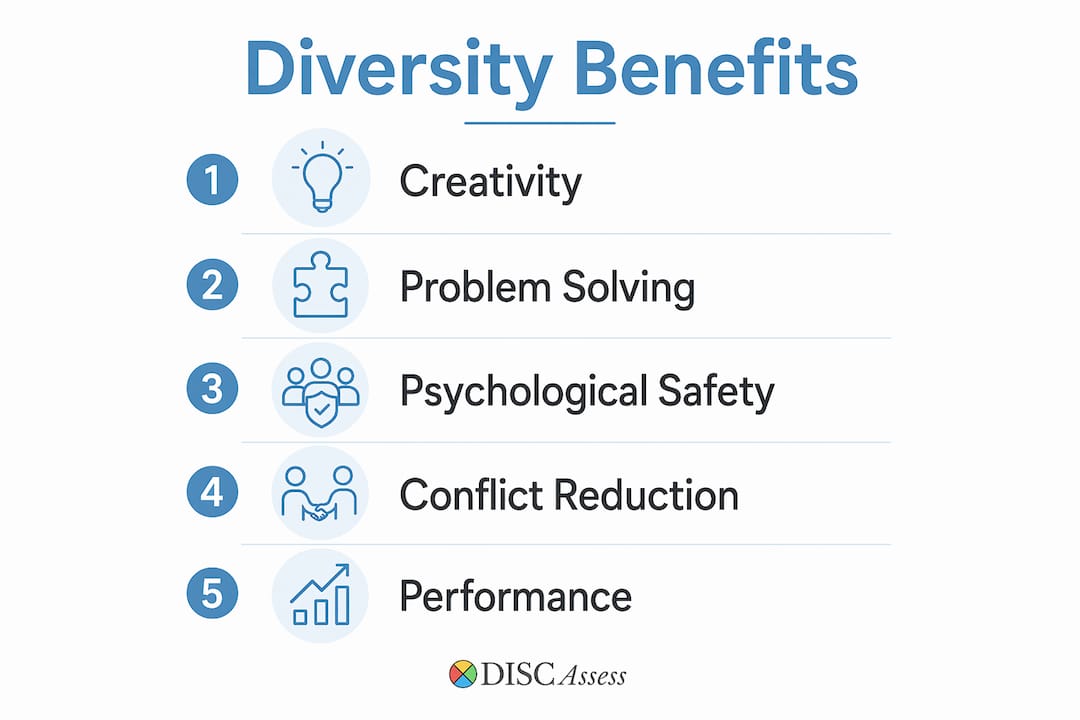
Personality diversity is not just a feel-good concept. High-performing teams show approximately 35% better personality-diversity balance compared to underperforming teams. That gap reflects real differences in how teams generate ideas, weigh risks, and reach decisions.
The mechanism is straightforward. When a team contains only one dominant personality style, it develops blind spots. An extravert-heavy group, for example, is vulnerable to the HiPPO effect, where the Highest Paid Person's Opinion wins by default rather than by merit. Introverts in that same room often hold the most carefully considered views but stay quiet when the social pressure to agree is high. A mixed team surfaces those quieter perspectives before a decision locks in.
Personality diversity reduces groupthink not by creating conflict, but by making it structurally harder for one voice to dominate. The goal is not disagreement for its own sake. It is ensuring that every relevant perspective reaches the table before the decision is made.
Diversity also fuels creativity. Teams with varied Openness scores approach problems from genuinely different angles. A high-Openness member challenges assumptions while a high-Conscientiousness member pressure-tests the plan. Together, they produce outcomes neither would reach alone.
Psychological safety mediates these benefits. Without it, personality diversity increases friction rather than performance. Leaders who invest in psychological safety, through consistent feedback norms, clear conflict protocols, and genuine listening, convert personality differences from a liability into a competitive advantage.
Pro Tip: After any major team decision, ask each member to share one concern they did not voice in the meeting. This single habit surfaces suppressed perspectives and builds the psychological safety that makes diversity work.
What are the common pitfalls in using personality for team building?
The biggest mistake leaders make is treating personality assessments as permanent labels. A DISC profile describes behavioral tendencies under typical conditions. It does not define a person's ceiling or predict how they will perform in every situation. Labeling someone as "a D" and routing all decisions through that lens limits both the individual and the team.
A second pitfall is mismatching diversity to task type. Diverse teams excel in creative tasks but too much diversity can hamper routine execution. A product brainstorm benefits from wide personality range. A compliance audit does not. Applying the same team composition to both phases creates unnecessary friction during execution.
Watch for these specific traps:
- Ignoring the minimum Conscientiousness rule. One low-Conscientiousness member can degrade overall team output, even when every other trait is balanced. Execution reliability requires a baseline across the whole team.
- Over-relying on self-reported data. Personality assessments reflect how people see themselves, not always how they behave under stress. Validate assessment results against observed behavior over time.
- Using personality to avoid hard conversations. "She's just a high-S, she doesn't like conflict" is not a conflict resolution strategy. Personality explains behavior. It does not excuse it.
Pro Tip: Match your team's personality diversity to the project phase. Maximize diversity during ideation. Tighten for execution by assigning clear ownership to your highest-Conscientiousness members.
How can leaders apply personality insights to improve team dynamics?
Practical application starts with building a team personality map. A team personality map visualizes collective profiles, showing where the group clusters and where it has gaps. If your map shows five high-Dominance styles and no high-Steadiness, you know before the project starts that process management and patience will be weak spots.
Here is a four-step process for applying personality insights in real teams:
- Assess every team member. Use a validated framework like DISC to establish a baseline. Discassess offers group assessment packages with admin tools that make this straightforward for teams of any size.
- Build the team personality map. Plot each member's dominant style and note where the team has coverage gaps. A team heavy in Influence and Dominance styles will likely underinvest in detail and process.
- Run a personality workshop. Bring the team together to share results and discuss how each style shows up in daily work. A shared personality framework gives teams a common language that reduces misinterpretation and improves morale.
- Assign roles by phase. Route creative and strategic work toward high-Openness and high-Influence members. Assign execution and quality control to high-Conscientiousness members. Revisit assignments as the project evolves.
Conflict resolution also improves when personality is part of the conversation. When a high-D and a high-S clash over pace, naming the personality dynamic shifts the conversation from personal to professional. Situational leadership that adapts along a directive to non-directive continuum works the same way. A leader who adjusts their style to meet each team member's needs gets more from every personality type.
You can also use personality awareness in staff meetings to structure participation. Give introverts written pre-work before discussions. Give extraverts a defined speaking window. These small adjustments produce more balanced input without requiring anyone to change who they are.
Key Takeaways
Personality-based team building works when leaders treat it as an ongoing practice, not a one-time assessment event, and match personality diversity deliberately to task type and team phase.
| Point | Details |
|---|---|
| Personality predicts performance | High Conscientiousness and Agreeableness are the strongest trait predictors of team output. |
| Diversity improves decisions | Teams with balanced personality styles show approximately 35% better performance than homogeneous groups. |
| Task fit matters | Maximize personality diversity during creative phases; tighten it during routine execution to reduce friction. |
| Shared language reduces conflict | A common personality framework helps teams reframe behavioral differences with empathy rather than frustration. |
| Psychological safety is required | Personality diversity increases risk without it; structured feedback norms convert that risk into performance. |
Personality in teams is a practice, not a profile
My honest view is that most leaders use personality assessments exactly once and then file the results. That is the single biggest waste in organizational development. Personality data has a shelf life measured in years, not weeks. The teams I have seen grow the most are the ones that revisit their profiles quarterly, not just at onboarding.
The second thing I have learned is that adaptive leadership is the real skill. Knowing your team's personality map is only useful if you actually change how you lead based on it. A high-Steadiness team member needs consistency and advance notice. A high-Dominance member needs autonomy and clear outcomes. Treating both the same way is not fairness. It is inattention.
Personality diversity also requires an investment in psychological safety that most organizations underestimate. You cannot ask people to bring their full selves to a team and then punish them when their style creates friction. The friction is the point. It is where the best ideas come from, if you have built the container to hold it.
Use personality assessments as tools for empathy, not as labels for limitation. The goal is not to sort people into boxes. It is to help your team understand each other well enough to do their best work together. That is a worthy and ongoing pursuit.
— Tres
Build stronger teams with Discassess group assessments
Discassess makes personality-informed team building accessible for HR professionals, team leaders, and organizational development specialists who want real results without a complex rollout.
The DISC group package from Discassess includes assessment credits and an admin portal, so you can manage your entire team's results in one place. Detailed reports give each member clear, practical insight into their behavioral style. The platform is built for teams that want to move from assessment to application quickly, without requiring certification or technical expertise. Backed by Prism Counseling & Coaching, Discassess brings over a decade of experience to every group package it offers.
FAQ
What is the role of personality in team building?
Personality shapes how team members communicate, resolve conflict, and make decisions together. Teams that understand and account for personality differences consistently outperform those that ignore them.
Which personality traits matter most for team performance?
Conscientiousness and Agreeableness are the strongest predictors of team performance, based on a meta-analysis of 42 studies. A minimum level of Conscientiousness across all members is required for reliable execution.
What is a personality-based teamwork strategy?
A personality-based teamwork strategy uses validated frameworks like DISC or Big Five to assign roles, structure communication, and resolve conflict based on each member's natural behavioral tendencies. It treats personality data as an ongoing leadership tool, not a one-time hiring filter.
Can too much personality diversity hurt a team?
Yes. Excessive diversity increases coordination friction in routine, high-stakes execution tasks. The most effective approach matches diversity level to task type, maximizing it during creative phases and reducing it during structured execution.
How does knowing coworker personality improve morale?
A shared personality framework gives teams a common language for behavioral differences. That shared language reduces misattribution of intent, which is one of the most common sources of workplace frustration and low morale.