

Office collaboration personality awareness is the conscious practice of recognizing and adapting to diverse personality traits and work styles to improve communication, reduce conflict, and strengthen team productivity. The DISC model, a four-type behavioral framework used widely in workplace settings, gives managers and teams a shared language for understanding why people work, communicate, and respond to pressure differently. Research confirms that teams leveraging cognitive differences transform tension into productive traction rather than letting it stall progress. For small to mid-sized organizations, this kind of awareness is not a luxury. It is the foundation of a team that actually works well together.
What personality types matter most for office collaboration?
The most widely used framework for mapping team dynamics is the four-type personality model: Drivers, Analyticals, Expressives, and Amiables. Each type focuses on a different priority. Drivers want results. Analyticals want accuracy. Expressives want ideas and energy. Amiables want cooperation and harmony. When a manager understands these priorities, communication friction drops because disagreements can be traced back to style differences rather than bad intentions.
Beyond the four-type model, researchers have mapped out eight distinct work personalities, each with natural strengths and real blind spots. A team heavy on big-picture thinkers may generate strong ideas but struggle with follow-through. A team full of detail-oriented personalities may execute well but resist change. Balancing personality types prevents these blind spots and supports every phase of work, from ideation to execution. The goal is not to label people. The goal is to build a team where every critical work activity has someone naturally suited to it.

Recognizing collaboration personality types also changes how you read conflict. Two people arguing about a project timeline are often not arguing about the timeline at all. One person may need certainty before moving forward (Analytical), while the other is ready to act on instinct (Driver). When you name the style difference, the argument loses its personal charge. That shift alone can change the entire tone of a team meeting.
Here are the most common personality-driven friction points in office teamwork and what drives them:
- Driver vs. Amiable: Drivers push for speed and decisions; Amiables need consensus and can feel steamrolled.
- Analytical vs. Expressive: Analyticals want data before acting; Expressives want to brainstorm first and refine later.
- Expressive vs. Driver: Both are assertive, but Expressives want recognition while Drivers want outcomes.
- Amiable vs. Analytical: Both are reserved, but Amiables avoid conflict while Analyticals avoid ambiguity.
Understanding these patterns helps you anticipate friction before it becomes a problem. You can use tools like DISC personality profiles to map your team and make these patterns visible to everyone.
How can teams build collective emotional intelligence?
Collective emotional intelligence is the shared ability of a team to read its own mood, manage unspoken tension, and respond to pressure without fracturing. This is different from individual emotional intelligence. One emotionally aware person on a team does not automatically make the team emotionally aware. The whole group must develop that sensitivity together.
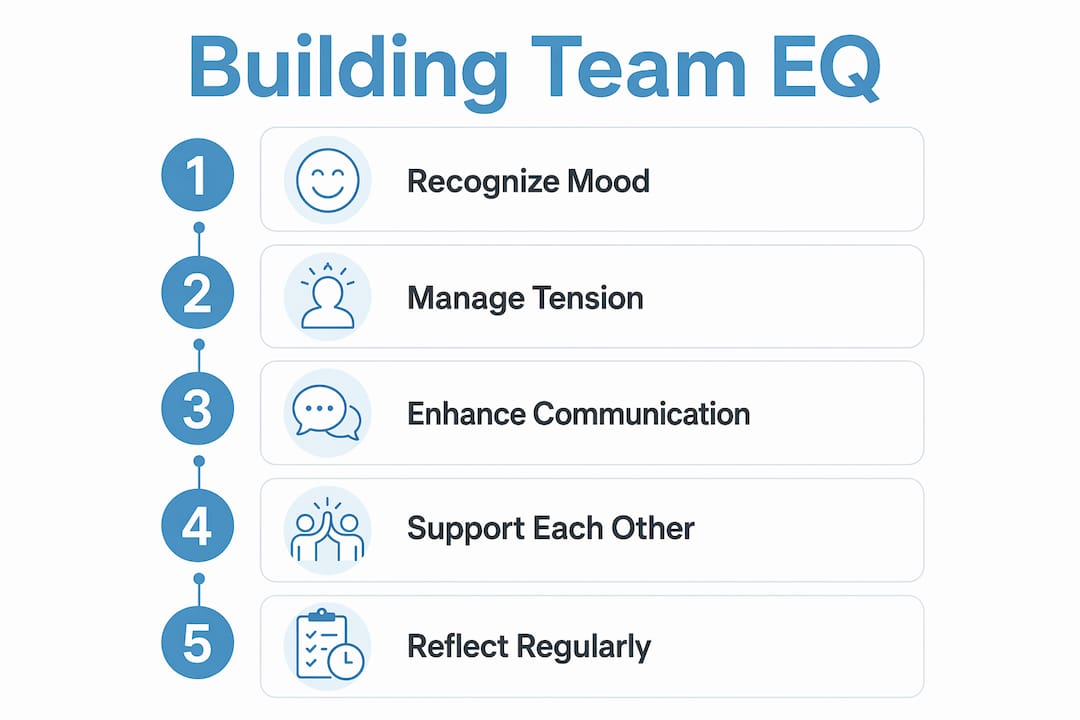
The TESI model (Team Emotional and Social Intelligence) outlines seven skills teams need to function well. These skills include team identity, motivation, emotional awareness, communication, stress tolerance, conflict resolution, and positive mood. Collective emotional intelligence enables teams to read the room and sustain energy under pressure, which is exactly what small office teams need when deadlines pile up or a project hits a wall.
Building these skills takes deliberate practice. A team that never talks about how it is feeling will not suddenly become emotionally aware during a crisis. Regular check-ins, even brief ones at the start of a meeting, build the habit of noticing group energy. When a manager asks "How is everyone showing up today?" before diving into the agenda, that question signals that emotional awareness is part of how the team operates.
- Name the team's current mood. Start meetings with a one-word check-in. This takes two minutes and surfaces tension before it derails the work.
- Identify unspoken patterns. If the same person goes quiet every time a certain topic comes up, that silence is data. Address it privately and with care.
- Respond to stress as a team. When pressure rises, acknowledge it collectively rather than expecting individuals to manage it alone.
- Celebrate recovery, not just success. Teams that recognize how they bounced back from a hard week build resilience faster than teams that only celebrate wins.
Pro Tip: After a difficult meeting, send a brief follow-up message acknowledging the tension and naming one thing the team did well. This small act builds psychological safety over time.
What practical steps implement personality awareness in daily teamwork?
Personality awareness does not live in a one-time workshop. It lives in the daily habits and routines of how a team communicates, plans, and resolves disagreement. The most effective approach combines structured sessions with small, repeatable practices.
Quarterly working agreement sessions of about 30 minutes give teams a regular opportunity to review how they are working together and address personality friction before it compounds. These sessions are not performance reviews. They are design conversations. The team asks: "Are our meeting formats working for everyone? Are quieter members getting space to contribute? Are we moving too fast or too slow for different people's comfort?"
The table below outlines four practical strategies, the personality need each one addresses, and how to apply it:
| Strategy | Personality need addressed | How to apply it |
|---|---|---|
| Silent writing before discussion | Introverts and Analyticals need processing time | Give 5–10 minutes of quiet writing before open discussion |
| Rotating meeting facilitators | Expressives and Drivers dominate; others withdraw | Assign facilitation by rotation to balance airtime |
| Personality-first conflict reframe | All types benefit from depersonalized disagreement | Ask "Is this a style difference?" before escalating conflict |
| Quarterly working agreements | All types need clarity on team norms | Hold 30-minute sessions each quarter to review team dynamics |
Silent writing in meetings is one of the most underused tools in office teamwork. Giving team members 5–10 minutes to write their thoughts before discussion levels the playing field. Introverts and Analyticals, who process internally, arrive at the conversation with their ideas already formed. Expressives and Drivers, who tend to think out loud, often produce better ideas when they slow down first.
Pro Tip: When a conflict surfaces in a team meeting, pause and ask: "Could this be a difference in how we each prefer to work rather than a disagreement about the work itself?" That one question shifts the conversation from blame to curiosity.
Personality-first conversations replace blame with mutual recognition. When a manager says "I know you prefer to have all the details before committing, and I tend to decide faster. Let's find a middle point," that acknowledgment builds trust. It also models the kind of self-awareness you want every team member to develop.
What challenges arise when applying personality awareness to office teamwork?
The most common mistake teams make is treating personality types as fixed boxes. Personality awareness works when it opens up understanding. It fails when it becomes a reason to dismiss someone. "Oh, that's just how Analyticals are" is not awareness. It is a shortcut that stops growth.
Psychological safety is the top factor driving team performance beyond individual personalities. Teams with personality-first conversations resolve conflicts faster by reframing disagreements as style differences rather than character flaws. Without psychological safety, personality discussions feel threatening rather than helpful. People worry they will be judged or limited by their type.
Here are the most common challenges and how to address them:
- Pigeonholing: Remind the team that personality types describe tendencies, not ceilings. People grow, adapt, and show up differently in different contexts.
- Blind spot gaps: If your team skews heavily toward one type, cover work type gaps by assigning roles that stretch people or by bringing in a collaborator with a complementary style.
- Resistance to personality discussions: Some team members find personality frameworks uncomfortable or reductive. Start with low-stakes activities, like a team quiz or a group discussion about communication preferences, before introducing formal assessments.
- Surface-level application: Knowing your type is not enough. The real work is in applying that knowledge to specific interactions. Pair assessment results with concrete behavioral agreements.
The DISC assessment works best when it is introduced as a growth tool, not an evaluation. When team members feel safe exploring their own tendencies, they become more willing to understand others.
Key Takeaways
Office collaboration improves most when teams treat personality differences as assets to be used, not obstacles to be managed.
| Point | Details |
|---|---|
| Use a shared framework | The four-type model (Drivers, Analyticals, Expressives, Amiables) gives teams a common language for style differences. |
| Build collective emotional intelligence | The TESI model's seven skills help teams read group mood and manage pressure together, not just individually. |
| Make it a routine | Quarterly working agreement sessions and silent writing practices embed personality awareness into daily team life. |
| Prioritize psychological safety | Teams resolve conflict faster when disagreements are framed as style differences rather than personal failures. |
| Avoid pigeonholing | Personality types describe tendencies, not limits. Treat them as starting points for growth, not permanent labels. |
Why personality awareness is the most underused team skill
Most managers I work with know their own personality type. Far fewer have built a team culture where that knowledge actually changes how people interact day to day. That gap is where most collaboration problems live.
The insight I keep coming back to is this: leveraging personality differences is not the same as identifying them. A team can complete a personality assessment, post the results on a whiteboard, and then go right back to the same patterns. Real change happens when the team agrees to use that knowledge in specific moments, like when a conflict starts, when a meeting loses energy, or when a decision needs to be made and people are stuck.
I have also seen teams get tripped up by the idea that personality awareness means everyone needs to change. It does not. It means everyone needs to understand. A Driver does not need to become an Amiable. But a Driver who understands that their Amiable colleague needs a moment to process before committing will get better results from that relationship. That is not a personality change. That is wisdom.
The teams that grow the most are the ones willing to keep the conversation going. One assessment, one workshop, one retreat is not enough. The goal is a team culture where personality awareness becomes second nature, where people naturally ask "How does this land for you?" and mean it.
— Tres
Discassess tools to support your team's growth
Discassess, backed by Prism Counseling & Coaching, gives small and mid-sized teams a practical path to personality awareness without the complexity of enterprise platforms. Whether you are a manager running a team of five or a nonprofit coordinator working with volunteers, the tools are built to be used right away.
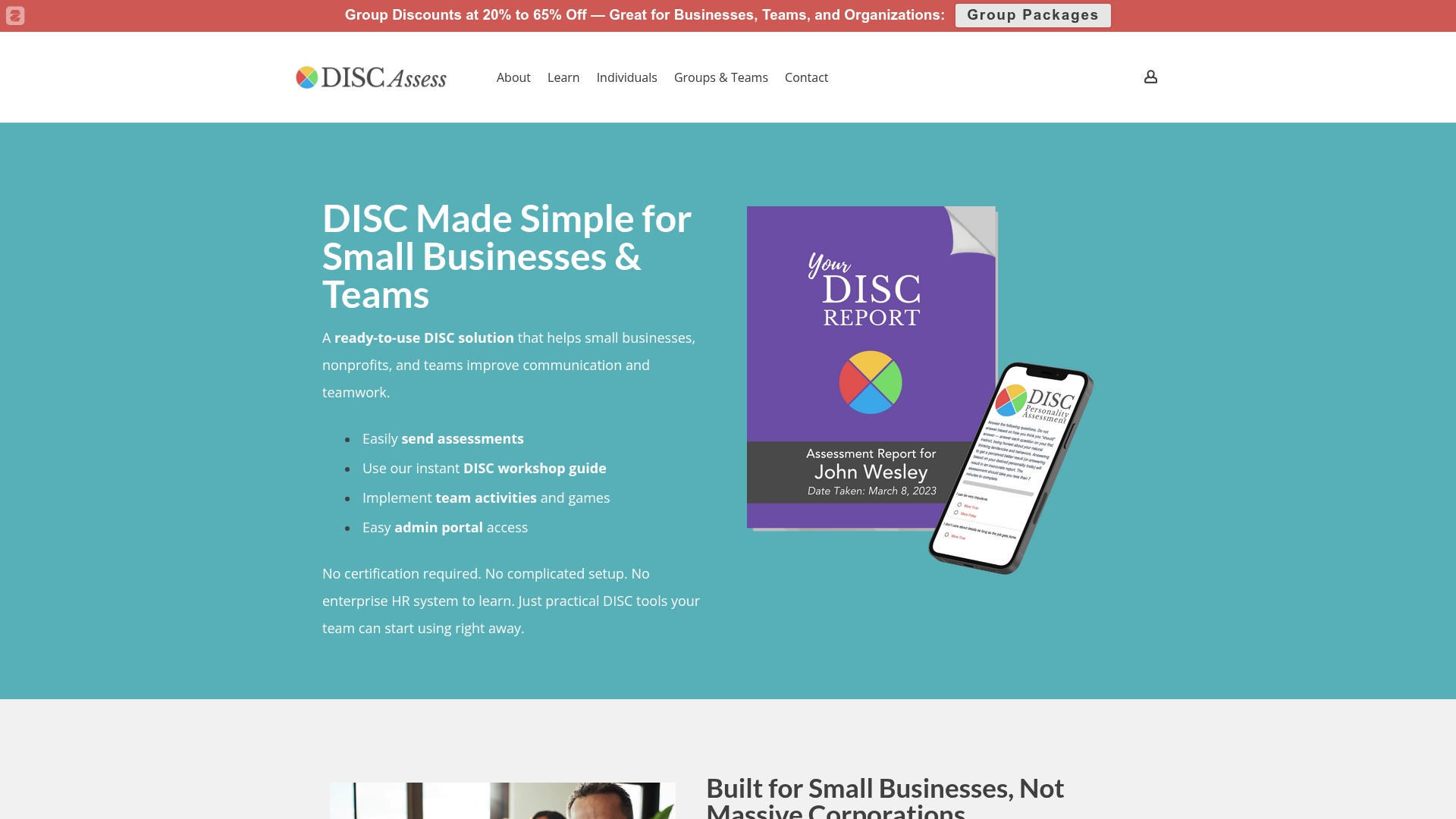
The DISC Admin Account lets you manage assessments, track results, and build group reports in one place. Live group training sessions walk your team through their results together, turning data into real conversation. Printable profiles make it easy to share personality insights in workshops, team meetings, or one-on-one coaching. For teams ready to go deeper, the self-guided team training option gives you a structured path at your own pace.
FAQ
What is office collaboration personality awareness?
Office collaboration personality awareness is the practice of recognizing how different personality types affect communication, decision-making, and conflict within a team. It uses frameworks like DISC to give teams a shared language for understanding work style differences.
Which personality framework works best for small office teams?
The four-type model (Drivers, Analyticals, Expressives, Amiables) is widely used and easy to apply without HR expertise. DISC assessments build on this model and are designed for teams of any size.
How does personality awareness reduce workplace conflict?
Personality-first conversations reframe disagreements as style differences rather than personal conflicts. Teams that use this approach resolve friction faster and with less damage to working relationships.
What is the TESI model?
The TESI (Team Emotional and Social Intelligence) model outlines seven skills, including emotional awareness, communication, and stress tolerance, that teams need to build collective emotional intelligence and function well under pressure.
How often should teams revisit personality awareness practices?
Quarterly working agreement sessions of about 30 minutes are effective for reviewing team dynamics and adjusting collaboration norms. Regular check-ins keep personality awareness active rather than letting it fade after an initial assessment.
Recommended
- The Appeal of DISC: Why People Love Using This Popular Personality Assessment - DISC Assess | Affordable, Professional DISC Assessments for Small Businesses
- How to Use the DISC Personality Assessment with Employees - DISC Assess | Affordable, Professional DISC Assessments for Small Businesses
- DISC Personality Assessment | Prism Counseling & Coaching - DISC Assess | Affordable, Professional DISC Assessments for Small Businesses
- DISC Assess | Affordable, Professional DISC Assessments for Small Businesses - All Articles