

Open an individual profile PDF, a group or team report, and a facilitator supplement first. Those three sample types reveal whether a DISC product will actually serve HR, coaching, or team development. A disc report translates behavioral tendencies into practical guidance, and previewing these three formats before you buy tells you whether that guidance is clear enough to use. Discassess maintains a working sample catalog built for exactly this kind of evaluation.
TL;DR:
- Preview sample reports matching your intended use, including individual, paired, group, facilitator, or role-specific formats, to identify clarity and relevance before buying.
- Ensure reports include actionable guidance, such as specific behavior suggestions and practical communication tips, not just personality descriptions.
- Confirm facilitator resources like scripts, discussion prompts, and group material are included, especially for team or workshop use.
- Check for export options or group-level reporting capabilities to support scaling from small teams to larger organizations.
- Verify the clarity of access and costs in samples, and ask vendors if facilitator or group reports are included with standard licenses.
Table of Contents
- Disc Report Examples Worth Downloading Before You Buy
- What a Disc Report Actually Contains
- A Checklist for Judging Sample Reports Before You Commit
- How Discassess's Sample Reports Map to Real Use Cases
- Reading Sample Reports With Clients: A Practitioner's Note
- Preview Discassess's Sample Reports and Get Started
- Where to Go Next
- Sources
Disc Report Examples Worth Downloading Before You Buy
Before committing to any provider, pull the formats that mirror how you'll actually use the assessment. Each sample type answers a different question, and skipping one usually means finding out its weaknesses after you've already paid for a group license.
- Individual profile sample. This is the foundation document, and most vendors lead with it because it's the easiest to preview. Look for a behavioral graph, a plain-language summary, and at least one page of coaching or workplace recommendations. If you're evaluating for one-on-one coaching or a single hire, this sample alone tells you 80% of what you need.
- Comparison or paired-profile sample. These reports place two people's graphs side by side, usually with a section on friction points and shared ground. They matter most for hiring decisions between finalists or for coaching a manager through a difficult working relationship. Not every vendor offers this format, so check for it specifically if you plan to use DISC in promotion or succession conversations.
- Group reports. A team-level sample shows the composite culture of a department, often with a visual map plotting every member's style. Some publishers bundle a printable poster with this report, useful for posting in a break room or referencing during a workshop kickoff. Group samples matter most when your goal is team development rather than individual coaching, since they surface communication gaps a single profile can't show.
- Facilitator supplements. These are built for the person running the debrief, not the person being assessed. A good facilitator sample includes a script, suggested discussion prompts, and notes on common misreadings of each style. If you're a coach or trainer running sessions for others, this is the sample that tells you whether the vendor actually supports live facilitation or just hands you a PDF and walks away.
- Job-match or role-fit samples. A smaller number of vendors publish samples tied to specific roles, sales or customer service, for example, mapping natural styles against role demands. These are worth downloading if your evaluation centers on hiring rather than existing-team development.
Publishers like Wiley, which produces Everything DiSC, maintain official sample libraries precisely because buyers expect to preview before purchasing. Training hubs echo the same practice, offering downloadable sample reports across most of these formats so buyers can compare before committing to a license.
What a Disc Report Actually Contains
A DISC report is a document that translates raw assessment answers into behavioral insight across four styles: Dominance, Influence, Steadiness, and Conscientiousness. Reports typically move from data to interpretation to action, and a strong disc profile example makes that progression easy to follow on the first read.
Pro Tip: Flip straight to the action-steps page before reading anything else. If a sample report can't turn a personality label into a concrete behavior change, the full version won't either.
Here's what to expect page by page:
- The graph. Most reports plot two lines, natural style and adapted style, showing how someone behaves under normal conditions versus how they shift under workplace pressure. A wide gap between the two lines often signals stress or role mismatch worth discussing in a debrief.
- The style label. Reports typically summarize results into one of four primary styles or a blended label like "DI" or "SC." Comprehensive reports go further, sorting results into 12 recognized combination styles for more precise interpretation.
- Interpretation pages. These cover strengths, likely development areas, and blind spots the person may not recognize in themselves.
- Practical guidance. The best samples include a "so now what" section, translating results into communication tips, conflict-handling advice, and specific coaching actions rather than leaving the reader to guess.
- Delivery extras. Many vendors bundle posters, group visual maps, or facilitator notes alongside the core PDF to support workshop use.
A report that stops at "you are a D" without a single action step is a report that wastes a purchase.
A Checklist for Judging Sample Reports Before You Commit
Run every sample through the same six checks, in this order, before you decide a vendor is worth a group license.
- Practicality first. Does the sample include specific action steps, or does it stop at description? A report that names a tendency without a corresponding behavior suggestion isn't finished doing its job.
- Audience fit. Match the sample format to your actual use, coaching, hiring, team development, or workshop facilitation, rather than judging a report against a use case you don't have.
- Readability. Read one full page aloud. If it sounds like a psychology textbook, your team members won't retain it either.
- Facilitator resources. Confirm whether scripts, debrief notes, and group materials come standard or cost extra. Some vendors gate this content behind admin-only access, so ask directly rather than assuming.
- Scalability signals. Check whether the sample hints at export options or group-level reporting. A provider with no visible path to a team report will be a poor fit once your program grows past a handful of people.
- Access and cost clarity. Note which pages appear in the public preview versus which are locked behind an admin login. This tells you what you're actually paying to unlock.
Pro Tip: Ask any vendor directly whether their sample group and facilitator reports are included with a typical license or sold as an add-on. Training hubs report this varies widely, and it's the single most common surprise buyers run into after purchase.
How Discassess's Sample Reports Map to Real Use Cases
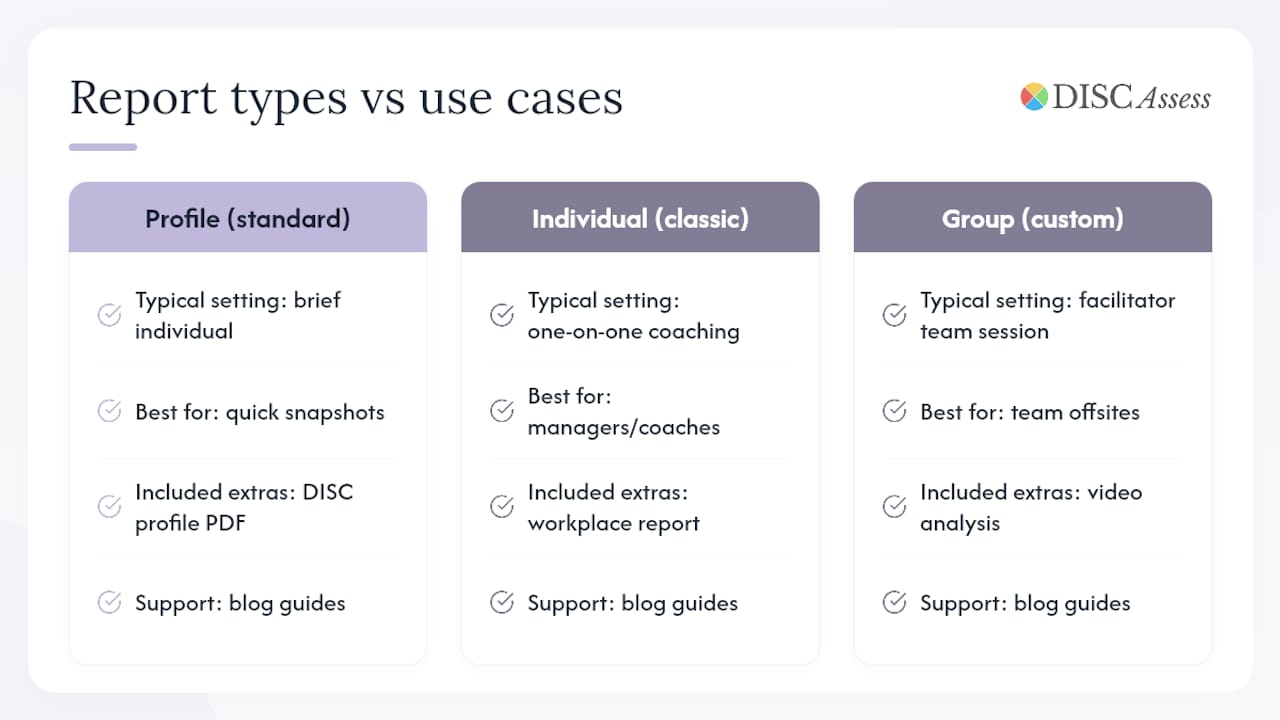
Discassess offers sample formats that mirror the priority list above almost exactly: an individual profile from the standard DISC personality assessment, a classic individual report for straightforward workplace use, and a custom group report paired with video analysis for facilitator-led sessions.
That pairing matters for a specific reason: a PDF alone rarely changes behavior. Discassess backs its samples with blog resources that walk through reading DISC reports with coaching clients and applying results in real settings, including volunteer onboarding at small nonprofits. A manager running a one-on-one coaching conversation, a nonprofit onboarding a new volunteer, and a facilitator running a full team session each pull a different sample from the same catalog.
Pro Tip: If you coach one person at a time, start with the classic individual sample. If you're planning a team offsite, request the custom group report sample instead, it's built for exactly that setting.
Reading Sample Reports With Clients: A Practitioner's Note
I've watched a single individual profile change the entire tone of a coaching session once a client saw their adapted-style line spike under the natural line. That gap became the whole conversation.
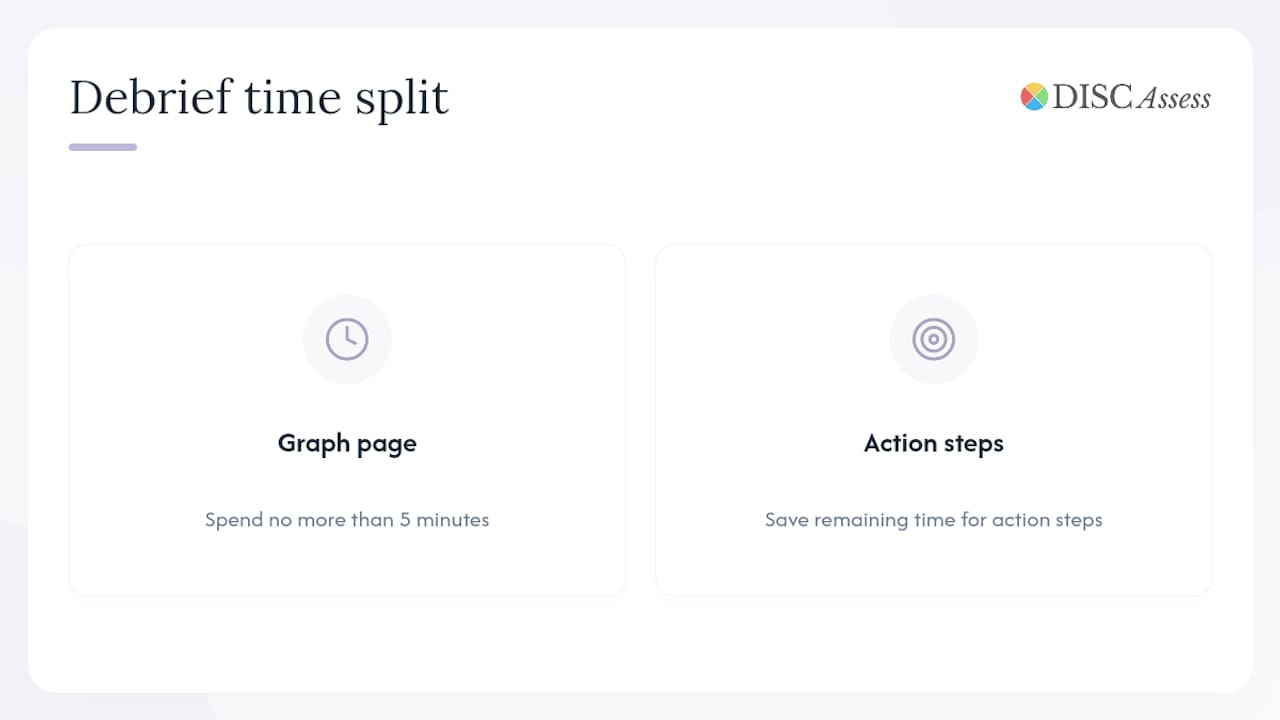
Spend no more than five minutes on the graph page. Save the remaining time for the action-steps section, since that's what the client actually walks away remembering. For a fuller coaching workflow, Discassess's leadership coaching guide walks through structuring an entire debrief session around a sample report.
— Tres
Preview Discassess's Sample Reports and Get Started
Discassess gives you a faster, less complicated path to the same report types covered above, without the enterprise pricing or certification requirements many traditional DISC providers demand. The Individual Classic DISC assessment mirrors the standard individual sample discussed earlier, while the custom group report with video analysis gives facilitators the team-level view and coaching walkthrough that many providers charge extra for or lock behind admin access.
If you run volunteer teams, Discassess's group tools pair well with resources on personality-based staff development for nonprofits, and if role fit is your priority, the campaign leadership qualities guide is a useful companion for matching styles to volunteer roles. Preview the online DISC personality assessment and report today and see for yourself whether the format fits your team before you buy a single license.
Where to Go Next
For deeper reading, review Indeed's breakdown of the four DISC styles and 12 subtypes, browse Discassess's article library, or explore sample facilitator reports from established training hubs.
Sources
- The 4 DISC personality types (Plus 12 styles) | Indeed
- Wiley - Everything DiSC
- Sample Everything DiSC Reports • disc training hub