

When a personality clash surfaces on your team, do three things immediately: document the observable behaviors (with dates and specific impacts), separate the individuals for private one-on-one conversations, and set a 24–48 hour stabilization plan that includes temporary interaction rules and a follow-up check-in. Personality conflict costs U.S. employers an estimated $359 billion in lost work hours annually, and most of that loss is preventable with a structured manager response. Frameworks like the Big Five and DISC help explain why these clashes happen, and tools like Discassess give teams a neutral vocabulary to work through them. The checklist below gets you started right now.
Immediate stabilization checklist:
- Stop public interactions that are fueling the tension (reassign seating, adjust meeting groupings temporarily)
- Preserve evidence: write down dates, the exact actions you observed, and the project impact
- Schedule separate, private manager-led check-ins within 24 hours of identifying the clash
Table of Contents
- How do you resolve workplace personality clashes in the first 48 hours?
- Why do personality clashes happen? The research-backed explanation
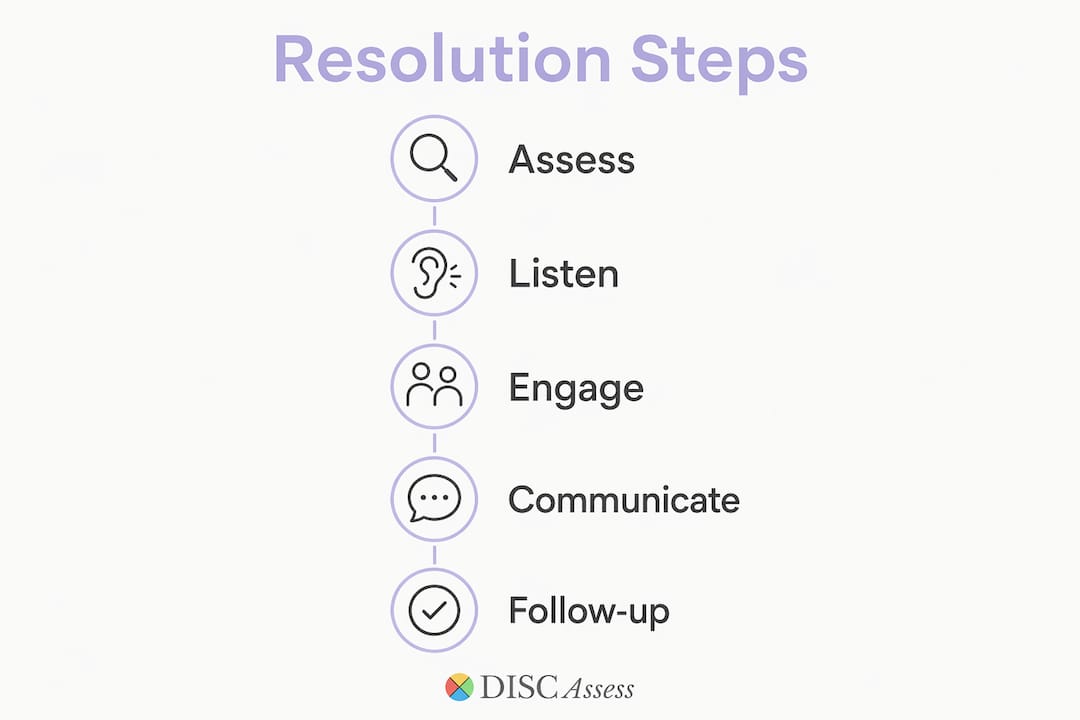
- The step-by-step manager process for lasting resolution
- When should you escalate to HR or external mediation?
- What tools and interventions actually help?
- How do you prevent personality clashes from recurring?
- Key Takeaways
- The part most managers underestimate
- Discassess helps you move from insight to agreement
- Useful sources for managers
How do you resolve workplace personality clashes in the first 48 hours?
Move quickly, but do not rush into a joint conversation before you have facts. Your first priority is to reduce exposure — meaning fewer shared spaces and fewer opportunities for the friction to play out in front of the team.
In each private check-in, ask open questions and listen more than you speak. What you are collecting is behavioral evidence: specific dates, specific actions, and the concrete effect on work. Avoid language that assigns motive or character ("she's just difficult"). Write down what you heard after each conversation, not from memory later.
Pro Tip: Open every private check-in with this script: "I want to understand what's been happening from your perspective. Can you walk me through a specific situation — what was said or done, and how it affected your work?" This keeps the conversation behavior-focused and non-accusatory from the first sentence.
If the tension is visible enough to affect the team's rhythm, send a brief, neutral message: "We're adjusting how a few tasks are coordinated this week to keep things running smoothly. I'll follow up with each of you individually." No drama, no detail. The goal is to protect psychological safety while you gather facts.
Why do personality clashes happen? The research-backed explanation
Most chronic workplace conflict is not about bad intentions. It comes from stable working-preference gaps: one person processes information quickly and decides fast; another needs time to review data before committing. Neither approach is wrong. They are simply incompatible behavioral drives running in the same space without a translation layer.

The DISC framework and the Big Five personality model both map these patterns clearly. A high-Dominance person (fast, direct, results-focused) paired with a high-Conscientiousness person (thorough, accuracy-driven, cautious) will generate predictable friction around decision speed and quality standards — not because either is failing, but because they are each mitigating risk from opposite ends of the spectrum.
| Common Friction Pairing | Core Tension | Working-Preference Language |
|---|---|---|
| High-D vs. High-C (DISC) | Speed vs. accuracy | "Prefers fast execution" vs. "prefers full data review" |
| High extraversion vs. low extraversion | Collaboration vs. focus time | "Energized by group work" vs. "needs uninterrupted blocks" |
| Big-picture vs. detail-oriented | Vision vs. precision | "Focuses on the 'what if'" vs. "focuses on the 'what could go wrong'" |
Reframing the clash this way matters practically. When you describe someone as "difficult," you invite defensiveness. When you say "she prefers high-speed execution and he prefers more data before deciding," you open a problem-solving conversation.
The step-by-step manager process for lasting resolution
This sequence moves from preparation through follow-up and is designed to produce a working agreement, not just a temporary ceasefire.
- Prepare (Day 1–2). Collect your behavioral documentation. Identify the specific pattern: what triggers the friction, which projects it affects, and what the measurable impact has been. Set private meetings with each person.
- Meet individually (Day 2–3). Name the observed behavior and its impact without assigning blame. Use this structure: "On [date], when [specific action happened], the result was [specific work impact]. I'd like us to find a way to handle that differently." Document the meeting: date, attendees, exact examples discussed, and any initial commitments.
- Bring the parties together (Day 4–7). Only after both individuals have been heard separately. The goal is a co-designed working agreement: explicit rules for how they will communicate, make decisions, and flag tension before it escalates. Examples: "We agree to use written agendas for shared projects" or "We agree to a 24-hour review window before finalizing decisions."
- Document the agreement. Record the date, both names, the specific behavioral commitments, and the timeline for review. Objective records protect everyone and make coaching conversations evidence-based.
- Follow up at 30, 60, and 90 days. Short check-ins: Are the agreements holding? Have there been new incidents? Adjust the working agreement if the situation has changed.
Short-term success looks like: fewer interruptions in shared meetings, on-time deliverables on joint projects, and improved responses on any team psychological safety pulse check you run.
When should you escalate to HR or external mediation?
Not every clash is a manager-level problem. Some situations require formal organizational intervention, and recognizing that boundary early protects both your staff and your organization.
Escalate immediately when you observe any of the following:
- Bullying or intimidation: repeated targeted behavior that humiliates or undermines a specific person
- Discrimination or harassment: any behavior tied to a protected class (race, gender, religion, disability, etc.)
- Credible threats: any statement or action that suggests physical harm
- Persistent high-conflict patterns: the clash has affected multiple team members or recurred after a documented resolution attempt
- Impaired wellbeing: an employee reports anxiety, fear, or inability to perform their role
When you escalate, send HR your dated documentation, your meeting notes, and any witness statements. Keep your own language factual and behavioral throughout. Your role at that point is to hand over a clear record, not to adjudicate the outcome. For teams navigating protracted conflict, employee wellbeing support can also help individuals process the stress that lingers even after a formal resolution.
What tools and interventions actually help?
The right tool depends on where you are in the process.
- Personality assessments (awareness stage): Short, validated tools like a DISC assessment give teams a neutral vocabulary. When someone can say "I'm wired for high-C, so I need more lead time on decisions," it removes the personal charge from the conversation. Assessment results used as neutral language shift the discussion from character judgments to operational fixes.
- Structured mediation (reframing stage): Short, structured mediation outperforms ad hoc "work it out" directives for persistent clashes because a neutral facilitator moves the conversation from positions to underlying needs. Use this when the manager-led process has stalled or when the power dynamic between the two individuals makes a manager-facilitated joint meeting difficult.
- Skills training (prevention stage): Active listening, feedback delivery, and communication-style flexibility training reduce the frequency of future clashes. These are most effective when delivered to the whole team, not just the two people in conflict.
- Role adjustments (immediate relief): Temporarily separating task ownership reduces daily friction while the deeper work happens. Assign an accuracy-checker role to the high-C person on a fast-moving project; give the high-D person ownership of the execution timeline.
Ethical implementation matters: assessments should be voluntary, results kept confidential, and findings interpreted with a trained facilitator rather than used as labels. Discassess's group packages include admin tools and facilitation resources designed with exactly those guardrails in mind.
How do you prevent personality clashes from recurring?
Prevention lives in the routines you build before the next clash appears.
Team-level norms to establish:
- A written communication agreement (who gets email vs. a quick message vs. a meeting)
- Decision protocols that specify when the team decides fast and when it iterates
- Meeting rules that protect both high-extraversion and low-extraversion preferences (e.g., agenda distributed 24 hours in advance; no open-ended brainstorms without a defined close)
"Practical checklists and team personality reviews help leaders assign missing roles — such as audit or pioneering — and lower interpersonal friction before it becomes conflict." — Discassess: Staff meeting team personality review
As a manager, your own style creates blind spots. Leaders wired for high speed unconsciously reward fast movers and penalize careful thinkers. Conscious flexing — slowing your communication rhythm for a high-C team member, giving a low-extraversion person written questions before a meeting — improves fairness and reduces friction. A team personality review built into your quarterly rhythm, using assessment summaries as a shared language, keeps these habits active rather than reactive. You can also use corporate team-building activities to reinforce norms in a lower-stakes setting after a resolution.
Key Takeaways
Resolving workplace personality clashes requires behavior-focused documentation, a structured five-step manager process, clear escalation criteria, and team-level norms that prevent recurrence.
| Point | Details |
|---|---|
| Document behaviors, not character | Record dates, specific actions, and work impacts — objective records protect everyone and make coaching evidence-based. |
| Follow the five-step process | Prepare, meet individually, co-design agreements, document, and follow up at 30/60/90 days. |
| Know when to escalate | Bullying, discrimination, harassment, or persistent impairment requires HR involvement, not more manager coaching. |
| Build prevention into routines | Explicit communication norms, decision protocols, and quarterly personality reviews reduce future friction. |
| Discassess supports the full process | Individual DISC reports and group packages give teams neutral vocabulary and facilitation resources to turn insights into working agreements. |
The part most managers underestimate
There is a pattern worth naming honestly: most managers wait too long, then move too fast. They tolerate the friction for weeks, and when they finally act, they call both people into a room together and ask them to "work it out." That approach almost never produces a durable agreement. It produces a temporary truce, and the same clash resurfaces three months later with more history behind it.
What actually works is slower at the front end and faster at the back. Separate conversations first. Behavioral language throughout. A written agreement that both people helped design. Then follow-up that treats the agreement as a living document, not a one-time fix.
The other thing worth saying: your own wiring is part of this. If you are a fast-moving, results-oriented manager, you will naturally find the high-C person on your team slower than necessary. That instinct is not a character assessment of them. It is your behavioral code reading theirs as a mismatch. The managers who resolve these clashes most effectively are the ones who can see their own tendencies clearly enough to set them aside during the process.
Discassess helps you move from insight to agreement
Personality clashes do not resolve themselves, but they do respond to the right tools used well. Discassess offers individual DISC reports and group assessment packages that give managers exactly what the playbook above calls for: a neutral, validated vocabulary that shifts team conversations from blame to behavioral awareness.
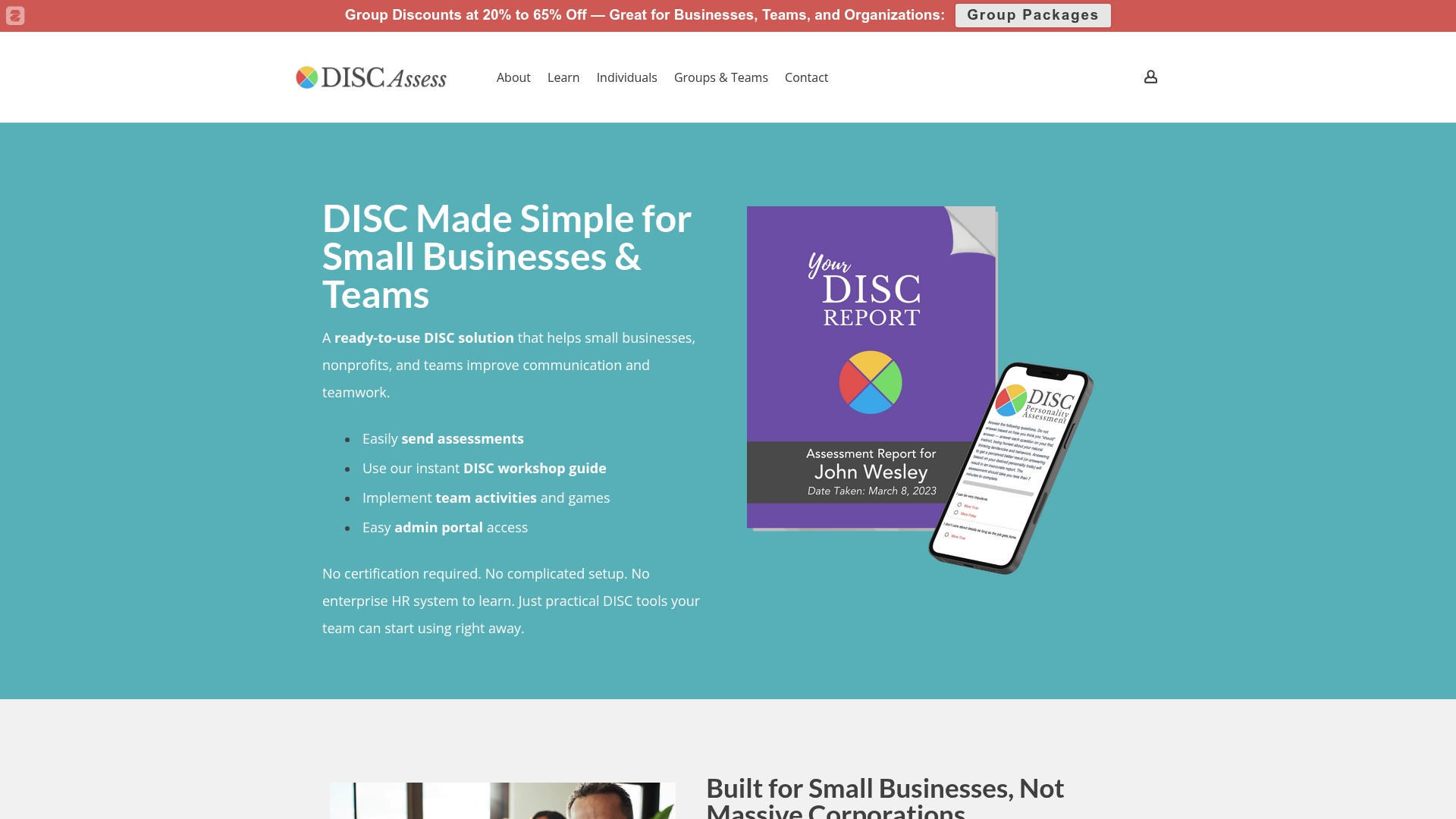
For a manager running a one-on-one resolution process, a single DISC Personality Assessment and Report gives you and the individual a shared language before the joint meeting. For teams needing a broader rollout, the Individual Classic DISC Assessment and group admin tools let you manage multiple assessments, track results, and facilitate a team review without needing a certification or an outside consultant. Discassess is built for small teams and nonprofits that need practical results without a complex implementation. Take the first step: run an individual assessment today and bring a common language into your next conversation.
This article is general information for educational purposes. For situations involving legal, HR, or clinical concerns, consult a qualified professional or your organization's HR department.
Useful sources for managers
- How Do I Manage a Personality Conflict on My Team? — Inc.com (Alison Green): Practical guidance on documentation and behavioral language for manager-led conflict conversations.
- Personality Conflicts at Work — JobCannon: Covers the DISC conflict matrix and a five-step resolution framework with concrete behavior pairings.
- Managing Personality Conflicts in the Workplace — NeuroLaunch: Source for the $359 billion annual cost figure and structured mediation guidance.
- What Are Workplace Behavioral Tendencies — Elevating Everyone: Explains behavioral tendency frameworks and their role in reducing personal blame.
- Personality-Based Conflict Resolution — Discassess Blog: Practical guide to assessment-led resolution with templates and facilitation notes.
- Staff Meeting Team Personality Review — Discassess Blog: Meeting scripts and a facilitated review template for quarterly personality-awareness sessions.
- How Personality Assessments Improve Team Collaboration — Discassess Blog: Evidence and steps for rolling out assessments and converting results into working agreements.
- Coworker Conflict Resolution Checklist for Managers — Discassess Blog: A manager checklist and documentation templates that map directly to the step-by-step process.
- Personality Differences at Work — Hey Compono: Research-backed framing on how personality differences create signaling errors and team gaps.
- It's Not Personality, It's Wiring — Meraki Consulting: Deep explanation of behavioral opposition and how managers can reframe and leverage differences.
- How To Deal With Personality Conflicts At Work — WorkPeace: Covers communication strategies, HR escalation criteria, and conflict prevention practices.