

Personality-based conflict resolution is the practice of addressing interpersonal disagreements by understanding how individual personality traits shape conflict behavior and then adapting your approach accordingly. Most chronic workplace tension arises from stable personality differences, not poor intentions or bad professionalism. That reframe matters because it shifts the goal from "fixing" a difficult person to designing better interactions. The stakes are real: personality conflicts cost U.S. employers about $359 billion annually in lost productivity. Understanding what is personality-based conflict resolution, and applying it well, is one of the most practical skills you can develop for work and life.
What is personality-based conflict resolution?
Personality-based conflict resolution is the recognized practice of using personality frameworks, such as the Big Five traits or the Thomas-Kilmann conflict mode model, to identify why two people clash and to design responses that work for both. The standard industry term for this broader field is personality-informed conflict management. Both phrases describe the same core idea: conflict is not random. It follows predictable patterns rooted in how people are wired.
The Big Five personality traits, which are Openness, Conscientiousness, Extraversion, Agreeableness, and Neuroticism, each predict how a person enters and exits conflict. The Thomas-Kilmann model maps five conflict styles, which are competing, collaborating, compromising, avoiding, and accommodating, along two axes: assertiveness and cooperativeness. Together, these frameworks give you a shared language for what is actually happening when tension rises.
This approach works because it depersonalizes the problem. When you can name a pattern rather than blame a person, the conversation changes. You move from "she is impossible" to "her high conscientiousness and my low agreeableness create a predictable friction point." That shift opens the door to real resolution.
How do personality traits influence conflict behaviors and styles?
Personality traits directly shape how people engage with conflict, often before they are even aware of it. Agreeableness predicts conflict style with notable consistency: low agreeableness links to competing, while high agreeableness links to accommodating or avoiding. That means two people with opposite agreeableness scores will almost always experience friction when a disagreement arises, not because either is wrong, but because their defaults pull in opposite directions.
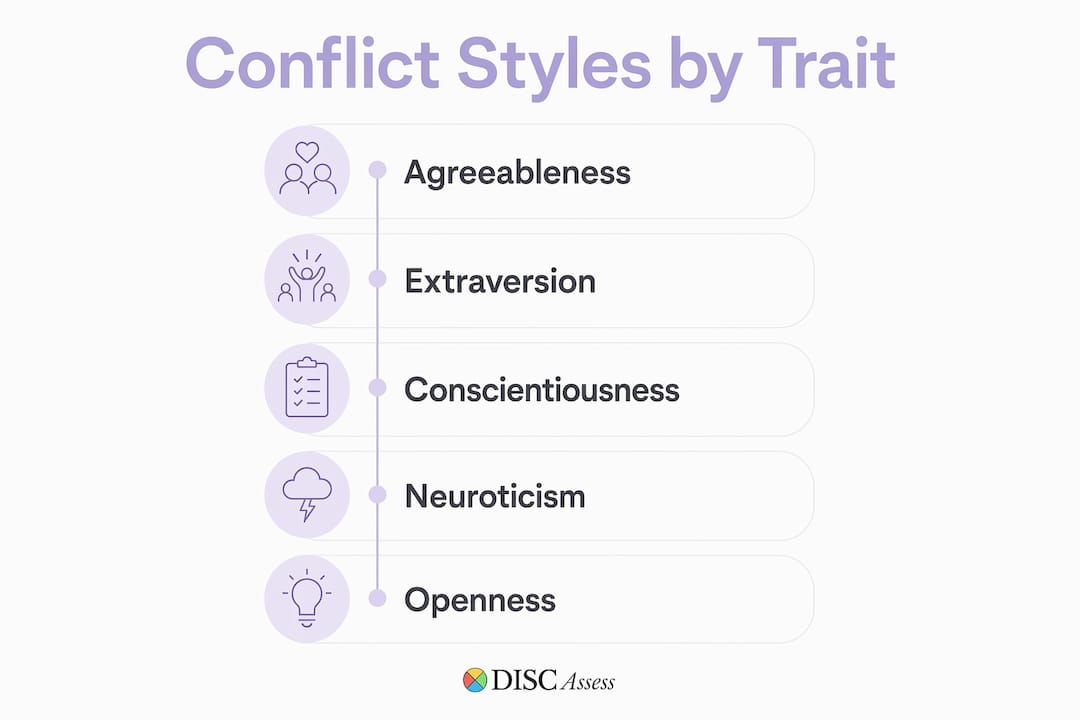
Other traits add important layers. Extraverts engage conflict openly, often processing out loud and expecting quick resolution. People with high Openness seek multiple perspectives and tolerate ambiguity well. High Neuroticism amplifies the emotional cost of conflict, making recovery slower and misunderstandings feel more personal. These are not character flaws. They are predictable tendencies that, once named, become manageable.
Trait mismatches are a common source of friction. Mismatches between high conscientiousness and low agreeableness, or between strong introversion and strong extraversion, predict recurring tension. Knowing the mismatch exists lets you address the structure of the interaction rather than the character of the person.
Here is how specific traits typically show up in conflict:
- High Agreeableness: Avoids direct confrontation; may agree outwardly while staying resentful inwardly
- Low Agreeableness: Engages conflict head-on; can read as aggressive to high-agreeableness counterparts
- High Conscientiousness: Wants clear rules and follow-through; frustrated by ambiguity or broken commitments
- High Neuroticism: Experiences conflict as emotionally costly; needs recovery time before productive dialogue
- High Extraversion: Processes conflict verbally and quickly; may overwhelm introverted colleagues
- High Openness: Welcomes creative solutions; may frustrate those who prefer established procedures
Pro Tip: Before your next difficult conversation, identify one Big Five trait that likely shapes the other person's conflict default. That single insight can change your entire approach.
What are effective frameworks for resolving personality-based conflicts?
The most reliable method for resolving personality-informed conflicts follows a five-step sequence. Effective resolution involves naming behaviors neutrally, acknowledging needs, identifying minimum accommodations, designing explicit working agreements, and scheduling recurring check-ins. Each step builds on the last, and skipping any one of them tends to leave the conflict unresolved at its root.
- Name the behavior neutrally. Describe what happened without attaching intent. "You interrupted me three times in the meeting" is observable. "You disrespect me" is an interpretation.
- Acknowledge each person's underlying need. One person may need efficiency; the other may need to feel heard. Both needs are legitimate.
- Identify minimum accommodations. What is the smallest adjustment each person can make that still honors their core need? This keeps agreements realistic.
- Design explicit working agreements. Write down what each person commits to doing differently. Vague promises dissolve under pressure.
- Schedule recurring check-ins. Personality differences do not disappear. Regular check-ins normalize ongoing adjustment and prevent resentment from building silently.
The table below maps common conflict scenarios to the most effective resolution approach:
| Conflict scenario | Recommended approach | Why it works |
|---|---|---|
| High vs. low agreeableness clash | Explicit agreements with written commitments | Reduces ambiguity that frustrates both parties |
| Introvert vs. extravert friction | Structured turn-taking in discussions | Balances processing styles without favoring either |
| High conscientiousness vs. flexible style | Clear deadlines with agreed flexibility windows | Honors structure need while allowing adaptability |
| Emotional escalation (high Neuroticism) | Timed pause before resolution conversation | Lowers emotional cost before practical problem-solving |
Pro Tip: Write your working agreements down, even in a shared email or note. Verbal agreements fade. Written ones create accountability without blame.
How can you recognize and adapt your default conflict style?
No conflict style is universally ideal. Strategic flexibility, meaning the ability to choose your style based on context rather than habit, is the mark of a skilled conflict resolver. Most people default to one or two styles under pressure. Recognizing your default is the first step toward expanding your range.
People can consciously override their natural conflict defaults by separating the emotional discomfort of conflict from the practical need to resolve it. That separation is a skill, not a personality trait. You can feel anxious about confrontation and still choose to engage directly when the stakes require it.
The Thomas-Kilmann model gives you a practical map for this. Collaborating, which uses high assertiveness and cooperativeness, produces the most durable resolutions. Accommodation works well for low-stakes or time-sensitive issues. Avoidance is appropriate when a conflict is genuinely unresolvable in the moment. The key is matching the style to the situation, not defaulting to comfort.
Here is a quick self-assessment to identify your default and expand it:
- Identify your go-to move. Do you push back immediately, go quiet, or look for a middle ground? That is your default.
- Notice the stakes. High-stakes conflicts with lasting consequences deserve collaboration. Low-stakes friction may not need full engagement.
- Assess the relationship. A close colleague warrants more investment than a one-time interaction.
- Practice the uncomfortable style. If you default to avoiding, rehearse one direct statement before your next conflict conversation.
- Debrief after each conflict. Ask yourself what style you used and whether it served the situation. Adjust next time.
Understanding personality's role in team dynamics helps you see your own defaults more clearly, especially when you can compare them to others on your team.
What practical strategies help teams manage conflicting personalities?
Teams manage personality conflicts best through structured, shared processes rather than one-off interventions. Structured group discussions where each person identifies their strengths, weaknesses, and triggers, then commits to specific behavioral strategies, create mutual accountability without blame. This method works because it normalizes vulnerability. When everyone shares their friction points, no one person is labeled the problem.
Personality assessments play a specific and important role here. Using assessments provides a neutral vocabulary that prevents conflicts from being weaponized into personal attacks. When a team member says "my D-style pushes for fast decisions" instead of "I am just direct," the conversation stays behavioral and constructive. Discassess offers accessible DISC assessments designed specifically for teams who want this kind of shared language without requiring HR certification or a large budget.
Reframing conflict as a design problem rather than a people problem changes the entire team culture. When you map conflicts to personality interaction patterns, such as a high-D style clashing with a high-C style over decision speed, you shift focus from personal blame to structural mismatches that need design accommodations. That shift is both more accurate and more productive.
Practical strategies for teams include:
- Run a team personality review. Use a staff meeting personality review to surface each person's tendencies before conflict arises.
- Create shared behavioral agreements. Document how the team will handle disagreements, decision-making, and communication preferences.
- Use neutral language consistently. Replace "she is stubborn" with "her high conscientiousness means she needs more lead time."
- Build in regular check-ins. Monthly or quarterly conversations about team dynamics prevent small frictions from becoming entrenched conflicts.
Pro Tip: Introduce personality assessments before a conflict occurs, not during one. Using them reactively can feel like labeling. Using them proactively builds a shared framework everyone trusts.
Key Takeaways
Personality-based conflict resolution works because it replaces blame with behavioral insight, giving every person a practical path toward durable, respectful resolution.
| Point | Details |
|---|---|
| Personality drives conflict defaults | Traits like Agreeableness and Neuroticism predict how people engage and recover from conflict. |
| Five-step resolution sequence | Name behaviors, acknowledge needs, agree on minimums, write agreements, and check in regularly. |
| Strategic flexibility beats rigid style | Match your conflict style to the stakes and relationship, not to habit or comfort. |
| Assessments depersonalize conflict | A shared personality vocabulary keeps conversations behavioral and prevents personal attacks. |
| Design, not blame | Treating conflict as a structural mismatch shifts teams from blame to problem-solving. |
Why I think we have been solving personality conflict backward
Most conflict training I have seen focuses on communication skills: listen better, speak more clearly, manage your tone. Those skills matter. But they treat the symptom, not the source. The source is almost always a stable personality difference that no amount of active listening will dissolve.
What actually works is treating the conflict as a design problem. Two people with genuinely different wiring will keep colliding in the same spots unless the structure of their interaction changes. That means explicit agreements, not just goodwill. It means scheduled check-ins, not just hoping things improve. It means naming the pattern out loud so neither person feels like the villain.
The most underused tool in this process is shared vulnerability. When a team sits down and everyone names their own triggers and blind spots, the whole dynamic shifts. Suddenly the person who seemed difficult is just someone with a high-C style who needs more data before deciding. That reframe is not soft. It is precise. And precision is what produces lasting change.
Diverse personalities are not a liability to manage. They are a genuine strength, provided you build the structures that let different wiring coexist productively. That is the real work of personality-informed conflict resolution, and it is worth doing well.
— Tres
How Discassess supports personality-based conflict resolution
Discassess makes it straightforward for small teams, nonprofits, and individual users to build the shared personality language that conflict resolution requires.
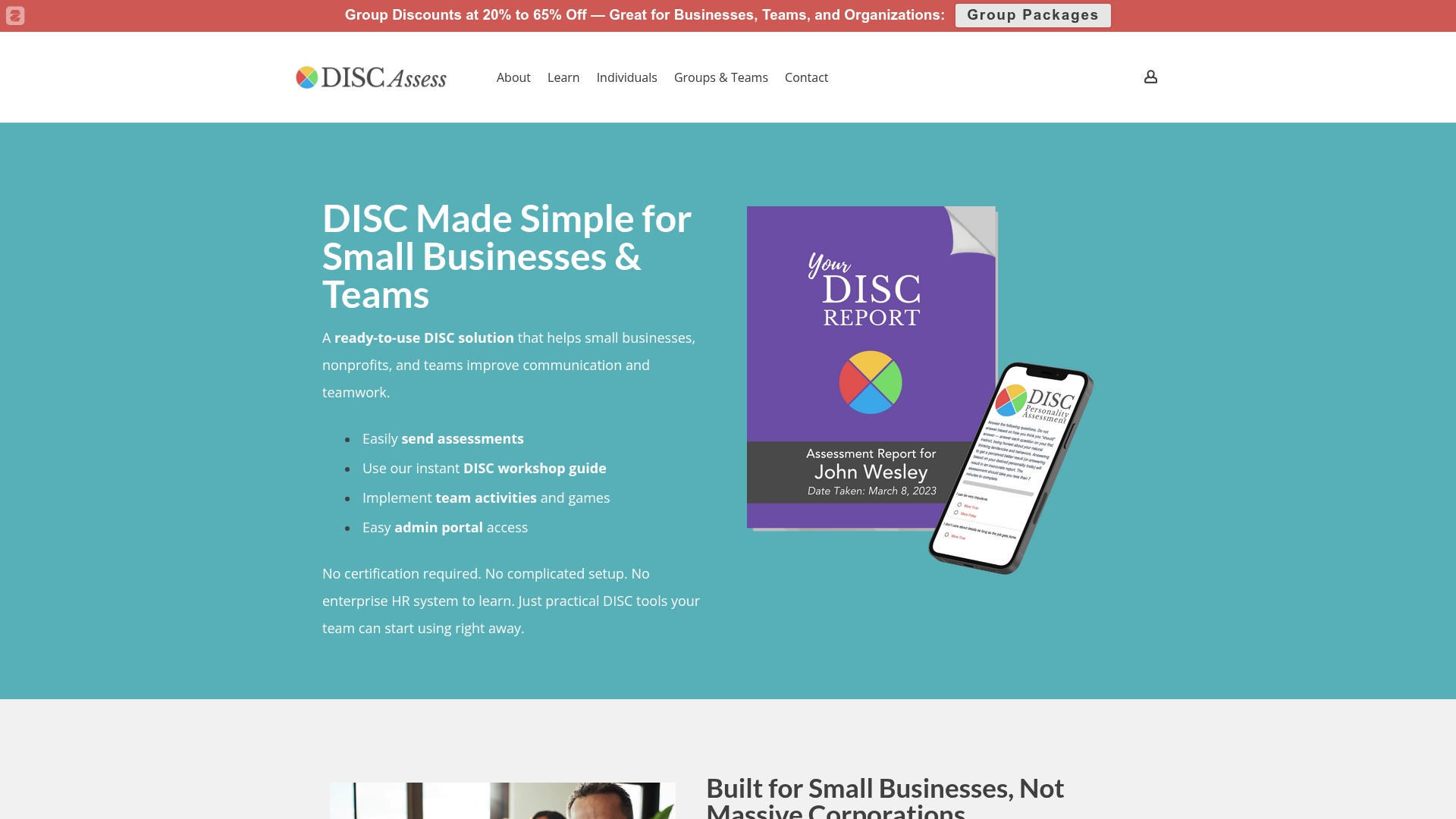
The DISC Group Package gives teams a common framework for understanding how each person's style shapes their conflict defaults, without requiring HR expertise or a large budget. For individuals working through interpersonal friction on their own, the Individual Classic DISC Assessment delivers a detailed report that names your tendencies, your blind spots, and your growth edges in plain language. Backed by Prism Counseling & Coaching, Discassess brings over a decade of practical experience to every assessment it offers.
FAQ
What is personality-based conflict resolution?
Personality-based conflict resolution is the practice of addressing disagreements by identifying how each person's personality traits shape their conflict behavior and then adapting strategies to fit those differences. It uses frameworks like the Big Five traits and the Thomas-Kilmann model to make conflict patterns predictable and manageable.
How do I resolve personality conflicts at work?
Start by naming the behavior neutrally, then acknowledge each person's underlying need, agree on minimum accommodations, write down explicit commitments, and schedule regular check-ins. Personality assessments help teams build a shared vocabulary that keeps conversations behavioral rather than personal.
What are the five Thomas-Kilmann conflict styles?
The five styles are competing, collaborating, compromising, avoiding, and accommodating. Each sits at a different point on the axes of assertiveness and cooperativeness, and the most effective style depends on the stakes and the relationship involved.
Can personality conflict be fully resolved?
Stable personality differences do not disappear, but their friction can be managed through explicit agreements and ongoing dialogue. The goal is not to change who someone is but to design interactions that work for both people's wiring.
How does a DISC assessment help with conflict resolution?
A DISC assessment gives individuals and teams a neutral, behavioral vocabulary for describing personality differences. That shared language prevents conflicts from becoming personal attacks and makes it easier to identify the structural mismatches that drive recurring tension.