

The most effective leadership styles for small business owners are coaching, democratic, transformational, servant, and autocratic — deployed situationally rather than as a fixed identity. Effective leaders use four or more styles and shift between them based on what the team and moment actually need. Relying on a single approach is one of the most common reasons small businesses stall.
Here is a quick reference for the core styles and when each fits best:
- Coaching: Best as your everyday base style for teams of 5–50; builds long-term capability
- Democratic: Use for strategic decisions where team buy-in matters
- Autocratic: Reserve for genuine crises that require fast, clear direction
- Transformational: Use when casting vision or driving cultural change
- Servant: Builds deep loyalty and trust, especially in values-driven teams
- Laissez-faire: Works only with highly skilled, self-directed employees; misapplied, it leaves work undone
- Situational: The meta-approach that ties all others together, matching style to the person and task
The single most important shift most founders need to make is away from defaulting to autocratic under pressure and toward coaching as a daily practice. That transition takes roughly 90 days of deliberate effort, but it compounds.
Table of Contents
- Why leadership matters more in a small business than anywhere else
- An overview of the major leadership styles and how they work
- How your leadership approach evolves as your business grows
- Leadership versus management: why the difference matters for your team
- How to develop your leadership skills as a small business owner
- Practical examples of each leadership style in a small business
- Advantages and disadvantages of each leadership style for small businesses
- How to assess and choose the right leadership style for your small business
- How leadership style shapes employee motivation and retention
- Real-world leadership patterns that drive small business success
- Discassess helps you lead your team with self-awareness and clarity
- Key Takeaways
Why leadership matters more in a small business than anywhere else
Leadership quality is a competitive advantage for small businesses, and it requires more than authority. It demands self-awareness, endurance, fairness, and the ability to inspire people who could walk out the door tomorrow.

In a small business, the owner's leadership style is felt by every single person on the team, every day. There is no buffer of middle management to absorb poor decisions or miscommunication. The qualities that matter most include decisiveness, integrity, enthusiasm, and the self-awareness to know your own blind spots.
Strong leadership also directly supports employee motivation and business growth. When your team trusts your direction, they commit rather than merely comply. That distinction shapes everything from daily productivity to whether your best people stay.
| Leadership Quality | Why It Matters for Small Business |
|---|---|
| Self-awareness | Helps you recognize your default style and when to shift |
| Decisiveness | Keeps the team moving when clarity is needed fast |
| Fairness | Builds trust and prevents resentment in close-knit teams |
| Integrity | Earns genuine commitment, not just compliance |
| Endurance | Models resilience when the business faces hard seasons |
| Emotional intelligence | Allows you to read your team and adapt your approach |
An overview of the major leadership styles and how they work
There is no single best leadership style for every situation. Each approach has a distinct pattern of decision-making, communication, and delegation, and each works in some contexts while failing in others.
Coaching leadership
The coach-leader focuses on developing each team member's skills over time. Rather than just directing tasks, you ask questions, give feedback, and invest in people's growth. For small businesses with small to mid-sized teams, this is the most effective base style because it builds a capable team that does not depend entirely on you for every decision.
Pros: Builds long-term capability; increases retention; reduces bottlenecks Cons: Takes time to show results; requires patience and consistency
Democratic leadership
Democratic leaders bring the team into decisions before making the final call. This approach raises engagement and produces better decisions when the team has relevant knowledge. It works especially well for strategic planning and process improvements.
Pros: Higher team buy-in; surfaces better ideas; builds ownership Cons: Can slow decisions; requires a team willing to participate constructively
Autocratic leadership
The autocratic leader decides and the team executes, with minimal input from others. This style is genuinely useful in a crisis, when speed matters more than consensus. Used long-term, though, it demoralizes people and limits innovation.
Pros: Fast decisions; clear chain of command; effective in emergencies Cons: Stifles creativity; burns out small teams; reduces commitment over time
Transformational leadership
Transformational leaders inspire through a compelling vision and challenge their team to grow beyond their current limits. Transformational leadership positively influences employee motivation and business performance in small and medium enterprises. This style is powerful during periods of change or when you need to build a culture around shared values.
Pros: High motivation; strong culture; drives innovation Cons: Can neglect day-to-day execution; requires a leader with genuine vision and credibility
Servant leadership
The servant leader prioritizes the needs of the team above their own. You remove obstacles, develop people, and make sure your team has what they need to succeed. This approach has grown notably in values-driven and faith-aligned organizations.
Pros: Deep loyalty; strong culture of care; high retention Cons: Can blur authority; requires strong personal boundaries to avoid over-giving
Laissez-faire leadership
This hands-off approach delegates broadly and trusts the team to self-direct. It works well with highly skilled, motivated employees who need space to operate. Misapplied, it creates confusion and leaves work undone because small teams have no slack to absorb drift.
Pros: Empowers skilled employees; encourages autonomy Cons: Detrimental to performance when team lacks experience or motivation
Situational leadership
Situational leadership, developed by Paul Hersey in 1969, is the framework that ties all other styles together. It asks you to match your approach to the specific person and task at hand, ranging from directing to coaching to delegating based on the employee's skill and confidence level.
- Telling/Directing: Best for new employees or crisis situations
- Coaching/Explaining: Best for developing employees who need guidance
- Participating/Collaborating: Best for capable employees who need confidence
- Delegating/Empowering: Best for experienced, self-directed team members
How your leadership approach evolves as your business grows
Most founders default to autocratic or charismatic styles in the early days, and that is often appropriate. Speed matters more than consensus when you have five employees and a product to ship. The problem is that founders who do not update their style as the team grows past 10 people become bottlenecks.
The shift from autocratic to coaching and democratic is the hardest leadership transition most small business owners face. It requires letting go of control over decisions you could make faster yourself, trusting people to grow into responsibility, and accepting that short-term slowdowns produce long-term scale.
| Business Stage | Team Size | Most Effective Style |
|---|---|---|
| Startup | 1–5 | Charismatic + Autocratic |
| Early growth | 5–15 | Coaching + Autocratic (crises only) |
| Scaling | 15–50 | Coaching + Democratic |
| Maturity | 50+ | Democratic + Transformational |
Leadership also needs to flex around external conditions, not just internal growth. A supply chain disruption, a key hire leaving, or a sudden market shift all call for different responses. Adaptive leadership, as defined by Ronald Heifetz, Alexander Grashow, and Marty Linsky, is "the practice of mobilizing people to tackle tough challenges and thrive." The four principles guiding it are emotional intelligence, fairness, development, and character.
- Recognize when a crisis calls for directive leadership, even if democratic is your default
- Revisit your style intentionally at each growth milestone, not just when something breaks
- Build a working repertoire of at least four styles so you are never constrained by your default
Leadership versus management: why the difference matters for your team
Small business owners often conflate management and management, and that confusion costs them. Leadership and management serve different functions: leadership is about inspiring people toward a vision, while management is about executing tasks and maintaining structure. Both are necessary, but treating them as the same thing creates a team that follows orders rather than one that believes in the mission.
When you spend all your time managing, you deprive your team of the inspiration and direction they need to stay motivated. When you lead without managing, nothing gets done. The skill is holding both roles consciously.
| Dimension | Leadership | Management |
|---|---|---|
| Primary focus | Vision and inspiration | Task execution and structure |
| Decision style | Guides direction | Implements processes |
| Team response | Commitment and belief | Compliance and completion |
| Time horizon | Long-term culture | Short-term deliverables |
| Key risk if neglected | Team loses direction | Work falls through the cracks |
The practical guidance is to protect time for both. Block time each week for leadership activities like one-on-ones, vision conversations, and team development. Do not let the urgent management tasks crowd out the leadership work that builds your team's long-term commitment.
How to develop your leadership skills as a small business owner
Self-awareness is the foundation of every other leadership skill. You cannot choose the right style for a situation if you do not know what your default style is or how your behavior affects the people around you. Start there. Tools like DISC profiles for leadership give you a concrete, research-backed framework for understanding your own tendencies and how they interact with your team's.
Leadership development in small and mid-size businesses is most effective when it follows the 70-20-10 model: 70% through challenging assignments, 20% through mentoring and coaching relationships, and 10% through formal learning programs. That means most of your growth happens in the work itself, not in a classroom.
Pro Tip: Assign yourself one new leadership behavior to practice deliberately for 90 days. Switching from autocratic to coaching, for example, does not happen in a meeting. It happens over a quarter of conscious, repeated choices in specific situations.
Practical steps that work for small business owners:
- Stretch assignments: Take on a challenge slightly beyond your current comfort zone, then reflect on what worked and what you would do differently
- Involve emerging leaders in planning: Including future leaders in strategic planning accelerates their development and deepens their understanding of the business
- Build in reflection time: After a difficult meeting or decision, write down two things that worked and one thing you would change
- Seek a mentor or coach: A trusted outside perspective catches blind spots you cannot see from inside your own business
- Use behavioral data for decisions: Understanding how your team members are wired helps you lead each person more effectively
Internal leadership development is also the most cost-effective retention and scaling strategy available to small businesses. Growing leaders from within builds loyalty, reduces hiring costs, and creates a team that understands your culture from the inside out.
Practical examples of each leadership style in a small business
Abstract descriptions only go so far. Here is how each style actually shows up in day-to-day small business operations.
Coaching in practice: A bakery owner notices that her lead baker struggles with delegating to the prep team. Instead of stepping in to fix it, she meets with him weekly, asks what obstacles he is running into, and helps him develop his own solutions. Over three months, he becomes a confident team lead.
Democratic in practice: A five-person marketing agency is deciding whether to add video production services. The owner brings the full team into a structured discussion, gathers input on capacity and client demand, then makes the final call. The team executes with full buy-in because they helped shape the decision.
Autocratic in practice: A restaurant owner discovers a health code violation two hours before the health inspector arrives. She gives clear, direct instructions to every team member with no debate. The situation is resolved. This is exactly the context where autocratic leadership earns its place.
Transformational in practice: A nonprofit founder rallies her staff around a new community program by connecting daily tasks to the organization's larger mission. She shares stories of impact, celebrates small wins publicly, and consistently ties individual roles to the bigger picture.
Servant in practice: A small tech firm's owner notices that one developer is overwhelmed. He rearranges priorities, takes a task off her plate himself, and asks what she needs to do her best work. She stays with the company through a competitor's recruiting effort.
Laissez-faire in practice: A creative director at a small design studio gives her senior designers full autonomy over client projects, checking in only at key milestones. With experienced, self-motivated professionals, this approach produces excellent work and high job satisfaction.
Advantages and disadvantages of each leadership style for small businesses
Every style carries real trade-offs. Understanding them helps you deploy each one with clear eyes.
| Style | Key Advantage | Key Disadvantage |
|---|---|---|
| Coaching | Builds lasting team capability | Slow to show results; requires consistent effort |
| Democratic | High buy-in and better decisions | Can slow execution; requires team participation |
| Autocratic | Fast, clear direction in crises | Demoralizes teams when overused; limits innovation |
| Transformational | Drives motivation and culture | Can neglect execution; depends on leader credibility |
| Servant | Deep loyalty and retention | Can blur authority; risks leader burnout |
| Laissez-faire | Empowers skilled, autonomous teams | Detrimental to SME performance when misapplied |
| Situational | Flexible and context-responsive | Requires high self-awareness and discipline to execute |
The pattern worth noting: the styles that feel most comfortable under pressure (autocratic, charismatic) are often the ones that cause the most damage when used as defaults. The styles that feel slower and harder (coaching, democratic) are the ones that build the team you actually want.
How to assess and choose the right leadership style for your small business
Choosing your approach starts with honest self-assessment. Write out your natural tendencies: how you typically make decisions, how you respond under pressure, and how your team seems to experience your leadership. Then ask a trusted colleague to do the same for you. The gap between those two pictures is where your development work lives.
From there, consider three factors together. First, your business stage: a startup in survival mode needs more directive leadership, while a mature team benefits from collaborative approaches. Second, the task at hand: a crisis calls for autocratic clarity, while a strategic pivot benefits from democratic input. Third, the individual employee: a new hire needs direction, while a seasoned team member needs autonomy and trust.
Personality-based leadership insights can also help you understand why you default to certain styles and how your natural tendencies interact with your team's. The goal is not to become a different person. It is to expand your range so you can meet each situation with the right tool.
Pro Tip: Map your team members individually. Ask yourself which style each person responds to best, then practice leading each one accordingly. This single habit shifts you from a one-size-fits-all approach to genuinely adaptive leadership.
How leadership style shapes employee motivation and retention
Your leadership approach is one of the most direct levers you have on whether people stay or leave. Transformational and visionary leadership styles positively influence employee motivation and business performance in small and medium enterprises, while laissez-faire leadership has measurably detrimental effects on productivity and satisfaction.
The mechanism is straightforward. When people feel seen, developed, and connected to a purpose larger than their task list, they commit. When they feel ignored, micromanaged, or directionless, they disengage. In a small business, disengagement is visible immediately, and turnover is expensive in ways that go beyond the hiring cost.
Employee engagement practices that reinforce good leadership include regular one-on-ones, public recognition of contributions, and involving team members in decisions that affect their work. These are not perks. They are the daily expression of a leadership style that values people. The communication style you bring to those interactions either builds trust or erodes it, one conversation at a time.
Real-world leadership patterns that drive small business success
The most instructive leadership stories from small businesses share a common thread: the owner recognized when their default style was no longer serving the team and made a deliberate shift.
A common pattern in service businesses: a founder builds the company through sheer force of will and autocratic decision-making. At five employees, it works. At fifteen, the team stops bringing ideas forward because they expect to be overruled. The founder who recognizes this and transitions to coaching and democratic approaches over the following year typically sees a measurable uptick in team initiative and retention.
Another pattern appears in faith-based and nonprofit organizations, where servant leadership is often the natural starting point. The challenge there is that servant leaders sometimes struggle to hold authority when it is needed. The most effective leaders in those settings learn to blend servant and coaching approaches with the willingness to be directive when the mission requires it.
The leadership development frameworks that work best for small businesses are not borrowed wholesale from corporate playbooks. They are built around the specific people, stage, and culture of the organization. The founders who grow the strongest teams are the ones who treat their own leadership development with the same seriousness they bring to their product or service.
Understanding how organizations identify leadership potential can also help you spot and develop future leaders within your own team before you need them, rather than scrambling when a key person leaves.
Discassess helps you lead your team with self-awareness and clarity
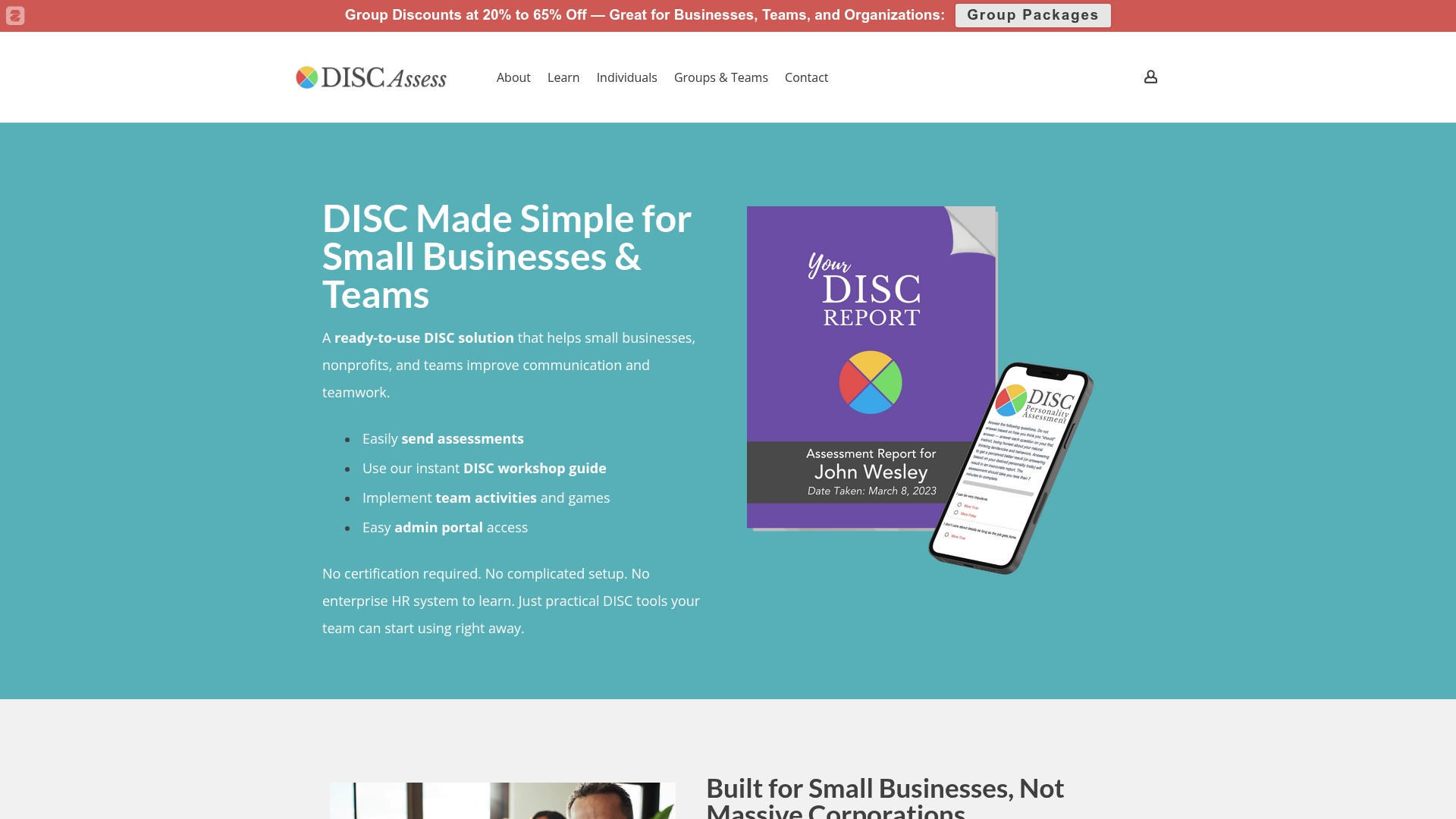
Knowing which leadership style fits a situation is only half the work. The other half is understanding yourself and your team well enough to apply that knowledge in real time. That is where Discassess makes a practical difference for small business owners.
Discassess is a Phoenix-based DISC assessment platform built specifically for small businesses, nonprofits, and teams that want real insight without a corporate budget or an HR department. The Individual Classic DISC Personality Assessment gives you a detailed report on your natural behavioral tendencies, including how you lead, communicate, and respond under pressure. The DISC Personality Assessment is available for individual team members, so you can understand not just yourself but the people you are leading. For teams, the DISC Group Package includes an admin account and assessment credits, making it straightforward to run assessments across your whole team and compare profiles side by side. Backed by over a decade of experience through Prism Counseling & Coaching, Discassess is designed for immediate use without certification or technical expertise. Take your assessment today at discassess.com and start leading with the self-awareness your team deserves.
Key Takeaways
Effective small business leadership requires a flexible repertoire of styles, with coaching as the most valuable everyday foundation and autocratic reserved for genuine crises.
| Point | Details |
|---|---|
| No single style wins | Effective leaders use four or more styles, shifting based on team needs and business stage. |
| Coaching is the base | For teams of 5–50, coaching builds lasting capability and reduces founder bottlenecks. |
| Style shifts take 90 days | Transitioning from autocratic to coaching takes roughly 90 days of deliberate practice. |
| Leadership drives retention | Transformational and visionary styles positively influence motivation; laissez-faire has detrimental effects on SME performance. |
| Discassess supports growth | The DISC Group Package and individual assessments help small business owners understand their leadership style and their team's behavioral tendencies. |
Recommended
- Why Personality Assessments Matter for Small Business
- DISC Assessment for Leadership Development: A Practical Guide
- Personality-Based Leadership Styles Explained for Managers
- How Small Businesses Owners Can Utilize the DISC - DISC Assess | Affordable, Professional DISC Assessments for Small Businesses