

Employee engagement best practices are defined as the specific, repeatable actions managers and HR professionals take to connect employees to their work, their team, and their organization's purpose. Global engagement dropped to 20% in 2025, a historic low that signals a structural problem, not a motivational one. The good news is that managers account for 70% of the variance in team engagement, meaning the highest-leverage fixes are within your direct control. The practices that move the needle most are not company-wide programs. They are daily habits around clarity, recognition, and feedback that any manager can build starting today.
1. Employee engagement best practices start with empowering managers
Manager quality is the single greatest predictor of team engagement. When managers lack the skills or support to lead well, no amount of company-wide programming compensates for it. The 70% variance in engagement attributed to managers is not a soft finding. It is the most replicated result in workplace research.
Empowering managers means giving them practical tools, not just training decks. The most effective support focuses on three skills:
- Setting clear goals. Managers who define success in concrete terms reduce ambiguity and frustration.
- Providing ongoing feedback. Weekly check-ins outperform annual reviews for keeping employees on track and feeling valued.
- Coaching for growth. Asking "What do you need to succeed?" builds trust faster than performance monitoring alone.
Effective engagement is built through everyday manager-employee interactions far more than through company-wide programs. That means the return on investing in manager capability is higher than the return on launching another initiative.
Pro Tip: Give managers a simple weekly check-in template with three questions: What went well? What is blocked? What support do you need? This structure takes five minutes and builds the feedback habit without adding complexity.

2. How clear communication drives employee motivation
Role clarity is a foundational engagement driver that most organizations underinvest in. Only 47% of employees strongly agree they know what is expected of them at work. That means more than half your team may be working without a clear picture of what success looks like.
Clarity is not just about job descriptions. It is about helping employees understand how their daily work connects to the organization's goals. When people see that connection, their motivation rises naturally. When they cannot see it, even talented employees disengage.
Strong communication practices that improve clarity include:
- Simplifying priorities. Limit team focus to three to five goals at a time. More than that creates confusion, not productivity.
- Explaining decisions in context. When leadership makes a change, tell employees why. Context reduces resistance and builds trust.
- Creating two-way channels. Town halls, team huddles, and anonymous feedback tools all give employees a voice, not just a seat.
- Closing the loop. When an employee raises a concern, acknowledge it and report back on what happened. Silence signals indifference.
Adding more initiatives on top of overloaded processes often worsens engagement. Simplifying work and clarifying priorities is more effective than layering on new programs.
Pro Tip: At the start of each quarter, send your team a one-page "What matters most" summary. List the top three priorities, the key decisions made, and one thing that changed based on their feedback. This single document does more for clarity than most communication training.
3. Recognition and work-life balance as pillars of morale
Recognition is one of the most cost-effective employee motivation techniques available, yet most organizations do it poorly. Generic awards like "Employee of the Month" can actually demotivate employees who feel the selection process is arbitrary. Immediate, specific recognition tied to a real business outcome is what actually moves morale.
The "24-Hour Rule" is a practical standard worth adopting. When an employee does something worth recognizing, acknowledge it within 24 hours. The specificity matters as much as the speed. "You handled that client complaint with real patience and saved the relationship" lands far better than "Great job this week."
Work-life balance now outranks pay as a job priority. 83% of employees rate work-life balance as their top job factor, above compensation. That shift has real implications for retention strategy.
Organizations with structured recognition programs see 31% lower voluntary turnover than those without them. Turnover is expensive. Recognition is not.
Practical recognition and balance practices include:
- Peer recognition programs. Platforms that let teammates recognize each other spread the habit beyond managers.
- Flexible scheduling. Even small adjustments, like a flexible start time, signal respect for personal lives.
- Protected time off. Managers who model taking vacation give employees permission to do the same.
- Public and private praise. Some employees thrive on public recognition. Others prefer a private note. Know your team.
4. Using pulse surveys to sustain engagement over time
Annual engagement surveys are too slow to be useful. By the time results are analyzed and shared, the moment for action has passed. Short pulse surveys of three to five questions, run monthly or biweekly, give managers real-time data they can actually act on.
The format matters less than the follow-through. Survey fatigue is real, and it sets in fast when employees feel their responses disappear into a void. The "You Said, We Did" model addresses this directly. After each survey cycle, share what you heard and what changed as a result. That loop builds trust and keeps participation rates high.
Steps to build a working feedback cycle:
- Send a three to five question pulse survey focused on one theme (workload, communication, recognition).
- Review results within 48 hours and identify one or two clear patterns.
- Share findings with the team in plain language, not just percentages.
- Name one specific change you will make based on the feedback.
- Follow up in the next survey to confirm the change landed.
Engagement embedded in daily work routines enhances retention far more than annual events. Pulse surveys are one of the simplest ways to make engagement a living practice rather than a calendar item.
Pro Tip: Keep pulse surveys anonymous and tell employees they are anonymous. Trust in the process determines response quality. If employees doubt confidentiality, they will give safe answers, not honest ones.
5. Aligning purpose, development, and psychological safety
Employees stay engaged when they understand how their work drives real value. Purpose alignment is not a soft concept. It is a practical management skill. When you connect a team member's daily tasks to a customer outcome or organizational mission, you give their work meaning that no pay raise can replicate.
Career development is equally powerful. Employees who see a path forward are more optimistic and more committed. That path does not require a promotion. It can be a new skill, a stretch project, or a mentorship relationship. The key is that growth feels possible and supported.
Psychological safety is the third pillar. Teams where employees feel safe to speak up, ask questions, and admit mistakes outperform those where silence is the norm. Leadership quality, learning, and development are consistent engagement drivers, but they must be tailored to your organization's specific culture and context.
Signs of a healthy engagement culture include:
- Employees raise problems before they escalate.
- Team members ask for help without fear of judgment.
- Managers share their own mistakes openly.
- Feedback flows in both directions, not just top-down.
- People talk about their work with genuine enthusiasm.
| Practice | What it builds |
|---|---|
| Purpose alignment | Meaning and commitment |
| Career development | Optimism and loyalty |
| Psychological safety | Trust and innovation |
| Two-way feedback | Accountability and respect |
Strategies must be tailored to organizational context because what drives engagement in one culture may not work in another. Data analysis, not assumption, should guide your choices.
Key takeaways
The most effective strategies for employee engagement center on manager empowerment, role clarity, and timely recognition because these three factors produce the highest, most measurable impact on team performance and retention.
| Point | Details |
|---|---|
| Managers drive engagement | 70% of engagement variance is tied to manager behavior, making their development the top priority. |
| Clarity reduces disengagement | Only 47% of employees know what is expected; simplifying priorities closes that gap fast. |
| Recognition must be specific | The 24-Hour Rule and outcome-tied praise outperform generic awards for morale and retention. |
| Pulse surveys beat annual reviews | Short, frequent surveys with transparent follow-through build trust and keep feedback useful. |
| Purpose and safety sustain growth | Connecting work to mission and creating psychological safety keeps engagement alive long-term. |
What I have learned about engagement after years of working with teams
Most engagement programs fail for the same reason: they treat the symptom instead of the cause. Organizations launch wellness initiatives, recognition platforms, and culture committees while leaving managers under-supported and employees unclear on what they are actually supposed to accomplish. The programs look good on a slide deck. They rarely move the numbers.
What I have seen work, consistently, is simpler than most leaders expect. A manager who checks in weekly, explains the "why" behind decisions, and says "great work on that specific thing" within a day of it happening builds more loyalty than any company-wide initiative. The relationship between a manager and their direct report is where engagement lives or dies.
The risk I see most often is initiative overload. Piling programs onto overloaded systems worsens engagement rather than improving it. Every new initiative adds cognitive load. The teams I have seen thrive are the ones whose leaders had the discipline to do fewer things better. Simplicity is not a compromise. It is the strategy.
If you are an HR professional reading this, your highest-value move is not designing the next program. It is equipping your managers with clear skills, simple tools, and the confidence to have honest conversations every single week. That is where the return is.
— Tres
How Discassess helps managers build more engaged teams
Understanding your team's communication styles and behavioral tendencies is one of the fastest ways to improve day-to-day engagement. Discassess offers affordable, professional DISC assessments built specifically for small businesses, nonprofits, and leadership teams who want practical insights without a complex certification process.
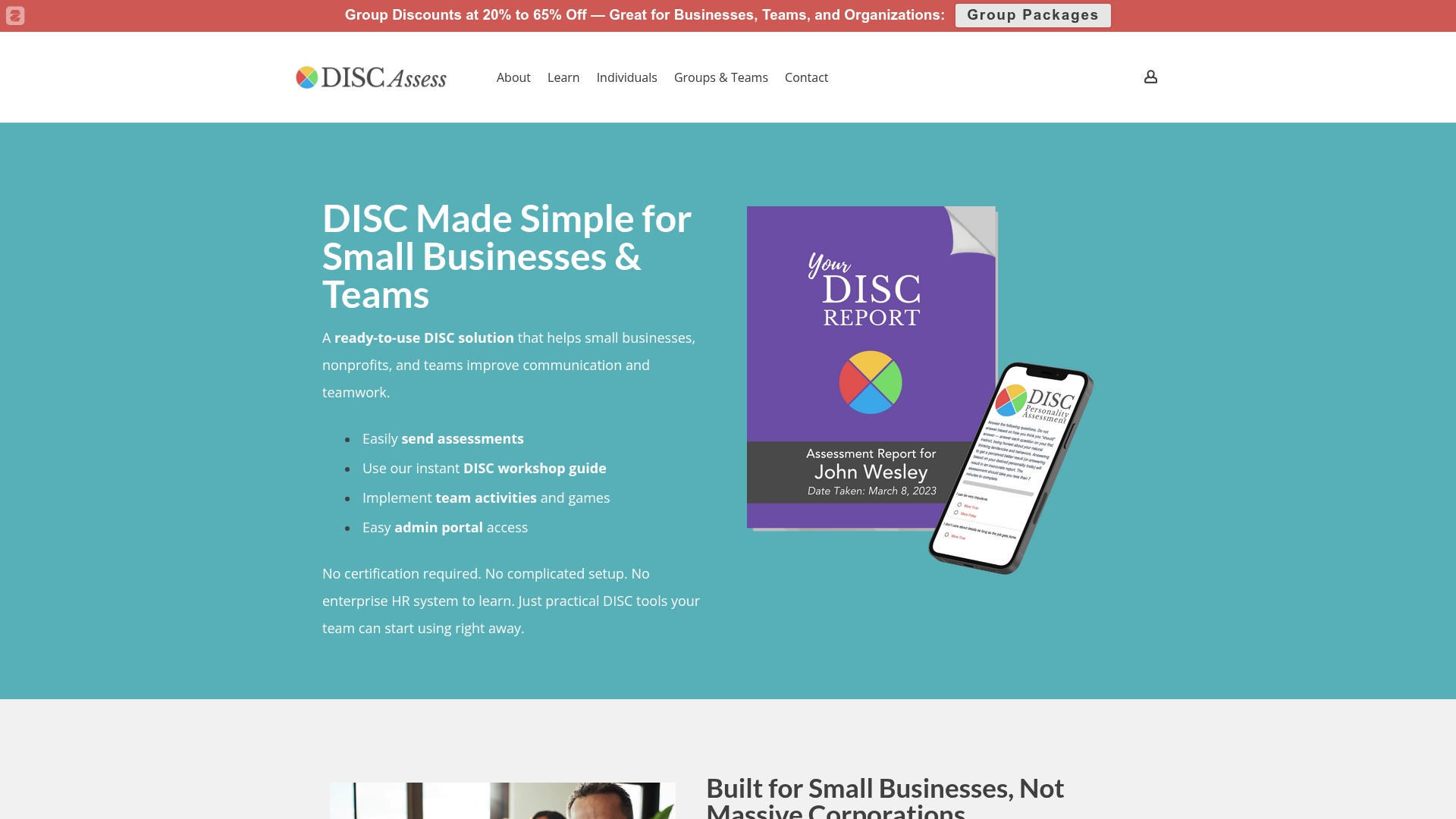
When managers understand how each team member processes feedback, handles conflict, and prefers to be recognized, they can apply the best ways to engage employees with real precision. Discassess provides individual assessments, group assessment packages, and an admin portal that makes it easy to manage results across your whole team. You can also explore the admin demo to see how the platform supports manager-led development without requiring an HR background or technical expertise.
FAQ
What is employee engagement?
Employee engagement is the degree to which employees feel connected to their work, their team, and their organization's purpose. Engaged employees are more productive, less likely to leave, and more likely to contribute beyond their basic job requirements.
Why do managers have such a large impact on engagement?
Managers account for 70% of the variance in team engagement because they control the daily interactions, feedback, and clarity that shape how employees experience their work. No company-wide program can substitute for a skilled, attentive manager.
How often should we run employee engagement surveys?
Short pulse surveys of three to five questions run monthly or biweekly outperform long annual surveys. The key is following each survey with a visible action so employees trust that their responses matter.
What is the most cost-effective recognition practice?
Specific, timely recognition delivered within 24 hours of a positive behavior is the most effective and lowest-cost approach. It outperforms generic awards and formal programs because it feels personal and directly tied to real work.
How does DISC assessment support employee engagement?
A DISC assessment helps managers understand each employee's communication style and behavioral tendencies, making it easier to give feedback, assign work, and recognize contributions in ways that actually resonate with each individual.
Recommended
- How to Use the DISC Personality Assessment with Employees - DISC Assess | Affordable, Professional DISC Assessments for Small Businesses
- DISC Admin Account - DISC Assess | Affordable, Professional DISC Assessments for Small Businesses
- DISC Assess | Affordable, Professional DISC Assessments for Small Businesses - All Articles
- How Political Campaigns Can Use the DISC with Staff and Volunteers - DISC Assess | Affordable, Professional DISC Assessments for Small Businesses