
Effective conflict resolution in groups starts with one discipline: diagnose before you act. Identify whether the disagreement is about tasks, relationships, process, or values, then choose the right intervention for that type. Most conflicts that spiral do so because someone tried to fix a relationship problem with a task-level solution, or vice versa.
Your next 24–72 hours:
- Diagnose privately. Speak one-on-one with each person involved. Listen for the root cause, not just the surface complaint.
- Convene or pause. If emotions are still high, schedule a structured meeting 24–48 hours out. If the situation is stable, bring the group together sooner.
- Commit to follow-up. Before the meeting ends, agree on specific actions, owners, and a check-in date within one week.
Key Takeaways
Effective conflict resolution in groups requires diagnosing the root cause first, then applying the right style, process, and follow-up structure to produce agreements that actually hold.
| Point | Details |
|---|---|
| Diagnose before you act | Identify whether the conflict is task, process, relationship, or status-based before choosing an intervention. |
| Match style to situation | The Thomas–Kilmann framework offers five styles; no single one fits every conflict, so choose based on urgency and relationship stakes. |
| Follow up at one and three weeks | Agreements without scheduled follow-up often revert; check in at one week and again at three weeks to catch backsliding. |
| Managers spend ~20% of time on conflict | Targeted frameworks and pre-built scripts reduce that cost and improve outcomes for the whole team. |
| Discassess DISC Group Package | Maps communication styles across your team so leaders can tailor conflict conversations before disputes escalate. |
Table of Contents
- Why does conflict happen in groups?
- What are the five Thomas–Kilmann conflict-management styles?
- How do you run a step-by-step conflict resolution process?
- What skills do managers and facilitators need?
- How do you prevent conflict before it starts?
- How do you handle conflict in remote and hybrid groups?
- When should you escalate to HR or formal mediation?
- How can DISC-style assessments help prevent and de-escalate conflict?
- Copyable templates for conflict resolution meetings
- How do you handle power imbalances in group conflict?
- Conflict resolution in diverse groups
- How do you measure whether conflict resolution actually worked?
- How group norms shape conflict escalation and de-escalation
- Cultural differences and their impact on group conflict resolution
- A word from the Discassess team
- Discassess can help your team build these skills faster
- Sources
Why does conflict happen in groups?
According to HBR research, managers spend a substantial portion of their time handling team conflict, and the most common reason those conflicts drag on is misdiagnosis. Leaders treat every dispute as a personality clash when many are actually structural problems hiding in plain sight.
The four most common sources are unclear roles, competing priorities, communication breakdowns, and perceived unfairness. Unclear roles produce the most friction in project groups: two people both believe they own a decision, so both act on it, and the collision feels personal even when it isn't. Competing priorities show up when team members report to different managers or serve different stakeholders, each pulling the group's attention in a different direction.
Communication breakdowns are subtler. A team member who stops contributing in meetings, starts routing conversations around a colleague, or goes quiet in group chats is often signaling a conflict that hasn't been named yet. Catching those early signs, a simple check-in question can prevent a full escalation.
Diagnostic questions to identify root cause:
- "Is the disagreement about what we're doing, how we're doing it, or who gets to decide?" (task vs. process vs. status)
- "Did this start after a specific event, or has it been building over time?" (acute vs. chronic)
- "Would this conflict exist if these two people had never met, or is it specific to their relationship?" (structural vs. interpersonal)
Answering those three questions honestly usually points you toward the right intervention before you've called a single meeting.
What are the five Thomas–Kilmann conflict-management styles?
The Thomas–Kilmann Conflict Mode Instrument (TKI) maps five styles on two axes: assertiveness (how much you pursue your own concerns) and cooperativeness (how much you attend to others'). No single style is universally best. Effectiveness depends on matching the style to the situation.
| Style | What it does | Best when | Risk |
|---|---|---|---|
| Competing | Pursues your position firmly | Safety issue, urgent decision, clear authority | Damages relationships if overused |
| Accommodating | Yields to the other party | Relationship matters more than the issue; you may be wrong | Builds resentment if used habitually |
| Avoiding | Withdraws or postpones | Issue is trivial or timing is wrong | Lets real problems fester |
| Compromising | Splits the difference | Time pressure, equal power, temporary fix needed | Neither party fully satisfied |
| Collaborating | Seeks a solution that fully satisfies both | Complex issue, long-term relationship, creative solution possible | Time-intensive |
Decision matrix: When urgency is high and the relationship is secondary, competing or compromising works. When the relationship is central and the problem is complex, collaborating is worth the extra time. Avoiding is rarely a strategy; it's a delay. Use it only when a cooling-off period genuinely helps, not as a default.
For a deeper look at how these styles play out in mission-driven organizations, the guide on conflict styles in nonprofit workplaces offers useful context.
How do you run a step-by-step conflict resolution process?
A practical resolution process begins before anyone enters the room. Skipping preparation is the single most common reason facilitated meetings fail.
Preparation (before the meeting)
- Interview each party privately. Ask what they need, not just what happened.
- Gather any relevant facts: emails, project timelines, role descriptions.
- Write a neutral problem statement: "The team disagrees about who approves client-facing deliverables." Not: "Alex and Jordan can't work together."
The resolution meeting: a numbered agenda
- Open (5 min). State the purpose and ground rules: one person speaks at a time, no interrupting, focus on behaviors not character.
- Each party shares (10 min each). Uninterrupted. Facilitator paraphrases after each turn.
- Identify shared interests (10 min). What does each person actually need underneath their stated position?
- Brainstorm options (15 min). Generate without evaluating. Write every idea on a shared surface.
- Evaluate and choose (10 min). Which option meets the most shared interests?
- Document the agreement (5 min). Specific actions, named owners, deadlines.
Follow-up schedule
Check in after about a week to confirm actions are underway. A second check-in a few weeks later catches backsliding before it restarts the cycle. Without structured follow-up, many agreements quietly revert to old patterns within a month.
For a ready-to-use version of this process, the coworker conflict resolution checklist for managers covers the key decision points in sequence.
What skills do managers and facilitators need?
The skills that matter most in a live conflict conversation are not the ones most managers practice. Reading frameworks helps; rehearsing responses under pressure is what actually builds composure, as research on simulation-based training confirms.
Core skills:
- Active listening: Reflect back what you heard before responding.
- Neutral facilitation: Your job is to manage the process, not pick a winner.
- Emotional regulation: Name the tension without amplifying it.
- Reflective questioning: Ask questions that open thinking rather than close it.
- Paraphrasing: Summarize each person's position so both feel understood.
- Separating behavior from intent: "You missed the deadline" is a behavior. "You don't care about the project" is an attribution. Stay with the behavior.
Sample scripts:
Opening: "I want us to understand each other's perspective today, not assign blame. I'll ask each of you to share what's happening from your side, and I'll make sure we both get heard."
Reflecting: "What I'm hearing is that you felt left out of the decision. Is that right?"
Summarizing: "So both of you agree the handoff process needs to change. The question is how. Let's focus there."
Reframing a blame statement: "Let's set aside what each person intended and talk about what actually happened and what we need going forward."
Pro Tip: When a conversation starts to escalate, slow the pace rather than raise your voice. Say: "Let's pause for a moment. I want to make sure I understand what you're saying." That single move lowers the emotional temperature and signals that you're listening, not judging.
How do you prevent conflict before it starts?
Most authorities recommend managing conflict so it stays productive rather than waiting to resolve it after it turns destructive. Prevention is cheaper than repair.
Practical preventive measures:
- Team charter: A one-page document the team ratifies together, covering decision rights, communication norms, and how disagreements will be handled.
- RACI matrix: Clarifies who is Responsible, Accountable, Consulted, and Informed for each key decision. Role ambiguity is the leading structural cause of group conflict.
- Operating agreements for meetings: Explicit rules about how decisions get made (consensus, majority, single decision-maker), how agenda items are raised, and what happens when someone misses a meeting.
- Periodic norm review: Schedule a 15-minute team retrospective every 4–6 weeks to surface friction before it becomes a dispute.
Sample team norms your group can adopt directly:
- "We raise concerns directly with the person involved before bringing them to the group."
- "We separate the idea from the person presenting it."
- "We assume positive intent until we have clear evidence otherwise."
- "Disagreement in the room is welcome. Silence followed by side conversations is not."
Conflict charter template (bite-sized):
Early in a team's life, explicitly discussing what "good conflict" looks like, and what makes it destructive, sets a standard everyone can hold each other to. DISC-style profiles used during this stage help members interpret behavioral differences as style rather than intent, which reduces the personalization of disagreements.
How do you handle conflict in remote and hybrid groups?
Remote conflict escalates faster than in-person conflict for a structural reason: text-based channels strip out tone, facial expression, and timing cues, so readers fill the gap with their own assumptions. A terse Slack message reads as hostile even when the sender was simply busy.
Best practice is to move sensitive conversations off chat and onto video or, when possible, in person. That rule should be stated explicitly in the team's operating agreement, not left to individual judgment in a heated moment.
Do's and don'ts for remote conflict:
- Do move to video the moment a text exchange becomes adversarial.
- Do document agreements in writing after a video call, so there's no ambiguity about what was decided.
- Don't try to resolve a dispute across time zones in an async thread. Schedule a synchronous meeting.
- Don't use group channels to address what is really a two-person issue.
Cooling-off reflection questions (send privately before a mediated meeting):
- "What do you need the other person to understand about your experience?"
- "What outcome would feel fair to you, and why?"
- "What are you willing to contribute to a resolution?"
Addressing conflict quickly matters in any setting, but in remote teams the window is shorter. Letting a text-based dispute sit for 48 hours without acknowledgment often attaches more emotion to it, not less. A brief "I'd like to talk through this on a call" message sent the same day can prevent a week of compounding tension.
For practical guidance on staff communication in small remote teams, the norms and async practices covered there translate directly to conflict prevention.
When should you escalate to HR or formal mediation?
Not every group dispute belongs in a manager's hands. Knowing when to step back and involve HR or a third-party mediator is itself a leadership skill.
Warning signs that informal resolution isn't enough:
- One or more parties report feeling unsafe, harassed, or discriminated against.
- The same conflict has recurred more than twice despite documented agreements.
- There is a significant power imbalance (supervisor vs. direct report) that makes neutral facilitation impossible.
- Legal risk is present: potential policy violations, hostile work environment claims, or whistleblower concerns.
- A party is unwilling to participate in good faith.
What formal mediation adds: A neutral third party with no stake in the outcome, a documented process that protects all parties, and agreements that carry more weight because they were reached under structured conditions.
Escalation checklist for managers:
- Document the conflict history: dates, behaviors, prior resolution attempts.
- Notify HR before the situation becomes a formal complaint, not after.
- Propose mediation to both parties as a neutral option, not a punishment.
- Protect confidentiality: share only what HR needs, not the full narrative with the broader team.
- Follow up after HR involvement to confirm the team's working relationship is recovering.
How can DISC-style assessments help prevent and de-escalate conflict?
Personality frameworks like DISC don't resolve conflict on their own, but they give leaders a shared language for talking about behavioral differences without it feeling like an attack. When a team member understands that a colleague's blunt communication style reflects a high-D (Dominance) tendency rather than personal hostility, the conflict often loses its emotional charge before it fully forms.
Three practical use cases:
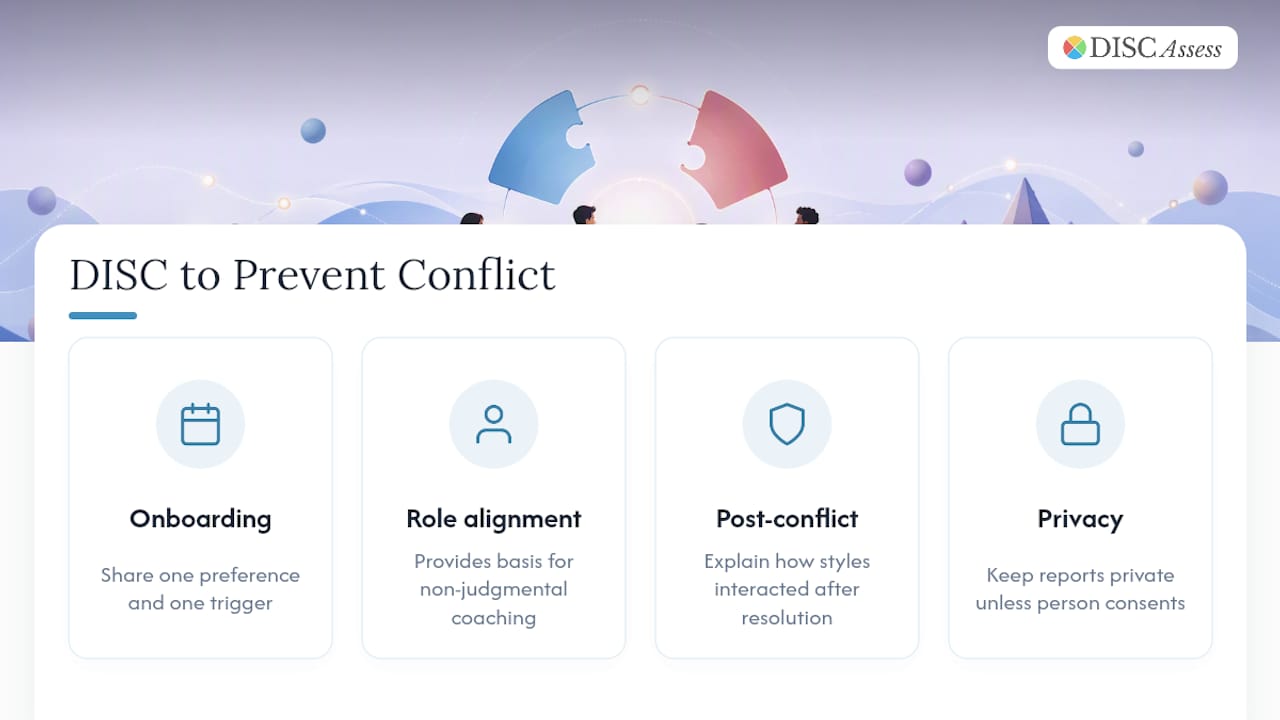
Onboarding: Introduce DISC profiles during the first team meeting. Ask members to share one communication preference and one trigger from their report. This sets a norm of self-awareness from day one.
Role alignment: When recurring friction traces back to a mismatch between a person's natural style and their assigned role, DISC data gives the manager a concrete, non-judgmental basis for a coaching conversation.
Post-conflict coaching: After a resolution meeting, use DISC results to help both parties understand how their styles interacted during the dispute. This turns the conflict into a learning moment rather than a closed case.
Privacy and consent: Individual DISC reports should remain private unless the person explicitly consents to share them. Never use assessment results to label or categorize team members in a group setting without permission. The goal is to change interaction patterns and improve role alignment, not to reduce people to a four-letter type.
Pro Tip: In a mediation conversation, you can reference DISC insights without sharing the report. Say: "Based on what I know about how you each prefer to communicate, let's try framing this differently." That keeps the insight useful while protecting individual privacy.
Copyable templates for conflict resolution meetings
These templates are designed to be used as-is or lightly adapted. They work for in-person and video meetings.
Meeting agenda (45-minute conflict resolution session)
- Welcome and ground rules (5 min): Purpose, speaking norms, confidentiality.
- Party A shares (8 min): Uninterrupted. Facilitator paraphrases.
- Party B shares (8 min): Uninterrupted. Facilitator paraphrases.
- Shared interests (8 min): What does each person genuinely need?
- Options brainstorm (8 min): All ideas welcome, no evaluation yet.
- Agreement (5 min): Choose an option, assign owners and deadlines.
- Close (3 min): Confirm follow-up date and confidentiality expectations.
Three opening scripts
Neutral facilitator: "We're here because something isn't working, and both of you matter to this team. My role is to make sure each person is heard and that we leave with a clear path forward."
Manager to employee: "I've noticed some tension, and I want to address it directly because I respect you both. This isn't about assigning blame. It's about figuring out what we need to change."
Peer to peer: "I think we've gotten off track, and I'd rather talk about it directly than let it sit. Can we take 20 minutes to clear the air?"
Follow-up email template
Cooling-off reflection questions (send before a follow-up meeting)
The Community Tool Box from the University of Kansas recommends structured reflection as a preparation step before facilitated sessions. Send these privately:
- "What has changed since our last conversation?"
- "What are you still finding difficult?"
- "What would a good outcome look like for you?"
How do you handle power imbalances in group conflict?
Power imbalances are one of the most underestimated complicating factors in team conflict resolution. When a senior team member and a junior one are in dispute, the junior person often self-censors in a joint meeting, which produces a surface agreement that doesn't hold.
Several techniques help level the dynamic. Separate pre-meeting interviews give each party equal time to articulate their position without the power gradient in the room. Anonymous written input before a group session, collecting concerns via a shared document or survey, lets quieter voices contribute without the social cost of speaking up in front of authority. Rotating facilitation in ongoing team meetings, where leadership of the agenda shifts among members, builds a norm of shared voice that makes power-based silencing harder to sustain.
When the imbalance involves a direct supervisor, a neutral third-party facilitator is often the only way to create genuine psychological safety. The manager's presence, even a well-intentioned one, shapes what the subordinate feels safe saying.
Conflict resolution in diverse groups
Cultural background, generational experience, and professional identity all shape how people interpret conflict and what resolution looks like to them. In some cultural contexts, direct disagreement is a sign of respect and engagement. In others, it signals disrespect or aggression. Neither interpretation is wrong; they're just different, and a facilitator who doesn't account for that will misread the room.
Practical adjustments for diverse groups include offering multiple input channels (written, verbal, one-on-one, and group) so that members who are less comfortable with public confrontation can still contribute fully. Naming the norm explicitly at the start of a session, "In this conversation, disagreement is welcome and expected," reduces the ambiguity that cultural differences can create. Checking understanding rather than agreement is also useful: "Does this feel fair to you?" lands differently than "Do you agree?" and often surfaces concerns that a simple yes would have buried.
Using "I" statements and focusing on behaviors rather than character judgments, as NCSU's counseling guidance recommends, reduces defensiveness across cultural lines because it keeps the conversation anchored to observable facts rather than interpretations.
How do you measure whether conflict resolution actually worked?
Most teams declare a conflict resolved the moment the meeting ends. That's too early. A resolution holds when the behaviors that caused the conflict have actually changed, not just when both parties said they would.
Useful indicators to track in the weeks after a resolution:
- Recurrence rate: Has the same issue resurfaced? One recurrence may be normal; two suggests the root cause wasn't addressed.
- Participation patterns: Are previously withdrawn team members re-engaging in meetings and group channels?
- Agreement completion: Were the specific actions from the resolution meeting completed on time by the named owners?
- Team climate check: A brief anonymous pulse survey, three to five questions, run four weeks after resolution gives you data rather than impressions.
The improving workplace relationships checklist offers a structured way to track trust-rebuilding after a conflict, which is a useful complement to the behavioral indicators above.
How group norms shape conflict escalation and de-escalation
Group norms are the invisible rules that govern what's acceptable to say, how disagreement gets expressed, and who gets to speak. They form whether or not a team consciously creates them. The question isn't whether your team has norms; it's whether those norms are working for you or against you.
A norm of "keep it positive" sounds healthy but often suppresses legitimate concerns until they explode. A norm of "whoever speaks loudest wins" rewards aggression and silences careful thinkers. Both accelerate conflict rather than contain it.
Effective conflict management strategies include periodic review of group norms as a standing practice, not a one-time exercise. When a team revisits its norms after a conflict, it turns the incident into a structural improvement rather than a personal failure. That reframe matters enormously for psychological safety: the conflict becomes evidence that the team's norms needed updating, not that the people involved are difficult.
Cultural differences and their impact on group conflict resolution
Beyond individual cultural backgrounds, the organizational culture itself sets the frame for how conflict is handled. A team inside a high-accountability, low-hierarchy organization will navigate disagreement very differently from one inside a traditional command-and-control structure, even if the individuals involved share similar personal backgrounds.
Three cultural dimensions that consistently affect group conflict resolution are directness norms (how explicitly disagreement is expected to be stated), face-saving expectations (how much public acknowledgment of error is tolerable), and time orientation (whether the group prioritizes a quick resolution or a thorough one). A facilitator who pushes for a fast, explicit agreement in a group where face-saving is culturally important may produce compliance without genuine buy-in.
The practical response is to build in more private processing time, use written input before verbal discussion, and frame agreements in terms of shared goals rather than individual concessions. That structure works across a wider range of cultural orientations than a single direct-confrontation model does.
A word from the Discassess team
Conflict in groups is not a sign that something is broken. It's a sign that people care enough about the work to disagree about it. The teams we've worked with through Prism Counseling & Coaching over the past decade have taught us that the groups who handle conflict well are rarely the ones who avoid it. They're the ones who've built the skills and the structures to move through it with integrity.
If you're leading a team through a difficult season, or simply want to build the kind of culture where disagreements surface early and resolve cleanly, the frameworks in this guide are a solid starting point. For those who want structured support, assessment tools and facilitated training can accelerate the process considerably.
Discassess can help your team build these skills faster
Knowing the framework is one thing. Having a clear picture of how your team members are wired to communicate, and where the friction points are likely to emerge, is another level of readiness entirely.
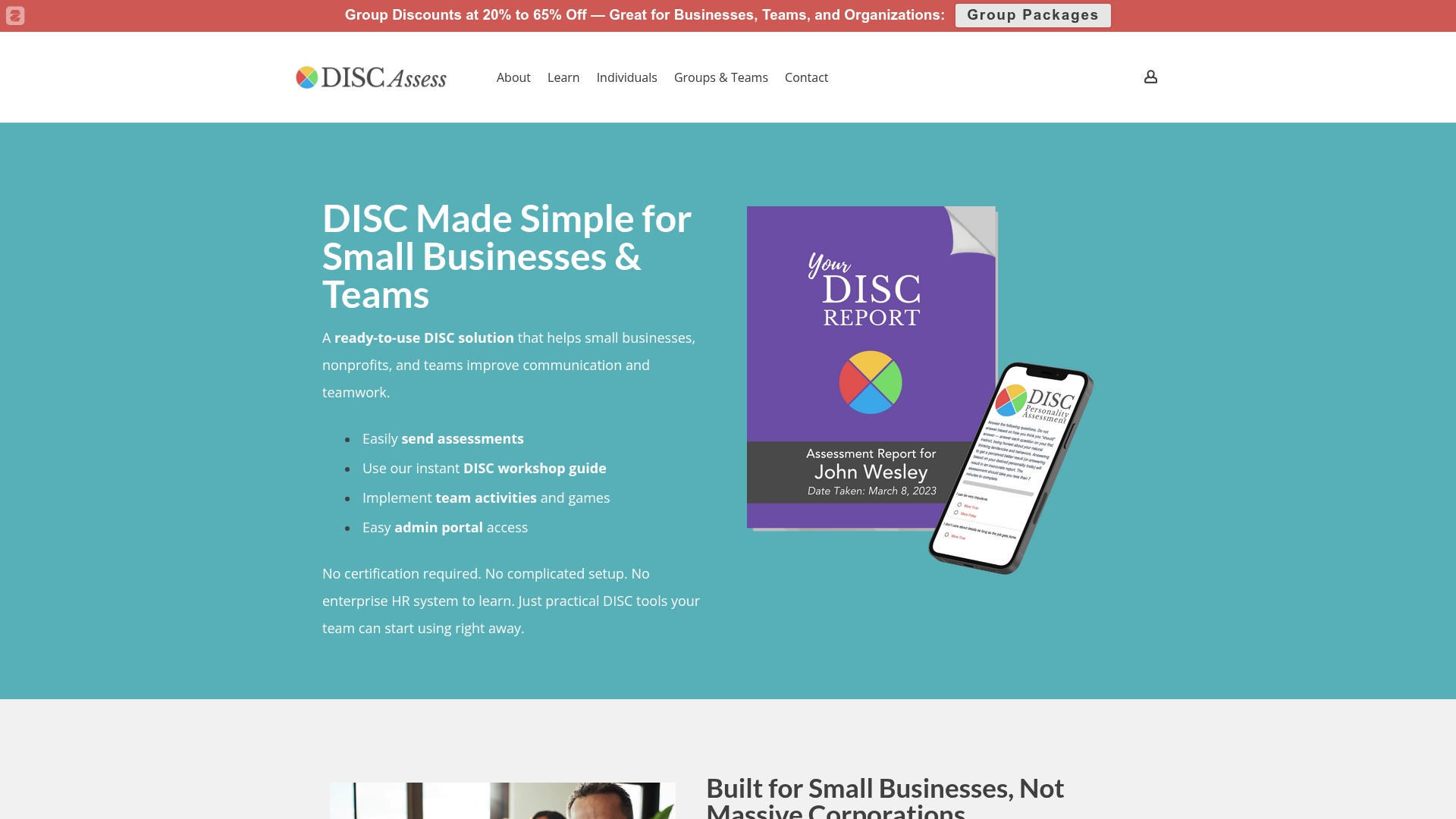
The DISC Group Package from Discassess gives team leaders an admin account plus assessment credits for every team member, so you can map communication styles across the whole group before conflict takes root. Each person receives a detailed individual report, and the admin view lets you see patterns at the group level. For coaches and consultants working with multiple organizations, the White Label DISC System offers a branded, scalable option. Individual leaders who want to start with their own profile can access the Individual Classic DISC Assessment immediately, with an instant report. Assessment tools support skilled facilitation; they don't replace it. But they do give every conversation a clearer, more compassionate starting point. Visit Discassess to explore options or request a demo.
Sources
- Preventing and Managing Team Conflict - Professional & Executive Development | Harvard DCE
- 5.06: Effective Conflict Management Strategies - Social Sci LibreTexts
- 4 common types of team conflict — and how to resolve them - Harvard Business Review