

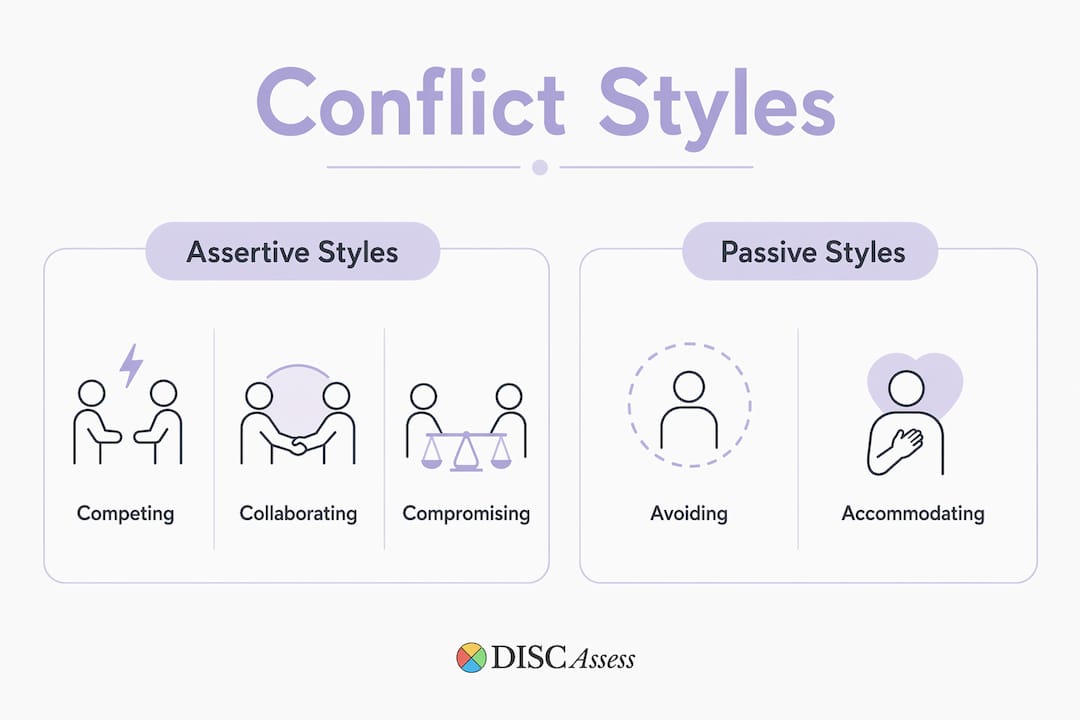
Conflict style in the nonprofit workplace refers to the characteristic approach an individual or team uses to handle disagreements, categorized by the Thomas-Kilmann model into five distinct modes: competing, avoiding, accommodating, compromising, and collaborating. Each mode sits on a two-axis grid measuring assertiveness against cooperativeness. Nonprofits carry unique stakes in this equation. Mission-driven work creates deep emotional investment, small teams amplify every tension, and employees spend an average of 2.8 hours weekly dealing with workplace conflict at a cost of roughly $7,500 and more than seven lost work days per failed conversation. With nonprofit annual turnover running at 19%, unmanaged conflict is not a soft problem. It is a financial and mission threat.
What is conflict style in the nonprofit workplace?
The Thomas-Kilmann model is the industry standard for understanding conflict styles. It maps five modes on a grid where the vertical axis measures assertiveness (concern for your own outcome) and the horizontal axis measures cooperativeness (concern for the other party's outcome). Every person defaults to one or two of these modes under pressure, and that default shapes how disagreements play out across the whole team.
Here is how each mode shows up in nonprofit settings:
- Competing is high assertiveness, low cooperativeness. A leader using this style pushes for a specific outcome and expects others to follow. It works well for urgent, mission-critical decisions where delay causes real harm. Overuse, however, risks escalating tensions and eroding trust on small, closely bonded teams.
- Avoiding is low assertiveness, low cooperativeness. The person sidesteps the conflict entirely, either by delaying or withdrawing. Nonprofits are particularly prone to this style because staff often prioritize harmony over confrontation. Short-term peace comes at the cost of unresolved tension.
- Accommodating is low assertiveness, high cooperativeness. The person yields to the other party to preserve the relationship. This works for low-stakes disagreements, but frequent accommodation without balance leads to burnout and quiet resentment, especially in organizations where staff already sacrifice salary for mission.
- Compromising sits in the middle of both axes. Both parties give something up to reach a workable agreement. It resolves conflict faster than collaborating, but the solution is often temporary because neither party fully commits.
- Collaborating is high assertiveness, high cooperativeness. Both parties work together to find a solution that fully satisfies both sides. This is the most constructive style for long-term team alignment, but it requires significant time and resources that many nonprofits simply cannot spare during high-demand program seasons.
Pro Tip: Map your team's default conflict styles before a crisis hits. Knowing whether your staff leans toward avoiding or competing tells you exactly where your next unresolved tension will come from.
Why is managing conflict in nonprofits uniquely challenging?

Nonprofit workplaces carry emotional weight that most corporate environments do not. Staff members often chose their roles out of personal conviction, which means a disagreement about program direction can feel like a personal attack on their values. That blurred line between professional feedback and personal criticism makes conflict harder to address directly.
Avoidance culture is the most common result. Teams prioritize harmony to protect relationships and mission focus, so tensions simmer quietly until they erupt. Nonprofits frequently confuse interpersonal conflict with systemic problems caused by unclear roles and reporting structures. A staff member who seems "difficult" may actually be responding to an organizational design flaw, not a personality clash.
Structural gaps compound the problem. Many small and mid-size nonprofits lack a dedicated HR function. Without a neutral resource to distinguish interpersonal friction from serious conduct issues, managers carry the full burden of conflict resolution without training or support. That burden accelerates burnout.
| Challenge | Impact on nonprofit teams |
|---|---|
| High emotional investment in mission | Conflict feels personal, not professional |
| Avoidance culture | Tensions go unaddressed and escalate |
| No dedicated HR function | Managers handle conflict without training |
| Unclear roles and reporting lines | Recurring disputes despite individual resolutions |
| 19% annual turnover | Constant onboarding disrupts team cohesion |
The financial cost is real and measurable. Seven lost work days per failed conversation adds up quickly in organizations where every staff hour is tied to program delivery. Unchecked conflict drives turnover, and turnover in a nonprofit does not just cost money. It costs institutional knowledge, donor relationships, and community trust.
How can nonprofit leaders apply conflict style knowledge?
The first shift is mindset. Experts advocate reframing conflict as essential information rather than evidence that something is broken. When a team disagrees, that disagreement often surfaces a real gap in clarity, resources, or values alignment. Leaders who treat conflict as data rather than failure respond more effectively.
Practical application follows four steps:
- Assess your team's default styles. Use a structured tool like a DISC personality assessment to understand how each team member naturally responds to pressure and disagreement. This gives you a map of where avoiding or competing tendencies cluster on your team.
- Train managers to recognize style patterns early. Proactive manager training that targets de-escalation within 1–2 days of a conflict surfacing reduces the chance of a small friction becoming a formal grievance. Managers need language and process, not just good intentions.
- Build clear reporting pathways. Clear policies and HR access are critical for distinguishing interpersonal friction from conduct issues. Even a part-time HR consultant or a documented escalation process gives staff a neutral path forward.
- Match the style to the situation. Use competing when a mission-critical decision needs to move fast. Use collaborating when long-term buy-in matters more than speed. Effective leaders select flexibly among all five styles depending on urgency and stakes. Rigidity in any single style is the real risk.
Pro Tip: Review your team's workplace relationship patterns quarterly, not just after a conflict erupts. Prevention is always cheaper than repair.
Sustaining these changes requires psychological safety. Staff must believe they can raise concerns without retaliation or social cost. That belief does not come from a policy document. It comes from watching leaders respond to disagreement with curiosity rather than defensiveness, consistently, over time.
What are common mistakes in applying conflict styles?
The most damaging mistake is treating avoidance as a default setting. Nonprofits that prize harmony above all else create a culture where tension simmers and erupts unpredictably. Staff learn not to raise concerns, which means leaders lose access to the early warning signals they need most.
Several other pitfalls appear regularly in mission-driven organizations:
- Over-relying on accommodation to keep the peace causes the accommodating party to feel powerless and resentful over time. This is especially common among junior staff who defer to leadership out of respect for the mission, not genuine agreement.
- Assuming collaborating is always best sets unrealistic expectations. Collaboration requires both parties to have time, emotional bandwidth, and roughly equal standing. In a nonprofit under program pressure, those conditions rarely align.
- Using competing style without context signals to staff that their input does not matter. A leader who defaults to competing in every disagreement will see avoidance and disengagement spread through the team.
- Ignoring power dynamics distorts every style. A staff member cannot truly collaborate with a supervisor who controls their performance review. Style selection must account for the actual power structure in the room.
- Treating conflict resolution as a one-time fix misses the systemic dimension. Many recurring conflicts trace back to unclear roles or overlapping responsibilities. Resolving the interpersonal piece without fixing the structural cause guarantees the conflict returns.
The goal is not to eliminate conflict. Building "conflict-health" means developing the capacity to engage productively with disagreement, not the ability to avoid it entirely.
Key Takeaways
Understanding conflict styles in the nonprofit workplace requires applying the Thomas-Kilmann model situationally, building structural supports, and treating conflict as information rather than failure.
| Point | Details |
|---|---|
| Five conflict styles | Competing, avoiding, accommodating, compromising, and collaborating each serve different situations. |
| Nonprofit-specific risks | Avoidance culture and missing HR structures let small tensions grow into costly turnover. |
| Situational flexibility | Effective leaders match the conflict style to the urgency and stakes of each situation. |
| Structural fixes matter | Recurring conflicts often trace to unclear roles, not personality clashes. |
| Conflict-health over harmony | The goal is productive engagement with disagreement, not eliminating it. |
What I've learned from watching nonprofits handle conflict badly
The most common pattern I see is a leadership team that genuinely cares about its people and, because of that care, avoids every hard conversation. The intention is kindness. The result is a team where everyone knows the real problems but nobody names them. That silence is not harmony. It is a slow leak.
What actually works is training managers to see conflict as a signal, not a failure. When a team member raises a concern, that is the system working. The DISC framework for managers gives leaders a concrete language for understanding why two people respond to the same situation so differently. That language alone reduces the emotional charge in most disagreements.
The other thing I would tell every nonprofit leader: do not wait for a crisis to build your conflict resolution infrastructure. The organizations that handle conflict well built their norms, skills, and reporting pathways before they needed them. Culture shifts take months. You cannot install psychological safety in a week.
Patience with the process is not weakness. It is the most practical investment a mission-driven leader can make.
— Tres
How Discassess helps nonprofits understand and manage conflict styles
Knowing your team's conflict styles is the first step. Acting on that knowledge is where Discassess makes the difference for nonprofits.
Discassess offers group assessment packages built specifically for small teams and nonprofits, with no certification required and no complex setup. Each assessment produces a detailed personality report that shows how individual team members naturally respond to pressure, disagreement, and collaboration. Leaders can use those reports to spot avoiding or competing tendencies before they become team-wide patterns. Discassess also offers live group training to help managers apply assessment insights directly to conflict situations. For nonprofits ready to build a conflict-healthy culture, Discassess provides the tools to start that work today.
FAQ
What is the Thomas-Kilmann conflict model?
The Thomas-Kilmann model is the industry-standard framework for conflict styles, defining five modes based on assertiveness and cooperativeness: competing, avoiding, accommodating, compromising, and collaborating.
Which conflict style is most common in nonprofits?
Avoidance is the most common default in nonprofits, where staff prioritize harmony and relationship preservation over direct confrontation, often allowing tensions to build unaddressed.
How does DISC relate to conflict styles in the workplace?
DISC personality assessments reveal how individuals naturally respond to pressure and disagreement, giving teams a shared language for understanding and adapting their conflict styles before disputes escalate.
What does "conflict-health" mean for a nonprofit?
Conflict-health means building the organizational capacity to engage productively with disagreement rather than eliminating it, supported by clear norms, manager training, and psychological safety.
How can nonprofit leaders reduce the cost of workplace conflict?
Investing in proactive systems including manager training, clear reporting pathways, and personality assessments reduces unresolved disputes, lowers turnover, and protects the mission focus that nonprofits depend on.