

Soft skills development in the workplace is the intentional process of building interpersonal, behavioral, and cognitive abilities that determine how effectively people work with others and navigate professional challenges. Carnegie Foundation research attributes 85% of long-term career success to soft skills and only 15% to technical proficiency. That finding reframes the entire conversation around professional growth. Technical expertise gets you hired. People skills determine how far you go. This guide explains what soft skills development means, which skills matter most, and how professionals and managers can build them systematically through proven frameworks.
What is soft skills development in the workplace?
Soft skills development in the workplace refers to the active, structured practice of improving abilities like communication, emotional intelligence, adaptability, and leadership. The industry increasingly uses the term power skills to reflect how central these capabilities are to organizational success. Nearly 7 in 10 US employers prioritize candidates with strong power skills over those with technical credentials alone. That number signals a fundamental shift in what employers value most.
These skills are not fixed personality traits. Soft skills are capabilities refined through real-world practice, feedback loops, and continuous learning. A person who struggles with public speaking today can become a confident presenter through deliberate, repeated practice. The key word is deliberate. Passive experience rarely produces lasting change. Intentional effort does.

Which soft skills matter most in the modern workplace?
The most in-demand soft skills today cluster around human connection and adaptability. Emotional intelligence, leadership, and adaptability top employer priority lists because they cannot be automated. AI can process data, but it cannot read a room, resolve a conflict, or inspire a team.
The six soft skills with the highest workplace impact are:
- Communication: Clearly expressing ideas in writing, speech, and active listening
- Adaptability: Adjusting behavior and thinking when circumstances change
- Emotional intelligence: Recognizing and managing your own emotions and others'
- Teamwork: Contributing effectively within diverse groups toward shared goals
- Critical thinking: Analyzing situations and making sound decisions under pressure
- Leadership: Guiding others with clarity, empathy, and accountability
65% of employers report gaps in new graduates' communication, listening, resilience, and adaptability. That gap is not closing on its own. Remote and hybrid work has widened it by reducing the informal, face-to-face interactions where these skills naturally develop. Managers who recognize this gap and address it directly give their teams a measurable advantage. Reviewing staff communication strategies for small teams is a practical starting point for identifying where those gaps show up in daily work.
How does soft skills development differ from hard skills training?
Hard skills training follows a predictable path. You learn a process, practice it, and measure your accuracy. Soft skills development does not work that way. Soft skills require an environment and others' input to master, which makes the learning process inherently unpredictable and complex.
Consider the difference between learning Excel formulas and learning to give constructive feedback. Excel responds the same way every time. A colleague does not. Their reaction depends on their mood, your relationship, the timing, and a dozen other variables outside your control. That complexity is exactly why soft skills training programs that rely solely on classroom instruction or online modules often fall short.
The behavioral focus is the critical distinction. Improvement fails when professionals focus on "skills" as abstract categories instead of specific, observable behaviors. "Improve my communication" is too vague to act on. "Ask one clarifying question before responding in meetings" is specific enough to practice and measure.
Pro Tip: Before enrolling in any soft skills training program, identify one specific behavior you want to change. Vague goals produce vague results. Specific behaviors produce measurable progress.
The ongoing nature of soft skills learning also sets it apart. Technical skills reach a point of mastery. Soft skills continue to evolve as your role, team, and environment change. A manager who leads a team of five needs a different communication style than one leading a team of fifty. Growth never fully stops.
How to develop soft skills at work: a practical framework
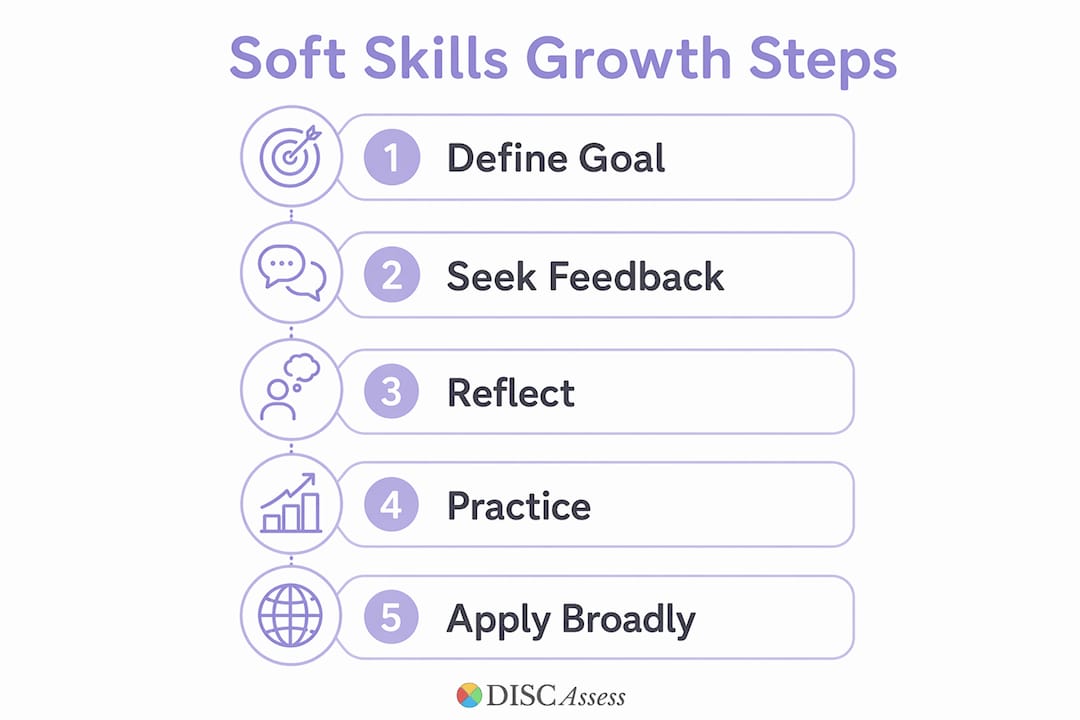
The most effective approach to building soft skills follows a four-step behavior loop. Optimal soft skill mastery involves a 10–15 repetition loop focused on specific behaviors within targeted situations, typically over a two-week window. Here is how to apply that loop in practice:
- Define the specific behavior. Choose one observable action, not a broad skill. For example: "State my view within the first five minutes of a team meeting" rather than "be more assertive."
- Choose a low-stakes situation. Start with familiar settings where the pressure is manageable. A weekly team check-in works better than a board presentation for early practice.
- Execute and log the result. After the meeting, write two sentences. What did you do? What happened? Most people skip this logging step, which is exactly why their progress stalls.
- Adjust and repeat. Review your notes after each attempt. Identify one small adjustment and apply it in the next session.
| Step | Action | Time frame |
|---|---|---|
| Define behavior | Write one specific, observable action | Day 1 |
| Choose situation | Select a low-stakes, recurring context | Day 1–2 |
| Execute and log | Practice and record a two-line note | Days 3–14 |
| Adjust and repeat | Refine based on your log and feedback | Ongoing |
Feedback is the other non-negotiable ingredient. Targeted feedback requests yield far better results than broad questions. Instead of asking a colleague "What can I improve?", ask "In yesterday's meeting, did my opening comment help clarify the agenda?" That specificity gives the other person something concrete to respond to and gives you something concrete to act on.
Pro Tip: Schedule a two-minute reflection immediately after any meeting where you practiced a target behavior. Memory fades fast. Your notes from that moment are worth more than a week of general reflection later.
Once you have repeated a behavior successfully in low-stakes settings, move it to higher-stakes contexts. Bring that same assertive opening comment to a cross-departmental meeting. Then to a client call. Incremental progression builds genuine confidence rather than manufactured bravado. Exploring personal growth assessment tools can help you track this progression with more structure and objectivity.
What are the benefits of soft skills development for individuals and organizations?
Strong soft skills produce measurable returns at every level of an organization. For individuals, they accelerate career advancement, improve leadership effectiveness, and build resilience when facing change. For organizations, they drive collaboration, reduce conflict, and create cultures where people actually want to show up.
"The ability to communicate clearly, adapt under pressure, and lead with empathy is not a soft advantage. It is the foundation of every high-performing team and every career that lasts."
The organizational benefits are especially significant in environments shaped by rapid technological change. Teams with high emotional intelligence navigate restructuring and AI adoption more effectively than those without it. They ask better questions, surface problems earlier, and recover from setbacks faster. Reviewing employee engagement best practices shows how directly these skills connect to retention and productivity outcomes.
The benefits of soft skills development also extend to workplace inclusion. Empathy and active listening create conditions where diverse perspectives are heard and valued. That is not just a cultural good. Teams that include diverse viewpoints consistently produce better decisions. Soft skills are the mechanism that makes inclusion functional rather than theoretical.
Common challenges and misconceptions in soft skills development
The biggest obstacle to soft skills growth is a fixed mindset about what these skills are. Many professionals treat communication style or emotional reactivity as personality traits rather than trainable behaviors. Professionals who see soft skills as fixed miss the most important opportunities for growth. The belief that "I'm just not a people person" is a ceiling, not a fact.
Three other common challenges derail progress:
- Vague goals: Aiming to "be a better listener" without defining what that looks like in a specific meeting produces no measurable change.
- Skipping the log: Without written notes after each practice session, patterns stay invisible and adjustments never happen.
- Avoiding high-stakes settings: Practicing only in safe environments means the skill never transfers to the situations where it matters most.
A subtler challenge involves identity. Some professionals resist changing their communication style because it feels like abandoning who they are. The goal is not replacement. It is expansion. A naturally direct communicator does not need to become soft-spoken. They need to add the ability to slow down and listen when the situation calls for it. Behavior-specific goals make this expansion feel manageable rather than threatening.
Pro Tip: Frame every soft skill goal as an addition, not a replacement. "I will add one question before I respond" feels far less threatening than "I need to stop being so blunt." Both address the same behavior. One invites growth.
Why "power skills" is the right frame for this work
The label "soft skills" has always undersold what these abilities actually do. Renaming them power skills is not just a branding exercise. It reflects the reality that these capabilities drive innovation, inclusivity, and adaptability at every level of an organization. I have watched teams with average technical skills outperform technically brilliant groups simply because they communicated well and trusted each other.
The professionals who invest in this work early rarely regret it. The ones who wait until a promotion is on the line or a team is in crisis find themselves playing catch-up under pressure. That is the hardest time to learn. The behavior loop framework described here works precisely because it builds the skill before the stakes are high. You practice stating your view in a weekly team meeting so that when the board asks for your opinion, the behavior is already automatic.
What I find most encouraging is that this work aligns with something deeper than career advancement. Growing in patience, empathy, and clear communication reflects the kind of character development that matters beyond any job title. The fruit of that growth shows up in every relationship, not just the professional ones. If you lead a team, the most lasting investment you can make is in your own interpersonal growth, and then in creating the conditions for your team to do the same.
— Tres
How Discassess supports your soft skills growth
Understanding your natural behavioral style is the fastest way to identify which soft skills need the most attention. Discassess offers accessible DISC personality assessments that reveal how you communicate, respond to conflict, and adapt under pressure.
The DISC Group Package gives managers a clear picture of their team's behavioral tendencies, making it easier to target development efforts where they will have the most impact. Individual assessments through the Classic DISC Assessment provide detailed reports that connect personality insights to specific communication and leadership behaviors. Discassess is built for small businesses, nonprofits, and teams that want practical results without a complex implementation process.
FAQ
What is soft skills development in the workplace?
Soft skills development in the workplace is the structured practice of building interpersonal and behavioral abilities like communication, adaptability, and emotional intelligence. These skills are trained through deliberate practice, feedback, and repetition rather than passive experience.
How long does it take to develop a soft skill?
Research points to a 10–15 repetition loop over approximately two weeks as the baseline for building a specific soft skill behavior. Transferring that skill to higher-stakes settings requires additional practice cycles.
What are the most important soft skills for professional success?
Communication, emotional intelligence, adaptability, critical thinking, teamwork, and leadership consistently rank as the highest-impact soft skills across industries. Employers report the largest gaps in communication, listening, and resilience among new hires.
How is soft skills development different from hard skills training?
Hard skills training follows a predictable, measurable path to mastery. Soft skills development depends on interpersonal context, behavioral feedback, and ongoing adjustment, making it more complex and never fully complete.
How can managers support soft skills development in their teams?
Managers accelerate team growth by setting behavior-specific development goals, creating low-stakes practice opportunities, and asking targeted feedback questions after specific interactions. Reviewing workplace relationship strategies gives managers a structured starting point for this work.
Key Takeaways
Soft skills development in the workplace produces the most lasting results when professionals focus on specific, observable behaviors rather than broad skill categories and repeat them through structured practice loops.
| Point | Details |
|---|---|
| Power skills, not soft skills | Reframing these abilities as power skills reflects their real impact on innovation, leadership, and team performance. |
| Behavior-specific goals work | Targeting one observable action, like asking a clarifying question, produces measurable progress where vague goals do not. |
| The four-step loop is the method | Define, choose a situation, execute and log, then adjust. Repeat 10–15 times over two weeks for lasting change. |
| Logging is non-negotiable | Writing two sentences after each practice session is the step most people skip and the one that matters most. |
| DISC assessments accelerate growth | Knowing your behavioral style helps you identify which skills need development and how to approach that work effectively. |