

Objective thinking means prioritizing verifiable evidence and structured reasoning over unexamined feelings and assumptions. It is the discipline of testing a conclusion against facts before accepting it as belief. The Foundation for Critical Thinking describes this as a lifelong, self-directed practice, not a personality trait you either have or lack.
Here is the claim worth sitting with: people who practice objective thinking consistently make clearer decisions and avoid many mistakes that come from acting on assumption alone. That is true whether you are choosing a job, leading a team through a hard call, or simply trying to understand why a conversation went sideways. Tools built for self-awareness, like the assessments from Discassess, give this practice something concrete to work with.
What follows is a practical walk through:
- What separates objective thinking from subjective reaction
- The biases that quietly sabotage good judgment
- Step-by-step techniques, including a weighted decision matrix
- The psychological and emotional forces at play, and how to work with them rather than against them
Key Takeaways
Objective thinking works because it replaces unexamined impressions with verifiable evidence and structured criteria, and it improves measurably with deliberate practice.
| Point | Details |
|---|---|
| Definition anchors the practice | Objective thinking prioritizes evidence that others could verify over personal feeling alone. |
| Biases are predictable and namable | Confirmation bias, anchoring, and groupthink each have a specific, practical mitigation step. |
| The weighted matrix is the core tool | Score options against weighted criteria to turn a hunch into an arguable decision. |
| Emotion informs, it doesn't decide | Label feelings separately from evidence rather than suppressing them outright. |
| Discassess supplies the missing input | Individual and group DISC reports give a verified, third-party baseline to feed directly into any decision framework. |
Table of Contents
- What Is Objective Thinking, and How Does It Differ From Subjective Thinking?
- Why Does Objective Thinking Matter for Decisions and Growth?
- What Cognitive Biases Get in the Way of Objective Thinking?
- Which Techniques and Decision Frameworks Actually Build Objectivity?
- What Does the Research Say About Practicing Objectivity?
- How Does DISC Assess Support Objective Self-Awareness?
- What Happens in the Brain During Objective Thinking?
- How Does Emotion Affect Objective Thinking?
- What Are Common Misconceptions About Objective Thinking?
- How Does Objective Thinking Vary Across Cultures?
- Why Objective Thinking Deserves More Respect Than It Gets
- Getting Started With Discassess: What to Try First
- Sources
What Is Objective Thinking, and How Does It Differ From Subjective Thinking?
Objective thinking is the practice of forming conclusions based on evidence that other reasonable people could examine and verify, using clear criteria rather than gut reaction alone. Robert Ennis, whose work anchors much of modern classroom instruction in this area, defines critical thinking as "reasonable and reflective thinking focused on deciding what to believe or do." Objective thinking is the evidentiary half of that process: the part concerned with what is actually true or likely true, independent of who is looking at it.
Subjective thinking runs on a different fuel. It draws from personal values, emotional response, and lived experience, none of which are wrong to have, but none of which are verifiable by a third party. The philosophical distinction matters here: objectivity involves claims that hold up under observation, experimentation, and intersubjective dialogue, while subjectivity centers on first-person feeling. Both have a place. The trouble starts when subjective impressions get treated as if they were objective facts.
Consider two examples:
- A personal decision. You are deciding whether to leave a stable job for a startup offer. An objective approach compares salary trajectory, industry stability, and your actual skill match against the role's requirements. A subjective approach leans on how exciting the interview felt or how bored you are with your current desk.
- A group decision. A nonprofit board is choosing between two program directors. Objective inputs include track record, budget management history, and structured personality assessment data on leadership style. Subjective inputs include which candidate the hiring committee simply "liked more" in the room.
Neither example says feelings are irrelevant. Peter Facione's widely taught framework treats critical thinking as a combination of skills and dispositions, meaning the desire to be fair and open to evidence matters as much as the mechanics of analysis. The goal is not to eliminate feeling. It is to stop feeling from masquerading as fact.
Why Does Objective Thinking Matter for Decisions and Growth?
Objective thinking pays off in ways that are easy to underestimate until you watch it fail. Decisions made on verified information tend to hold up better under pressure, because they were never resting on a shaky assumption in the first place.
The benefits show up in a few recurring places:
- Better decisions under uncertainty. When you separate what you know from what you assume, you stop mistaking confidence for accuracy.
- Stronger teamwork. Teams that evaluate ideas on merit rather than seniority or charisma make fewer costly missteps.
- Reduced bias exposure. Structured evaluation catches distortions before they calcify into policy or habit.
- Measurable outcomes. You can actually track whether a decision worked, because you defined success criteria before you decided.
Picture a mid-level manager weighing a promotion decision between two internal candidates. One approach: pick the person who has been "a great cultural fit" and seems most enthusiastic in meetings. Another approach: score both candidates against defined criteria like project delivery, peer feedback, and readiness for the specific responsibilities of the new role. The second approach requires more time but is less likely to lead to a grievance later.
The evidence behind this isn't just theoretical. A peer-reviewed synthesis of decision-making research lays out ten practical rules for more objective decision-making, including breaking a decision into parts, actively mitigating known biases, and building in feedback loops after the fact. These are not abstractions. They are steps you can run through on a Tuesday afternoon before a budget meeting.
What Cognitive Biases Get in the Way of Objective Thinking?
Certain mental shortcuts distort judgment so reliably that psychologists have named and studied them for decades. Recognizing them by name is the fastest way to catch yourself in the act.
- Confirmation bias. You notice and remember evidence that supports what you already believe, and quietly discount the rest. It shows up when you read one glowing review and stop researching a product. Mitigation: deliberately seek out the strongest argument against your position before deciding.
- Motivated reasoning. You reason backward from a conclusion you want to be true. It shows up when you justify a purchase you already made your mind up about. Mitigation: ask what evidence would have to exist for you to be wrong, then look for it.
- Anchoring. The first number or idea you encounter distorts everything that follows. It shows up when an initial salary offer shapes every later negotiation, even irrelevant ones. Mitigation: generate your own independent estimate before seeing anyone else's.
- Availability bias. You overweight information that comes to mind easily, usually because it was recent or vivid. It shows up when a single dramatic news story reshapes your sense of overall risk. Mitigation: check base rates and broader data, not just the memorable case.
- Groupthink. A group converges on agreement to avoid friction, sacrificing scrutiny for harmony. It shows up in meetings where nobody wants to be the one who raises the awkward objection. Mitigation: assign someone the explicit job of arguing the other side.
- Cognitive dissonance. You feel discomfort holding two conflicting beliefs, so you unconsciously adjust one to relieve the tension. It shows up when you downplay red flags about a decision you have already committed to publicly. Mitigation: separate the decision from your identity, so revising it doesn't feel like losing face.
Management research on confirmation bias in organizations points to a consistent fix across most of these traps: build in a structured moment where disconfirming evidence and outside critique are actually invited, not just tolerated.
Pro Tip: Before finalizing any decision that affects other people, write down the single strongest argument against your choice. If you cannot articulate one honestly, you have not looked hard enough yet.
Which Techniques and Decision Frameworks Actually Build Objectivity?
Objectivity is a skill, not a personality trait, and skills improve with specific, repeatable drills. These five techniques work in sequence, from questioning your assumptions to stress-testing your final call.
- Run Socratic questioning on your own assumptions. Ask directly: What is the evidence for this belief? What would change my mind? Who benefits if I'm wrong about this? These three questions alone surface most hidden assumptions within minutes.
- Separate objective criteria from subjective ones. List every factor influencing your decision, then sort each into "verifiable" (cost, timeline, track record) or "values-based" (comfort, preference, gut feeling). This alone often reveals that a decision felt harder than it needed to be because two different categories of input were tangled together.
- Build a weighted decision matrix. This is the single most concrete tool in the peer-reviewed literature on objective decision-making, and it works for anything from hiring to home purchases.
- Invite real critique, not polite feedback. Ask a specific question: "What's the strongest reason this could fail?" A vague "what do you think?" invites a vague answer.
- Know when to privilege values over pure data. Objectivity is a tool for clarity, not a replacement for conscience. Some decisions, like whether to forgive a friend or how to parent a specific child, resist full quantification on purpose.
A simple example of a weighted matrix compares two job offers on criteria like salary, growth potential, and commute. Each criterion receives a weight, options are scored from 1 to 10, and weighted scores summed. The decision becomes transparent and subject to discussion rather than intuition alone.
| Step | What to do |
|---|---|
| 1. Question assumptions | Ask what evidence supports the belief and what would change your mind. |
| 2. Sort criteria | Separate verifiable factors from values-based preferences. |
| 3. Weight and score | Assign percentage weights to each criterion, score every option, multiply and sum. |
| 4. Invite critique | Ask someone specifically for the strongest counterargument to your choice. |
| 5. Reassess after outcome | Compare the actual result against your original criteria to calibrate future decisions. |
What Does the Research Say About Practicing Objectivity?
The strongest guidance on this topic comes from two directions: applied decision science and classical critical-thinking theory, and they largely agree with each other.
"Ten simple rules" for more objective decision-making recommend breaking decisions into component parts, actively mitigating bias through better inputs, staying transparent about your reasoning, building feedback loops after the decision is made, and using structured tools like weighted matrices instead of relying on impression alone.
That synthesis, published in PMC, reads less like abstract theory and more like an operating manual. Ennis's framework adds the piece that decision science sometimes skips: disposition matters as much as method. A person can know exactly how to build a weighted matrix and still avoid using it if they lack what Ennis calls the disposition to be "open-minded" and to "seek reasons." Skill without the willingness to apply it under pressure produces little practical change.
Objectivity has limits worth naming honestly. Decisions involving deep personal values, like whom to marry or whether to reconcile with an estranged parent, resist full quantification, and pretending otherwise produces a false sense of precision. The Stanford Encyclopedia's entry on critical thinking notes that educational interventions involving dialogue and mentoring show measurable gains in reasoning ability over time, which is itself the strongest argument for practice over pure talent.
How Does DISC Assess Support Objective Self-Awareness?
The techniques above depend on one input that is easy to overlook: an accurate picture of your own tendencies. It is difficult to weigh criteria fairly or invite honest critique if you do not know your own default communication style, decision speed, or conflict pattern going into the conversation.
- An Individual Classic DISC assessment surfaces behavioral blind spots you can feed directly into a decision matrix as objective, third-party data rather than self-report guesswork.
- Group packages and custom reports with video analysis give teams a shared, transparent baseline, which is exactly the kind of structured input that supports honest critique rather than polite deflection.
- Reviewing results alongside a colleague, using an approach similar to the one described in conflict styles guidance for teams, turns a personality report into an actual feedback loop instead of a filed-away PDF.
Discassess is backed by Prism Counseling & Coaching, which has spent over a decade building practical tools for small organizations, coaches, and leadership teams who need clarity without a certification requirement standing in the way.
Pro Tip: Treat your DISC report as one input in the weighted matrix, not the whole decision. Behavioral tendencies inform criteria like "communication fit" or "decision speed under pressure," but they should carry a defined weight, not an outsized, unexamined one.
What Happens in the Brain During Objective Thinking?
Objective thinking draws heavily on the prefrontal cortex, the region responsible for weighing evidence, delaying gratification, and holding multiple possibilities in mind at once before committing to a conclusion. This region matures relatively late in human development and is also the first to lose bandwidth under stress or fatigue, which is a large part of why tired, rushed decisions tend to skew more emotional and less evidence based.

Working memory plays a direct role too. Comparing several criteria across several options, exactly what a weighted decision matrix asks you to do, requires holding multiple variables active simultaneously. That is cognitively demanding, which explains why most people default to a single dominant impression instead. It is easier. It is also less reliable.
The amygdala, the brain's threat-detection center, can override deliberate reasoning almost instantly when it perceives risk, urgency, or social threat. This is a survival mechanism, not a flaw, but it means that decisions made in a state of anxiety or anger are structurally biased toward speed over accuracy. Slowing down before a high-stakes decision is not a soft suggestion. It is a way of giving the slower, more deliberate reasoning system time to actually engage instead of ceding control to the faster alarm system.
None of this means objective thinking is purely a matter of willpower. It is partly a matter of conditions: enough rest, enough time, and enough distance from the immediate emotional trigger to let the deliberate system do its job.
How Does Emotion Affect Objective Thinking?
Emotion is not the enemy of objective thinking. It is often the signal that tells you a decision matters enough to think about carefully in the first place. The problem starts when emotion substitutes for evidence rather than simply flagging that evidence is needed.

Strong emotional states narrow attention. Fear tends to make risks feel larger and more urgent than base rates justify. Anger tends to make blame feel obvious when the actual cause is more distributed. Excitement tends to make downsides feel temporarily invisible, which is exactly why major purchases made in a state of enthusiasm deserve a mandatory cooling-off period before signing anything.
A few practical strategies manage this interference without pretending emotion doesn't exist:
- Name the emotion out loud or in writing. Simply labeling "I feel anxious about this" reduces its grip on judgment, a well-documented effect in emotional regulation research.
- Delay decisions during emotional peaks. A 24-hour rule for major decisions gives the prefrontal cortex time to catch up with the amygdala's initial alarm.
- Separate the feeling from the fact. Write "I feel like this will fail" next to "the data shows a 30% failure rate in similar cases" as two distinct lines, not one blended impression.
Objective thinking is not emotionless reasoning. The goal is ensuring conclusions rest on evidence and defensible criteria while still letting values and feeling guide which outcome you actually want.
What Are Common Misconceptions About Objective Thinking?
The most persistent misconception is that objective thinking means suppressing emotion entirely, as if the ideal thinker were some kind of calculator with no preferences. That is not what the research supports, and pursuing it tends to backfire, producing decisions that are technically defensible but personally hollow.
A second misconception treats objectivity as an all-or-nothing state you either achieve or fail at. In practice, objectivity operates on a sliding scale and fluctuates by domain. You might reason with real rigor in your professional specialty while remaining thoroughly biased in an area where you have no real experience, like parenting advice or investment tips from a friend who "just knows a guy." Practical improvement usually means identifying your specific weak domains rather than assuming you are uniformly rational or uniformly biased.
A third pitfall is mistaking confidence for accuracy. Someone who states a conclusion forcefully is not automatically more correct, yet confident delivery reliably sways group decisions more than the actual quality of the underlying evidence.
A fourth trap is treating a single data point as proof. One bad experience with a vendor, one rude interaction with a coworker, one viral anecdote online: none of these constitute a pattern, though they feel like one because they are vivid and recent. Objective thinking requires actively resisting the pull of the memorable case in favor of the broader, duller trend.
How Does Objective Thinking Vary Across Cultures?
The mechanics of evidence and logic do not change across borders, but what counts as legitimate evidence, and how directly people are expected to challenge a conclusion, varies considerably by cultural context.

In many individualist cultures, common across much of North America and Western Europe, direct debate and open disagreement are treated as respectful, even necessary, parts of reaching a sound conclusion. Challenging a colleague's proposal in a meeting is often read as engagement, not disrespect. In many collectivist cultures, common across large parts of Asia, Africa, and Latin America, preserving group harmony and hierarchy carries real weight alongside the evidence itself, and direct public challenge can be read as a breach of respect rather than rigorous analysis.
This does not mean objectivity works differently at its core. It means the social packaging around delivering an objective conclusion needs to adapt. A team lead working across cultural contexts might get better results by inviting critique privately and in writing rather than expecting someone to challenge a senior figure out loud in a group setting. The underlying discipline, testing conclusions against evidence rather than status or comfort, stays constant. Only the method for surfacing disagreement needs to flex.
Workplaces that operate across multiple cultural norms benefit from making the feedback process explicit rather than assuming everyone shares the same comfort level with open disagreement.
Why Objective Thinking Deserves More Respect Than It Gets
Most advice on this topic treats objective thinking as a mood: get calm, get rational, decide. That framing undersells what the actual research supports. Objectivity is closer to a set of drills than a state of mind, and the drills work whether or not you feel calm when you run them.
The gap between conventional wisdom and what the evidence actually shows is this: people assume objectivity requires suppressing emotion, when the real lever is separating emotion from evidence on the page, not in the head. A weighted matrix does that separation mechanically. A Socratic question does it verbally. Neither requires you to feel like a neutral robot first.
Where the popular advice falls shortest is on feedback. Everyone talks about "getting outside opinions." Almost nobody builds an actual structure for it, which is why the PMC synthesis treats feedback loops as a discrete rule rather than a vague nicety. If there is one place to start, it's there: pick one recent decision, write down the criteria you actually used, and hand it to someone whose job is to find the hole in it.
— Tres
Getting Started With Discassess: What to Try First
The fastest way to put any of this into practice is to get an accurate baseline of your own tendencies before your next real decision. An Individual Classic DISC Personality Assessment gives you a report in minutes, not weeks, with no certification or HR background required to understand it.
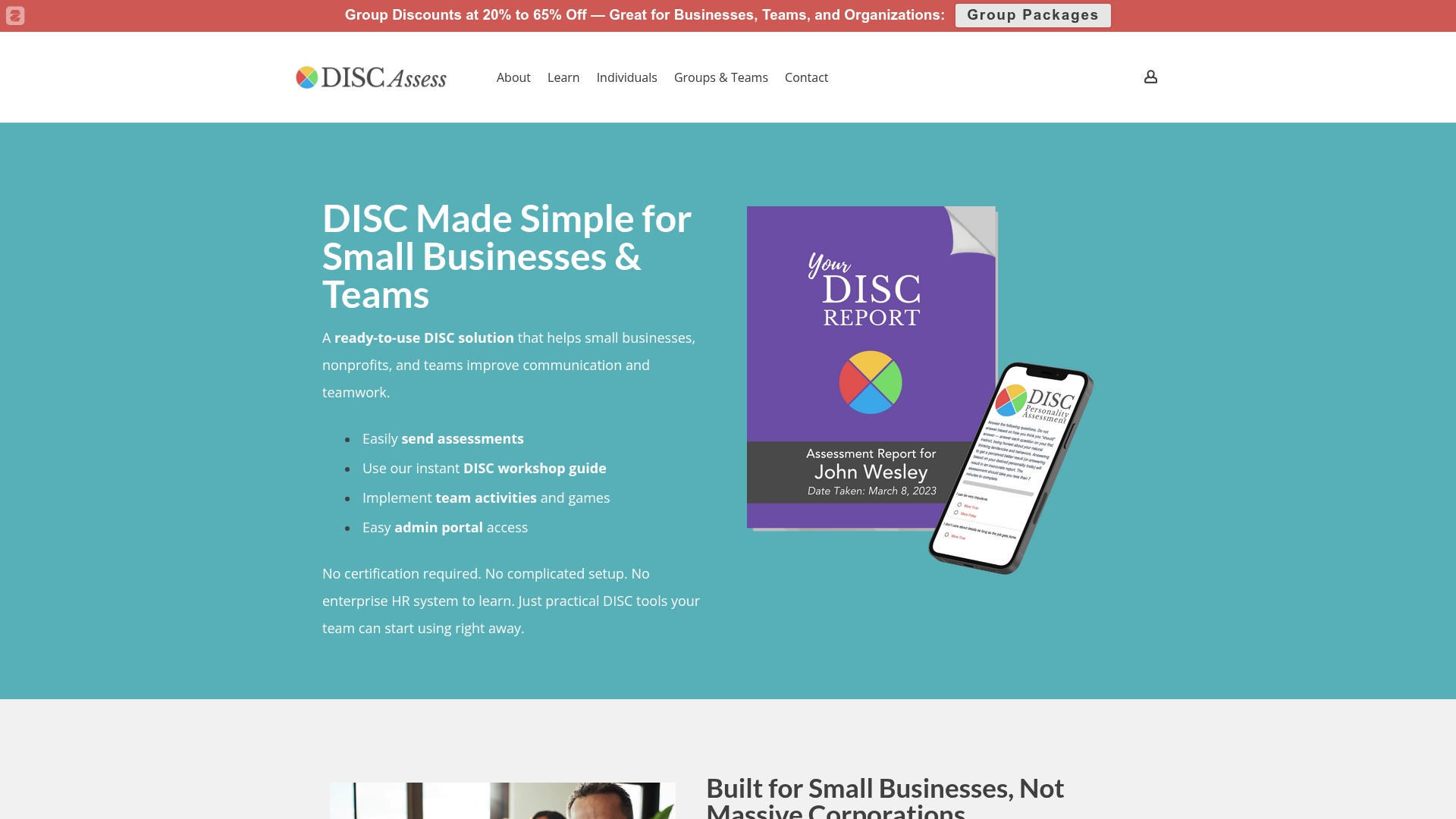
Once you have your report, do the exercise this article walked through: pull out one page of key traits, hand it to someone you trust, and ask them directly what they'd push back on. That single conversation does more for objective self-awareness than reading ten articles on bias. If you are leading a team rather than working solo, the DISC Group Package bundles an admin account with assessment credits so everyone works from the same shared baseline, and organizations that expect to run assessments regularly can explore the demo of the admin portal before committing. Every report stays private to the account holder unless it's deliberately shared, and the platform was built for people without a technical or HR background to navigate on their own. Start with one assessment, one honest reviewer, and one real decision on the table.
Sources
- Ten simple rules for more objective decision-making — PMC
- Defining Critical Thinking — Foundation for Critical Thinking
- Critical thinking — Stanford Encyclopedia