

A behavioral assessment tool is a structured method used to observe, record, and interpret an individual's behaviors and the environmental factors that shape them. Unlike traditional personality tests that focus on fixed traits, these tools measure observable actions and the variables influencing them, guiding treatment plans, educational supports, and hiring decisions. You will find them used across clinical psychology, school settings, and HR departments, each context drawing on the same core principle: understand what a person actually does, not just what they say about themselves.
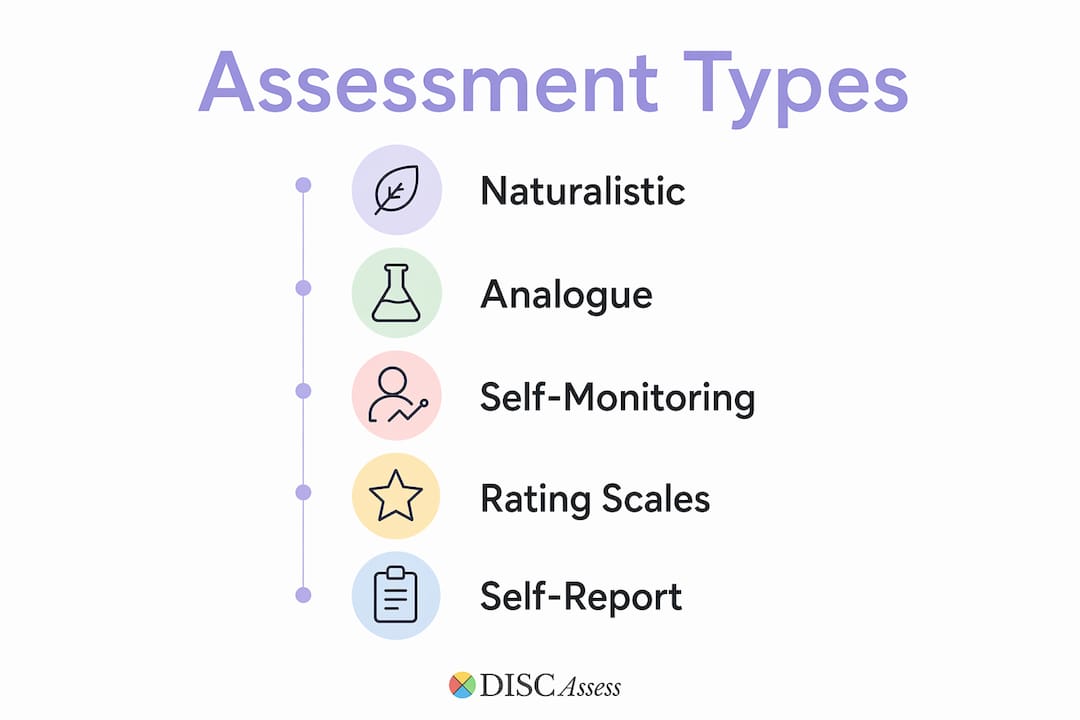
The methods that fall under this category include:
- Naturalistic observation: watching behavior as it occurs in real settings
- Structured (analogue) observation: observing behavior in controlled or role-play scenarios
- Self-monitoring: individuals tracking their own behavior through diaries or logs
- Behavior rating scales: structured questionnaires completed by parents, teachers, or supervisors
- Self-report inventories: standardized questionnaires completed by the individual being assessed
Each method captures a different angle of the same person, which is exactly why practitioners rarely rely on just one.
What are the main types of behavioral assessment tools?
The five core categories of behavioral evaluation techniques each serve a distinct purpose, and knowing which to use depends heavily on your setting and goals.

Naturalistic observation places the assessor in the individual's real environment, whether a classroom, workplace, or home. Clinicians and educators favor this approach because it captures behavior as it genuinely occurs, without the distortion that comes from artificial settings. The trade-off is time: thorough naturalistic observation requires extended periods of data collection.
Analogue observation brings behavior into a controlled environment, often through role-playing or structured tasks. HR professionals use this format in assessment centers, where candidates respond to simulated workplace scenarios. Behavioral assessments in hiring range from brief questionnaires to comprehensive evaluations that include these situational tasks, helping organizations predict workplace fit by examining temperament, habits, and communication styles.
Self-monitoring tools ask individuals to record their own behavior in real time, using diaries, logs, or apps. This method works particularly well in cognitive-behavioral therapy contexts, where tracking thought patterns and emotional responses is central to treatment. For a deeper look at how self-monitoring connects to emotional regulation strategies, the link between behavioral data and intervention becomes clear.
Behavior rating scales gather input from multiple observers, such as parents, teachers, or coworkers, using standardized checklists. They are especially common in educational settings, where a child's behavior at home may differ significantly from behavior in the classroom. Multi-informant data reduces the blind spots that any single observer carries.
Self-report inventories ask the individual to respond to standardized questions about their own tendencies and experiences. These are widely used in clinical diagnosis and organizational settings, though practitioners interpret them alongside other data sources rather than in isolation.
Well-known examples of behavioral assessment tools in practice
Four instruments stand out as widely recognized across clinical and educational domains. Each targets a different population and set of concerns, but all share the goal of producing data that practitioners can act on.
| Tool | Target Population | Key Domains Measured | Primary Use |
|---|---|---|---|
| Behavioral Assessment Screening Tool (BAST) | Adults with chronic brain injury | Neurobehavioral symptoms, functional changes | Tracking symptom progression over time |
| Vineland Adaptive Behavior Scales | Children and adults with developmental concerns | Communication, daily living, socialization, motor skills | Diagnosing developmental disabilities, building IEPs |
| Conners Rating Scales | Children and adolescents | Attention, hyperactivity, oppositional behavior | ADHD diagnosis and treatment monitoring |
| Behavior Assessment System for Children (BASC) | Children and adolescents | Emotional, behavioral, and adaptive functioning | Educational planning, clinical diagnosis |
The Behavioral Assessment Screening Tool (BAST) is a 47-item self-report instrument designed primarily for chronic brain injury populations, supporting the tracking of neurobehavioral symptoms and functional changes over time. Its focused scope makes it a practical choice for rehabilitation settings where monitoring progress is as important as initial diagnosis.
The Vineland Adaptive Behavior Scales measure how well an individual manages everyday tasks across communication, daily living skills, socialization, and motor development. Clinicians and school psychologists use Vineland results to support diagnoses of autism spectrum disorder and intellectual disabilities, and to build Individualized Education Programs (IEPs).
The Conners Rating Scales gather input from parents, teachers, and the child or adolescent directly, covering attention, hyperactivity, and oppositional behaviors. The multi-informant design is one of its defining strengths, since ADHD symptoms often look different at home than in a structured classroom.
The Behavior Assessment System for Children (BASC) covers a broader range than most single-domain tools, assessing emotional functioning, behavioral patterns, and adaptive skills together. Clinical and educational settings use BASC results to identify social interaction patterns, daily living challenges, and emotional regulation concerns, often as the foundation for both treatment plans and school-based supports.
How to conduct a behavioral assessment effectively
Effective behavioral assessment follows a clear sequence, though the process is rarely linear. You gather data, interpret it, intervene, and then gather more data.

Step 1: Identify the target behavior. Be specific. "Aggression" is too broad; "hitting peers during unstructured classroom time" gives you something measurable. Precision at this stage shapes every decision that follows.
Step 2: Select appropriate tools. Match the instrument to the population, setting, and question you are trying to answer. A rating scale designed for children will not serve an adult rehabilitation patient well.
Step 3: Collect data across multiple sources. Combine direct observation with self-monitoring logs, rating scales, and informant reports. Multimethod approaches integrate observation, self-monitoring, and sometimes physiological measures, producing a picture of behavior that reflects real-world actions rather than any single perspective.
Step 4: Apply the A-B-C model. The Functional Behavioral Assessment (FBA) framework organizes data around Antecedents (what happens before the behavior), the Behavior itself, and Consequences (what follows). This structure reveals the function the behavior serves, whether that is gaining attention, escaping a task, or accessing a preferred item.
Step 5: Interpret and intervene. Use the data to design a targeted intervention, then continue monitoring. Behavioral assessment is iterative, meaning the data you collect after an intervention informs the next round of adjustments rather than closing the case.
- Observe behavior in the natural environment whenever possible, not just in clinical or office settings
- Use at least two informants when assessing children or individuals in multiple environments
- Document the frequency, duration, and intensity of target behaviors, not just their presence or absence
- Revisit your assessment tools as the individual's situation changes
Pro Tip: Set a scheduled review point, such as four to six weeks after an intervention begins, to compare new behavioral data against your baseline. This prevents the common mistake of assuming an intervention is working based on impression rather than evidence.
What components does a behavioral assessment typically include?
A thorough behavioral assessment draws on several distinct data streams, each capturing something the others might miss.
The A-B-C model is the structural backbone of most assessments. Antecedents are the conditions or events that precede a behavior; the behavior is the observable action itself; consequences are what follows and either reinforces or discourages the behavior. Mapping all three reveals why a behavior persists, which is the question that matters most for intervention design.
The triple-response system adds depth by assessing behavior across three domains: motor actions (what the person physically does), physiological responses (heart rate, muscle tension, and similar measures), and cognitive-emotional responses (thoughts, feelings, and self-perceptions). Physiological and motor data often provide less biased insights than self-reported emotional responses, which is why practitioners who rely solely on self-report risk missing a significant portion of the picture.
Additional components typically include:
- Multiple informant reports: perspectives from parents, teachers, supervisors, or caregivers, depending on the setting
- Rating scales and checklists: standardized instruments that allow comparison across time and populations
- Behavioral function analysis: determining whether a behavior serves to gain something (attention, a tangible reward) or avoid something (a task, a social situation)
- Environmental and contextual factors: documenting the physical setting, time of day, social context, and any recent life changes that may influence behavior
Together, these components produce a functional understanding of behavior rather than a static label. The goal is not to categorize the person but to understand the conditions under which specific behaviors occur and change.
Modern perspectives and best practices in behavioral assessment
The field has moved decisively away from one-time evaluations that produce a fixed report. Current best practice treats assessment as an ongoing process woven into the fabric of intervention itself.
One of the most meaningful shifts is toward idiographic assessment, which focuses on the individual's unique behavioral patterns and natural environment rather than comparing them only to population norms. Individualized behavioral analysis prioritizes integrating multiple data sources to produce a functional understanding of behavior, recognizing that a score on a standardized test tells you far less than a careful analysis of how a specific person behaves in specific situations.
Functional Analysis represents the most rigorous end of the behavioral assessment spectrum. Rather than passively observing behavior, practitioners deliberately manipulate environmental variables to identify what drives a behavior, whether that is attention, escape, sensory stimulation, or access to preferred items. This method goes beyond what observation alone can reveal and is particularly valuable when challenging behaviors have not responded to standard interventions.
Ethical practice in behavioral assessment rests on several commitments:
- Informed consent: individuals and, where applicable, their guardians must understand what is being assessed and why
- Confidentiality: behavioral data, especially clinical data, carries significant privacy implications and must be stored and shared responsibly
- Avoiding overgeneralization: a behavioral pattern observed in one setting does not automatically apply to all settings; practitioners must resist drawing conclusions beyond what the data actually supports
- Cultural competence: behavioral norms vary across cultures, and assessors must account for cultural context when interpreting results
- Transparency in reporting: findings should be communicated in language the individual and their family or team can understand and act on
For HR professionals, the same principles apply. Behavioral assessments that scale consulting and organizational work depend on responsible data use and clear communication of what the results do and do not mean. A behavioral profile is a starting point for conversation, not a verdict.
The most effective practitioners treat behavioral assessment not as a tool for labeling but as a living document, one that grows more accurate and useful as the individual grows and changes.
Key Takeaways
Behavioral assessment tools measure observable actions and their environmental drivers, making them far more useful for intervention design than trait-based personality tests alone.
| Point | Details |
|---|---|
| Core purpose | Behavioral assessment tools identify and measure specific behaviors and the variables influencing them to guide treatment, education, and hiring decisions. |
| Five main methods | Naturalistic observation, analogue observation, self-monitoring, behavior rating scales, and self-report inventories each capture a different dimension of behavior. |
| Triple-response system | Effective assessments examine motor, physiological, and cognitive-emotional responses, since self-report alone can miss key behavioral data. |
| Iterative process | Assessment does not end at diagnosis; data collected after an intervention informs the next round of adjustments and refinements. |
| Ethical foundation | Informed consent, confidentiality, cultural competence, and avoiding overgeneralization are non-negotiable standards in responsible behavioral assessment. |
Ready to put behavioral insight to work for your team?
Understanding behavior is one thing. Having a practical, accessible tool to act on that understanding is another. Discassess, backed by Prism Counseling & Coaching, offers DISC-based behavioral assessments designed for small businesses, nonprofits, leadership teams, and coaches who want real insight without the complexity of enterprise-level platforms.
Whether you are assessing an individual or managing a group, Discassess makes the process straightforward. You can start with a single DISC assessment for personal or professional use, or explore the DISC group package for teams that need coordinated results and an admin portal to manage them all in one place.