

A group dynamics assessment tool is a structured instrument that measures how individuals within a team interact, collaborate, and perform collectively to identify strengths and areas for growth. These tools draw on standardized frameworks like the Group Climate Questionnaire, Tuckman's model of team development, and Hemphill's Index of Group Dimensions to give team leaders and HR professionals a clear picture of what is actually happening beneath the surface of team life. Used well, they move teams from guesswork to grounded, evidence-based development. Whether you lead a small nonprofit, a church staff, or a corporate department, understanding group behavior assessment techniques gives you the foundation to build something that truly works together.
What is a group dynamics assessment tool, and what types exist?
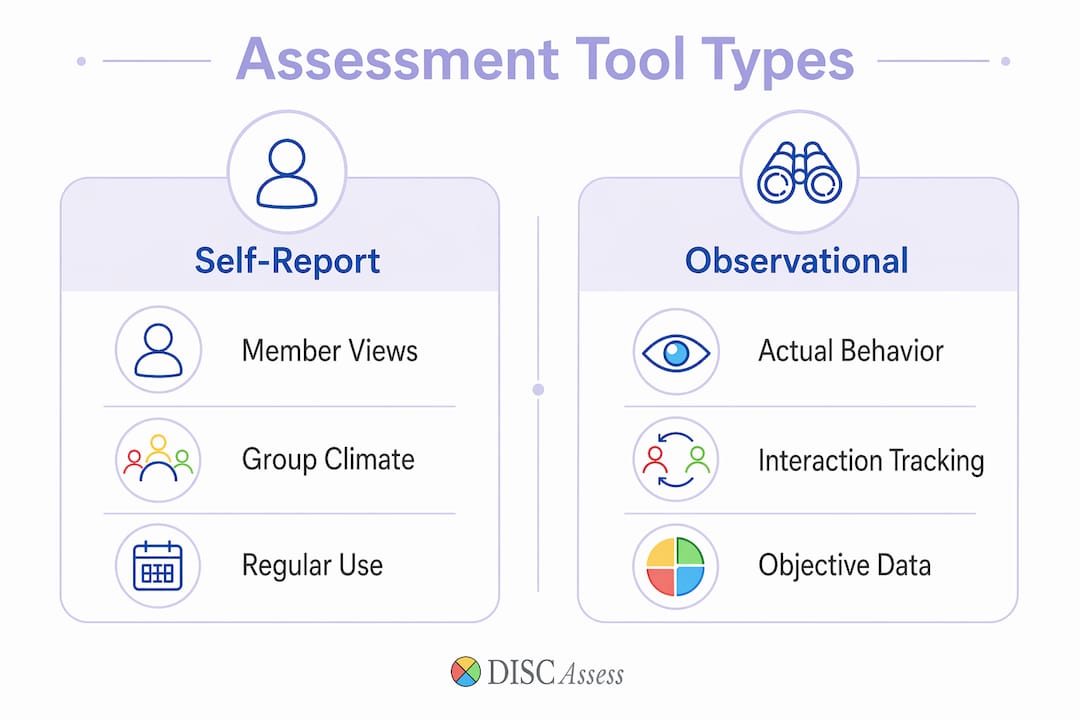
A group dynamics assessment tool falls into three main categories: self-report questionnaires, observational techniques, and multi-dimensional structural assessments. Each type captures a different layer of group life, and knowing the difference helps you choose the right one for your situation.
Self-report questionnaires
Self-report questionnaires ask team members to rate their own perceptions of the group. The Group Climate Questionnaire captures members' perceptions across three subscales: Engagement, Avoidance, and Conflict. Engagement reflects how involved and committed members feel. Conflict measures interpersonal tension. Avoidance tracks whether members withdraw from difficult conversations. The Group Cohesion Scale uses 25 items and demonstrates high reliability in detecting changes in cohesiveness over time, making it well suited for tracking team development across multiple points. These tools are quick to administer and easy to score, which makes them popular for regular check-ins.
Observational techniques
Observational tools record what actually happens during group interactions rather than what members think is happening. Interaction Process Analysis, developed by Robert Bales, categorizes verbal and nonverbal behaviors into task-focused and socio-emotional categories during live meetings. This approach removes the social desirability bias that skews self-report data. A trained observer codes behaviors in real time, producing a behavioral map of how the group functions. The tradeoff is that observation requires trained facilitators and more time investment than a questionnaire.

Multi-dimensional structural assessments
Multi-dimensional tools like Hemphill's Index of Group Dimensions capture structural properties of a group: size, stability, permeability, and control. These instruments are less about feelings and more about the architecture of the group itself. They answer questions like: How clearly are roles defined? How open is the group to new members? How much autonomy do members have? This category is especially useful for organizational development practitioners who need to compare groups across a department or organization.
The table below summarizes how these three types differ in practice:
| Tool type | Primary focus | Best used when |
|---|---|---|
| Self-report questionnaire | Member perceptions, cohesion, conflict | Regular check-ins and team surveys |
| Observational technique | Actual behavior during interactions | Diagnosing communication breakdowns |
| Multi-dimensional structural | Group architecture and properties | Comparing teams or redesigning structure |
How do group development models integrate with assessment tools?
Group development models give assessment tools a timeline. Without a developmental framework, a survey score is just a number. With one, it tells you where your team is on its growth path and what it needs next.
Tuckman's model remains the most widely used framework in this space. It describes five stages of team development:
- Forming — Members are polite and cautious, still figuring out roles and expectations.
- Storming — Conflict emerges as personalities and working styles clash.
- Norming — The group establishes shared norms and begins to trust each other.
- Performing — The team works with high efficiency and shared purpose.
- Adjourning — The group wraps up its work and members prepare to move on.
The Tuckman Team Development Survey scores each stage out of 40 and provides instant results for reflection and team conversations. A team scoring high on Storming and low on Norming knows exactly where to focus its energy. That specificity is what makes model-based assessments so practical for team leaders.
That said, developmental models have real limits. Developmental surveys differ significantly from behavioral diagnostic tools designed to identify systemic frictions. Using a Tuckman survey to make performance management decisions, for example, risks undermining psychological safety. Members who fear consequences will not answer honestly, and the data becomes unreliable. Developmental tools belong in the growth conversation, not the performance review.
Pro Tip: Run the Tuckman Team Development Survey at the start of a new project phase, not just at team formation. Teams often cycle back through Storming when scope or membership changes, and catching that early saves weeks of friction.
Best practices for implementing group dynamics assessments
Choosing the right tool is only half the work. How you implement it determines whether you get honest data or polished answers.
- Use a blended approach. Combining self-reflection with behavioral observation and structural evaluation gives you a fuller picture than any single method. A self-report questionnaire tells you what members perceive. Observation tells you what is actually happening. Structural data tells you whether the group's design supports its goals.
- Time assessments at meaningful moments. Structured checkpoints at project milestones improve assessment effectiveness. Assessing a team mid-project, when tensions are real and stakes are clear, yields more honest data than assessing during a quiet period.
- Protect psychological safety. Assessments used for high-stakes judgments, like promotions or layoffs, destroy the candor that makes them useful. Make the purpose of the assessment clear before you begin. Members need to trust that honest answers lead to support, not punishment.
- Pair quantitative data with qualitative observation. Cross-referencing surveys with structured observation improves accuracy and reduces blind spots created by social desirability bias. After reviewing survey scores, observe one or two team meetings with a structured coding sheet before drawing conclusions.
- Debrief results as a team. Data shared only with leadership rarely changes behavior. Bringing results back to the group, framed as a conversation rather than a verdict, builds shared ownership of the development process.
Pro Tip: If your team scores low on Engagement in the Group Climate Questionnaire, resist the urge to immediately redesign meetings. First, ask members what "engagement" means to them. The gap between their definition and yours is often the real problem.
How to use assessment results to improve team dynamics
Assessment results are only as valuable as the actions they inspire. Raw scores need interpretation, and interpretation needs context.
The most effective approach starts with identifying two or three themes from the data rather than trying to address everything at once. A team showing high Conflict scores alongside low Engagement scores likely has an unresolved interpersonal issue that is draining motivation. That calls for a different intervention than a team with high Avoidance scores, which points to a culture of silence around difficult topics.
The Team Dynamics Assessment model illustrates this well. It provides a summary of strengths, stretch areas, and a complementary review with experts to guide development planning. That structure, strengths first, then growth areas, then a plan, prevents the common mistake of turning assessment results into a list of problems. Teams that see their strengths named alongside their challenges respond with more energy and less defensiveness.
Common interventions informed by assessment data include:
| Theme identified | Suggested intervention | Expected outcome |
|---|---|---|
| High conflict scores | Facilitated conflict resolution session | Reduced interpersonal tension |
| Low engagement | Role clarity workshop or one-on-one coaching | Increased commitment and participation |
| High avoidance | Psychological safety training | More open communication |
| Unclear roles | Structural redesign or RACI mapping | Improved accountability |
Follow-up assessments close the loop. Running the same instrument three to six months after an intervention tells you whether the change held. The Group Cohesion Scale-Revised is particularly well suited for this because its 25 items show sensitivity to change over time. Tracking scores across multiple points turns a one-time snapshot into a genuine growth story for your team.
Behavioral data also informs leadership decisions at a deeper level. Understanding why behavioral data matters helps leaders move from reacting to team problems to anticipating them. That shift from reactive to proactive is where real organizational development begins.
Key Takeaways
A group dynamics assessment tool delivers the most value when you combine self-report questionnaires, behavioral observation, and developmental models into a single, context-aware process.
| Point | Details |
|---|---|
| Three tool types exist | Self-report, observational, and structural tools each capture a different layer of group life. |
| Models need the right context | Use Tuckman's stages for team awareness and growth conversations, not performance evaluation. |
| Blended approaches work best | Pairing surveys with direct observation reduces bias and produces more reliable insights. |
| Psychological safety is non-negotiable | Teams only give honest data when they trust the assessment will not be used against them. |
| Follow-up assessments confirm progress | Re-administering the same tool after interventions shows whether change actually took hold. |
What I've learned from years of watching teams assess themselves
The most common mistake I see is treating the assessment as the destination. Leaders run a survey, review the scores, and feel like they have done something meaningful. They have not. The survey is the starting line, not the finish line.
The second mistake is underestimating how much the facilitator matters. A skilled facilitator can take a mediocre instrument and generate a breakthrough conversation. An unskilled one can take the best tool available and produce nothing but defensiveness. Organizational readiness matters just as much as tool selection. If your culture punishes vulnerability, no assessment will give you honest data.
What actually works is a patient, iterative process. You assess, you listen, you act on one or two things, and then you assess again. The Group Climate Questionnaire remains the preferred choice for evaluating psychological atmosphere, but even it requires longitudinal use to produce accurate insights. One snapshot tells you where the team is today. A series of snapshots tells you whether it is growing. That long view is where the real fruit of this work appears, and it is worth every bit of the patience it requires.
— Tres
Discassess and the DISC approach to team understanding
Understanding group dynamics starts with understanding the individuals who make up the group. Discassess offers DISC group assessment packages designed for teams of any size, giving each member a detailed behavioral profile and giving leaders a clear view of how different personality styles interact under pressure.
Backed by Prism Counseling & Coaching with over a decade of experience, Discassess makes DISC assessments accessible without requiring certification or a large HR budget. You can take a DISC assessment individually or run your whole team through the process using group packages built for small businesses, nonprofits, and ministry teams. The reports pair naturally with the group dynamics evaluation methods covered in this article, giving you both the individual behavioral data and the group-level insight you need to lead well.
FAQ
What is a group dynamics assessment tool?
A group dynamics assessment tool is a structured instrument that measures how team members interact, collaborate, and develop together. Common examples include the Group Climate Questionnaire, the Tuckman Team Development Survey, and the Group Cohesion Scale.
How do I choose the right tool for assessing group dynamics?
Match the tool type to your goal. Use self-report questionnaires for regular check-ins, observational techniques when you need to diagnose communication problems, and structural assessments when comparing teams or redesigning group architecture.
What are the benefits of group dynamics assessment?
Group dynamics assessments identify hidden tensions, clarify roles, and give leaders data to guide targeted interventions. Teams that use them consistently show improved cohesion, clearer communication, and stronger accountability over time.
Can group dynamics tools be misused?
Yes. Using developmental surveys like the Tuckman Team Development Survey for performance management decisions undermines psychological safety and produces unreliable data. These tools belong in growth conversations, not high-stakes evaluations.
How often should teams complete a group dynamics evaluation?
Teams benefit most from assessments at key milestones: project launch, mid-project review, and project close. Re-administering the same instrument three to six months after an intervention confirms whether the changes made a lasting difference.
Recommended
- Group Assessment Management Coaching Practice Guide
- Take DISC Personality Assessment - DISC Assess | Affordable, Professional DISC Assessments for Small Businesses
- How the DISC Compares to 3 Other Popular Personality Assessments - DISC Assess | Affordable, Professional DISC Assessments for Small Businesses
- DISC Personality Assessment | Prism Counseling & Coaching - DISC Assess | Affordable, Professional DISC Assessments for Small Businesses