

A team assessment tools comparison is the process of evaluating features, costs, and use cases of available solutions to select the best fit for your organization's performance goals. The right tool shapes how your team communicates, resolves conflict, and grows together. Frameworks like DISC and CliftonStrengths have become standard reference points for HR professionals, while Gallup research consistently links strengths-based development to measurable productivity gains. This guide gives managers and HR professionals a clear framework for choosing the best team assessment tools based on real criteria, not marketing promises.
What key types and features differentiate team assessment tools?
Two broad categories define the team assessment tools comparison landscape: snapshot tools and pulse tools. Snapshot tools deliver a deep, one-time profile of personality, strengths, or behavioral tendencies. Pulse tools collect ongoing sentiment and engagement data, often weekly or monthly, to track how team morale shifts over time.
Most tools focus on one of four areas:
- Personality and behavioral style (e.g., DISC, Myers-Briggs Type Indicator)
- Strengths identification (e.g., CliftonStrengths)
- Employee engagement and culture (morale scores, culture surveys)
- Pulse and performance feedback (frequent check-ins, goal tracking)
Core features to compare across any platform include scoring accuracy, report delivery speed, team-level insight aggregation, and integration with HR systems. Pricing models split into two main structures. One-time fees range from $20 to $90 per user, while subscriptions typically run $4 to $16 per employee per month. That gap matters when you are budgeting for a team of 15 versus a department of 200.
Pro Tip: Before comparing platforms, write down your top two goals. Are you building self-awareness, tracking engagement, or both? Your answer narrows the field immediately.

1. Strengths-based assessment tools
Strengths-based tools identify what each team member does best and help managers assign roles accordingly. Teams using strengths-based development report a 12.5% productivity increase, according to Gallup. That number reflects a real shift: when people work in their areas of natural ability, output improves and frustration drops. CliftonStrengths is the most recognized tool in this category, producing 34 ranked talent themes per individual.
2. Personality and behavioral style tools
Personality frameworks give teams a shared language for understanding how each person thinks, communicates, and responds under pressure. DISC is the most widely used behavioral model in workplace settings, organizing tendencies into four types: Dominance, Influence, Steadiness, and Conscientiousness. Learning how a colleague processes information reduces friction and builds empathy. Discassess offers a straightforward DISC platform built specifically for small businesses and nonprofits, making it one of the most affordable team assessment options available without sacrificing report quality.
3. Employee engagement tools
Engagement tools measure how connected your team feels to their work, their manager, and the organization's mission. They typically produce culture scores, satisfaction ratings, and trend data over time. HR professionals use these results to identify burnout risk, retention threats, and morale gaps before they become turnover problems. Most engagement platforms deliver results through dashboards rather than individual reports, making them better suited for people operations teams than for small group coaching.
4. Pulse tools for ongoing feedback
Pulse tools run short, frequent surveys, often five to ten questions, sent weekly or biweekly. They capture real-time sentiment rather than a fixed snapshot of a person's personality. For managers who need to track how a team responds to a new project, a leadership change, or a restructuring, pulse tools provide the fastest signal. Enterprise platforms for teams above 300 employees typically include pulse tools as part of a broader People Ops suite.
5. 360-degree feedback tools
360-degree feedback tools collect input from peers, direct reports, and managers to build a multi-perspective view of each person's performance. They are powerful for leadership development and succession planning. The cost structure, however, requires careful attention. Enterprise 360-feedback platforms charge per respondent seat, which means a group of 10 leaders with 80 respondents can generate a much larger bill than a flat per-user fee suggests. Always calculate total respondent volume before committing to a platform.
6. Assessment completion time and reporting speed
Speed matters more than most managers expect. Effective team assessments take 10–30 minutes per person, and the best platforms deliver team-level insight reports in under one hour after the last submission. Slow reporting creates a gap between assessment and action, and that gap kills momentum. When evaluating platforms, ask specifically how long it takes to receive a group report after all members complete their assessments.
Pro Tip: Schedule assessments on a Tuesday or Wednesday morning. Completion rates drop sharply on Mondays and Fridays, which delays your group report.
7. How to evaluate tools for cost-effectiveness and scalability
Total cost of ownership extends well beyond the license fee. Training and rollout costs represent a median of 25% of L&D budgets on top of licensing. That means a $5,000 platform investment can quietly become $6,250 once you factor in facilitation, refresher sessions, and onboarding time. Managers who skip this calculation often face budget surprises mid-year.
Key cost factors to evaluate:
- License model: one-time fee vs. subscription, and whether pricing scales per user or per team
- Hidden implementation costs: training hours, facilitation fees, and internal HR time
- Respondent pricing: especially relevant for 360-feedback tools with large reviewer pools
- Refresh cycles: some snapshot tools recommend reassessment every 12–18 months, adding recurring cost
Scalability is a separate question from price. A tool that works well for a 12-person team may not support a 300-person organization without a platform upgrade. Ask vendors directly whether their reporting and admin features change at higher user volumes.
| Cost Factor | What to Ask |
|---|---|
| Per-user licensing | Does price change at 50, 100, or 500 users? |
| Respondent fees | Are reviewers in 360 tools charged separately? |
| Implementation | Is facilitation or training included or billed extra? |
| Refresh cycles | How often should teams reassess, and at what cost? |
8. Situational recommendations: matching tools to team scenarios
The right tool depends on your team's size, maturity, and current goals. Pulse tools work best for small teams needing frequent check-ins, while enterprise platforms serve large organizations with dedicated People Ops functions. A 10-person nonprofit does not need the same platform as a 500-person corporation. Matching tool complexity to team size prevents overspending and under-utilization.
Combining snapshot and pulse assessments gives teams both foundational clarity and ongoing measurement. The most effective approach runs a DISC or CliftonStrengths assessment every 6–12 months for deep behavioral insight, then layers in pulse surveys quarterly to track engagement shifts. This combination catches both structural communication issues and short-term morale dips.
| Team Scenario | Recommended Approach |
|---|---|
| Small team, frequent check-ins needed | Lightweight pulse tool, monthly cadence |
| New team needing shared language | Snapshot personality tool (e.g., DISC) |
| Leadership development program | 360-degree feedback platform |
| Large org with People Ops team | Enterprise engagement platform |
| Growing team needing both | Snapshot every 6–12 months plus quarterly pulse |
Pro Tip: If your team has never done a formal assessment, start with a personality or behavioral tool. It builds the shared vocabulary that makes every other assessment more useful.
Key takeaways
The most effective team performance evaluation strategy combines a snapshot tool for behavioral clarity with a pulse tool for ongoing engagement tracking, sized and priced to match your team's actual needs.
| Point | Details |
|---|---|
| Match tool type to goal | Use snapshot tools for deep behavioral insight and pulse tools for ongoing sentiment tracking. |
| Budget for hidden costs | Training and rollout add a median 25% on top of licensing fees. |
| Watch respondent pricing | 360-feedback tools charge per reviewer, which inflates costs for large groups. |
| Combine tool types | Running DISC every 6–12 months plus quarterly pulse surveys delivers the strongest results. |
| Size your platform correctly | Small teams need lightweight options; enterprise platforms add unnecessary complexity for teams under 50. |
What I've learned from watching teams use assessment tools
After working with teams across small businesses, nonprofits, and ministry organizations, one pattern stands out clearly. Most managers buy a tool, run it once, and then file the reports away. The assessment becomes a one-time event rather than a living resource. That is where the real value gets lost.
The teams that grow the most are the ones that give members direct access to their own data. When people can review their own DISC profile or strengths report at any time, they take ownership of their development. They start applying the language in real conversations, not just in a workshop debrief. That shift from centralized leadership control to team-owned assessment data is what actually changes behavior.
I have also seen managers over-rely on a single tool category. A team that only runs pulse surveys knows how people feel but not why. A team that only runs personality assessments understands communication styles but misses real-time morale shifts. The combination is what creates a full picture. You can read more about applying DISC in small business settings through Discassess's guide on DISC for small businesses.
My honest recommendation: prioritize usability above all else. A tool your team actually completes and discusses beats a sophisticated platform that sits unused. Start simple, build the habit, and add complexity only when your team is ready for it.
— Tres
Discassess makes team assessment practical and affordable
Managers and HR professionals who want to act on the insights in this guide without a large budget or a complex rollout will find Discassess worth a close look. Built by Prism Counseling & Coaching and based in Phoenix, Discassess offers professional DISC assessments designed specifically for small businesses, nonprofits, and leadership teams.
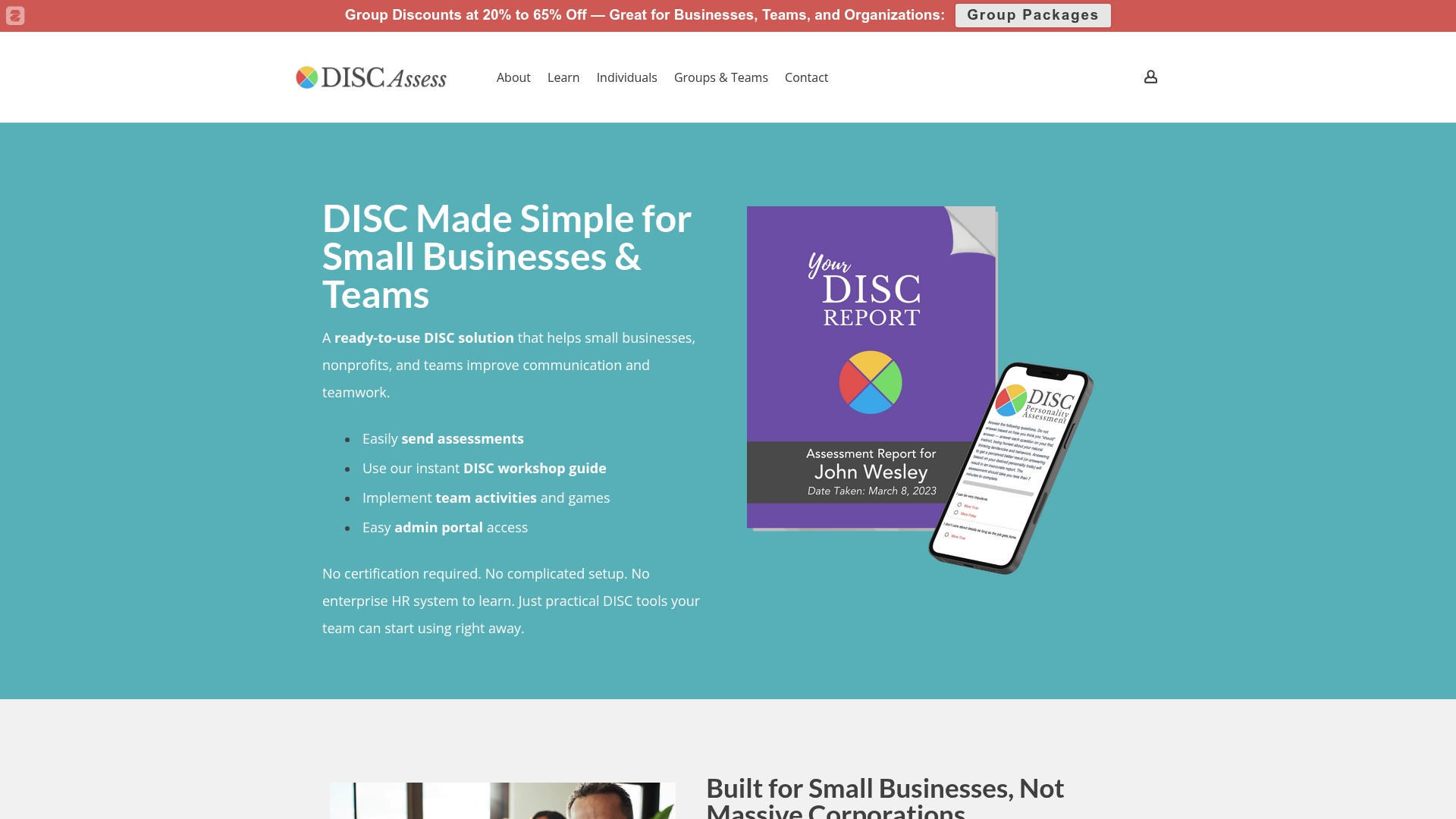
The platform requires no certification and no technical background. You can manage group assessments for your entire team from a single admin account, access detailed reports immediately after completion, and use built-in resources to facilitate team discussions. Pricing includes individual assessments, group packages, and unlimited memberships. Try the DISC Admin Account to see how the platform fits your team's workflow before committing.
FAQ
What is a team assessment tools comparison?
A team assessment tools comparison is the process of evaluating available platforms based on features, cost, use case, and team fit to select the best option for your organization's performance goals.
How long does a team assessment take to complete?
Most team assessments take 10–30 minutes per person, with group insight reports delivered in under one hour after all members submit their responses.
What is the difference between snapshot and pulse assessment tools?
Snapshot tools deliver a one-time deep profile of personality or strengths, while pulse tools collect short, frequent surveys to track ongoing engagement and morale shifts.
How much do team assessment tools cost?
One-time fee tools typically range from $20 to $90 per user. Subscription models run $4 to $16 per employee per month, though hidden costs like training can add 25% on top of licensing fees.
Which type of team assessment tool should I start with?
Start with a behavioral or personality tool like DISC if your team has no prior assessment experience. It builds a shared language that makes every subsequent assessment, including pulse and engagement tools, more effective.
Recommended
- How the DISC Compares to 3 Other Popular Personality Assessments - DISC Assess | Affordable, Professional DISC Assessments for Small Businesses
- When the DISC is not the Right Fit: Understanding the Limitations of This Personality Assessment - DISC Assess | Affordable, Professional DISC Assessments for Small Businesses
- The Appeal of DISC: Why People Love Using This Popular Personality Assessment - DISC Assess | Affordable, Professional DISC Assessments for Small Businesses
- DISC Assess | Affordable, Professional DISC Assessments for Small Businesses - All Articles