

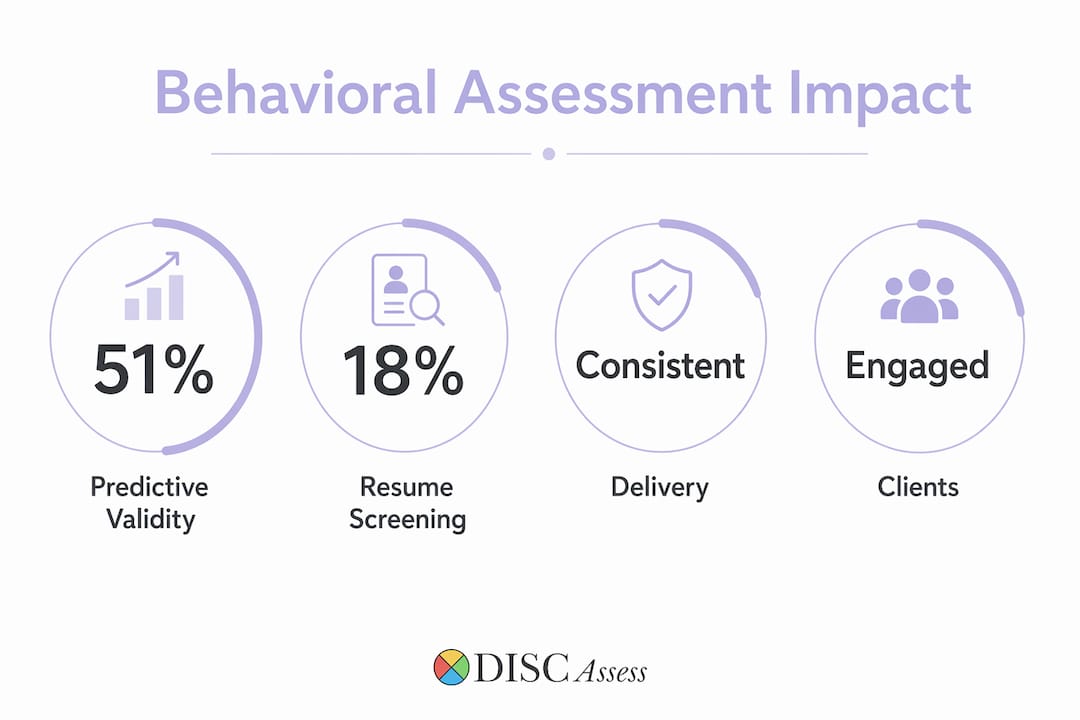
Behavioral assessments are defined as structured, scientifically validated tools that convert observable human tendencies into objective, measurable data. For consultants and coaches, this objectivity is the foundation of a scalable practice. Subjective impressions erode client trust and limit growth. Objective data, by contrast, creates defensible recommendations, repeatable delivery, and a shared language that clients actually adopt. Assessment centers, the gold standard in industrial-organizational psychology, achieve a predictive validity of r = 0.51, far outperforming unstructured interviews. That number tells you something important: behavioral data is not just useful, it is measurably superior to the alternatives consultants typically rely on.
Why behavioral assessments scale consulting practice
Behavioral assessments give consultants something that intuition never can: a consistent, objective anchor for every client engagement. When your recommendations rest on validated data rather than personal observation, clients push back less. They trust the process more. That trust is what makes your service repeatable across dozens of clients without you personally managing every conversation.
The mechanisms behind this are practical, not theoretical:
- Objective data reduces friction. When a client questions your recommendation, you point to behavioral data rather than your opinion. That shift changes the entire dynamic of the relationship.
- Standardized metrics create documentation. Once you define what "high Dominance" or "low Conscientiousness" means for a given role, you can build delivery templates around those definitions. Your process stops living in your head and starts living in a system.
- Assessments build a shared vocabulary. Clients who understand their own behavioral profile communicate more clearly with your team. That clarity speeds up every phase of your engagement.
- Repeatable frameworks enable delegation. When your delivery process is built on a consistent assessment framework, a trained associate can run it. You are no longer the bottleneck.
Behavioral data also improves client engagement in a way that generic advice cannot. When clients see their own tendencies reflected in a report, they engage with the material personally. That personal connection increases follow-through and program completion rates.
Pro Tip: Before you add any new service line, document exactly how you currently use assessment data in your best-performing client engagements. That documentation becomes your first standard operating procedure.

What does the science say about behavioral assessments?
The research on behavioral assessments is not ambiguous. Assessment centers outperform both resume screening (r = 0.18) and unstructured interviews (r = 0.20) in predictive validity. A coefficient of r = 0.51 means the data reliably predicts real-world performance outcomes. For consultants, that reliability is the difference between a recommendation you can defend and one you cannot.
| Method | Predictive Validity (r) | Practical Implication |
|---|---|---|
| Assessment centers | 0.51 | Strongest predictor of job performance |
| Unstructured interviews | 0.20 | Highly subjective, easily challenged |
| Resume screening | 0.18 | Weakest predictor, prone to bias |
Assessor training matters just as much as the tool itself. Well-trained assessors produce inter-rater reliability coefficients above 0.85. That means two trained consultants evaluating the same person will reach nearly identical conclusions. Consistency at that level is what makes your practice scalable and legally defensible.
"Behavioral assessments reduce bias in talent and leadership decisions by providing standardized, objective data on candidate and client fit. Data-backed assessments improve legal defensibility under EEOC guidelines, giving consultants a foundation that holds up to scrutiny."
Role-specific behavioral benchmarks increase accuracy further. When you define what behavioral profile a specific leadership role requires, your assessment data becomes a precision instrument rather than a general observation. That specificity is what separates a consulting practice that grows from one that plateaus.
Why you must standardize delivery before you scale
Scaling a consulting practice requires a fundamental shift: moving from bespoke, consultant-dependent delivery to a predictable, repeatable process. Growing revenue and scaling are not the same thing. True scale means your system delivers consistent results whether you are in the room or not.
Behavioral assessments are the objective anchor that makes standardization possible. Here is a practical sequence for building that foundation:
- Document your best current engagement. Map every step where you use behavioral data with a client. Write it down as if training someone who has never met you.
- Define your behavioral benchmarks. Identify the specific DISC profiles or behavioral patterns that predict success in the roles or contexts you serve most often.
- Build delivery templates around those benchmarks. Create report interpretation guides, client conversation scripts, and feedback frameworks that any trained associate can follow.
- Create standard operating procedures for each phase. Intake, assessment administration, debrief, and follow-up should each have a written process. Behavioral data enables you to externalize these processes so delegation happens without quality loss.
- Test the system before you hire. Run a new associate through your documented process with a real client before you commit to growth. Fix the gaps first.
Failing to standardize delivery before adding staff creates fragmented client experiences. Clients who receive inconsistent service do not renew. That churn destroys the revenue growth you were trying to achieve in the first place.
Pro Tip: Treat your first standard operating procedure as a living document. Update it after every client engagement where something did not go as planned. Your SOP improves with every iteration.
How assessments create a shared language that clients actually use
Shared behavioral language reduces subjective misunderstandings and interpersonal tension inside client organizations. When everyone on a leadership team understands what "high Influence" or "steady Compliance" means, conversations about performance and conflict become grounded in data rather than personality clashes. That shift accelerates your engagement timeline significantly.
The communication advantages of a shared assessment language extend well beyond the initial debrief:
- Client conversations become more efficient. You spend less time explaining your recommendations and more time implementing them, because the client already understands the behavioral framework.
- Peer-to-peer learning accelerates. When team members can describe their own tendencies using a common vocabulary, they coach each other without your direct involvement.
- Group program delivery becomes viable. A shared language makes group coaching sessions far more productive. Participants reference the same framework, which keeps discussions focused and reduces the time you spend managing group dynamics.
- Feedback acceptance improves. Clients who understand their behavioral profile receive feedback as data about their tendencies, not as personal criticism. That distinction dramatically increases follow-through on development goals.
Personality assessments improve team collaboration in ways that generic team-building exercises cannot replicate. The reason is simple: a shared framework gives people a neutral, non-threatening way to discuss differences. That neutrality is what makes lasting behavioral change possible.
Practical steps to implement behavioral assessments for growth
Choosing the right assessment platform is as important as choosing the right assessment framework. Here is how to build your implementation plan:
- Start with your premium one-on-one service. Master the assessment integration process at the individual level before you attempt group delivery. Document every step as you go.
- Select a scientifically validated platform. Choose tools that provide role-specific behavioral insights and clear, client-ready reports. Avoid platforms that produce generic output with no interpretive guidance.
- Prioritize white-label capability. White-label platforms protect your client relationships by keeping all assessment activity under your brand and domain. Relying on a third-party branded portal risks client leakage to the platform provider.
- Build a repeatable group coaching offer. Once your one-on-one process is documented, adapt it for groups. Group packages built on an assessment framework are your highest-leverage product because the marginal cost of adding participants is low.
- Train before you hire. Build internal assessor capacity through formal training before adding staff. Assessor training is the variable that determines whether your system produces consistent results or inconsistent ones.
Reviewing a team assessment tools comparison before committing to a platform helps you evaluate options against the criteria that matter most for your practice size and client base.
Key Takeaways
Behavioral assessments scale consulting practices by replacing subjective judgment with objective, validated data that supports standardized delivery, shared client language, and delegation-ready systems.
| Point | Details |
|---|---|
| Scientific validity matters | Assessment centers achieve r = 0.51 predictive validity, making recommendations defensible and trustworthy. |
| Standardize before you scale | Document delivery processes using behavioral data as the anchor before adding staff or new service lines. |
| Shared language accelerates adoption | A common behavioral vocabulary reduces client friction and speeds up group program delivery. |
| White-label platforms protect relationships | Keep assessments under your brand to prevent client leakage to third-party providers. |
| Train assessors first | Inter-rater reliability above 0.85 requires formal training; consistency is what makes your system scalable. |
What I have learned about assessments and real scale
Assessments are diagnostic tools. They reveal conditions. They do not create change on their own. I have seen consultants invest in excellent assessment platforms and then wonder why their practice did not grow. The platform was not the problem. The absence of a system around it was.
The consultants who scale effectively treat assessments as leadership diagnostics, not as deliverables. They use the data to design the engagement, not just to start it. They also resist the temptation to scale before their delivery process is fully documented. Adding clients to a broken system does not fix the system. It amplifies the damage.
One more thing worth saying directly: avoid platforms that lock your clients into their ecosystem. Your client relationships are your most valuable asset. A platform that sits between you and your client, under someone else's brand, is a liability. Choose tools that keep you at the center of the relationship. That discipline, more than any single assessment tool, is what separates practices that grow from practices that stall.
— Tres
Discassess group packages for consultants ready to grow
Consultants who are ready to move from individual delivery to group-based programs need an assessment platform that keeps pace with that growth. Discassess offers group assessment packages designed specifically for coaches and consultants who need to administer multiple assessments efficiently, without sacrificing report quality or client experience.
The White Label DISC System from Discassess lets you run every assessment under your own brand, protecting your client relationships and your margins. Backed by Prism Counseling & Coaching with over a decade of experience, Discassess keeps the process simple, affordable, and immediately usable. Whether you are building your first group coaching program or expanding an existing practice, the platform gives you the infrastructure to deliver consistently at scale.
FAQ
What are behavioral assessments in consulting?
Behavioral assessments are structured tools that measure observable tendencies and convert them into objective data. Consultants use this data to make defensible recommendations, design client programs, and standardize delivery across engagements.
How do behavioral assessments help consultants scale?
Behavioral assessments create repeatable frameworks that consultants can document, delegate, and deliver consistently. That consistency is what allows a practice to grow beyond the founder's direct involvement.
What is the predictive validity of behavioral assessments?
Assessment centers achieve a predictive validity coefficient of r = 0.51, which outperforms unstructured interviews (r = 0.20) and resume screening (r = 0.18), making them the most reliable basis for talent and leadership decisions.
Why does white-label matter for consulting practices?
White-label assessment platforms keep all client interactions under the consultant's brand and domain. This prevents client leakage to the platform provider and protects the long-term value of the consultant's client relationships.
When should a consultant standardize delivery before scaling?
Standardization should happen before any new hires or service line expansions. Adding staff to an undocumented delivery process creates inconsistent client experiences and operational problems that are far harder to fix after growth than before it.