

DISC replaces the nonverbal cues your remote team loses every day with a shared behavioral language, and that shift alone can reduce miscommunication, speed alignment, and make every one-on-one feel less like guesswork. The core idea is simple: when you know how each person prefers to receive information, process feedback, and engage in meetings, you stop projecting your own style onto them and start communicating in theirs.
Here is where to begin right now:
- Assess: Have every team member complete a DISC assessment promptly.
- Share: Host a 30-minute virtual debrief where each person shares their top two style traits.
- Adapt: Adjust your next meeting agenda and one-on-one format to reflect what you learned.
Your 48-hour next step: Schedule a short team debrief and identify the top two DISC styles present on your team. That single action sets the foundation for everything else in this playbook.
Key Takeaways
DISC supports remote team connection most effectively when it moves from a one-time assessment into a daily communication habit, with style-adapted channels, meeting formats, and feedback practices embedded into your team's rhythm.
| Point | Details |
|---|---|
| Assess and share first | Have every team member complete DISC and share top two styles before adapting any process. |
| Match channels to styles | Use video for I and S styles, async text for D and C styles, and shared documents for detailed C feedback. |
| Embed norms, not just insights | A one-page behavior agreement turns DISC results into daily communication habits the whole team follows. |
| Measure early impact | Track meeting efficiency and run a pulse survey at Day 45 to confirm the rollout is working. |
| Discassess for small teams | Discassess provides instant reports, an admin portal, and group packages sized for small remote teams. |
Your 30-day action plan:
- Days 1–3: Choose your assessment platform and purchase a group package.
- Days 3–5: Send consent note and assessment links to your team.
- Days 5–10: Collect completed assessments; review the group summary report.
- Days 10–14: Host a 45–60 minute virtual debrief using the agenda in this article.
- Days 14–20: Post the team style map to your shared channel.
- Days 20–30: Draft and agree on a one-page communication norms document.
- Days 30–45: Send a three-question pulse survey and review clarity scores.
- Day 90: Host a follow-up session; update the team map if anyone's role has shifted.
Table of Contents
- How does DISC support remote team connection?
- The four DISC styles and what they need from you remotely
- How do you lead a mixed-style remote team effectively?
- What communication and meeting practices match each DISC style?
- How do you introduce DISC to a remote team step by step?
- What are the real benefits of DISC for remote teams, and what can go wrong?
- A hands-on example: rolling out DISC with a five-person remote team
- What experienced managers get wrong in early DISC rollouts
- Discassess makes it easy to run this playbook with your team
- Sources
How does DISC support remote team connection?
Remote work strips away the hallway conversation, the quick read of body language, and the tone of voice that softens a blunt message. What remains is text on a screen, and text is notoriously easy to misread. A terse Slack message from a high-D colleague reads as cold or dismissive to an S-style teammate who values warmth and reassurance. A long, context-heavy email from a C-style team member feels like noise to a D who wants the bottom line in two sentences.
DISC gives remote teams a shared behavioral language that substitutes for those missing signals. Instead of guessing why someone went quiet after a meeting or why a peer always seems to push back on new ideas, you have a framework that makes tendencies visible and predictable. That predictability reduces friction.
Applying DISC in remote settings improves collaboration and reduces conflict when leaders use it to match channels, meeting formats, and feedback styles to each person's preferences. The practical payoff is real: fewer tone misreads, faster trust-building, and clearer expectations across time zones.
- Lost nonverbal cues create tone ambiguity in text-based channels.
- DISC creates explicit behavioral agreements that replace implicit social signals.
- Style-adapted communication reduces the friction that slows remote teams down.
The four DISC styles and what they need from you remotely
Each of the four styles shows up differently in a virtual environment, and the manager's job is to recognize those patterns and respond to them deliberately.
D (Dominance): direct, decisive, results-focused
Remotely, D-style team members prefer short meetings with clear agendas, fast decisions, and minimal small talk. They can come across as blunt in async messages, which others sometimes read as conflict when it is simply efficiency.
Do: Send bullet-point updates, give them ownership of a defined outcome, and keep one-on-ones under 20 minutes with a clear agenda sent in advance. Don't: Open a meeting without a stated goal or send long explanatory emails when a two-line summary will do.
Sample Slack message for a D: "Update on Project X: launch moved to Friday. Two blockers cleared. One remaining: need your call on vendor by EOD."
I (Influence): enthusiastic, collaborative, people-oriented
I-style team members miss the social energy of an office more than any other style. They thrive on video calls, respond well to recognition, and can lose motivation when remote work feels isolating.
Do: Start meetings with a brief personal check-in, celebrate wins publicly in a team channel, and use video for one-on-ones whenever possible. Don't: Rely exclusively on async text for this style or skip the relational warmup before diving into tasks.
Sample video check-in invite for an I: "Hey [Name], let's hop on a quick video call Thursday — I want to hear how the client pitch went and catch up before we plan next steps."
S (Steadiness): patient, loyal, team-oriented
S-style team members value stability and consistency. Sudden changes in process, unexpected meeting invites, or ambiguous feedback can create anxiety that never surfaces in a chat message.
Do: Give advance notice of changes, provide written summaries after meetings, and check in regularly with a warm, unhurried tone. Don't: Spring agenda changes on them mid-meeting or give feedback in front of the group.
Sample async message for an S: "Just wanted to give you a heads-up: we're shifting the reporting format starting next week. I'll send the new template by Wednesday so you have time to review it."
C (Conscientiousness): analytical, precise, quality-focused
C-style team members want data, context, and time to think before responding. They prefer written communication over spontaneous video calls and will disengage if asked for an opinion before they feel fully prepared.
Do: Send meeting agendas and supporting documents well in advance, use email or a shared document for detailed feedback, and give them space to ask clarifying questions. Don't: Put them on the spot in a live meeting or dismiss their questions as overthinking.
Sample email opener for a C: "I've attached the Q2 data and a brief summary of the three options we're considering. Please review before Thursday's call — I'd love your analysis."
Pro Tip: Most team members carry traits from two or even three styles. When you see a blend (say, a D/C), honor both: lead with the bottom line, then provide the supporting data. The blend tells you the order of operations.
How do you lead a mixed-style remote team effectively?
The real challenge is not managing one style. It is running a meeting where a D wants to decide in ten minutes, an I wants to brainstorm for thirty, an S needs reassurance before committing, and a C has three follow-up questions. A few structural habits make this manageable.
Weekly rhythm checklist:
- Send every meeting agenda sufficiently in advance to serve C and S styles.
- Open with a 3-minute check-in question (serves I and S).
- Timebox each agenda item and assign a facilitator (serves D and C).
- Close with a written summary of decisions and next steps posted in your team channel (serves S and C).
- Reserve one-on-ones for style-specific feedback rather than status updates.
Pairing for tasks: D and C styles pair well on analytical projects where one drives pace and the other ensures accuracy. I and S styles work well together on relationship-heavy tasks like client communication or onboarding, where enthusiasm and patience complement each other.
Conflict resolution remotely: When two styles clash over a decision, name the behavioral difference explicitly rather than the personality. Try: "I think we're approaching this differently. [Name] is focused on speed, and [Name] wants to make sure we've covered the risks. Both are valid. Can we agree on a 48-hour window to gather the key data and then decide?" That reframe keeps the conversation about process, not character.
What communication and meeting practices match each DISC style?
Sync and async are not interchangeable. Choosing the wrong channel for the wrong style adds friction rather than removing it.
- Use video (sync) for I and S styles during one-on-ones, feedback conversations, and team check-ins. Microsoft Teams supports video, chat, and calling in one place, making it practical for teams that move between live and async work throughout the day.
- Use async text (chat or email) for D and C styles for updates, decisions, and detailed feedback. Slack's channel-based structure lets you keep project updates visible and searchable, which suits both the D's need for speed and the C's need for a record.
- Use shared documents for C styles when feedback is detailed or when decisions require analysis. Zoom Chat also supports quick transitions between async messaging and live video, which works well for I-style team members who want to jump from a chat thread to a face-to-face conversation.
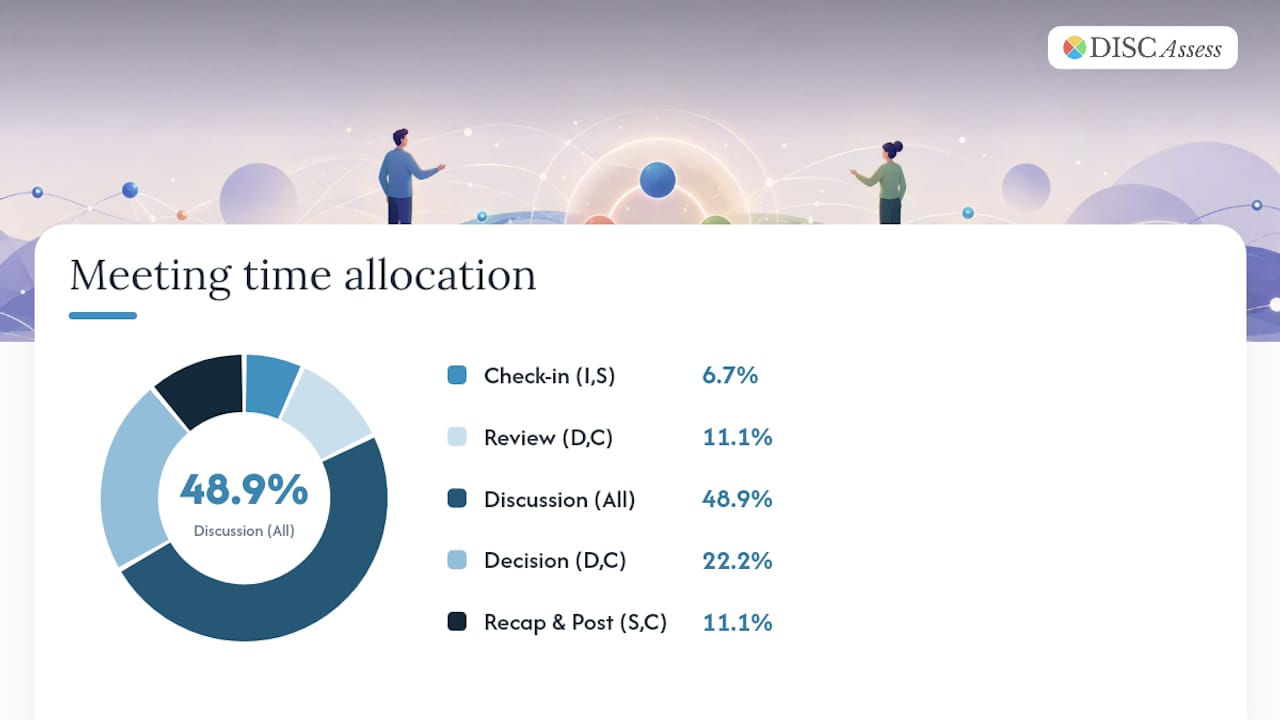
Meeting agenda template for a mixed-style team (45 minutes):
- 0–3 min: Check-in question (I, S)
- 3–8 min: Review agenda and goals (D, C)
- 8–30 min: Discussion, timeboxed by topic (all styles)
- 30–40 min: Decision or next steps (D leads, C confirms)
- 40–45 min: Recap and action items posted to channel (S, C)
Message templates for common manager tasks:
- Feedback to a D: "Here's what worked and what I'd change. One specific ask for next time."
- Feedback to an I: "You did a great job on [X]. One thing to build on: [Y]. I'm confident you'll nail it."
- Feedback to an S: "I want to share some thoughts in a way that's helpful. Nothing urgent. Can we talk Thursday?"
- Feedback to a C: "I've written up my observations with specifics. Please review before we discuss."
Pro Tip: Combine DISC results with short behavior agreements: a one-page team norm document that covers expected response times by channel, how to signal urgency, and how to tag a message as FYI versus action-required. This single artifact cuts tone misreads dramatically.
How do you introduce DISC to a remote team step by step?
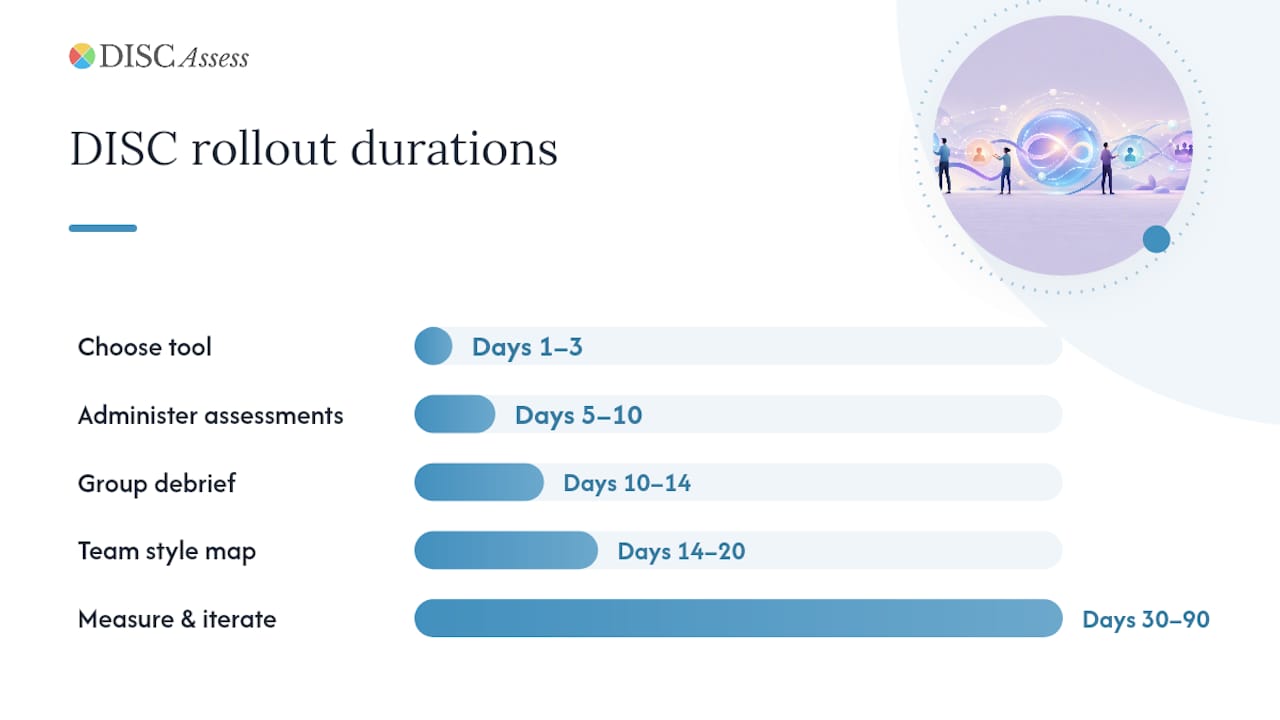
A responsible rollout takes about 30–90 days and follows a clear sequence. Rushing past the debrief or skipping the team map leaves people with a report they never use.
- Choose your assessment tool (Days 1–3): Select a platform that provides instant reports and group management features. Discassess offers individual assessments, group packages, and an admin portal that lets you manage results across your team without needing an HR background.
- Get informed consent (Days 3–5): Participation must be voluntary. Tell your team clearly: results are for growth and communication, not performance evaluation. This is non-negotiable for trust.
- Administer assessments (Days 5–10): Send individual assessment links. Most DISC assessments take 10–15 minutes.
- Run a group debrief (Days 10–14): Host a 45–60 minute virtual session where each person shares their style and one insight. Use a facilitator guide or the sample agenda in the next section.
- Create a team style map (Days 14–20): Plot every team member's primary style on a shared visual. This becomes a reference tool for meeting planning and role alignment.
- Embed communication norms (Days 20–30): Draft a one-page behavior agreement based on what the team learned. Post it in your team channel.
- Measure and iterate (Days 30–90): Run a short pulse survey after 30 days. Track meeting efficiency as an early KPI: time spent in meetings and a quick clarity rating after three meeting cycles give you a readable signal of early impact.
Privacy note: store assessment results in a secure, access-controlled platform and share them only with the individual and their direct manager unless the team member explicitly consents to broader sharing.
What are the real benefits of DISC for remote teams, and what can go wrong?
The benefits are concrete when DISC is applied consistently. The pitfalls are equally predictable, and most of them come from treating DISC as a one-time event rather than an ongoing practice.
Benefits:
- Faster alignment on communication preferences, especially across time zones.
- Clearer, less emotionally charged feedback because both parties understand the intent behind the style.
- Better role fit when managers use style data to assign tasks that match natural strengths.
- Stronger team cohesion because team members feel seen and understood rather than judged.
- Reduced conflict from tone misreads in async channels.
Common pitfalls:
- Over-labeling: Treating DISC as a fixed identity ("You're a C, so you won't like this idea") shuts down growth. DISC describes tendencies, not limits.
- One-off training: A single debrief without follow-up fades within weeks. Schedule a 90-day check-in from the start.
- Privacy misuse: Using results in performance reviews or hiring decisions without consent damages trust and defeats the purpose.
- Ignoring blended profiles: Most people are not a single pure style. Reducing someone to one letter misses the nuance.
DISC profiling paired with virtual workshops and follow-up sessions strengthens cohesion and gives teams practice applying behavioral insights in real work, not just in a one-time training.
A hands-on example: rolling out DISC with a five-person remote team
Here is how a manager might run a practical DISC rollout using Discassess with a five-person distributed team.
Week 1: Assess
- Manager purchases a group package through Discassess and sets up the admin portal.
- Assessment links are sent to all five team members on Monday with a brief note: "This is voluntary, takes about 12 minutes and we'll use it to communicate better as a team."
- Reports are available instantly. Manager reviews the group summary report before the debrief.
Week 2: Debrief and map
-
Manager hosts a 50-minute virtual workshop using this agenda:
- 0–5 min: Welcome and ground rules (results are for growth, not evaluation)
- 5–20 min: Each person shares their top style and one "this is so me" moment
- 20–35 min: Group discussion: where do our styles create friction? Where do they complement each other?
- 35–45 min: Draft two team communication norms together
- 45–50 min: Next steps and 30-day check-in date
-
Manager posts the team style map in the shared channel using Discassess's downloadable team map resource.
Week 4: Role alignment
- Manager reviews current task assignments against style strengths. Adjusts one or two assignments where there is a clear mismatch.
Week 6: Follow-up
- Manager sends a short pulse survey (three questions: clarity, connection, communication ease) and reviews results before the next one-on-one cycle.
Discassess features used in this example:
- Instant individual reports delivered after each assessment
- Admin portal for managing group results and tracking completion
- Group reporting for team-level style distribution
- Downloadable team map for visual reference
- Workshop materials and facilitator guides for the debrief session
What experienced managers get wrong in early DISC rollouts
The most common mistake is treating the debrief as the finish line. You run the session, everyone nods, and then the team map sits in a forgotten folder while old communication habits return within two weeks. DISC's value compounds over time, not in a single workshop.
A second mistake is using results as a shorthand for judgment. When a manager says "Well, she's an S, so she'll resist the change," they have turned a growth tool into a ceiling. The framework describes where someone starts, not where they are capable of going. Personality data feeds team-building most effectively when it is treated as a living reference, not a fixed label.
Three rapid corrections you can apply right now:
- Add a DISC style reminder to your one-on-one template so you consult it before every conversation.
- Reference the team map in your next retrospective and ask: "Did our styles show up this sprint? Where did we adapt well?"
- Schedule a 90-day DISC refresh session on the calendar today, before the initial energy fades.
Pro Tip: The managers who sustain DISC momentum longest are the ones who make it part of their onboarding process. When a new hire joins, they take the assessment in week one and the team map gets updated. That single habit keeps the framework alive without requiring a separate initiative.
DISC also supports personal leadership growth in ways that extend well beyond team dynamics. When you understand your own style's blind spots, you become a more self-aware communicator, which is the foundation every remote team needs from its leader.
Discassess makes it easy to run this playbook with your team
Small-team managers do not need a certification or an HR department to run a meaningful DISC rollout. Discassess was built for exactly this situation: a team leader who wants practical results without a complicated setup.
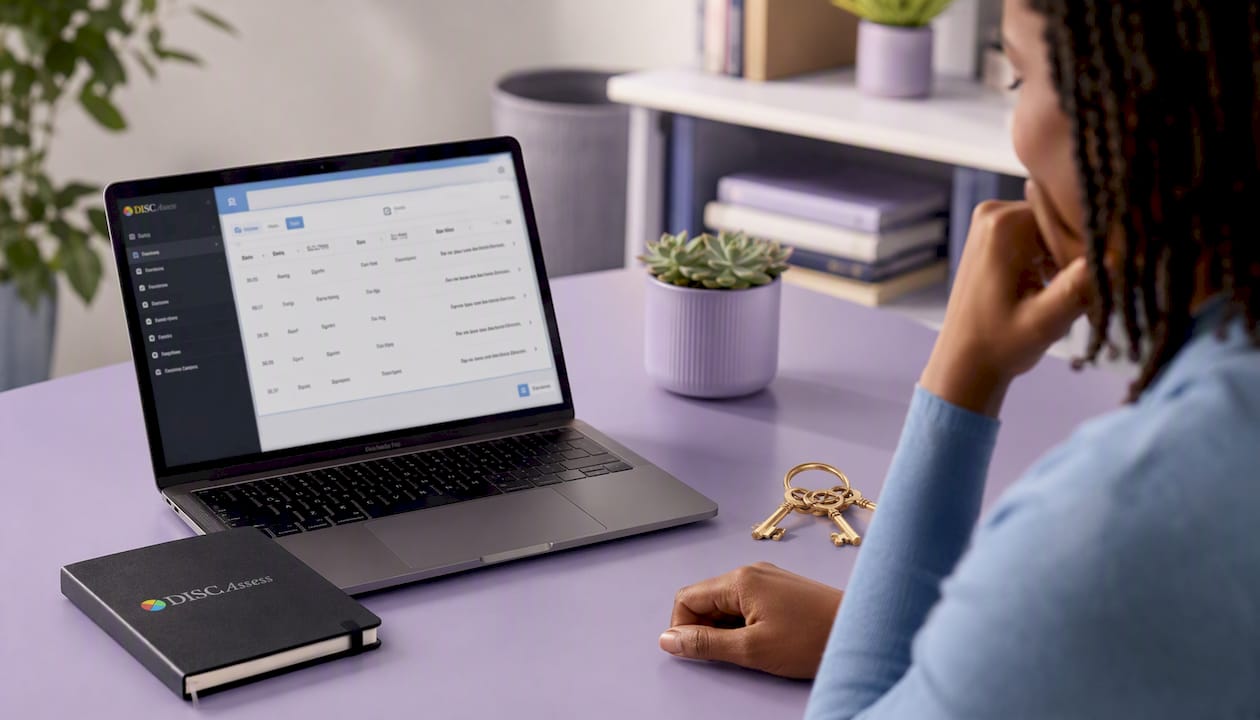
The platform delivers instant individual reports the moment an assessment is complete, so there is no waiting period before your debrief. The admin portal lets you manage your entire team's results in one place, track who has completed their assessment, and pull a group summary report before your workshop. Group packages and unlimited membership options mean you can scale from a five-person team to a fifty-person organization without renegotiating pricing. Workshop materials and downloadable resources are included, so your debrief agenda is ready to go.
Backed by Prism Counseling & Coaching, Discassess brings over a decade of experience to a platform designed for people who want to grow, connect, and lead well. Visit Discassess to get your team started today.
Sources
- DISC Communication in Remote Teams: How to Build Stronger Virtual Connections
- Video Conferencing, Meetings, Calling | Microsoft Teams
- Work chat that works from wherever you do | Slack