

DISC assessment is defined as a behavioral framework built on four dimensions: Dominance, Influence, Steadiness, and Conscientiousness. The role of DISC in personal leadership growth is to give leaders a practical, evidence-based map of how they naturally behave, communicate, and respond under pressure. Leaders who understand their DISC profile make better decisions, manage conflict more effectively, and engage their teams with greater intention. Backed by over a decade of applied practice at Prism Counseling & Coaching, Discassess brings this framework to individuals, coaches, and small teams who want real growth, not just theory.
How DISC's four behavioral styles shape your leadership
Every leader defaults to one or two DISC styles under normal conditions. Those defaults reveal both your greatest strengths and your most predictable blind spots.
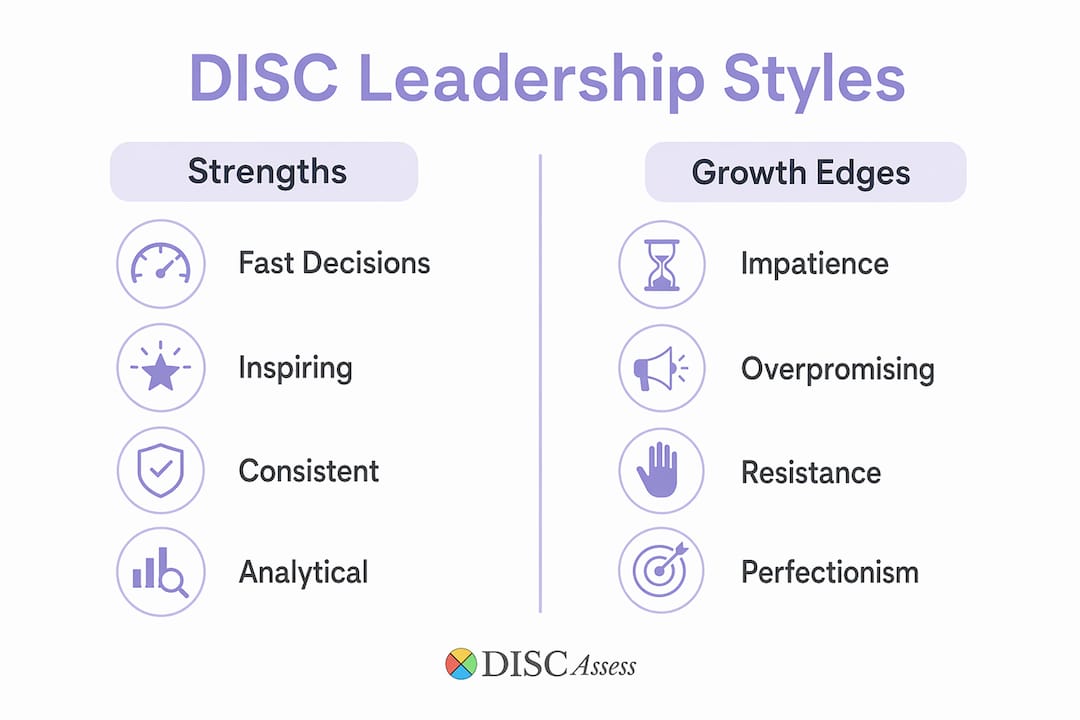
- Dominance (D): High-D leaders drive results and make decisions quickly. Their blind spot is impatience. They can override team input and create a culture of compliance rather than commitment.
- Influence (I): High-I leaders build energy and enthusiasm. Their blind spot is follow-through. Without accountability structures, their momentum fades before goals are reached.
- Steadiness (S): High-S leaders create stability and loyalty. Their blind spot is conflict avoidance. They often absorb tension rather than address it, which delays resolution.
- Conscientiousness (C): High-C leaders deliver accuracy and rigor. Their blind spot is analysis paralysis. They can delay decisions while seeking one more data point.
Stress amplifies every one of these tendencies. DISC behaviors under pressure shift predictably: high-D leaders become more demanding, and high-S leaders become passive-aggressive. That shift matters because the moments of highest stress are also the moments of highest leadership impact. Knowing your stress pattern gives you a window to pause and choose a different response.
Pro Tip: After your next high-pressure meeting, write down one behavior you noticed in yourself. Compare it to your DISC profile's stress description. The match will likely surprise you.

How does DISC improve self-awareness and communication?
The most common leadership problem is not a lack of skill. It is a gap between how you see yourself and how your team experiences you. DISC closes that gap by naming the gap directly.
A high-D leader may believe they are being efficient. Their team may experience them as dismissive. A high-I leader may believe they are being encouraging. Their team may experience them as unfocused. DISC gives both sides a shared language to name what is happening without it becoming personal.
Adaptive communication using DISC follows a clear pattern:
- With Dominant types: Be direct. Lead with the bottom line. Skip lengthy context.
- With Influencers: Build rapport first. Acknowledge their ideas before redirecting.
- With Steady types: Give advance notice. Avoid surprises. Affirm their contributions.
- With Conscientious types: Provide data. Offer logic. Allow time for questions.
These adaptations are not manipulation. They are respect in action. When you communicate in a way that fits how someone receives information, you reduce friction and build trust. Tailoring communication to DISC profiles prevents misunderstandings and saves significant time that would otherwise go to rework and repair.
Pro Tip: Before a difficult conversation, identify the other person's likely DISC style. Adjust your opening sentence to match their preference. A high-C colleague responds better to "Here's what the data shows" than "I feel like we need to talk."
The role of DISC in improving listening skills is equally significant. High-D leaders learn to slow down and hear concerns before acting. High-I leaders learn to listen without redirecting the conversation back to themselves. Listening is a learnable behavior, and DISC makes the specific adjustment visible.
How does DISC improve team dynamics and leadership agility?
A leader's job is not just to manage their own behavior. It is to read the room and respond to what the team needs in the moment. DISC gives leaders a systematic vocabulary for adaptive leadership that replaces guesswork with intention.
The most effective teams are not built by collecting one of every DISC style. They are built by aligning behavioral strengths to roles. Dominant members drive speed and decisions. Influencers manage morale and buy-in. Steady members provide continuity and reliability. Conscientious members deliver quality and accuracy. When roles match behavioral strengths, performance improves and friction drops.
| DISC Style | Leadership Strength | Best Role Fit | Growth Edge |
|---|---|---|---|
| Dominance | Fast decisions, goal focus | Project lead, change driver | Empathy, patience |
| Influence | Motivation, relationship-building | Culture lead, client liaison | Accountability, follow-through |
| Steadiness | Reliability, team cohesion | Operations, support roles | Assertiveness, conflict resolution |
| Conscientiousness | Accuracy, process rigor | Quality control, analysis | Speed, decisiveness |
Building a shared DISC vocabulary in a team creates psychological safety. Differences become visible and manageable rather than mysterious and frustrating. A team that can say "You're leading with your C right now, can we move to a decision?" is a team that communicates at a higher level.
Leadership agility means adjusting your style to what the situation requires, not abandoning who you are. A high-D leader can choose to slow down for a high-S team member without losing their drive. That choice is not inauthenticity. It is maturity. Situational leadership with DISC transforms style-flexing from an intuitive guess into a deliberate, repeatable skill.
The role of DISC in team intervention is particularly powerful when a team is stuck. When conflict is recurring and the cause is unclear, mapping the team's DISC profiles often reveals the pattern immediately. Two high-D leaders competing for control, or a high-C and a high-I clashing over pace, are problems that DISC names in minutes.
Practical steps for using DISC in your leadership development
Growth does not happen from reading a report once. It happens from returning to your DISC insights repeatedly and applying them in real situations. Here is how to build that practice.
- Take a quality assessment. Start with a full DISC report, not a free quiz. A detailed report from a platform like Discassess gives you behavioral graphs, stress responses, and communication preferences in one place.
- Identify your top two growth edges. Your report will show where your natural style creates friction. Choose two specific behaviors to work on, not five. Focus produces results.
- Bring DISC into coaching conversations. Share your profile with a coach or mentor. Use it as the starting point for every development conversation. DISC in leadership coaching programs works best when the profile is a living reference, not a one-time exercise.
- Use DISC to guide staff performance reviews. When you understand a team member's DISC style, you deliver feedback in a way they can actually receive. A high-C employee needs specific, evidence-based feedback. A high-I employee needs encouragement alongside correction.
- Revisit your profile every six to twelve months. Behavioral tendencies shift as your role, stress level, and environment change. Regular reassessment keeps your self-awareness current.
DISC improves leadership coaching by identifying specific behavioral gaps and focusing development on emotional intelligence, communication, and delegation based on individual style. High-D leaders benefit most from empathy training. High-I leaders benefit most from accountability systems. High-S leaders grow through assertiveness practice. High-C leaders develop by learning to make decisions with incomplete information.
Pro Tip: After each team meeting, rate yourself on one DISC-informed behavior: Did I listen before deciding? Did I give enough context? Did I follow through on what I said? Small, consistent reflections compound into real leadership change.
The role of DISC in building professional confidence is direct. When you understand why you lead the way you do, you stop second-guessing your instincts and start refining them. Confidence built on self-knowledge is durable. Confidence built on comparison is fragile.
Key Takeaways
DISC assessment is the most practical behavioral framework available for leaders who want to grow with intention, not just experience.
| Point | Details |
|---|---|
| DISC maps four behavioral styles | Dominance, Influence, Steadiness, and Conscientiousness each carry distinct leadership strengths and blind spots. |
| Stress reveals your real defaults | DISC behaviors amplify under pressure, making stress awareness a core leadership skill. |
| Communication adapts to DISC profiles | Matching your message to a person's DISC style reduces friction and builds trust faster. |
| Role alignment beats style diversity | Assigning roles based on behavioral strengths produces better team performance than balancing styles alone. |
| DISC works best as an ongoing practice | Revisiting your profile and applying insights in real situations produces lasting leadership growth. |
What I've learned from watching leaders use DISC over time
The leaders who get the most from DISC are not the ones who score highest on any dimension. They are the ones who take the results seriously enough to be uncomfortable with them.
I have watched high-D executives read their stress profile and immediately recognize a meeting from the previous week where they derailed their own team. That moment of recognition is worth more than any workshop. DISC does not tell you who you are. It shows you what you are doing and gives you the language to do something different.
The most common mistake I see is treating DISC as a label rather than a lens. Leaders who say "I'm a D, so that's just how I am" have missed the point entirely. DISC profiles are behavioral tendencies, not fixed traits. They shift with context, stress, and growth. The goal is not to become a different person. The goal is to become more aware of the person you are right now, so you can lead with greater intention.
The leaders I have seen grow the most are the ones who bring their DISC profile into every coaching conversation, every performance review, and every team conflict. They use it as a mirror, not a trophy. That is when DISC becomes a genuine tool for sanctification and growth, not just a personality curiosity.
— Tres
Discassess makes DISC-based leadership development accessible
Discassess offers DISC assessments built for individuals, coaches, and small teams who want practical results without complexity. Whether you are working through your own leadership development or guiding a group, the platform gives you detailed reports, group management tools, and resources you can use immediately. The individual DISC assessment delivers a full behavioral profile with stress responses and communication insights. For teams and coaches, the DISC group package provides assessment credits and an admin portal to manage multiple profiles in one place. Backed by Prism Counseling & Coaching, Discassess keeps the process affordable and straightforward, so the focus stays on growth.
FAQ
What is the role of DISC in personal leadership growth?
DISC gives leaders a behavioral map of their natural strengths, blind spots, and stress responses. That self-awareness is the foundation for improving communication, decision-making, and team effectiveness.
How does DISC help with communication in leadership?
DISC identifies how different people prefer to receive information, so leaders can adapt their message to reduce friction and build trust. Being direct with Dominant types and providing data to Conscientious types are two practical examples.
Can DISC improve staff performance reviews?
Yes. Understanding a team member's DISC style helps leaders deliver feedback in a format the person can actually receive and act on, making reviews more productive and less defensive.
How does DISC support leadership coaching programs?
DISC identifies specific behavioral gaps, such as a high-D leader needing empathy training or a high-I leader needing accountability systems, giving coaches a precise starting point for development conversations.
Are DISC profiles fixed or do they change over time?
DISC profiles reflect behavioral tendencies, not fixed personality traits. They shift with context and stress, which is why revisiting your profile regularly keeps your self-awareness accurate and your leadership growth on track.
Recommended
- DISC Profiles in Leadership Development Coaching
- DISC for Workplace Teams: A Manager's Practical Guide
- DISC Personality Assessment | Prism Counseling & Coaching - DISC Assess | Affordable, Professional DISC Assessments for Small Businesses
- DISC Assess | Affordable, Professional DISC Assessments for Small Businesses - All Articles