

Cohesive teams are a fundraising multiplier. When your staff moves in alignment using effective coaching tools, donor opportunities close faster, stewardship messages stay consistent, and every hour of staff time produces more mission impact through rapportagesoftware voor coaching. Research on over 200 nonprofits found that strong teamwork was one of the critical attributes enabling organizations to grow efficiently from early-stage to a substantial budget. Meanwhile, nonprofit knowledge workers report spending about 47% of their workweek on coordination tasks like tracking down information, waiting for answers, and resolving misunderstandings rather than advancing the mission.
Here is what that means for you as a leader: every hour your team spends chasing information is an hour not spent cultivating a donor relationship. The single most useful goal you can set this quarter is to reduce coordination friction so your people can do the work they were hired to do.
- Strong teamwork enables nonprofits to scale fundraising capacity and free senior leaders for capital strategy.
- About 47% of each workweek is lost to coordination problems that undermine productive collaboration.
- Many nonprofits are changing how they work, and teams with human-centered approaches are more likely to have clear goals.
Table of Contents
- Why does team cohesion drive fundraising results?
- What frameworks help you build a high-performing fundraising team?
- What barriers most often erode cohesion in nonprofits?
- How should leaders act and measure progress in the first 90 days?
- How do structured assessments like DISC Assess accelerate team alignment?
- How does team cohesion strengthen volunteer engagement?
- How does team cohesion shape your organizational culture and mission alignment?
- Key Takeaways
- The part most leaders skip
- Discassess helps your nonprofit team get aligned faster
- Useful sources
Why does team cohesion drive fundraising results?
Poor coordination does not just slow your team down. It costs you donors. When a major-gift prospect reaches out and two staff members send conflicting messages, or when a renewal appeal goes out without the program team's latest impact data, you lose trust you cannot easily rebuild. Cohesion removes those gaps.
The causal chain is straightforward. Unified stewardship messages mean donors hear one consistent story about their investment. Faster internal response times mean your team can acknowledge a major donor's inquiry the same day rather than three days later. Coordinated outreach means no prospect gets double-solicited or, worse, ignored entirely. These are not soft benefits; they show up in measurable outcomes like donor retention rate, average gift size, and time-to-close on major gifts.
Candid's 2025 research found that 64% of nonprofit teams regularly need information from other departments to do their jobs. When that handoff is slow or unreliable, fundraising suffers directly. A development officer waiting two days for a program update before a site visit is a development officer who walks into that meeting underprepared.
Consider a common scenario: a mid-size nonprofit's development and communications teams operate in separate silos. The development director closes a $50,000 gift, but the communications team does not hear about it for two weeks. The donor receives no personal acknowledgment beyond a form letter. Six months later, that donor does not renew. The problem was not the ask. It was the absence of a shared workflow.
What frameworks help you build a high-performing fundraising team?
Two frameworks, used together, give you a practical diagnostic for team health. The first is the Three C's: clarity of roles, community and mutual support, and consistent processes. The second is Patrick Lencioni's Five Dysfunctions model, which describes the behaviors cohesive teams exhibit: trust, healthy conflict, commitment, accountability, and collective results.

Mapped to fundraising, these frameworks become concrete. Role clarity means your development associate knows exactly which donor segments she owns and which belong to the major-gifts officer. No duplicated asks, no gaps. Consistent processes mean your gift acknowledgment workflow runs the same way every time, regardless of who is out of the office. Trust means your team surfaces problems early rather than hiding them until a donor relationship is already damaged.
Use this quick diagnostic to score your team's health before you invest in any intervention:
- Roles: Can every team member name their top three responsibilities without hesitation?
- Decision rights: Does everyone know who approves a donor communication before it goes out?
- Communication rhythm: Do you have a standing weekly touchpoint where fundraising metrics are reviewed together?
- Shared metrics: Is your whole team tracking the same donor retention and response-time numbers?
- Conflict norms: Do people raise disagreements openly, or do they wait until after the meeting?
A cross-national study of 451 participants found three configurational pathways to NGO project success, with strong team identification and shared climate sometimes substituting for direct leadership. That finding matters: you do not have to be present in every conversation for your team to perform well, as long as the culture and norms are solid.
Pro Tip: Schedule a 30-minute "productive disagreement" session once a month where your team debates one real strategic question. Structured forums for professional debate are what turn artificial harmony into genuine commitment. For practical guidance on managing those conversations, the nonprofit workplace conflict styles resource from Discassess is a useful starting point.
What barriers most often erode cohesion in nonprofits?
Most nonprofit teams do not fall apart because of dramatic conflict. They erode quietly, through unclear goals, siloed information, and the slow accumulation of unresolved frustrations. Recognizing these patterns early is what separates leaders who build lasting teams from those who are always in reactive mode.
Candid found that 33% of nonprofit workers said clearer goals would most improve their team's speed, another 33% cited shared processes, and 23% pointed to goal conflicts across teams. Those three problems compound each other. When goals are unclear, processes cannot be standardized, and when processes differ by department, conflicts multiply.
The table below pairs each common barrier with a practical routine that addresses it directly.
| Barrier | Practical Fix |
|---|---|
| Siloed information | Shared project hub (Asana, Notion, or a simple shared drive) with a weekly update protocol |
| Unclear goals | One-page team charter reviewed at the start of each quarter |
| Conflict avoidance | Monthly structured debate session with a rotating facilitator |
| Understaffing and overwork | Explicit capacity mapping before each campaign cycle |
| Poor role fit | 90-day performance check-in with clear role expectations in writing |
| Lack of shared metrics | A single fundraising dashboard visible to the whole team |
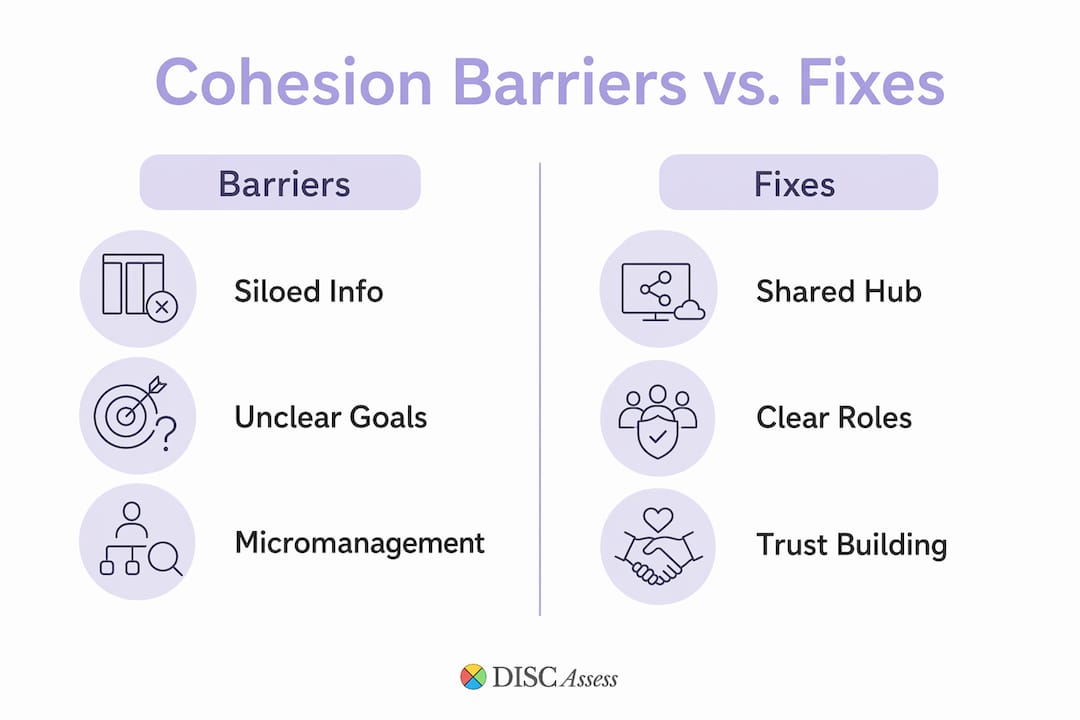
Common cohesion destroyers include micromanagement, poor communication, and trust deficits, all of which are addressable with consistent leadership routines rather than one-time workshops. The 47% of workweek time lost to coordination problems is not inevitable. It is a structural problem with structural solutions.
How should leaders act and measure progress in the first 90 days?
A 30/60/90-day plan gives you a sequenced path from diagnosis to measurable improvement without overwhelming your team or your calendar.
- Days 1–30 (Listen and diagnose): Run a brief listening tour with each team member. Ask three questions: What slows you down most? Where do you feel unclear about your role? What would help you serve donors better? Compile themes without judgment.
- Days 31–60 (Clarify and pilot): Publish a one-page role clarity document for each position. Pilot a new weekly meeting cadence that includes a five-minute donor-pipeline review. Introduce a shared communication channel for time-sensitive donor inquiries.
- Days 61–90 (Train and measure): Run one targeted skill session based on what the listening tour revealed. Begin tracking your four core KPIs: donor retention rate, average response time to donor inquiries, cross-team handoff time, and staff retention. Administer a short pulse survey to gauge team confidence.
For the pulse survey, six questions cover the essentials: Do you know what is expected of you this week? Do you have the information you need to do your job? Do you feel heard by your team? Are our goals clear? Do you trust your teammates to follow through? Do you feel your contribution matters? Run it monthly and share results with the team.
| Metric | Why It Matters |
|---|---|
| Donor retention rate | Reflects consistency of stewardship and relationship quality |
| Response time to donor inquiries | Measures cross-team communication speed |
| Staff retention rate | Signals team health and leadership effectiveness |
| Fundraising ROI | Ties cohesion improvements to bottom-line mission capacity |
| Cross-team handoff time | Reveals coordination friction between departments |
Atlassian's 2026 research shows that teams with human-centered approaches are 50% more likely to avoid duplicate work. When you introduce any new tool, whether a CRM update or an AI writing assistant, pair it with a conversation about how it changes roles and workflows. Technology without that human-centered change often fragments rather than unifies.
How do structured assessments like DISC Assess accelerate team alignment?
Frameworks and plans are only as good as your team's self-awareness. That is where structured assessments earn their place. A well-run personality assessment does not just produce a report; it creates a shared language your team can use to navigate differences, assign roles more intentionally, and reduce the friction that slows fundraising.
The DISC model maps directly onto the frameworks discussed earlier. It reveals communication preferences, decision-making tendencies, and conflict styles, which are exactly the variables that determine whether your team operates with clarity or confusion. Discassess, backed by Prism Counseling & Coaching, offers assessments designed for small nonprofit teams: affordable, immediately usable, and requiring no certification to administer.
Three concrete use cases for nonprofits:
- Leadership team alignment: Before a strategic planning retreat, each leader completes a DISC Personality Assessment. The debrief surfaces communication gaps that would otherwise derail the planning process.
- Fundraising team role clarity: The development team uses the Individual Classic DISC Assessment to identify who is naturally suited for major-gift cultivation versus grant writing versus donor events. Roles get assigned to strengths, not just availability.
- Volunteer team coordination: The DISC Group Package gives an admin account plus multiple assessment credits, making it practical to assess a volunteer cohort before a capital campaign or a major event push.
Implementation follows four steps. First, distribute assessments and collect results through the Discassess admin portal. Second, run a facilitated debrief where the team discusses patterns together, not just individual scores. Third, use the insights to update role assignments, communication norms, and meeting formats. Fourth, follow up with a pulse survey 60 days later to measure whether clarity and trust have improved. For a full workflow, the team dynamics assessment guide from Discassess walks through each step in detail.
Pro Tip: Do not share DISC results in a vacuum. The debrief conversation is where the real value lives. A report sitting in someone's inbox changes nothing; a team discussion about what the results mean for how you work together changes everything.
How does team cohesion strengthen volunteer engagement?
Volunteers experience your organization's culture the moment they walk in. If your paid staff are visibly fragmented, communicating inconsistently, or unclear about their own roles, volunteers pick up on that immediately. It erodes their confidence in the mission and shortens their tenure.
Cohesive staff teams create the conditions for volunteer success. When a volunteer coordinator knows exactly what the development team needs from a fundraising event, she can brief volunteers with precision. When program staff and development staff share a common language about impact metrics, volunteers hear a unified story they can repeat to their own networks. That word-of-mouth is one of the most cost-effective donor acquisition channels available to nonprofits.
Using DISC with volunteer teams is one practical way to extend the benefits of assessment beyond paid staff. Understanding a volunteer's communication style helps you assign them to roles where they will thrive and stay engaged, rather than burning out after one campaign. Volunteer retention is a fundraising asset. A long-tenured volunteer who understands your mission deeply is often your best major-gift referral source.
How does team cohesion shape your organizational culture and mission alignment?
Culture is not a values statement on the wall. It is the sum of how your team behaves when no one is watching, how decisions get made, and whether people feel safe raising concerns. Cohesion is what makes a healthy culture self-sustaining rather than dependent on any one leader's presence.
When teams share clear goals and trust each other's follow-through, mission alignment becomes natural rather than forced. Staff members who understand how their individual role connects to the organization's larger purpose tend to stay longer, perform better, and advocate more authentically for the cause. That alignment is especially visible in fundraising: a development officer who genuinely believes in the program she is funding raises money differently than one who is simply executing a job description.
Research on team effectiveness in NGO projects identified seven dimensions of team effectiveness, including inter-team coordination, leadership communication, and decision-making and information sharing. Each of those dimensions is a cultural artifact. They reflect the habits and norms your leadership team has built over time, intentionally or not. The good news is that habits can be changed. A consistent meeting rhythm, a shared set of metrics, and a culture of healthy debate are all within your reach as a leader.
Key Takeaways
Strong team cohesion directly improves fundraising outcomes, staff retention, and mission alignment, making it one of the highest-return investments a nonprofit leader can make.
| Point | Details |
|---|---|
| Cohesion drives fundraising ROI | Unified stewardship, faster responses, and coordinated outreach convert more donor opportunities. |
| Coordination waste is measurable | Nonprofit workers spend about 47% of their week on coordination tasks rather than mission work. |
| Frameworks guide diagnosis | Lencioni's Five Dysfunctions and the Three C's give leaders a practical checklist to score team health. |
| 30/60/90 plan starts today | Listen in month one, clarify roles in month two, train and measure in month three. |
| Discassess accelerates alignment | The DISC Group Package and Individual Classic DISC Assessment give nonprofit teams an affordable, immediate path to role clarity and communication improvement. |
The part most leaders skip
There is a tendency in nonprofit leadership to treat team health as something you address after the next campaign, after the next hire, after the next board meeting. The logic feels reasonable: programs need to run, donors need to be stewarded, and there is always something more urgent than an internal team conversation.
That reasoning is exactly backward. A leadership team that cannot communicate clearly will always be in reactive mode, because the coordination failures keep generating new crises. The fundraising bottleneck is almost never the ask itself. It is the three weeks of internal confusion that preceded it.
What the research actually supports is this: investing in team climate, shared purpose, and role clarity is not a luxury for well-resourced organizations. It is the mechanism by which under-resourced organizations stop hemorrhaging capacity. When your team knows their roles, trusts each other, and debates ideas openly, your senior leaders get their time back. And that time is what funds the mission.
If you are not sure where your team stands right now, run the six-question pulse survey from the 30/60/90 plan this week. The answers will tell you more than any consultant's assessment.
Discassess helps your nonprofit team get aligned faster
Small nonprofit teams rarely have the budget for a multi-day offsite or a full organizational development consultant. Discassess was built for exactly that reality: affordable, easy-to-use DISC assessments that give your team a shared language for communication, role fit, and conflict resolution without requiring a certification or a lengthy onboarding process.
Backed by Prism Counseling & Coaching with over a decade of experience, Discassess offers three practical options for nonprofit teams:
- Individual Classic DISC Personality Assessment: A single-use online assessment and detailed report, ideal for onboarding a new development hire or preparing a leader for a strategic planning session.
- DISC Personality Assessment (Online) and Report: A clear, accessible assessment for any team member who needs to understand their communication tendencies and how they affect collaboration.
- DISC Group Package (Admin Account + Assessment Credits): The right fit for leadership teams or volunteer cohorts, with an admin portal that lets you manage multiple assessments and track results in one place.
Visit the group assessments page to find the package that fits your team size, or purchase an individual assessment today and run your first debrief within the week.
Useful sources
The following resources informed this article and offer deeper reading for nonprofit leaders who want to go further.
- What Does It Take to Grow a Nonprofit? Teamwork and Capital — Nonprofit Quarterly study of over 200 organizations on the role of teamwork in scaling to a $2 million budget.
- 5 Takeaways on the State of Nonprofit Teamwork — Candid's 2025 research findings on coordination challenges, goal clarity, and shared processes.
- The State of Nonprofit Teams 2026 — Atlassian's research on AI adoption, human-centered teamwork, and goal clarity in nonprofits.
- Building Resilient Nonprofit Teams: Insights from Lencioni's Five Dysfunctions — A practical adaptation of Lencioni's framework for nonprofit contexts.
- Configurational Pathways to Sustainable NGO Project Success — Cross-national study on servant leadership, team identification, and project outcomes in NGOs.
- Team Effectiveness in NGO Projects — Academic study identifying seven dimensions of team effectiveness specific to NGO social projects.
- What Destroys Team Cohesion — ProAct Safety's overview of the organizational behaviors that erode cohesion over time.
- About the DISC — Discassess and the Discassess blog offer practical next steps for nonprofit leaders ready to run their first assessment.