

DiSC supports group workshop facilitation by giving every participant a shared language, a visual map of team dynamics, and structured practice in adapting their communication style to others. When you run a DiSC-based workshop well, you are not just delivering a personality report. You are creating the conditions where real behavior change becomes possible, often within a single session.
Three things make this model particularly useful for group settings:
- Shared language: DiSC replaces vague interpersonal complaints ("she's too aggressive," "he never commits") with observable, non-judgmental style descriptions that the whole group can use.
- Style mapping: Plotting participants on a visual quadrant during the session makes abstract theory concrete within minutes, revealing gaps in representation and explaining recurring meeting patterns.
- Tone-switching: Facilitators who adapt their own delivery to each style in real time model the very skill they are teaching, which accelerates participant engagement.
Your next step: At your next team meeting, run a 20-minute style map followed by a start/stop/continue conversation. That single combination moves a group from awareness to a specific, agreed behavior request before anyone leaves the room.
Table of Contents
- Why DiSC actually works in group settings
- What to do before the workshop starts
- How to run the session: agenda, prompts, and handling resistance
- Activities, templates, and your facilitation toolkit
- Should you co-facilitate, and how do you coordinate?
- After the workshop: follow-up, action plans, and measuring what changed
- Practitioner techniques that separate good facilitation from great facilitation
- Key Takeaways
- The insight most facilitators take too long to learn
- Discassess makes it easier to run DiSC workshops at any scale
- Useful sources and further reading
Why DiSC actually works in group settings
The DiSC model works in workshops because it solves a problem most teams do not know they have: they lack a neutral vocabulary for talking about behavioral differences. Without one, feedback conversations quickly become personal. With one, a facilitator can redirect "why does she always push back?" into "her D-style tendency is to challenge assumptions — how do we use that rather than fight it?"
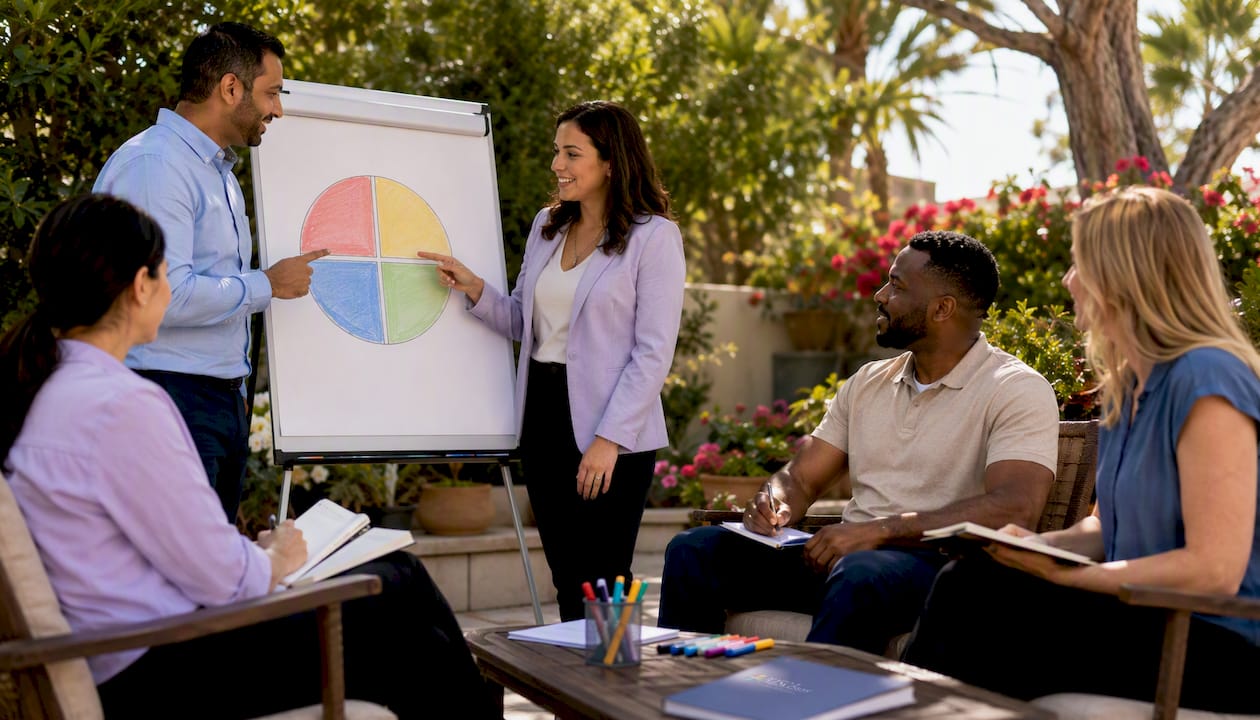
That shift is the shared-language effect. It reduces what psychologists call attribution errors, where we explain other people's behavior by their character and our own behavior by our circumstances. A common vocabulary interrupts that reflex and opens space for coaching conversations that would otherwise stall.
Style mapping adds a second layer of value. When you plot a team's profiles on a quadrant during the session, participants can see at a glance whether the group skews heavily toward one style. A room full of high-D leaders, for instance, will make decisions fast but may underinvest in relationship-building. Seeing that pattern on a whiteboard is more persuasive than hearing it described.
One honest caution: awareness alone does not change behavior. Teams that treat DiSC as a multi-phase rollout — assessment, facilitated debrief, and structured follow-up — see more sustained behavior change than teams that treat it as a one-day event. Your workshop design must include practice activities and a follow-up plan, or the insight fades within weeks. DiSC describes tendencies, not fixed traits, and that distinction matters for how you frame every activity.
What to do before the workshop starts
Strong facilitation begins well before participants arrive. The preparation phase determines whether your session feels purposeful or improvised.
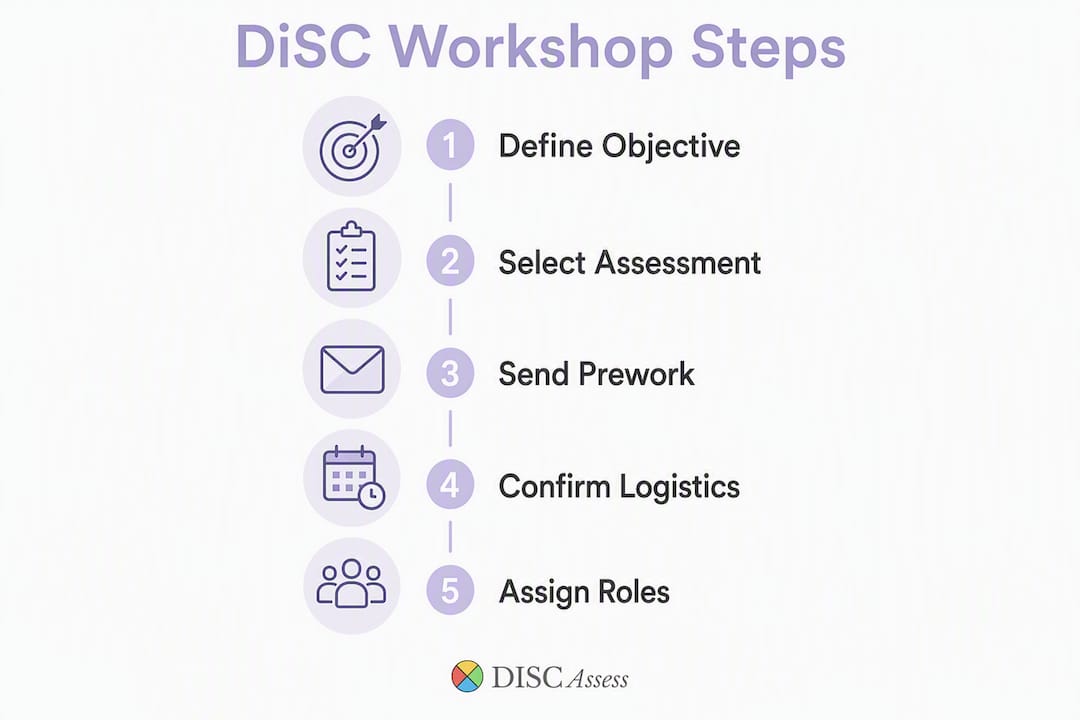
Step 1: Define a clear objective
Choose one primary focus: communication style awareness, feedback quality, decision-making dynamics, or conflict navigation. Your objective shapes every activity, every debrief question, and how you measure success afterward. A workshop aimed at improving feedback conversations needs different role-play scenarios than one focused on cross-functional decision-making.
Step 2: Select the right assessment
For most professional groups, the classic DiSC assessment with a full report_with_Report.html) gives participants enough detail to work with during the session without overwhelming them. Collect completed reports at least 48 hours before the workshop so you can review the group's profile distribution and anticipate dynamics.
Step 3: Send prework to participants
A short pre-session intake (three to five questions about current communication challenges) primes participants to engage rather than observe. Include a brief confidentiality agreement and a clear statement that DiSC results will not be shared with HR or used in performance reviews. Psychological safety starts before the first slide.
Step 4: Confirm logistics
| Item | In-person | Virtual |
|---|---|---|
| Room setup | Rounds or clusters, not rows | Breakout rooms pre-assigned |
| Materials | Printed reports, style map handout, role-play cards | Digital workbook, shared whiteboard (Miro or Jamboard) |
| Tech check | Projector, markers, flip chart | Camera, audio, screen share tested before |
| Timing buffer | 15 minutes before start | 20 minutes before start |
Step 5: Assign roles
- Lead facilitator — owns the agenda, manages energy, and leads debriefs.
- Co-facilitator or producer — monitors chat (virtual), manages breakout rooms, and tracks time.
- Note-taker — captures key insights and action items for the follow-up report.
- Client sponsor — opens the session to signal organizational commitment and closes it with next steps.
The 5 P's of facilitation framework — Preparation, Process, Participation, Perception, and Practice — maps cleanly onto this pre-session work. Running through each "P" as a checklist the day before a workshop catches most gaps before they become problems.
How to run the session: agenda, prompts, and handling resistance
A 90–120 minute DiSC workshop has a natural rhythm. Deviate from it and you will either rush the practice or skip the debrief, which is where most of the learning actually happens.
Sample agenda (90 minutes)
- Welcome and framing (10 min): Sponsor opens. Facilitator sets norms: DiSC describes tendencies, not ceilings. No style is better than another.
- Report orientation (15 min): Participants review their own reports. Facilitator highlights the "dot" placement and the priority section, not the full narrative.
- Team style map (15 min): Each participant places a sticky note (or virtual marker) on a shared quadrant. Facilitator narrates patterns aloud: "Notice we have strong representation in S and C, and very little in D — what does that tell us about how we make decisions?"
- Breakout practice (25 min): Small groups work through a role-play scenario (see below). Observer uses a simple rubric.
- Large-group debrief (15 min): What did you notice? What felt hard? What would you do differently?
- Action planning (10 min): Each participant writes one specific behavior they will try before the next team meeting.
Tone-switching in practice
Adapting your delivery to each style is the core translator from awareness to practice. Here is what that looks like in concrete language:
- D-style participants: Lead with the bottom line. "Here is what this means for your team's output." Skip the warm-up story.
- I-style participants: Open with energy and connection. "What's one word that describes how you felt reading your report?" Let them share before you explain.
- S-style participants: Slow the pace. Give them a moment to process before calling on them. Affirm contributions: "That's a really grounded observation."
- C-style participants: Offer data and structure. "The research behind this model is well-documented — here is what the evidence says." Avoid vague generalizations.
Role-play scenario: feedback conversation
Set-up: Person A (D-style) needs to give feedback to Person B (S-style) about missed deadlines. Person C observes using this rubric: Did A adjust their pace? Did A invite B to respond? Did B express their concern directly?
Rotate roles after five minutes. Debrief with: "What did you notice about your natural instinct? What did you have to consciously override?"
Handling resistance
Some participants arrive skeptical, and that is healthy. When someone says "I don't think a four-letter label can capture who I am," agree with them: "You're right — it can't. DiSC is a starting point, not a summary." Acknowledge the limitation, then redirect: "What it can do is give us a shared language for this conversation." Defensiveness usually drops when participants feel heard rather than corrected. For deeper conflict dynamics in group settings, having a co-facilitator observe the room while you lead the debrief gives you an extra set of eyes on who is disengaging.
Pro Tip: Model tone-switching yourself during the session introduction. Deliver the same key message in two different styles — once with data and structure (C-style), once with a story and warmth (I-style) — and name what you just did. Participants immediately understand the concept in a way that no slide can replicate. Keep it brief and genuine; forced flexing reads as performance.
Activities, templates, and your facilitation toolkit
A well-prepared toolkit means you spend your energy on the room, not on building materials the morning of the session. The Discassess workshop guide provides facilitator resources designed to reduce build-from-scratch time, which is particularly valuable for coaches and team leaders running DiSC for the first time.
Core toolkit checklist
- Slide deck outline: Welcome and norms, model overview (one slide per style), style map activity instructions, role-play setup, action plan template.
- Participant workbook: Report summary page, style map handout, role-play observer rubric, start/stop/continue worksheet, action plan page.
- Style map handout: A blank quadrant participants can annotate during the session and take home.
- Role-play cards: Scenario descriptions, role assignments, and observer prompts printed on index cards or included in the digital workbook.
Activity menu
| Activity | Time needed | Best for | Low-prep variant |
|---|---|---|---|
| Team style map | 15 min | All group sizes | Verbal poll + whiteboard sketch |
| Start/stop/continue | 20 min | Follow-up sessions | Paired conversation, no worksheet |
| Perspective swap | 20 min | Cross-functional teams | Facilitator-led discussion |
| Decision-sequence simulation | — | Leadership teams | Shortened to one decision scenario |
| Gallery walk | 15 min | Large rooms (20+) | Post style descriptions on walls; participants annotate |
| Paired debrief | 10 min | Short sessions | Two questions, timed |
The start/stop/continue format deserves particular attention. Each participant identifies one behavior to start, one to stop, and one to continue, using DiSC language to frame each request. It converts abstract style labels into specific interpersonal agreements, which is why it works as both an in-session closer and a structured follow-up tool.
For large rooms or short sessions, the gallery walk is underused. Post a brief description of each DiSC style on four walls. Participants walk to the style that best describes a colleague they find challenging to communicate with, then write one question they would ask that style. The debrief writes itself.
When using Discassess group packages, the admin portal lets you distribute reports, track completion, and organize participants by team before the session begins, which removes one of the most common pre-workshop headaches.
Should you co-facilitate, and how do you coordinate?
Co-facilitation is worth the added coordination when the group is large, the topic is high-stakes, or the participants represent significantly different experience levels with DiSC. For a team of eight working through their first profile debrief, one skilled facilitator is usually enough. For a cross-departmental session of thirty with mixed DiSC familiarity and a history of interpersonal tension, a second person in the room changes the dynamic meaningfully.
When co-facilitation makes sense
- Group size exceeds 20 participants.
- The session covers sensitive topics (conflict history, leadership feedback, restructuring).
- One facilitator has deep DiSC expertise and the other has strong domain knowledge of the team's industry or function.
- Virtual delivery, where managing breakout rooms and monitoring chat simultaneously is genuinely difficult alone.
Before the session
- Divide planning tasks explicitly: who builds the slide deck, who manages report distribution, who writes the role-play scenarios.
- Agree on live handoff signals (a nod, a specific phrase like "I'll hand it back to you here") so transitions feel rehearsed, not improvised.
- Decide who owns each segment of the agenda and who observes during that segment.
During the session
- Lead facilitator: Runs the debrief, manages energy, holds the agenda.
- Producer/note-taker: Monitors participation, captures key quotes, manages breakout rooms virtually, and flags when a participant seems disengaged.
- Behavior observer: Watches for style-flexing moments and names them during the debrief ("I noticed when Mara shifted her pace there — that's a real example of what we're talking about").
After the session
- Run a joint debrief within 24 hours: what worked, what to adjust, who owns follow-up tasks.
- Agree on a single follow-up document so participants receive one consistent message, not two slightly different versions.
Pro Tip: Rehearse your two or three key transitions out loud before the session. The moment when the lead facilitator hands the room to the co-facilitator is where energy drops if it feels unplanned. A single practice run, even over a five-minute call, makes those moments feel natural.
After the workshop: follow-up, action plans, and measuring what changed
The workshop is the beginning, not the end. Without a structured follow-up, most participants retain the vocabulary but revert to their default style within two to three weeks. A multi-phase approach — assessment, facilitated debrief, and structured follow-up — produces more sustained behavior change than a single event.
Follow-up sequence
- Within 48 hours: Send each participant their completed action plan (the one they wrote during the session) plus a one-page summary of the team style map.
- Week 1–2: Manager check-in: one question only — "What's one thing you tried this week based on what you learned?" Keep it low-pressure.
- Week 2–3: Schedule a 20-minute team check-in to surface what people tried, what worked, and what still feels hard. This is where insight becomes habit.
- Week 4–6: Optional: run a start/stop/continue follow-up conversation using DiSC language to update the behavior agreements from the workshop.
Simple measurement options
You do not need a complex evaluation framework to know whether the workshop landed. Three lightweight signals are usually enough:
- Baseline/retrospective self-rating: Ask participants to rate their communication effectiveness (1–5) before and after the workshop using a single question. The gap is your signal.
- Follow-up survey (two questions): "What is one behavior you changed since the workshop?" and "How confident are you in adapting your style to a colleague with a different DiSC profile?" (1–5 scale).
- Behavioral examples: Ask managers to note one specific instance of style-flexing they observed in a team meeting. Concrete examples are more meaningful than aggregate scores.
Track participation in follow-up activities as a proxy for engagement. A team that shows up for the 20-minute check-in is a team that found the workshop worth continuing. For managers applying DiSC to ongoing team dynamics, these check-ins also create natural coaching moments that extend the workshop's value well beyond the original session.
Practitioner techniques that separate good facilitation from great facilitation
The difference between a competent DiSC workshop and one that genuinely shifts a team's communication is usually found in a handful of specific techniques, not in the content of the slides.
Running a team style map step by step
- Display a blank quadrant on a shared screen or flip chart (D top-right, I top-left, S bottom-left, C bottom-right is a common layout).
- Ask each participant to place their initials or a sticky note at the approximate location of their DiSC dot.
- Narrate what you see: "We have a cluster of S and C styles here, which suggests this team values thoroughness and harmony. What does that mean for how you approach a tight deadline?"
- Ask the group: "Where are the gaps? What perspectives might be underrepresented in your typical meetings?"
- Use the map as a reference point throughout the rest of the session, not just during this activity.
Role-play structure that actually works
A role-play that produces learning has four components: a clear scenario, defined roles, an observer with a rubric, and a structured debrief. Without the observer and the debrief, it is just acting.
- Set-up (2 min): Distribute role-play cards. Each card names the style, the situation, and one specific goal for the interaction.
- Role-play (5 min): Participants run the scenario. Observer tracks: Did the speaker adjust their pace? Did they use the other person's preferred communication cues?
- Rotate roles (5 min): Each person experiences both sides of the style gap.
- Debrief (5 min): "What felt natural? What required effort? What would you do differently in a real conversation?"
Phrase-level tone-switch guide
| Style | Say this | Avoid this |
|---|---|---|
| D | "Here's the bottom line and what it means for results." | Long preambles, excessive context |
| I | "What's your gut reaction to this?" | Dry data dumps, no personal connection |
| S | "Take a moment — there's no rush." | Sudden changes, pressure to decide fast |
| C | "The evidence behind this is solid — here's why." | Vague claims, skipping the rationale |
Cautions every facilitator should internalize
- Avoid labels as nouns. Say "someone with a high-D tendency" rather than "a D." The difference signals that you understand the model's limits.
- Watch for confirmation bias. Once participants know each other's styles, they sometimes stop listening and start predicting. Interrupt this with: "What surprised you about how that person responded?"
- Adapt for diverse groups. In groups with significant cultural diversity, acknowledge that behavioral norms vary across cultures and that DiSC tendencies interact with cultural context. Invite participants to name where their cultural background shapes their style expression.
- Surface your credibility quietly. You do not need to recite your credentials. Demonstrating that you know the model's limits, that you can hold a skeptical participant with respect, and that you have a clear plan for the room is what builds trust. Facilitators working with nonprofit and volunteer groups often find that transparency about the model's purpose — growth, not judgment — does more for credibility than any credential.
Key Takeaways
DiSC supports group workshop facilitation most effectively when facilitators combine a shared language, a visual style map, structured practice, and a multi-phase follow-up plan rather than treating the workshop as a single event.
| Point | Details |
|---|---|
| Start with a clear objective | Choose one focus (communication, feedback, or decisions) before selecting activities or measuring outcomes. |
| Run a style map early | Plot participant profiles on a shared quadrant early in the session to make the model concrete and reveal team dynamics. |
| Build in practice and follow-up | Schedule a 20-minute team check-in 2–3 weeks post-workshop; without it, awareness rarely becomes habit. |
| Use tone-switching as a live model | Adapt your own delivery to each DiSC style during the session; participants learn more from watching you flex than from any slide. |
| Discassess group packages | The Starter, Pro, and Group Discount packages include reports, admin tools, and facilitator resources that reduce prep time for any group size. |
The insight most facilitators take too long to learn
There is a version of DiSC facilitation that is technically correct and practically inert. The facilitator knows the model, delivers the content clearly, and hands out good reports. Participants leave saying it was interesting. Three weeks later, nothing has changed.
The gap is almost always in the practice, not the presentation. Groups need to feel the discomfort of flexing their style in a low-stakes environment before they will attempt it in a high-stakes one. A role-play that feels slightly awkward in the room is doing exactly what it should. The facilitator's job is not to make it comfortable. It is to make it safe enough to try.
The habit worth building is a two-minute style check before any significant meeting. Before you walk into a room, ask yourself: who is in this meeting, what are their likely style tendencies, and what is one small adjustment I can make to how I open or close the conversation? That question, practiced consistently, is what separates a leader who attended a DiSC workshop from one who actually uses it.
The style map is the most underused tool in the facilitator's kit. Most facilitators run it once and move on. The ones who return to it throughout the session, who point back to it during the debrief and again during action planning, are the ones whose participants remember it six months later. It is a visual anchor, and anchors work because you keep coming back to them.
Discassess makes it easier to run DiSC workshops at any scale
Running a DiSC workshop from scratch is genuinely time-consuming. Building reports, organizing participants, preparing materials, and designing follow-up activities can easily consume more hours than the session itself. Discassess is built to reduce that overhead, particularly for coaches, team leaders, and nonprofit facilitators who do not have a dedicated HR team behind them.
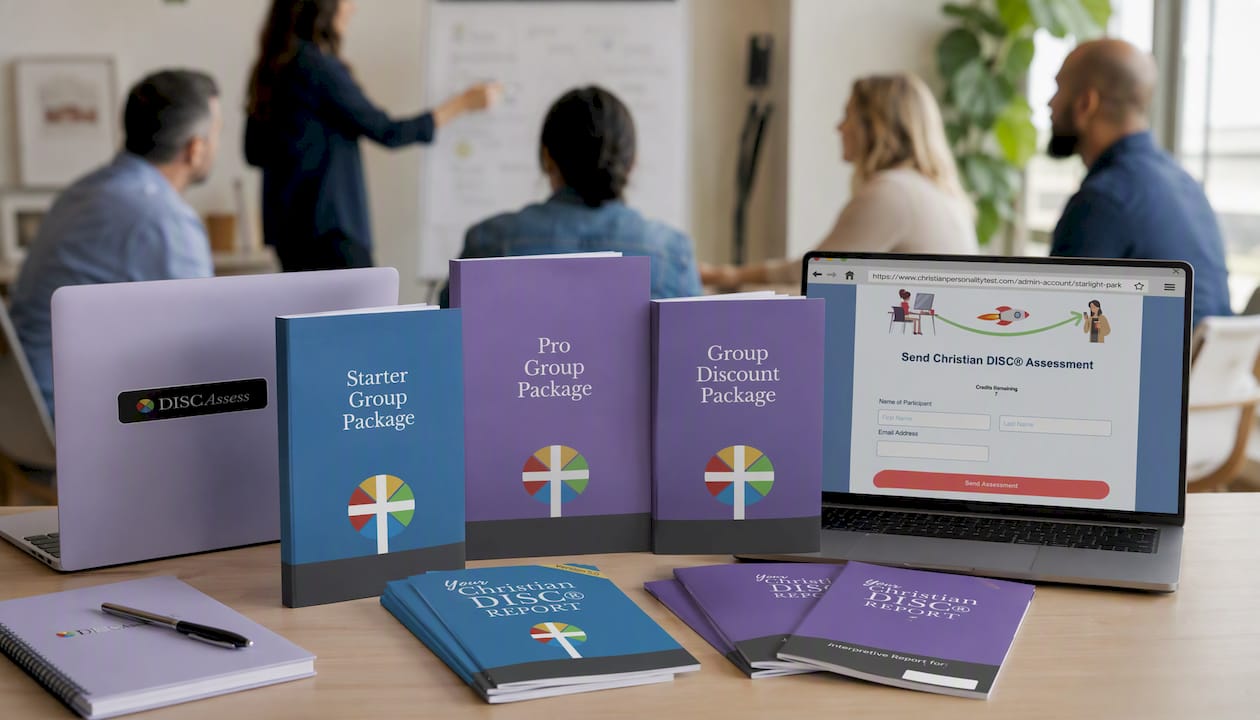
The Starter Group Package is the right entry point for small teams or first-time facilitators. It includes assessments and reports for a compact group, giving you everything you need to run a focused style-map session without building anything from scratch. For larger or more complex rollouts, the Pro Group Package adds facilitator resources and expanded group management tools that support multi-session programs. Teams that need to assess a larger number of participants affordably will find the Group Discount Package the most practical option, with per-assessment pricing that scales without requiring a long-term contract.
The Discassess admin portal lets you distribute assessments, track completion, and organize participants by team before the session begins. That means less logistical scrambling on the day and more time focused on the room. View the group packages at discassess.com and choose the option that fits your next workshop.
Useful sources and further reading
These resources offer practical facilitation guidance, research context, and downloadable tools to support your DiSC workshop planning:
- Using DiSC in the Workplace: A Practical Implementation Guide — LeadershipStrength.com: Covers multi-phase rollout design, style mapping, and follow-up frameworks with concrete implementation steps.
- Discassess Workshop Guide: Facilitator materials, admin portal guidance, and downloadable resources for group DiSC rollouts.
- Personality Tools for Nonprofit Staff Development — Discassess Blog: Practical guidance on adapting DiSC facilitation for nonprofit teams and mixed-experience groups.
- DiSC for Workplace Teams: A Manager's Practical Guide — Discassess Blog: Extends workshop learning into ongoing team management and manager-led coaching conversations.