

Yes, DISC belongs in your classroom toolkit when you use it the right way: as a mirror for self-awareness and a compass for adjusting how you communicate, not as a label for sorting students or staff. Teachers who apply DISC well see better student connections, smoother group work, and more collegial staff teams. The sections ahead walk through the styles, classroom activities, staff development, and the operational steps to run assessments responsibly.
TL;DR:
- Teachers should use DISC as a self-awareness and communication tool, not for labeling students or staff, to foster better relationships and reduce friction.
- Understanding the four DISC styles helps teachers tailor classroom routines, pacing, and support strategies to individual student needs and behavioral tendencies.
- When used with students, DISC activities should focus on describing preferences first and positioning results as self-reflection rather than assessments or grades.
- Staff development benefits from DISC-led team exercises, such as sharing feedback preferences and building mentoring pairs that consider behavioral styles to improve collaboration.
- Administrators need to carefully manage DISC assessments by defining clear objectives, ensuring privacy, and avoiding fixed identity labels to keep the tool focused on growth and communication.
Table of Contents
- Why DISC for Teachers Matters: Classroom Benefits and Sensible Uses
- What Are the Four DISC Styles and How Do They Shape Teaching?
- How Can Teachers Use DISC With Students and Groups?
- How Should Schools Use DISC for Staff Development and Leadership?
- How Do You Administer DISC Assessments in a School?
- Publisher Spotlight: Turnkey DISC Tools Built for Schools
- One Teacher, One Activity: What Actually Happened
- Ready to Bring DISC Into Your Classroom or Staff Room?
- Where to Find More Teacher Resources
- Sources
- FAQ
Why DISC for Teachers Matters: Classroom Benefits and Sensible Uses
DISC gives teachers a shared vocabulary for behavior, and that vocabulary reduces friction faster than almost anything else you can add to a staff meeting. When you understand that a colleague's blunt feedback style comes from a Dominance tendency rather than personal criticism, you stop taking it personally. When you recognize that a quiet student's hesitation reflects a Conscientious need for accuracy rather than disengagement, you adjust your question instead of your grade book.
The classroom outcomes that show up most consistently when teachers apply DISC thoughtfully include:
- Higher participation from students who once sat out group discussions because the format didn't match their communication comfort zone.
- Smoother teamwork in group projects once teams are built with a mix of styles rather than by alphabet or friendship.
- Better differentiated support, since a teacher who knows their own default style can spot when they're unconsciously favoring students who think the same way they do.
- Fewer repeated behavior conflicts, because the teacher adapts the approach instead of repeating the same correction that already failed twice.
Pro Tip: Run your own DISC assessment before you ever introduce it to students. You cannot coach a style you haven't examined in yourself.
The right use of DISC in schools stays close to professional development, advisory periods, and team-building. It's a poor fit for hiring decisions or performance evaluation, and no reputable DISC provider recommends using it that way. The U.S. Department of Education's teaching resources hub reinforces this distinction, framing personality and behavior tools as supports for instructional growth, not gatekeeping instruments. Treat DISC as a lens for reflection and communication, and it earns its place in your practice. Treat it as a verdict on a person's worth or capability, and you've misused a tool built for something else entirely.
What Are the Four DISC Styles and How Do They Shape Teaching?
Every teacher leans toward one of four behavioral styles, and that lean shows up in pacing, tone, and classroom routines whether you notice it or not.
-
Dominance (D) teachers move fast, value efficiency, and tend to run tight, results-oriented classrooms. The adjustment: slow down transitions for students who need more processing time, soften directive language ("Let's try this" instead of "Do this now"), and build in a few minutes of open-ended discussion so quieter voices get space.
-
Influence (I) teachers thrive on energy, storytelling, and relationship-building, which makes their rooms warm but sometimes short on structure. The adjustment: post visible routines so enthusiasm doesn't outrun clarity, use timers to keep engaging discussions from crowding out content, and give S and C students written instructions to supplement verbal ones.
-
Steadiness (S) teachers create calm, supportive, predictable environments where students feel safe taking risks. The adjustment: push for slightly faster pacing during transitions, practice direct redirection instead of gentle hinting when behavior needs correction, and invite more spontaneous activity to stretch D and I students who crave variety.
-
Conscientiousness (C) teachers bring precision, clear rubrics, and well-organized lessons. The adjustment: loosen rigid timelines occasionally, add room for creative tangents that I students need, and practice giving feedback with warmth alongside accuracy so it doesn't read as purely critical.
In colleague and coaching conversations, the do's and don'ts are simple. Do ask a coworker how they prefer to receive feedback before delivering it. Don't assume your own communication style is the neutral default everyone else should adapt to. A Dominance-style mentor coaching a Steadiness-style new teacher, for example, needs to dial back directness and add explicit reassurance, or the conversation will feel like an attack instead of support.
How Can Teachers Use DISC With Students and Groups?
DISC translates well into low-prep activities that build vocabulary for group dynamics without requiring a full curriculum overhaul. A five-minute reflection prompt like "Describe how you'd rather receive instructions: a checklist, a story, a quick chat, or space to figure it out yourself" gets students naming their preferences in language that maps directly onto the four styles, even if you never mention DISC by name to younger grades.
For team formation, balance beats convenience. A group of four Dominance-leaning students will compete for control; a group of four Steadiness-leaning students may stall on decisions. Aim for one style-leaning student per role when you can identify tendencies through observation or a light self-report survey:
- Assign a "driver" role to a naturally decisive student.
- Assign a "connector" role to someone who keeps morale and participation up.
- Assign a "quality check" role to a detail-oriented student.
- Assign a "steady hand" role to whoever keeps the group calm under deadline pressure.
Pairing these activities with existing curriculum materials cuts prep time significantly. PBS LearningMedia offers curriculum-aligned videos and interactives that work well as discussion starters before a DISC-informed group activity, and teachers report higher follow-through when the activity attaches to something they were already planning to teach.
| Grade band | Delivery note | Consent consideration |
|---|---|---|
| Elementary | Use simple language ("fast starters," "careful planners") instead of D/I/S/C labels | Keep results private; share only with the student and parent if asked |
| Middle school | Introduce basic style names as part of a social-emotional unit | Get parent notice before any formal self-assessment |
| High school | Full DISC vocabulary works; connect to career and teamwork units | Offer results as self-reflection only, never as a grade input |
How Should Schools Use DISC for Staff Development and Leadership?
Staff meetings built around DISC awareness tend to surface conflicts that have been simmering under the surface for months, and they do it faster than a generic "communication styles" workshop because the framework gives people specific language instead of vague complaints.
- Open a staff retreat with a group DISC snapshot. Have each department cluster by dominant style, then discuss as a group what your team does well and where friction shows up.
- Run a facilitated exercise on feedback preferences. Pair staff by contrasting styles (a D with a C, an I with an S) and have each explain how they prefer to receive critical feedback. Twenty minutes is enough.
- Build mentoring pairs with style awareness in mind. A new teacher's natural style should inform who mentors them, not just subject-area overlap.
- Measure impact with a short follow-up. Two weeks after any DISC-informed staff session, ask a single question in an anonymous form: "Has this changed how you communicate with at least one colleague?" A high enough yes rate tells you the exercise stuck, and a low one tells you to revisit the framing.
For a deeper dive into structuring these sessions, this practical guide to DISC for leadership development walks through agenda-building for teams outside the classroom, much of which transfers directly to school leadership contexts.
How Do You Administer DISC Assessments in a School?
Running DISC assessments well starts before anyone takes a single question, and it ends with how carefully you protect the results afterward.
- Define your goal first. Are you supporting a new advisory program, prepping for a staff retreat, or building better project teams? The goal shapes who takes the assessment and how you frame it.
- Get consent and communicate purpose clearly, especially with students and their parents. Frame DISC as a self-reflection tool, never as a graded or evaluative measure.
- Choose a package sized to your group, whether that's a single classroom, a grade-level team, or the entire staff.
- Schedule and send assessments through an admin portal that lets you track completion without chasing paper forms.
- Collect results and run group reports to see patterns across a team or class rather than reviewing individual profiles in isolation.
Look for a platform that gives you an admin portal, group-level reporting, and simple exports; without those, you'll spend more time managing spreadsheets than using the results. This step-by-step guide to administering DISC assessments covers the mechanics in more depth.
Two pitfalls trip up new administrators every time: treating a DISC style as a fixed identity instead of a tendency, and sharing individual results publicly instead of privately. Avoid both, and DISC stays a tool for growth instead of a source of new labels.
Publisher Spotlight: Turnkey DISC Tools Built for Schools
A DISC assessment platform built around simplicity rather than corporate complexity offers schools an admin portal, group management features, and instant reports without the certification requirements that slow down traditional DISC providers.
For a faith-based school or ministry setting, the Christian DISC® Classroom Bundle pairs the standard four-style framework with a spiritual growth lens, useful for advisory periods or discipleship-focused programs. Gift Cards and the Christian DISC® Assessment Gift Card option work well for recognizing a colleague or gifting a new teacher their first assessment.
Match your school's needs against a short checklist:
- Do you need group reporting across a whole grade level or department?
- Will results stay private, viewable only by the individual and an administrator?
- Does your budget favor a one-time package or an ongoing membership?
One Teacher, One Activity: What Actually Happened
A middle school advisory teacher tried a single low-prep DISC reflection: students described their ideal group project role in their own words before ever hearing the four style names. Matching those descriptions to D, I, S, and C language afterward gave the class a shared vocabulary for the rest of the semester. The replicable lesson: let students describe their preferences first, then introduce the framework as a way to name what they already know about themselves. For deeper implementation, pairing that activity with structured coaching or professional development turns a one-off exercise into lasting practice.
— Tres
Ready to Bring DISC Into Your Classroom or Staff Room?
Some DISC assessment platforms skip certification requirements and multi-week onboarding that can slow down traditional DISC providers, allowing teachers or administrators to integrate DISC assessments more quickly. These platforms may offer instant reports the same day of purchase and include admin portals for group management rather than HR departments.
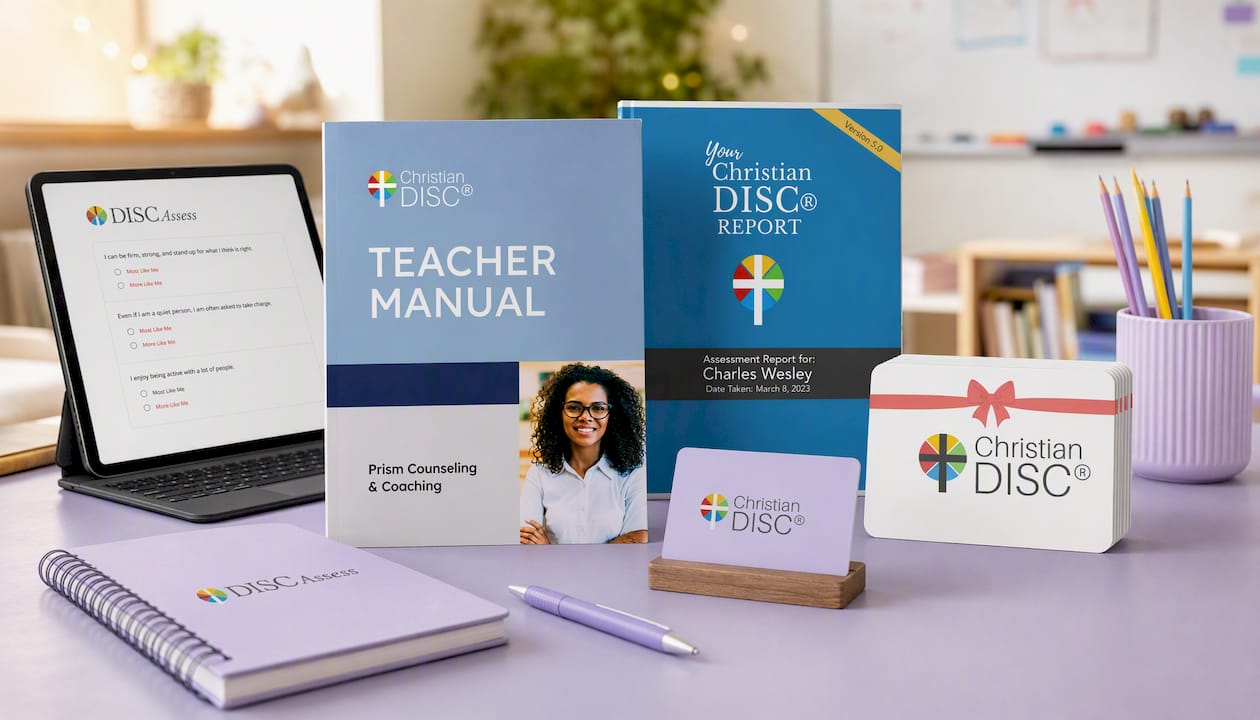
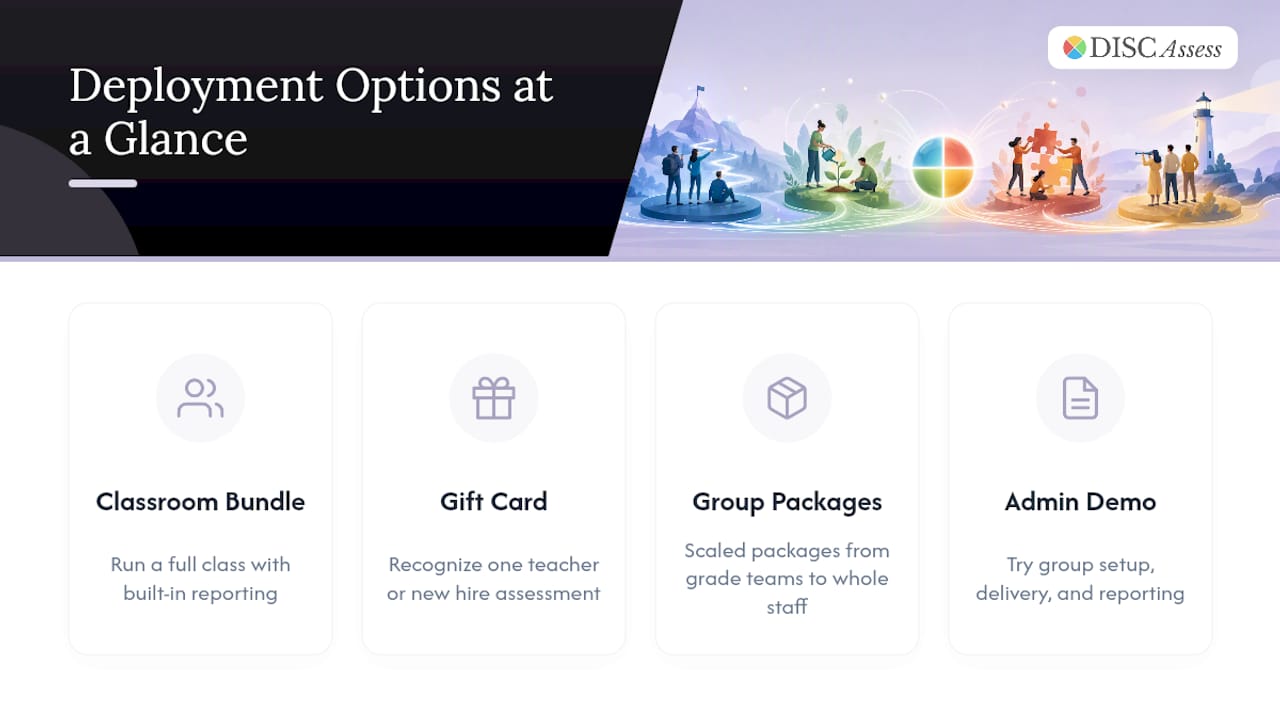
The Christian DISC® Classroom Bundle gives faith-based schools and ministry programs a ready-made way to run a full class or advisory group through the assessment with reporting built in. Smaller purchases, like gift cards, work well for recognizing an individual teacher or gifting a new hire their first assessment before rolling out to a full department. Schools weighing a district-wide rollout should look at group packages and unlimited memberships, sized for everything from a single grade-level team to an entire staff.
Ready to see the admin side before you commit? Try the admin demo and walk through group setup, assessment delivery, and reporting before deciding which package fits your school.
Where to Find More Teacher Resources
For lesson planning and PD beyond DISC itself: the Department of Education's teaching resources, PBS LearningMedia for curriculum materials, Teachers Pay Teachers for editable templates, and UNESCO's Global Teacher Campus for free online PD.
Sources
- Teaching resources | U.S. Department of Education
- PBS LearningMedia
- Teachers Pay Teachers
- Global Teacher Campus | UNESCO
FAQ
Is DISC Certification Worth It for Teachers?
Certification matters more for consultants who plan to administer and interpret DISC professionally for clients; classroom teachers generally get more value from a straightforward assessment platform paired with a short training session on how to read and apply results.
How Do I Become DISC Certified?
DISC certification programs typically involve a paid course covering assessment theory, interpretation, and facilitation practice, offered through various providers rather than a single governing body; check whether your district's PD budget supports it before enrolling.
Is There a Free DISC Assessment Available?
Free versions exist online, but they usually offer limited reporting depth compared to paid platforms with group management and admin features, which matters once you're trying to run reports across a classroom or staff team rather than for one person.
What DISC Style Fits a Typical Classroom Leader?
There's no single style that makes a "correct" teacher. Effective classroom leaders come from all four styles; the difference shows up in how deliberately they adjust their natural tendencies to meet different students where they are, not in which style they start with.
Can DISC Results Change Over Time?
DISC measures behavioral tendencies rather than fixed traits, so results can shift somewhat with role, context, or personal growth, though most people show a consistent core pattern across retakes taken months or years apart.