

DiSC conflict styles describe the four predictable ways people respond to disagreement: Dominance (D), influence (i), Steadiness (S), and Conscientiousness (C). Matching your communication to the other person's style, rather than defaulting to your own, is what actually de-escalates tension. Once you know which style you're facing, you can adjust your pace, your language, and even your timing to steer a hard conversation toward resolution instead of resentment.
TL;DR:
- Tailoring your communication style to match a D, i, S, or C type helps de-escalate conflict more effectively than using your default approach.
- D-styles respond best to directness and clear options, while i-styles need acknowledgment and warm open questions to engage.
- S-styles require advance notice and private conversations to avoid silence or resentment, and C-styles need detailed data and time for analysis.
- Recognizing conflict cues like pace, tone, and focus allows quick adaptation, whether getting straight to the point or offering reassurance.
- Mapping team styles in advance and conducting regular friction checks can prevent recurring clashes and improve overall conflict management.
Table of Contents
- Understanding Types of Conflict Styles in the DiSC Model
- Handling Conflict With a Dominance (D) Style
- Handling Conflict With an Influence (i) Style
- Handling Conflict With a Steadiness (S) Style
- Handling Conflict With a Conscientiousness (C) Style
- Reading the Room: Spotting Cues and Adapting in the Moment
- Using DiSC to Manage Conflict Across a Whole Team
- Why This Approach Holds Up: Author and Publisher Notes
- A D and an S, Learning to Meet in the Middle
- Turn This Playbook Into a Team Habit With Discassess
- Sources
Understanding Types of Conflict Styles in the DiSC Model
Most workplace friction is not a personality clash so much as a mismatch in pace and priorities. A D-style wants to solve the problem now. An i-style wants to protect the relationship while solving it. An S-style wants everyone calm and heard before anything gets decided. A C-style wants to see the facts before agreeing to anything at all. None of that makes a person difficult. It just means two good intentions are running on different clocks.
Here's the quick map:
- D (Dominance): Fast pace, focused on outcomes and control, tends to confront directly.
- i (Influence): Fast pace, focused on people and feelings, tends to talk through emotion.
- S (Steadiness): Slower pace, focused on harmony and stability, tends to go quiet or avoid.
- C (Conscientiousness): Slower pace, focused on accuracy and process, tends to critique or withdraw into analysis.
DiSC profiles reliably predict these conflict behaviors, which is why the same disagreement can look like an argument, a hurt feeling, a silent shutdown, and a spreadsheet request, all at once, depending on who's in the room. The sections below give you the specific adaptation for each.
Handling Conflict With a Dominance (D) Style
D-styles get triggered by three things: feeling slowed down, feeling controlled, or feeling like their competence is being questioned. Under stress, that shows up as interrupting, raising their voice, or pushing for an immediate decision before anyone else has finished thinking. The instinct to soften the moment with small talk usually backfires. It reads as stalling.
What a D-style needs immediately is directness, a clear ask, and at least one option they can choose between. Try this sequence:
- State the issue in one sentence, no preamble.
- Name the impact in concrete terms (time, money, outcome).
- Offer options and ask which they'd rather do.
- Confirm the decision and move.
A working opener: "Here's the problem. It's causing significant delays. I see a couple of ways to fix it. Which do you want to try first?"
Pro Tip: Never open a hard conversation with a D-style by asking how they feel about it. Ask what they want to do about it instead.
Handling Conflict With an Influence (i) Style
i-styles get triggered by cold, clinical delivery and by feeling excluded from the conversation before it starts. Left unmanaged, the pitfall runs two directions: they either over-talk their way past the actual issue, or they take the friction personally and go quiet out of hurt rather than agreement.
What an i-style needs is to feel heard before you get to the fix. Skipping that step and jumping straight to logic will stall the conversation every time.
- Open with a genuine, specific acknowledgment of their effort or intent.
- Name the issue as a shared problem, not a personal failing.
- Ask an open question before proposing a solution.
- Close with a concrete next step, said warmly, not just efficiently.
Try: "I know you care about how this lands with the team. I want to figure this out together. What's your read on what happened?"
Pro Tip: A five-second personal check-in before the business point often saves ten minutes of defensiveness later.
Handling Conflict With a Steadiness (S) Style
S-styles get triggered by surprise confrontation and public disagreement. The real risk isn't a blowup. It's silence. An S-style will often say "it's fine" in the moment, then carry resentment for weeks because they never felt safe enough to say what actually bothered them.
Give this style advance notice and privacy whenever possible.
- Schedule the conversation ahead of time instead of ambushing them in the moment.
- Hold it one-on-one, not in front of the group.
- Open by naming that you value the relationship, not just the fix.
- Ask a direct but gentle question, then wait. Don't fill the silence.
- Follow up a day later to check whether anything went unsaid.
A useful script: "I'd like to talk through what happened Tuesday. Nothing's wrong between us. I just want to understand your side. Is now a good time, or would later work better?"
Handling Conflict With a Conscientiousness (C) Style
C-styles get triggered by vague accusations, emotional appeals, and being rushed to a conclusion without evidence. Their defensive pattern is usually withdrawal into critique: picking apart the process instead of addressing the relationship, or going silent until they've had time to analyze the situation alone.
The fix is preparation, not persuasion.
- Bring specifics, not impressions. Dates, numbers, and examples carry more weight than tone or emotion.
- Explain the process you used to reach your conclusion, not just the conclusion itself.
- Give them time to review before expecting a response.
- Propose a next step framed as a test or trial, not a final verdict.
Try: "Here's what I'm seeing based on recent reports. I'd like to review the data with you and discuss next steps. Would you prefer to look it over first or discuss now?"
Reading the Room: Spotting Cues and Adapting in the Moment
You often have to identify a style before anyone tells you what it is. Watch for these signals in the first minute of tension:
- Pace: Fast and clipped points to D or i. Slow and measured points to S or C.
- Affect: Raised voice or blunt language points to D. Emotional language or storytelling points to i. Flat tone or long pauses points to S. Precise, factual language points to C.
- Content focus: Talk of outcomes and control points to D. Talk of people and reactions points to i. Talk of the team or "everyone" points to S. Talk of numbers, dates, or process points to C.
Once you've placed the style, pick one of four immediate moves:
- Get to the point (for D): drop the preamble, state the ask.
- Relate first (for i): acknowledge the person before the problem.
- Reassure and slow down (for S): lower the stakes, invite rather than confront.
- Document and propose process (for C): put it in writing, offer a structured next step.
Not every conflict needs to be resolved on the spot. If emotions are running hot on either side, pause and reschedule. If the issue is small and low stakes, resolve it immediately using the moves above. If it's recurring or systemic, schedule a longer conversation and bring documentation, especially if a C-style is involved.
Using DiSC to Manage Conflict Across a Whole Team
Individual tactics only get you so far if the same collisions keep repeating across a group. Certain pairings run into friction more predictably than others; D and S styles clash over pace and control, while i and C styles clash over process versus feeling. Mapping your team's styles ahead of time lets you preempt these collisions instead of reacting to them after the damage is done.
A few practices make this concrete:
- Map each team member's dominant style on a shared reference, visible during planning meetings.
- Set explicit rules of engagement: how disagreements get raised, who speaks first, and how decisions get documented.
- Run a short "friction check" every few weeks, a quick round where each person names one thing that's currently causing tension.
- Adapt your approach per person rather than applying one conflict script to the whole team, since managers get better results when they individualize their response.
- If two people have aligned communication styles but still disagree on approach, bring in a model like TKI, or escalate to mediation, rather than forcing another round of DiSC coaching.
Pro Tip: A five-minute friction check at the start of a Monday meeting catches most conflicts while they're still small and specific, long before they turn into a pattern nobody wants to name out loud.
For a deeper look at applying this across a management structure, see this manager's practical guide to team-wide DiSC mapping.
Why This Approach Holds Up: Author and Publisher Notes
This guide draws on documented DiSC conflict research and years of practical coaching experience, grounded in depersonalizing conflict as data rather than character judgment. Supporting tools referenced throughout include a printed style wheel and a full personality report. For additional grounding, see the full DISC Assess article library and this guide to personality-based conflict resolution.
A D and an S, Learning to Meet in the Middle
A D-style team lead and an S-style coordinator worked together but got stuck in a loop: the lead pushed for immediate decisions while the coordinator disengaged quietly. The solution was sequencing: the lead named the decision and allowed the coordinator time to respond before finalizing anything. This change eased the friction without altering the disagreement itself.
— Tres
Turn This Playbook Into a Team Habit With Discassess
Reading someone's style in the moment is only half the work. The other half is knowing your team's styles before conflict shows up, and Discassess makes that groundwork simple instead of theoretical. Start with the individual DISC personality assessment to get a full report on how a specific person tends to communicate and clash under pressure.
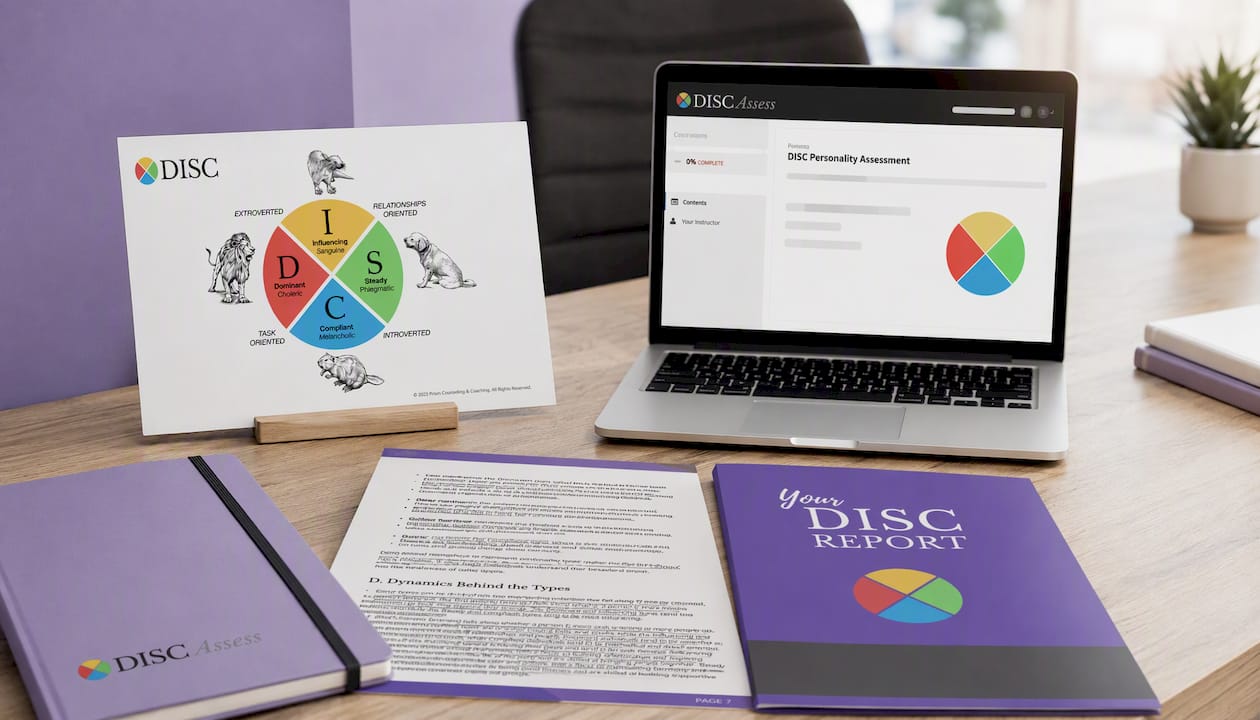
Once you know the styles on your team, keep the language visible day to day. A DISC wheel poster works well in a shared office or meeting room, so the four-style frame from this article stays in view during real disagreements, not just during training. If you coach or lead others regularly and want to guide these conversations with more depth, you can also add certification to formalize what you're already practicing. Order an assessment for your team this week and bring the friction-check habit into your next Monday meeting.
Sources
For more on the ideas behind this guide, see Harvard Professional Development's piece on preventing team conflict, HR Dive's reporting on managers and workplace conflict, OptimizeTeamwork's step-by-step DiSC conflict guide, and the Center for Leadership Studies on when DiSC styles collide.
- Optimizeteamwork
- Preventing and managing team conflict — Harvard Professional Development
- HR Dive — managers and workplace conflict
- When DiSC® styles collide — The Center for Leadership Studies