

The single fastest way to reduce friction on a team is to match your delivery to the listener's DISC style, adjusting your pace and priority instead of defaulting to your own natural rhythm. Do this consistently and you will see fewer misunderstandings, quicker decisions, and steadier trust between colleagues who once talked past each other. The sections ahead give you the identification cues, the per-style tactics, and the copy-ready scripts to put this into practice this week.
TL;DR:
- Matching your delivery to a team member’s DISC style can significantly reduce misunderstandings and accelerate decision-making.
- Recognizing a person's initial question type allows you to adapt your message quickly and improve engagement for each DISC style.
- Sending a simple three-line pre-read 24 hours before meetings can lead to shorter, more effective discussions by addressing different informational needs.
- Implementing DISC-based communication strategies requires minimal training, with a team assessment and behavior experiments lasting just a few weeks.
- The ideal DISC product for your team depends on whether you need quick group insights or deeper, context-rich reports to guide leadership discussions.
Table of Contents
- What Does DISC Measure, and Why Does Adapting It Matter?
- The Four DISC Styles: How to Spot Them and What to Do
- Scripts and Templates for Emails, Feedback, and Meetings
- Designing Meetings So Every Style Stays Engaged
- A Compact DISC Rollout for Small Teams
- How Discassess Supports a Fast Team Rollout
- What One Small Habit Change Actually Proves
- Which Discassess Product Fits Your Team Right Now
- Sources
What Does DISC Measure, and Why Does Adapting It Matter?
DISC maps communication across two axes: pace (fast versus measured) and priority (task-focused versus people-focused). Those two axes produce the four familiar styles, Dominance, Influence, Steadiness, and Conscientiousness, and each one processes information differently. Mismatched pace or priority is the quiet cause behind most workplace friction. A fast, task-driven manager who opens with three paragraphs of backstory loses a Dominance-style employee before the point even lands. A detail-oriented analyst who gets a verbal, big-picture pitch with no data walks away unconvinced, not because the idea was weak, but because the delivery skipped what that mind needed to trust it.
Three quick examples show the payoff of adjusting for this:
- A rushed one-line email to a Steadiness colleague reads as cold; adding one sentence about team impact changes the reception entirely.
- Presenting a new policy to a Conscientiousness-heavy finance team without a pre-read invites pushback that has nothing to do with the policy itself.
- Opening a status meeting with small talk in front of Dominance-style executives burns their patience before the real agenda starts.
The Four DISC Styles: How to Spot Them and What to Do
Learning to read a style in real time takes practice, but the signals are consistent enough to catch within the first few minutes of any conversation. Listen to the kind of question someone asks first: a D wants the bottom line, an I asks about people and energy, an S wants to know how something affects the team, and a C asks for evidence and assumptions. Once you know which question you are answering, the rest of the conversation gets much easier.
Dominance (D): fast-paced, direct, and impatient with preamble. D-style colleagues ask bottom-line questions and tend to interrupt when they already have the answer they need.
- Lead with the conclusion, not the setup.
- Offer two or three clear choices instead of open-ended options.
- Keep the conversation timeboxed and stick to the agreed time.
- Avoid long backstory. It reads as stalling, not context.
Influence (I): expressive, warm, and people-focused, often talking in stories rather than bullet points.
- Match their energy and let the conversation breathe a little.
- Invite brainstorming instead of handing them a finished plan.
- Recognize their contribution publicly when it is earned.
- Avoid burying them in detail. Too much data reads as a lecture.
Steadiness (S): measured, calm, and focused on how a decision affects relationships and stability.
- Build trust before pushing for a decision. Rapport comes first.
- Explain how a change affects the people involved, not just the process.
- Give them time to respond rather than expecting an answer on the spot.
- Avoid surprise decisions sprung on them without warning.
Conscientiousness (C): precise, analytical, and skeptical of anything that sounds like a guess.
- Prepare evidence before the conversation, not after they ask for it.
- Send pre-reads so they can process data at their own pace.
- Use specific numbers and sources instead of general impressions.
- Avoid vague language like "probably" or "should be fine."
Pro Tip: Keep a one-line cheat sheet on your desk with each style's top question (bottom line, vibe, impact, evidence). Glancing at it before a hard conversation takes ten seconds and changes how the whole exchange goes.
Scripts and Templates for Emails, Feedback, and Meetings
Ready-made language removes the guesswork in the moment you need it most. Use these as starting points and adjust the specifics to your situation.
- Email to a D: Subject: "Decision needed by Friday." Opener: "Here's the recommendation and why." Ask: "Approve, or tell me what's missing."
- Email to an I: Subject: "Exciting update on the project." Opener: "Wanted to loop you in because your input shapes this." Ask: "What's your gut reaction?"
- Email to an S: Subject: "A change that affects the team." Opener: "Wanted to walk you through this before it's final." Ask: "What concerns should we talk through first?"
- Email to a C: Subject: "Data attached for review." Opener: "Numbers and sources are below for your review." Ask: "Flag anything that needs more evidence."
- Feedback scripts: state the headline first, give one concrete example, then close with a clear ask or expectation, adjusting only the pace and detail level per style.
- Meeting openers: for a D, open with the decision on the table. For an I, open with the vision and why it matters. For an S, open by naming who this affects and how. For a C, open with the data behind the agenda.
Designing Meetings So Every Style Stays Engaged
A single meeting format rarely satisfies four different information appetites, which is why layering the content works better than picking one style and hoping the rest adjust. Structure the message as headline, then story, then people impact, then supporting data, a sequence that keeps mixed audiences engaged instead of tuning out halfway through.
- Send pre-reads at least 24 hours ahead for your S and C colleagues, who need processing time before they can engage confidently.
- Keep the live portion short and decision-focused for D attendees, who disengage quickly once the point has been made.
- Use structured rounds, where each person gets an uninterrupted turn, so S and C contributors aren't crowded out by faster talkers.
- Close with an explicit decision list so nobody leaves guessing what was actually agreed.
A Compact DISC Rollout for Small Teams
You don't need a training department to put this into practice. A simple four-step sequence works for teams of any size: assess each person's style, hold a short debrief on what it means for daily work, pick one behavior experiment to try for two weeks, then check in after 30 days to see what changed.
- Run the assessment and share a one-page debrief with prompts like "What drains your energy in meetings?" and "What makes you tune out?"
- Use a short communication health check, such as a 15-question diagnostic, to surface where friction actually lives.
- Pick one behavior to change as a team, like sending pre-reads or opening meetings with a decision list.
- Track three simple metrics: average meeting length, how often action items are clear without follow-up questions, and a quick pulse survey on perceived clarity.
How Discassess Supports a Fast Team Rollout
Each step above maps directly onto features built for small teams that don't have an HR department running the process. An admin account distributes assessment credits across the team in minutes, group reports turn individual results into a shared debrief document, and custom video analysis gives leadership teams a deeper walkthrough when the stakes are higher than a single meeting.
One documented example comes from a 10 to 20 person healthcare pilot that paired DISC-informed role expectations with a SBAR communication cadence during daily huddles, using group reports to structure handoffs and track KPIs. Teams weighing a similar rollout can start with a sample report or a short demo before committing to a full group package.
What One Small Habit Change Actually Proves
The habit worth stealing from every rollout that works is smaller than people expect: a three-line pre-read sent 24 hours before any meeting that touches a decision. Situation, options, ask. That's it. Teams that adopt this consistently report shorter meetings and clearer follow-through, because the C and S colleagues arrive already oriented instead of catching up in real time. Adapting delivery to style is a skill that transfers once practiced with one difficult relationship, and it tends to generalize across the rest of a leader's interactions. Try the three-line pre-read for one month before judging whether DISC-informed communication is worth the effort.
— Tres
Which Discassess Product Fits Your Team Right Now
A DISC platform gives you a faster path to shared vocabulary than building a training program from scratch, and the right entry point depends on where your team stands today. For a team that wants to run the assessment and get straight to a group debrief, the DISC Group Package bundles an admin account with assessment credits so you can launch the rollout above without waiting on procurement. Leadership teams heading into an offsite, where the conversation needs to go deeper than a one-page debrief, get more mileage from the Custom Group Report + Video Analysis, which walks through results in context instead of leaving leaders to interpret raw scores alone.
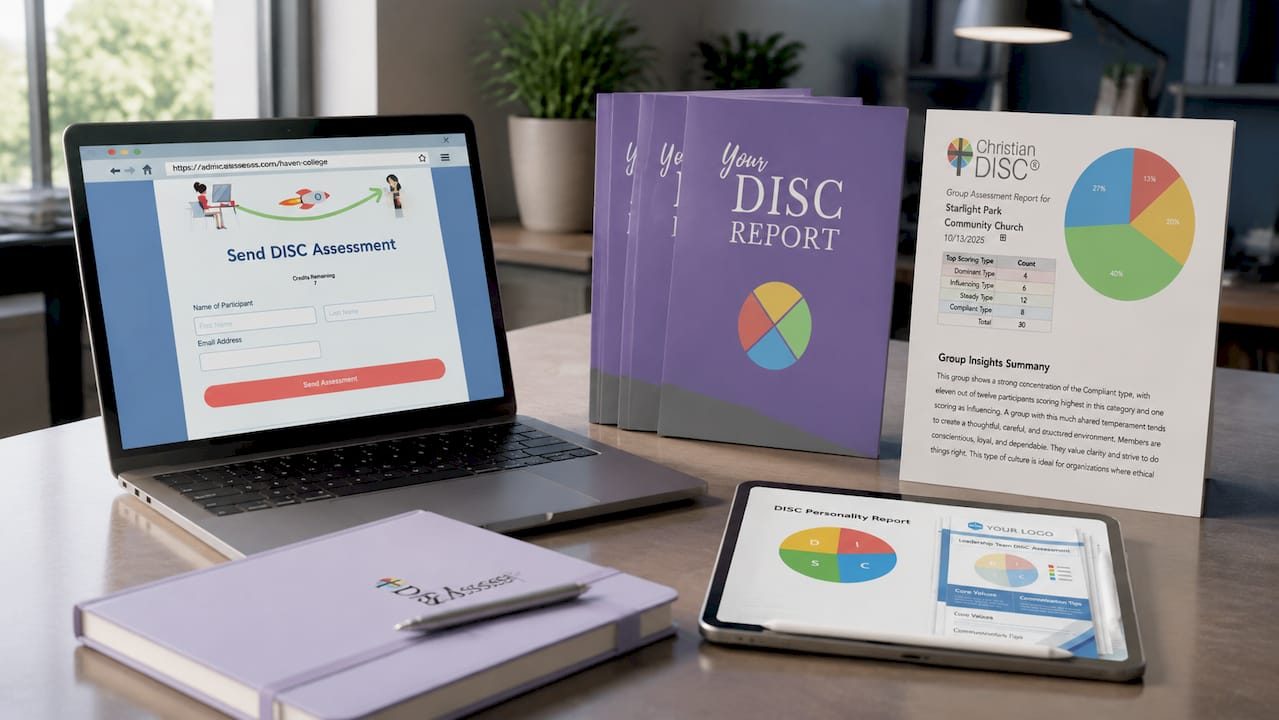
Coaches, consultants, and program partners who want their own branding on the experience can license the White Label DISC System and run assessments under their own name instead of Discassess's. If your team runs on a tighter facilitation structure, pairing your rollout with a practical meeting agenda template can help the decision lists mentioned above stick from week one. Whichever path fits, the next step is the same: pick a package, distribute the assessment, and schedule your first group debrief before the month is out.
Sources
- DISC Communication Styles Guide: Scripts & Tips (2026)
- Adapting Your Communication Style to Each DiSC® Type
- DISC assessment — Wikipedia