

Yes. DISC is a practical behavioral tool that, when piloted deliberately and woven into existing routines like SBAR handoffs, reduces miscommunication and strengthens team cohesion. The benefits show up first in fewer dropped handoffs and calmer conflict resolution, but only if leaders treat rollout as a measured process rather than a one-time training event. Pilot design and measurement determine whether the investment pays off, and the right package should match the scale of that pilot.
TL;DR:
- Implementing DISC deliberately during handoffs and team debriefs can significantly reduce communication errors and improve team cohesion within 8 to 12 weeks.
- Tailoring communication strategies based on DISC styles helps speed up decision-making in rapid responses and clarifies roles during high-stakes situations.
- Starting small with one high-friction unit and measuring key performance indicators is essential for a successful and sustainable DISC pilot.
- Different roles benefit from style-specific messaging, such as Physicians emphasizing recommendations first or nurses restating risk numbers to avoid misunderstandings.
- Using real unit scenarios to introduce DISC accelerates team recognition and acceptance, increasing the likelihood of long-term behavioral change.
Table of Contents
- How DISC for Healthcare Teams Fits Clinical Work
- Where DISC Creates Value: Handoffs, Conflict, and Retention
- A Step-by-Step Pilot for One Unit
- Adjusting Communication by Role and Style
- Tracking Results and Building the Case for Investment
- Why DISC Assess Fits Healthcare Rollouts
- What Small Pilots Taught Us About Rollout Discipline
- Getting Started with DISC Assess
- Sources
How DISC for Healthcare Teams Fits Clinical Work
Clinical competence and behavioral competence are not the same skill, though healthcare culture often treats them as one. A nurse can be technically excellent and still trigger friction on rounds because her communication style clashes with a physician's. A pharmacist can catch every interaction risk and still get talked over in a rapid response because his tendency is to process quietly before speaking. DISC gives teams a shared vocabulary for these differences instead of leaving them to fester as personality clashes.
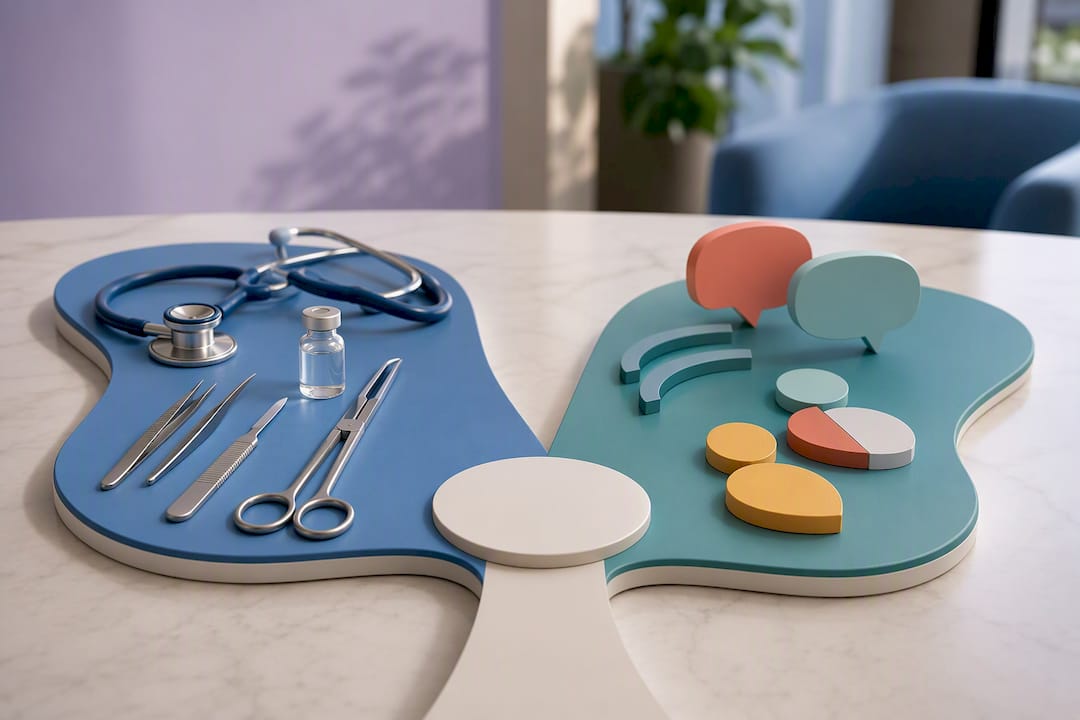
The four DISC styles map cleanly onto clinical stress responses. Dominance-leaning staff tend to take charge in a code and speak in directives. Influence-leaning staff build rapport quickly with patients and families but may under-communicate risk. Steadiness-leaning staff keep units calm and consistent but can hesitate to escalate concerns. Conscientiousness-leaning staff catch errors others miss but may withhold input until they are certain. Institutional literature increasingly treats this kind of behavioral awareness as a patient-safety issue, not a soft-skills extra. The NCBI's review of communication failures identifies breakdowns in team communication as a recurring root cause of preventable harm.
DISC training gives each style:
- A way to recognize their own default under pressure
- Language to flag when a colleague's style is causing a miscommunication, not a character flaw
- A framework leadership can reference during debriefs without assigning blame
Pro Tip: Introduce the four styles using real unit scenarios, not abstract descriptions. A team recognizes itself in "who talks first in a rapid response" far faster than in a personality-quiz color wheel.
Where DISC Creates Value: Handoffs, Conflict, and Retention
SBAR (Situation, Background, Assessment, Recommendation) is the backbone of most handoff protocols, but it assumes every clinician delivers information the same way. They don't. A Dominance-style nurse compresses SBAR into a rapid-fire recommendation and skips context the receiving team needed. A Conscientiousness-style nurse over-documents Background and buries the Recommendation. Teaching staff to recognize their own SBAR tendency, and to consciously slow down or speed up for the listener, is one of the fastest wins a DISC rollout produces.
Four moments where this pays off immediately:
- Shift handoffs. Style-aware SBAR scripting cuts the ambiguity that causes repeat questions and missed orders.
- Rapid responses. Naming who defaults to directive language and who defaults to caution helps a code team divide roles faster.
- Interdisciplinary rounds. Steadiness and Conscientiousness staff get structured space to speak, instead of being talked over by Dominance and Influence voices.
- Onboarding and retention. New hires paired with a manager who understands their style adjust faster and report higher early engagement.
A recent surgical-education study embedded the DiSC model directly into residency leadership training and reported measurable gains in nontechnical skill acquisition, the kind of soft-skill deficit that rarely gets formal curriculum time. Expect early wins in weeks, not months. A single facilitated debrief after a rocky handoff often surfaces the exact style mismatch causing repeat friction, and teams can test a fix the following week.
A Step-by-Step Pilot for One Unit
Start small. Pick the highest-friction microsystem in your organization, often an ED-to-ICU handoff line or a perioperative transition, where communication breakdowns are frequent and visible. Recruit a sponsor from each stakeholder group: a medical director for clinical credibility, a nurse manager for frontline buy-in, HR for logistics, and quality for measurement discipline.
- Assess. Every pilot participant completes an individual DISC profile.
- Map. Leadership reviews an aggregated team map showing the style distribution across the unit.
- Debrief. Run a single facilitated session, roughly one hour, where the team discusses what the map means for their actual workflow.
- Adjust. Apply two or three concrete SBAR or huddle-language tweaks based on what surfaced.
- Measure. Track a small KPI set for 8 to 12 weeks before deciding whether to scale.
Training format matters less than consistency. A single kickoff session followed by monthly 15 minute huddle reinforcements outperforms a one-off half-day workshop that nobody references again. Keep the initial ask light:
- One assessment per participant
- One facilitated debrief
- One follow-up check-in at 30 days
- One KPI review at 90 days
Public-health leadership organizations have reached the same conclusion in their own contexts. ASTHO's guidance on DISC frames the assessment as infrastructure for leadership development, not a one-time exercise.
Adjusting Communication by Role and Style
Different roles carry different default pressures, and DISC tactics need to flex accordingly.
- Physicians and Dominance-heavy clinicians: Coach toward stating the recommendation first, then backfilling context, so listeners aren't left guessing what action is needed.
- Nurses with Influence tendencies: Build a habit of restating the objective risk number or vital sign before the reassuring narrative, so urgency doesn't get softened.
- Pharmacists and Conscientiousness-heavy staff: Give explicit permission to interrupt with a concern before full analysis is finished; waiting for certainty costs time in fast-moving situations.
- Steadiness-leaning administrators: Build meeting agendas that front-load quiet processing time before open debate, rather than expecting immediate verbal input.
- Leadership teams: Set a huddle norm where each person names their style tendency before offering an opinion. It reduces defensiveness and speeds consensus during high-stakes discussions.
Scheduling accommodations matter too. Teams heavy in Steadiness or Conscientiousness styles benefit from agendas sent 24 hours ahead; Dominance and Influence-heavy teams often prefer same-day, verbal framing.
Tracking Results and Building the Case for Investment
Leaders evaluating a DISC pilot need numbers, not impressions, before they'll approve unit-wide rollout. Track these from day one:
- Handoff-error or near-miss rate, pulled from existing incident reporting
- Time-to-decision during rapid responses or rounds
- Staff engagement scores, pre- and post-pilot
- Voluntary turnover on the pilot unit versus a comparable control unit
- Patient-experience measures adjacent to communication, where HCAHPS-style data is already collected
Document short-term wins between four and 12 weeks. A drop in repeat-question handoffs or a faster rapid-response role assignment is concrete evidence, even before turnover data matures. Institutional adoption already supports the budget conversation: ACHE lists an Extended DISC assessment among its own career development tools, a signal that healthcare executives already treat this category as a legitimate leadership investment. Frame the ROI memo simply: package cost against the staff hours currently lost to repeat clarifications and the cost of one avoidable turnover.
Why DISC Assess Fits Healthcare Rollouts
DISC Assess maps cleanly onto each stage of the pilot roadmap described above. A single unit testing the waters needs one thing: real assessments, fast, without a lengthy procurement process.
- A pilot team of ten to twenty starts with the Starter Group Package or the DISC Group Package with admin credits.
- Organizations scaling past one unit move to the Pro Group Package for broader assessment credits and reporting.
- Units without reliable device access can add offline, printable assessments.
Backed by over a decade of experience through Prism Counseling & Coaching, the platform emphasizes group reporting and an admin portal built for teams without dedicated HR technology staff.
What Small Pilots Taught Us About Rollout Discipline
The pilots that stick share one trait: they start absurdly small. One unit, one debrief, one measurable change. The pilots that fail almost always tried to roll out organization-wide before proving the concept on a single high-friction team, and momentum died the moment the first busy week hit.
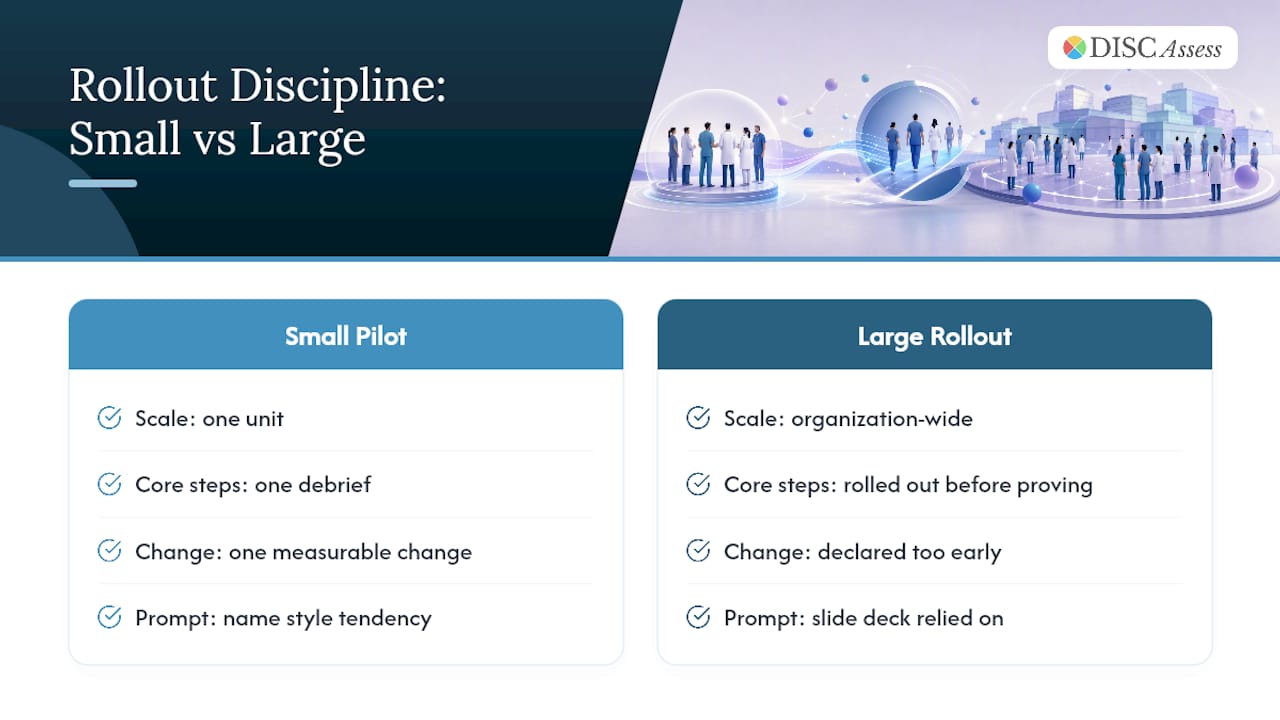
A simple huddle prompt does more work than any slide deck: ask each person to name their style tendency before offering an opinion. It sounds trivial. It isn't. Teams that adopt this in year one still use it in year three, because it gives quiet staff permission to speak and directive staff a reason to pause.
Measure early, adjust often, and resist the urge to declare victory after one good week.
— Tres
Getting Started with DISC Assess
If you've read this far, you already know which pilot size fits your unit. A team of ten to twenty testing DISC for the first time should start with the Starter Group Package, which includes enough assessment credits and admin access to run the full five-step rollout described above without overbuying. Departments scaling beyond a single pilot, or systems that want consistent reporting across multiple units, fit better with the Pro Group Package or a custom group report with video analysis for facilitators who want a deeper debrief tool.
Individual leaders who want to try the assessment themselves before committing budget can take the Individual Classic DISC Assessment first. Whatever package you choose, pair it with the minimal KPI plan from earlier: pick two metrics, track them for 90 days, and let the data make the case for scaling. Request a look at the admin portal demo to see how group reporting and credits work before your team's first assessment goes out.
Sources
- Patient Safety and Communication (NCBI Bookshelf)
- Utilizing the DiSC Assessment in Surgical Residency Leadership Training (Journal of Surgical Education)
- Extended DISC Assessment | American College of Healthcare Executives
- How the DiSC Personality Assessment Can Strengthen Public Health Leadership (ASTHO)