

DiSC for managers works because it gives you a shared language for behavior instead of guesswork. A management-specific DiSC report translates natural tendencies into practical scripts for motivating, delegating, and coaching each person on your team, with the specific strengths and blind spots named on the page. Platforms like Discassess build that report directly into the assessment experience, so a manager can move from results to action in the same sitting.
TL;DR:
- DiSC assessments can be scaled for teams and provide tailored insights that help managers modify their coaching, motivation, and delegation strategies effectively.
- Specific recommendations like giving direct feedback to Steadiness types within 48 hours or practicing one feedback session weekly improve management outcomes.
- Stress responses and potential derailers vary by style and require early coaching to prevent negative behavior under pressure.
- Assessment reports are quick to generate but must be paired with ongoing feedback and behavior tracking to ensure real change.
- Using DiSC ethically involves confidentiality, voluntary participation, and framing results as a conversation starter rather than a performance label.
Table of Contents
- What Is DiSC for Managers, and What's in a Management Report?
- How Managers Use DiSC to Motivate, Delegate, Coach, and Resolve Conflict
- DiSC Management Styles: Strengths, Blind Spots, and Derailers
- How the Assessment and Report Process Works
- A 6-Step Playbook Managers Can Use This Week
- Why Trust This Guide on DiSC for Managers
- Legal and Ethical Considerations When Using Personality Assessments in Management
- Use DiSC as a Coaching Language, Not a Label
- Get Your Team Started With Discassess
- Sources
What Is DiSC for Managers, and What's in a Management Report?
DiSC breaks behavior into four dimensions: Dominance (direct, results driven), influence (outgoing, persuasive), Steadiness (steady, supportive), and Conscientiousness (analytical, precise). Everyone carries a blend of all four, usually with one or two dominant.
A management-specific profile goes further than a standard personal report. It adds sections built around the actual job: how this person naturally directs work, what motivates them to stay engaged, how they tend to delegate (or avoid it), and where they need support developing as a leader.
Most management reports include:
- A summary of natural leadership tendencies and communication defaults
- Specific blind spots tied to the person's style, not generic weaknesses
- Communication tips for adapting to different team members
- Suggested development actions, often phrased as next steps rather than abstract advice
The value is in the specificity. A report that tells a Steadiness-style manager to "practice giving direct feedback within 48 hours of an issue" is more useful than one that says "improve communication."
How Managers Use DiSC to Motivate, Delegate, Coach, and Resolve Conflict
DiSC earns its place in day-to-day management when you apply it to the four moments that make or break a team: motivation, delegation, coaching, and conflict.
- Motivation. A D-style employee is energized by ownership and results; tell them the outcome you need and get out of the way. An i-style employee wants recognition and connection; a quick public shoutout goes further than a private email.
- Delegation. S-style team members need context and reassurance before taking on new responsibility. Say, "Here's why this matters, and I'm available if you get stuck," instead of just handing off a task.
- Coaching. C-style employees respond to data and precision. Bring specifics to feedback conversations instead of impressions. "Your last three reports had zero errors" lands better than "great work."
- Conflict resolution. Knowing a colleague's style helps you de-escalate before a disagreement turns personal, as explained in Conflict Coaching Explained: Empowering Mental Health Pros. A D-style manager might need coaching to slow down and let a S-style employee finish a thought before responding.
These same principles carry into onboarding, where a new hire's DiSC style shapes how you introduce expectations, and into succession planning, where you're matching future leadership styles to future team needs. Consultant guidance on motivation mapping and coaching prompts backs up all four applications with real management scenarios.
Pro Tip: A DiSC report is a starting point, not a finish line. Pair it with a recurring feedback rhythm, weekly check-ins or monthly one-on-ones, so the insight actually changes behavior instead of sitting in a folder.
DiSC Management Styles: Strengths, Blind Spots, and Derailers
Every DiSC style brings real leadership strengths and real risk. Great managers show up in all four quadrants; the research on leadership across DiSC styles makes clear there's no single "best" profile for management, only different tendencies to balance against the job's demands.
- D (Dominance): Strength: decisive, drives results fast. Blind spot: can steamroll input from quieter team members. Coaching tip: build in a pause before finalizing decisions.
- i (Influence): Strength: rallies people, builds morale. Blind spot: avoids hard conversations to stay likable. Coaching tip: practice one direct feedback conversation per week.
- S (Steadiness): Strength: dependable, builds trust. Blind spot: avoids conflict, delays necessary change. Coaching tip: set a deadline for addressing known issues.
- C (Conscientiousness): Strength: accurate, thorough. Blind spot: can stall on decisions waiting for more data. Coaching tip: set a "good enough" threshold before deciding.
Blended profiles are the norm, not the exception. If someone shows mixed D/C or i/S signals, expect their behavior to shift depending on the situation rather than staying fixed.
Under pressure, strengths flip into derailers. A decisive D manager can turn abrupt and impatient; a supportive S manager can over-accommodate and let real problems fester. Practitioner guidance on leadership derailment recommends catching the trigger early and coaching an alternative behavior before the pattern repeats. Discassess covers this in more depth in its guide to stress response types by DiSC style.
How the Assessment and Report Process Works
Most DiSC assessments take 10 to 15 minutes to complete, using adaptive scoring that adjusts based on your answers as you go. The report generates immediately after submission, typically delivered as a downloadable PDF with a summary page up front and detail pages behind it.
For one-on-ones and team workshops, managers lean on a few specific report pages:
- The style summary, useful for a quick reference before a coaching conversation
- The communication tips section, handy when prepping for a difficult conversation
- The team-map view, which shows where everyone lands relative to each other
Scaling this across a department requires more than individual reports. An admin portal that tracks assessment credits and manages group access, the kind Discassess builds into its group packages, lets one person run assessments for an entire team without chasing individual purchases.
A 6-Step Playbook Managers Can Use This Week
DiSC only pays off when you act on it. Here's a sequence that works whether you're managing three people or thirty.
- Review your own report first. Spend 30 to 45 minutes understanding your own tendencies before applying anything to your team.
- Map your team's styles. Note each direct report's primary style and any strong secondary trait.
- Pick one tweak per person. Don't overhaul your whole approach. Choose one adjustment: more direct feedback for an S-style employee, more context before deadlines for a C-style employee.
- Run a 15-minute check-in. Ask how the adjustment is landing. Keep it short and specific.
- Hold a short team discussion. A 60-minute session where the team shares styles and talks about how to communicate with each other builds buy-in faster than a memo ever will.
- Track one metric. Pick something simple, like fewer follow-up questions after assigning a task, or faster response times in team chat, and watch it for a month.
Sample prompts to use in the moment: for a D-style employee, "What's your recommended path forward?" For a C-style employee, "Walk me through the data behind that." For an i-style employee, "Who else on the team should hear about this win?" For an S-style employee, "What support do you need before we move forward?"
Pro Tip: Success metrics don't need to be complicated. Clarity of expectations and fewer repeated misunderstandings are two signals you can track with nothing more than a notebook and a month of attention.
Why Trust This Guide on DiSC for Managers
Discassess is a Phoenix-based DISC provider built specifically for the practical realities small teams face: no certification requirement to get started, no enterprise sales process, just a streamlined assessment platform with an admin portal and group packages built in.
The platform's report examples are written for immediate use, not academic reference, and its group management tools mean a manager can run assessments for a whole department without a technical background. Backed by Prism Counseling & Coaching's decade of coaching experience, Discassess pairs assessment access with practical resources built for onboarding, coaching, and succession planning conversations, not just one-time diagnostics.
Legal and Ethical Considerations When Using Personality Assessments in Management
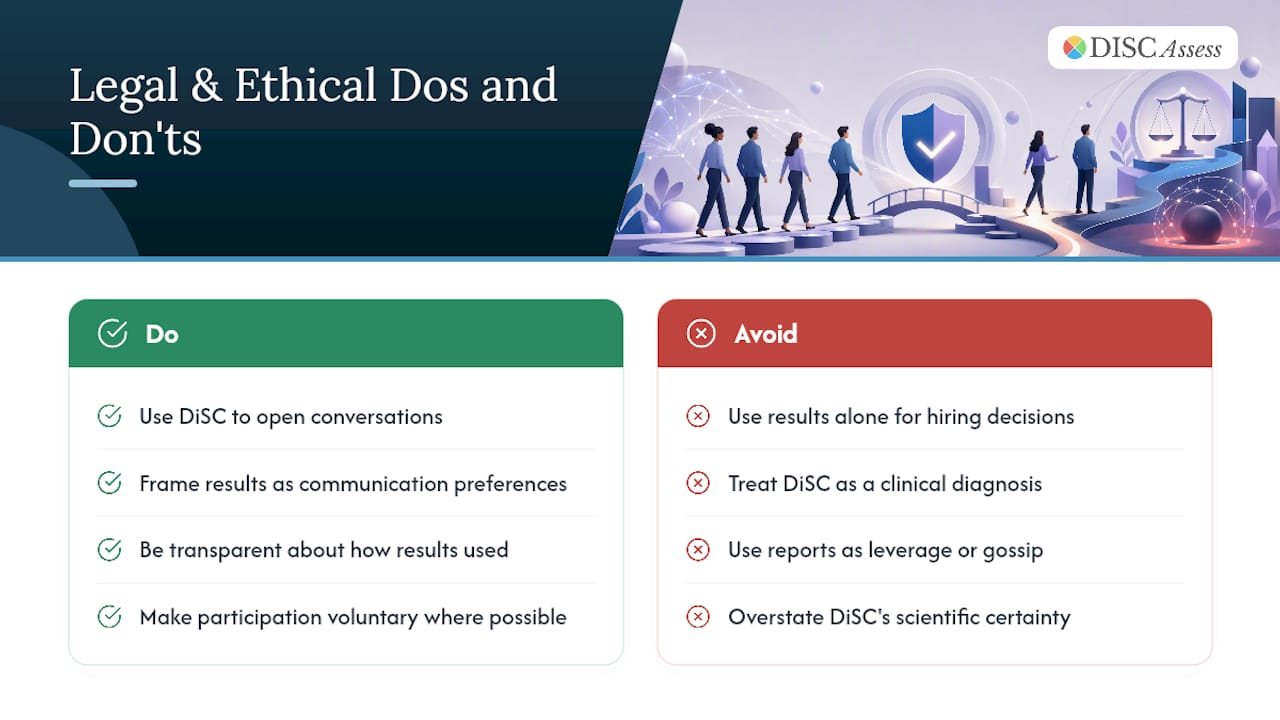
DiSC is a behavioral preference tool, not a clinical or diagnostic instrument, and treating it as one creates real risk. Never use DiSC results as the sole basis for hiring, firing, promotion, or compensation decisions. Employment law in the United States generally requires that personnel decisions rest on job-relevant, validated criteria, and a behavioral preference assessment alone rarely meets that bar for adverse action.
Confidentiality matters just as much. Results are most useful when employees choose to share and discuss them openly, not when a manager treats a report as leverage or gossip. Make participation voluntary where possible, and be transparent about how results will and won't be used before anyone takes the assessment.
There's also a scientific honesty issue. A peer-reviewed synthesis of personality and workplace outcomes confirms personality frameworks can predict some job-relevant behaviors, but the effects vary by context and outcome. DiSC is a useful lens for understanding tendencies, not a precise predictor of performance. Presenting it to your team as more scientifically certain than it is undermines trust once someone looks into the research themselves.
The ethical middle ground is straightforward: use DiSC to open conversations, not close them. Frame results as a starting point for how someone prefers to communicate and work, and always leave room for the report to be wrong about a specific situation.
Use DiSC as a Coaching Language, Not a Label
The managers who get the most out of DiSC treat it as a starting vocabulary for coaching conversations, not a permanent tag on someone's file. Revisit styles regularly, pair them with real feedback, and resist the urge to explain away a performance issue as "just how a D behaves." People grow past their default tendencies constantly; your job is to notice when they do.
— Tres
Get Your Team Started With Discassess
If you're managing more than a couple of direct reports, running individual assessments one at a time gets expensive and slow. The DISC Group Package with an admin account and assessment credits solves that by letting you purchase credits in bulk and assign them as your team grows, all from a single dashboard.
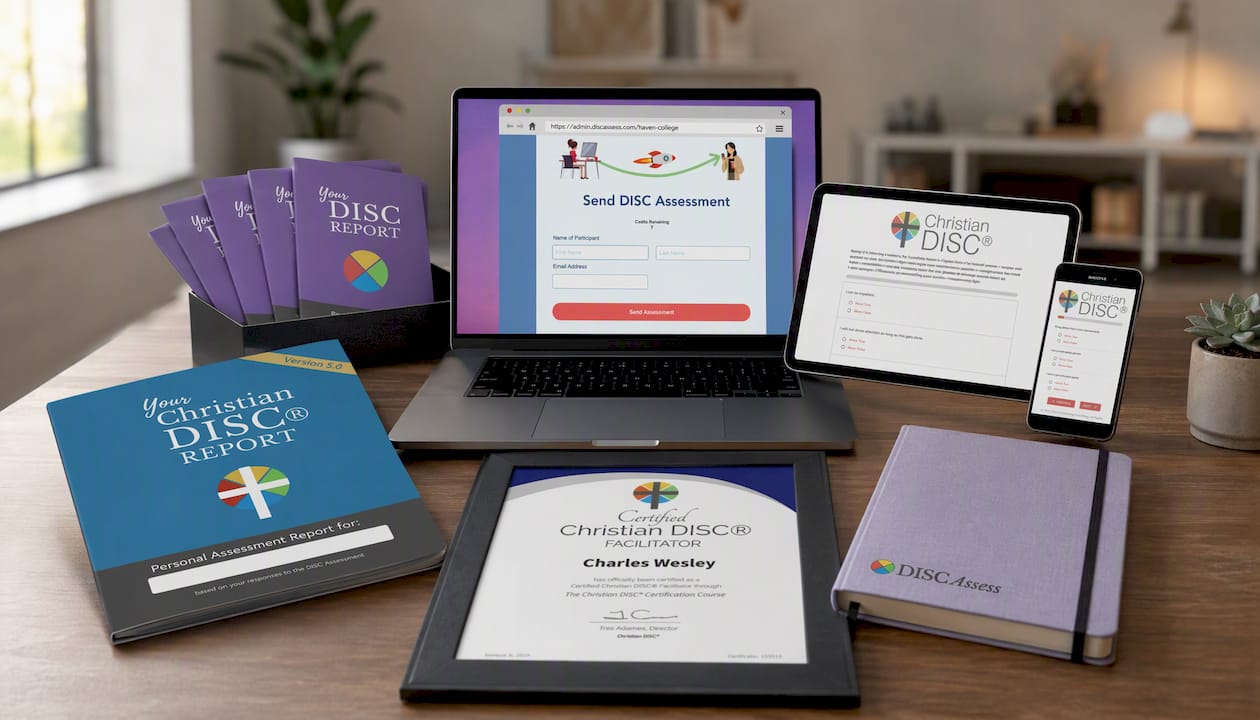
Larger teams or multi-department rollouts get more value from the Group Discount Package, which brings the per-assessment cost down as your headcount goes up. And if you'd rather build internal capacity to facilitate DiSC conversations yourself, without outsourcing every workshop, the Christian DISC® Certification gives managers and internal coaches the training to run team debriefs on their own.
Start with a single team assessment, review the reports together, and decide from there whether a group package fits your rollout.
Sources
- Personality and workplace outcomes (PMC review)
- DISC leadership styles (Rhythm Systems blog)
- The dark side of leadership: derailment (Hogan Assessments blog)
- Are certain DISC profiles better suited for leadership? (Kutsko Consulting)