

Each DiSC style shows a predictable stress signature: D grows more controlling and impatient, I becomes scattered and over-committed, S withdraws and goes quiet, and C turns hypercritical and paralyzed by perfectionism. According to MSU Human Resources, these stress signatures are identifiable and consistent, which means managers can map observable behaviors to tailored interventions before a situation becomes a crisis. The types of professional stress responses you see in your team are not random — they follow the grain of each person's wiring.
Quick Reference: One stress signature and one manager move per style
- D (Dominance): Becomes controlling and combative → Remove a blocker or restore autonomy immediately
- I (Influence): Over-commits, grows scattered, seeks approval → Reconnect relationally and reduce task load
- S (Steadiness): Withdraws, goes silent, avoids conflict → Offer stability and a private check-in
- C (Conscientiousness): Becomes rigid, over-analyzes, creates bottlenecks → Provide clear criteria and a defined decision deadline
Table of Contents
- How to spot stress early in your team members
- In-depth profiles: how each DiSC style behaves under stress and in distress
- How to use Discassess tools proactively to prevent stress crises
- Ready-to-use conversation scripts for each DiSC style
- Key Takeaways
- Why a DiSC lens changes how you lead through stress
- Put this guide to work with Discassess
How to spot stress early in your team members
Catching stress before it compounds is the highest-leverage thing a manager can do. The following cues give you something concrete to watch for during daily interactions and one-on-ones.
D style red flags:
- Interrupting others more than usual or dismissing input in meetings
- Pushing deadlines unilaterally without consulting the team
- Ask in a 1:1: "Is there something blocking you right now that I can help clear?"
I style red flags:
- Saying yes to every request, then missing follow-through
- Unusually quiet in group settings, or conversely, performing high energy that feels forced
- Ask in a 1:1: "How are you feeling about your current workload — honestly?"
S style red flags:
- Shorter responses in writing and in person; avoiding eye contact
- Agreeing in meetings but not executing afterward
- Ask in a 1:1: "I've noticed you seem quieter lately — is everything okay with you?"
C style red flags:
- Sending unusually long emails with excessive caveats
- Stalling on deliverables while requesting more data or more time
- Ask in a 1:1: "What would you need to feel confident moving forward on this?"
Pro Tip: Watch the gap between a person's natural style and how they are currently behaving. According to LM2 Enterprises, high-stakes moments reveal adapted behavior more clearly than routine days — so a deadline crunch or a restructuring announcement is actually your best diagnostic window.
In-depth profiles: how each DiSC style behaves under stress and in distress
Understanding the full arc from early stress to chronic distress helps you intervene at the right moment, not after the damage is done.
D — Dominance
Under acute stress, D-styles intensify their natural drive. They push harder, talk over others, and take unilateral action. A D under pressure may send terse one-line emails, cancel collaborative meetings, and start making decisions that belong to the group. WhatsMyDISC notes that D-styles under pressure can create real interpersonal damage as they tighten their grip on outcomes.
When stress becomes chronic, the distress flip is striking: the normally direct, decisive D may go completely silent, disengage from the team, and stop advocating for their work. That withdrawal is the signal for urgent intervention, not a sign that things have calmed down.
I — Influence
Acute stress in an I-style looks like frantic helpfulness. They over-commit, volunteer for more than they can handle, and fill silence with reassurance-seeking conversation. Assessments 24x7 describes this pattern as becoming scattered — the I's natural enthusiasm turns into noise without traction.
Chronically stressed I-styles often withdraw from the social connection that sustains them. They stop initiating conversations, miss team events, and become uncharacteristically flat. Managers who mistake that flatness for maturity or focus are missing a distress signal.
S — Steadiness
S-styles absorb stress quietly, which makes them the easiest to overlook. Under acute pressure they comply outwardly while disengaging inwardly, producing work that meets the minimum without the care they normally bring. Assessments 24x7 points out that S-styles may become passive-aggressive when pressured repeatedly without acknowledgment.
Chronic stress in an S-style can produce a full shutdown: they stop raising concerns, stop offering ideas, and eventually stop showing up fully. Because they rarely complain, the distress flip often goes unnoticed until turnover is already in motion.
C — Conscientiousness
A C under acute stress becomes a bottleneck. They request more information before deciding, revise documents past the point of usefulness, and send emails that read like legal briefs. WhatsMyDISC identifies perfectionism-driven paralysis as the C's primary stress presentation.
Chronic distress flips the C toward uncharacteristic impulsivity or complete withdrawal from quality standards — as though the internal critic has burned out entirely. Either extreme signals that the C has moved past productive tension into genuine distress.
How to use Discassess tools proactively to prevent stress crises
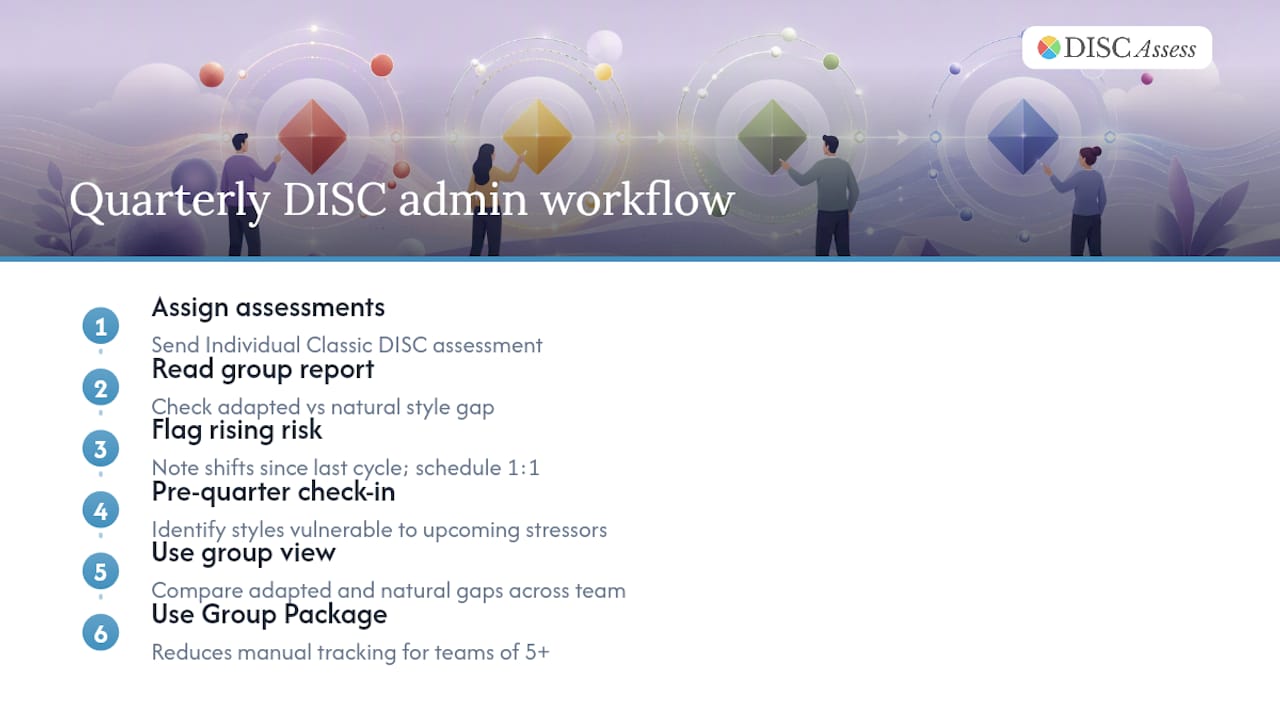
DISC data is most powerful when it runs ahead of a problem. Here is a practical admin workflow you can run on a quarterly basis.
Step 1 — Assign assessments. Use the Discassess admin portal to send the Individual Classic DISC Personality Assessment to each team member. For teams of five or more, the DISC Group Package with admin account credits reduces manual tracking significantly.
Step 2 — Read the group report. Look specifically at the adapted-vs-natural style gap for each person. A widening gap — where someone's adapted style looks very different from their natural style — often signals sustained effort to manage stress. That gap is your early organizational risk signal.
Step 3 — Flag rising risk. In your group report, note any team member whose adapted style has shifted noticeably since the last assessment cycle. Schedule a 1:1 within the week.
Step 4 — Run a pre-quarter check-in. Before a heavy season (a product launch, a budget cycle, a restructuring), pull the group report and identify which styles are most vulnerable to the specific stressors ahead. A D and a C on the same project with unclear ownership is a predictable friction point.
Pro Tip: Use the admin portal's group view to compare adapted and natural style gaps across the whole team at once. When several people show widening gaps in the same period, that is an organizational stressor, not an individual one — and it calls for a structural response, not just individual coaching. Learn more about deploying assessments with employees for a step-by-step walkthrough.
Ready-to-use conversation scripts for each DiSC style
These scripts are designed to match each style's communication comfort zone so the conversation opens rather than closes.
D style — 1:1 script
- Opening: "I want to be direct with you — I've noticed some friction lately and I want to address it head-on."
- Validation: "You carry a lot, and your drive is one of the things that makes this team work."
- Action: "Let's identify one thing I can take off your plate or unblock this week."
I style — 1:1 script
- Opening: "I just wanted to connect — how are you really doing?"
- Validation: "Your energy and relationships matter to this team more than you probably realize."
- Action: "Let's look at your commitments together and decide what we can defer."
S style — 1:1 script
- Opening: "There's no agenda here — I just wanted to check in with you personally."
- Validation: "Your steadiness and care for this team don't go unnoticed."
- Action: "Is there anything I can do to make the next few weeks feel more manageable for you?"
C style — 1:1 script
- Opening: "I want to make sure you have clarity on what success looks like here."
- Validation: "Your attention to quality is genuinely valued — I want to protect your ability to do that well."
- Action: "Let's agree on the standard for this deliverable right now so you can move forward."
Questions to assess workload, control, connection, or clarity needs:
- "On a scale of one to ten, how manageable does your workload feel this week?"
- "Is there a decision you're waiting on that's holding you back?"
- "Do you feel connected to the team right now, or a bit isolated?"
- "What would make you feel more confident about the direction we're heading?"
After each conversation, write down the commitment made, the accommodation offered, and the date of the next check-in. InternalChange emphasizes that verifying your observations through questions — rather than assuming — is what makes DiSC coaching genuinely collaborative.
Key Takeaways
Each DiSC style carries a distinct stress signature, and matching your intervention to that signature is the difference between a conversation that helps and one that escalates the problem.
| Point | Details |
|---|---|
| D style stress signature | Grows controlling and combative; restore autonomy and remove blockers immediately. |
| I style stress signature | Over-commits and becomes scattered; reconnect relationally and reduce task load. |
| S style stress signature | Withdraws silently; offer stability, a private check-in, and a predictable schedule. |
| C style stress signature | Becomes rigid and perfectionistic; provide clear success criteria and a firm deadline. |
| Escalation timeline | If no improvement after 3–7 days of coaching, involve HR and refer to your EAP. |
| Discassess group reports | Use the admin portal's adapted-vs-natural gap view to catch rising team-wide stress early. |
Why a DiSC lens changes how you lead through stress
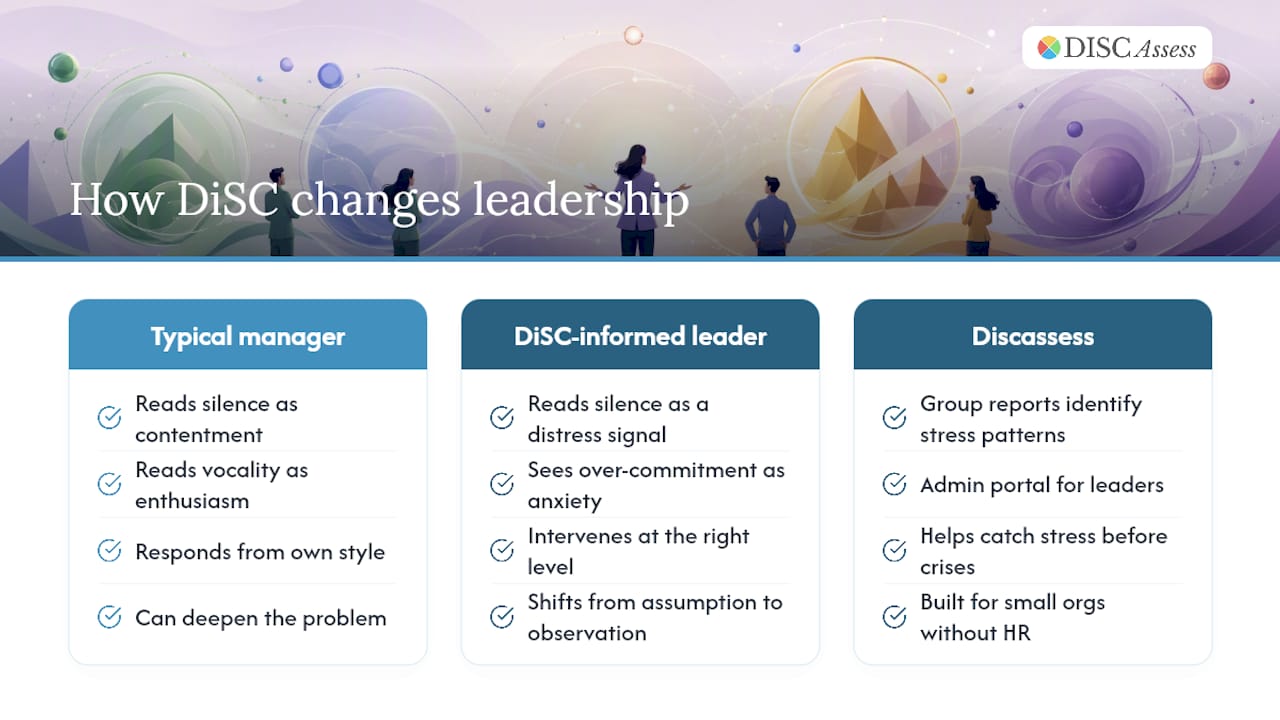
Most managers respond to workplace stress the way they themselves experience it. A high-D leader pushes harder; a high-S leader tries to smooth things over. Neither approach is wrong in isolation, but applied to the wrong style it can deepen the problem rather than resolve it.
What the DiSC framework offers is not a personality label but a behavioral map. When you know that your quietest team member's silence is a distress signal rather than contentment, you respond differently. When you understand that your most vocal team member's over-commitment is anxiety wearing the mask of enthusiasm, you intervene at the right level. That shift from assumption to observation is where real leadership growth happens.
Discassess, backed by Prism Counseling & Coaching, was built with exactly this kind of practical, people-first application in mind. The platform's group reports and admin portal exist so that small-business owners and nonprofit leaders, who rarely have a full HR department, can still catch stress patterns before they become crises. DISC is not a tool to sort people into boxes. Used well, it is a tool to see people more clearly and serve them more faithfully.
Put this guide to work with Discassess
Reading about stress signatures is one thing. Having the data in front of you during a 1:1 is another. Discassess gives small-business owners, team leaders, and nonprofit executives the assessment infrastructure that used to require a large HR team, at a fraction of the cost and with no certification required.
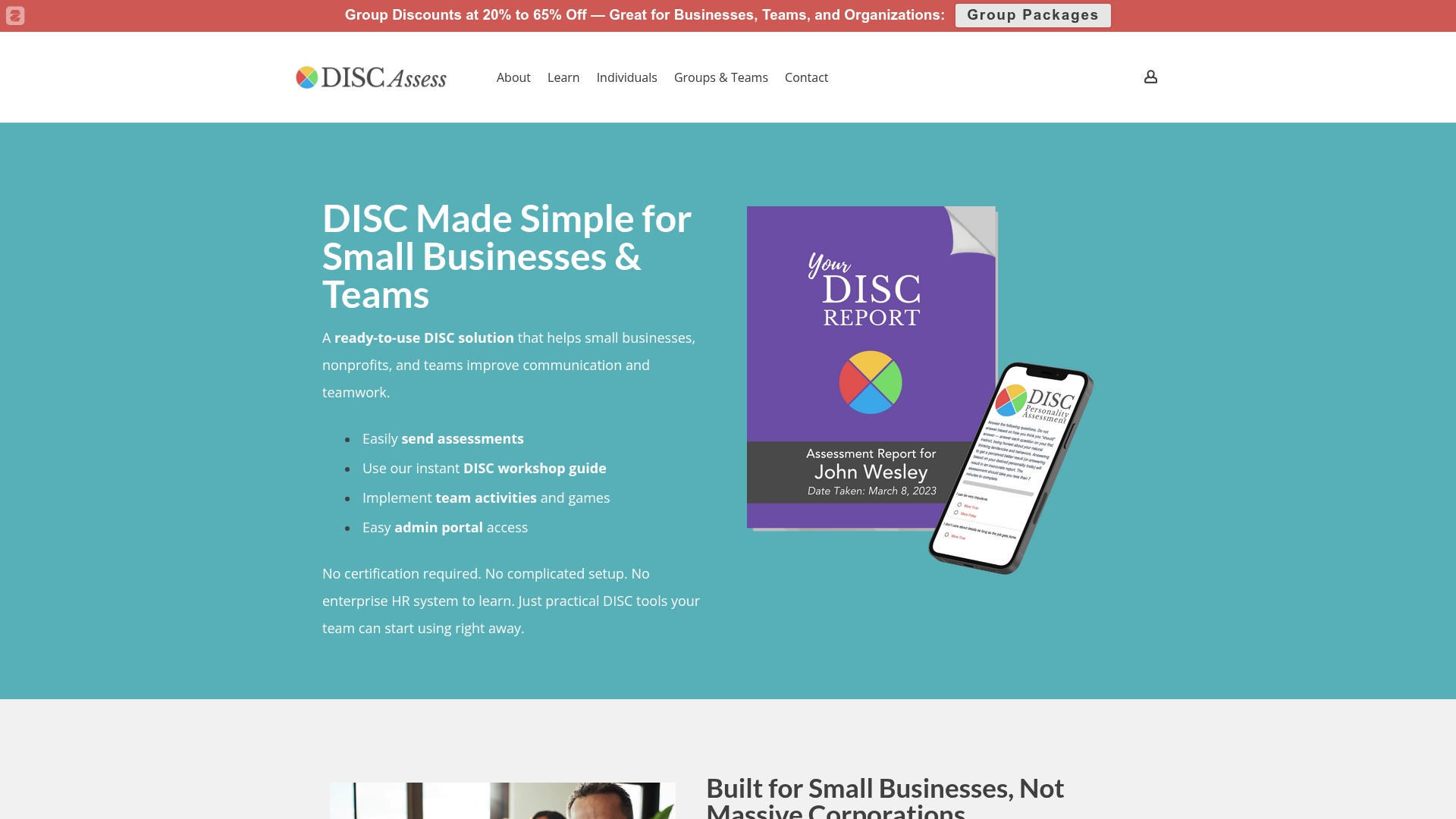
The DISC Group Package includes an admin account with assessment credits, a group report view, and the adapted-vs-natural gap data that makes early stress detection possible. For coaches and consultants who work across multiple organizations, the White Label DISC System lets you deliver branded assessments under your own name. Individual team members can start with the Classic DISC Personality Assessment and receive an instant report. If you want guided implementation, live group training is available for teams that prefer a facilitated rollout. All options are priced for small teams, and your data stays private. The next step is simple: pick the package that fits your team size and run your first group report this quarter.