

DISC profiles map observable behavioral preferences to predictable emotional triggers, and the single most useful next step for any team leader is to run a short DISC assessment for each team member and pair the results with a one-page trigger inventory. The whole process takes a short amount of time per person. Once you have those results in hand, teach your team Daniel Siegel's "name it to tame it" technique: labeling a trigger out loud moves emotional processing from reactive instinct toward deliberate choice. Discassess makes this baseline fast and affordable, so you can move from awareness to action within a single week.
Table of Contents
- How does each DISC style connect to emotional triggers at work?
- What DISC measures and what it doesn't: pairing it with emotional intelligence
- How to identify and track emotional triggers across your team
- Designing team interventions that reduce trigger-driven conflict
- A realistic rollout plan: timeline and cost ranges for small teams
- Ethics, consent, and language: protecting trust when using DISC
- How do you measure whether DISC-informed work actually improved team dynamics?
- Key Takeaways
- What most leaders miss about DISC and emotional triggers
- Discassess makes the first step easy for small teams
- Useful sources and further reading
How does each DISC style connect to emotional triggers at work?
DISC assessments serve as a behavioral roadmap that links each personality style to a predictable cluster of emotional triggers. Knowing those clusters lets you anticipate friction before it becomes conflict.
- Dominance (D): Triggered by inefficiency, micromanagement, or loss of control. The typical reaction is visible impatience, blunt pushback, or taking over a task unilaterally. Example: A D-style project lead who receives a third round of approval delays may cut the process short and make the call alone, creating downstream resentment.
- Influence (I): Triggered by rejection, exclusion from conversations, or public criticism. The reaction often looks like over-explaining, withdrawal, or an abrupt shift in enthusiasm. Example: An I-style team member left off a brainstorm invite may disengage from the next two meetings without explaining why.
- Steadiness (S): Triggered by sudden change, unresolved conflict, or feeling rushed. S-style individuals tend to go quiet, absorb stress internally, and avoid raising concerns until they reach a breaking point. Example: A surprise restructure announced on a Monday morning can leave an S-style employee visibly distracted for days.
- Conscientiousness (C): Triggered by ambiguous expectations, sloppy work, or being asked to skip steps. The reaction is often withdrawal into analysis, pointed questions, or quiet non-compliance. Example: A C-style analyst handed a half-finished brief may spend more time documenting its gaps than completing it.
One practical note: read the full DISC shape, not just the highest bar. The gap between a person's natural and adapted style signals how much energy they are spending to fit their environment, and a wide gap often predicts who will be most sensitive to role stressors.
What DISC measures and what it doesn't: pairing it with emotional intelligence
DISC captures observable behavioral tendencies, not emotional intelligence, and not clinical diagnosis. That distinction matters for how you use it. DISC tells you how someone tends to behave; it does not tell you how well they regulate those behaviors under pressure.
"DISC gives behavioral insight while EQ teaches emotion management and social skills — combining both strengthens leadership in ways neither tool achieves alone." (SUCCESS)
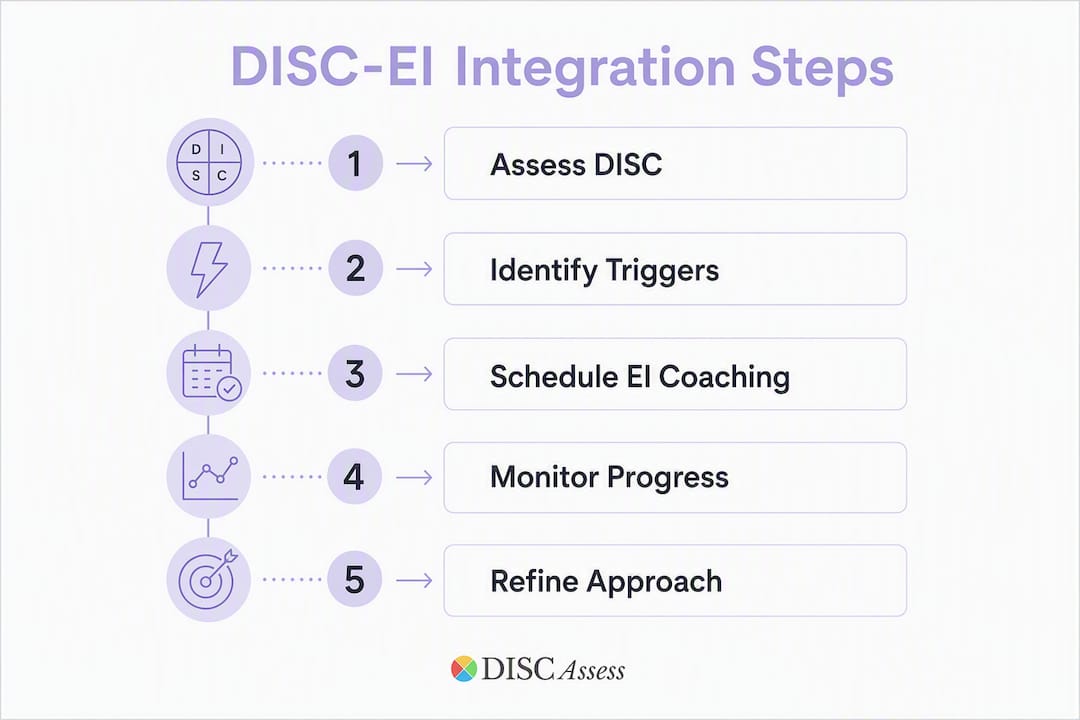
The practical implication: schedule a short EI micro-training or coaching cycle within two to four weeks of your team's DISC debrief. Even a two-hour workshop on self-regulation and active listening gives people the skills to act on what DISC reveals. DISC paired with EI development helps leaders slow their reactions and choose alternative responses rather than defaulting to their triggered state.
How to identify and track emotional triggers across your team
Moving from awareness to consistent de-escalation requires a repeatable workflow, not a one-time conversation.
- Run baseline assessments. Complete individual DISC profiles (10–20 minutes each) and review results as a leader before sharing them with the team.
- Build a trigger inventory. For each person, note the one or two triggers most likely given their DISC style. Keep this document confidential and separate from HR files.
- Open a two-week observation window. Watch for the behavioral reactions listed in the mapping above. Note the context: meeting type, deadline pressure, interpersonal dynamic.
- Introduce journaling. Give team members a simple template to complete after a charged moment:
| Field | Prompt |
|---|---|
| Date | When did this happen? |
| Trigger event | What specifically set it off? |
| DISC-style cue | Which tendency showed up (D/I/S/C)? |
| My reaction | What did I do or say? |
| Preferred support | What would have helped in that moment? |
- Run weekly short check-ins. A five-minute one-on-one question like "What felt most draining this week?" surfaces patterns before they escalate. Monthly, review the journal entries together and look for recurring themes.
For the one-on-one conversation itself, open with: "I noticed you seemed quieter than usual in Tuesday's meeting. I want to understand what you were experiencing, not evaluate it." Avoid labeling the person by their DISC letter. Frame feedback around the behavior and the context, not the personality type.
Pro Tip: Keeping a dedicated trigger journal alongside DISC results is one of the highest-value, lowest-cost habits a leader can build into a team's routine. Even two entries per week create enough data to spot patterns within a month.

Designing team interventions that reduce trigger-driven conflict
Group DISC reports shift the conversation from individual quirks to shared norms, which is where lasting change actually happens.
- Profile share-and-ask (60 minutes): Each person shares one trigger from their profile and asks the group for one accommodation. Facilitation note: model vulnerability first as the leader.
- Trigger-mapping workshop (90 minutes): Map the team's combined DISC styles onto a whiteboard. Identify the two or three situations most likely to activate multiple styles simultaneously (e.g., last-minute scope changes, public performance reviews).
- Role-play scenarios (45 minutes): Run two realistic conflict scenarios using the team's actual DISC mix. Debrief with: "What triggered you in that scenario, and what would have helped?"
For meeting protocols, three adjustments reduce reactivity immediately: send agendas 24 hours in advance (reduces C and S anxiety), assign clear roles before the meeting starts (reduces D frustration), and build in a two-minute pause before any major decision (reduces I impulsivity).
When using group reports, do frame them as conversation starters. Do not use them to explain away someone's behavior or assign blame. The language that builds trust frames everything around preferences and needs, not fixed labels.
For facilitation, self-led works well for teams with high psychological safety and a leader who has completed their own DISC debrief. HR-facilitated is the right call when the team has active conflict or when the leader is part of the dynamic being examined. An external coach adds value for cross-functional teams or when the stakes are high enough to warrant independent perspective.
A realistic rollout plan: timeline and cost ranges for small teams
A 6–8 week pilot is enough to generate meaningful data without overcommitting resources.
| Week | Activity | Owner | Approx. Cost |
|---|---|---|---|
| 1 | Purchase assessments, brief team on purpose and consent | HR / Team Lead | $20–30 per person |
| 2 | Complete individual DISC assessments | All team members | Included |
| 3 | Leader reviews results, builds trigger inventory | Team Lead | Staff time only |
| 4 | Individual debrief conversations (30 min each) | Team Lead or HR | Staff time only |
| 5–6 | Group workshop and trigger-mapping session | HR or external facilitator | $150–$600 total cost |
| 6–8 | Observation window, journaling, weekly check-ins | Team Lead | Staff time only |
For a team of eight to twelve people, total out-of-pocket costs typically fall between $150 and $600 depending on whether you use an external facilitator. A group package from Discassess reduces the per-person assessment cost significantly compared to individual purchases.
Expand to an organization-wide rollout when the pilot team shows measurable improvement on at least two of the KPIs in the next section and when the team lead can confidently facilitate a debrief without external support.
Ethics, consent, and language: protecting trust when using DISC
DISC is a powerful tool and a fragile one. Misuse erodes the psychological safety it is meant to build.
- Before administering: Tell participants what the assessment measures, how results will be stored, who will see them, and that participation is voluntary. Put this in writing.
- Individual vs. group reports: Individual reports belong to the individual. Share them only with the person's explicit consent. Group reports show aggregate patterns and are appropriate for team discussions, but never identify an individual's score without their permission.
- Storage: Keep individual results in a secure, access-controlled location. Do not store them in shared team drives or general HR files.
- Language in feedback: Replace "You're a high D, so you're aggressive" with "Your profile suggests you tend to move quickly and value efficiency." Preferences and tendencies, not diagnoses.
- Legal note: DISC is a self-report behavioral tool, not a clinical instrument. Never use it to make hiring, firing, or accommodation decisions, and always pair its use with a clear statement of its non-diagnostic purpose.
How do you measure whether DISC-informed work actually improved team dynamics?
Measurement keeps the work honest and builds the case for continued investment.
- Conflict incidents: Track the number of escalated conflicts reported to HR or leadership per month. Establish a baseline before the pilot and compare at the 30-day and 90-day marks.
- Meeting efficiency: Measure agenda adherence (percentage of meetings that cover all agenda items within the allotted time) before and after implementing meeting protocols.
- Engagement survey items: Add two targeted items to your next pulse survey: "I feel comfortable raising concerns with my team" and "I understand how my colleagues prefer to communicate."
- One-on-one wellbeing indicators: Track how often team members proactively raise concerns in check-ins versus waiting to be asked. A shift toward proactive sharing is a meaningful signal.
Run your baseline measurement in week one of the pilot, a quick post-intervention check at week eight, and a full review at the three-month mark. Build a simple dashboard in a shared spreadsheet: one row per metric, one column per measurement period, reviewed monthly by the team lead and HR together. Expect directional improvement, not perfect attribution. DISC-informed work is one input among many, and honest reporting of modest gains is more credible than overclaiming.
Key Takeaways
DISC profiles reliably predict emotional triggers by style, and pairing that awareness with EI training and a structured observation workflow produces durable improvement in team communication.
| Point | Details |
|---|---|
| DISC maps triggers by style | Each DISC style (D, I, S, C) connects to a predictable cluster of emotional triggers leaders can anticipate. |
| Pair DISC with EI training | DISC reveals behavioral patterns; EI training builds the self-regulation skills needed to act on that awareness. |
| Use journaling and 1:1 scripts | A simple trigger journal and weekly check-in questions move teams from reactive to proactive within weeks. |
| Measure with clear KPIs | Track conflict incidents, meeting efficiency, and engagement survey items at baseline, week 8, and month 3. |
| Discassess for fast, affordable rollout | Individual and group DISC assessments from Discassess take 10–20 minutes and include instant reports for immediate use. |
What most leaders miss about DISC and emotional triggers
Most teams treat DISC as a one-time event: take the assessment, share the results, move on. That approach captures maybe 20% of the tool's value. The real work begins after the debrief, in the ordinary friction of weekly meetings and deadline pressure, where behavioral tendencies collide with real stakes.
The leaders who get the most from DISC are the ones who treat it as a living reference rather than a report to file. They revisit the trigger inventory when a team member's behavior shifts. They adjust meeting protocols when a new project introduces new stressors. They use the "name it to tame it" framing not as a one-time lesson but as a shared team vocabulary that surfaces naturally in conversation.
There is also a spiritual dimension worth naming. Understanding why we react the way we do, and choosing a different response, is part of the deeper work of growth and character formation. DISC does not replace that work. It gives us a clearer mirror so the work can begin with honesty rather than guesswork.
Discassess makes the first step easy for small teams
For teams that want to move from reading about DISC to actually running it, the practical barrier is usually time and cost, not motivation. Discassess removes both. Individual Classic DISC assessments take 10–20 minutes and deliver instant, detailed reports your team can use the same day. Group packages reduce the per-person cost, and the admin portal lets you manage results, track participation, and maintain confidentiality without a dedicated HR system.
Every step in this playbook, from the trigger inventory to the facilitated workshop to the measurement dashboard, works better when you have clean, reliable DISC data underneath it. Discassess gives you that foundation without requiring a certification, a consultant, or a large budget. Start with a team DISC package and run your first debrief within the week.
Useful sources and further reading
The research and practitioner resources that informed this guide, along with recommended next reading for HR leaders:
- How DISC Can Enhance Emotional Intelligence in Leadership — SUCCESS
- The Synergy Between Everything DiSC and Emotional Intelligence — Flashpoint Leadership
- DISC Analysis: What It Measures, How to Read Your Results — Pigment
- DISC for Workplace Teams: A Manager's Practical Guide — Discassess Blog
- DISC Assessment for Leadership Development — Discassess Blog
- The Role of DISC in Personal Leadership Growth — Discassess Blog