
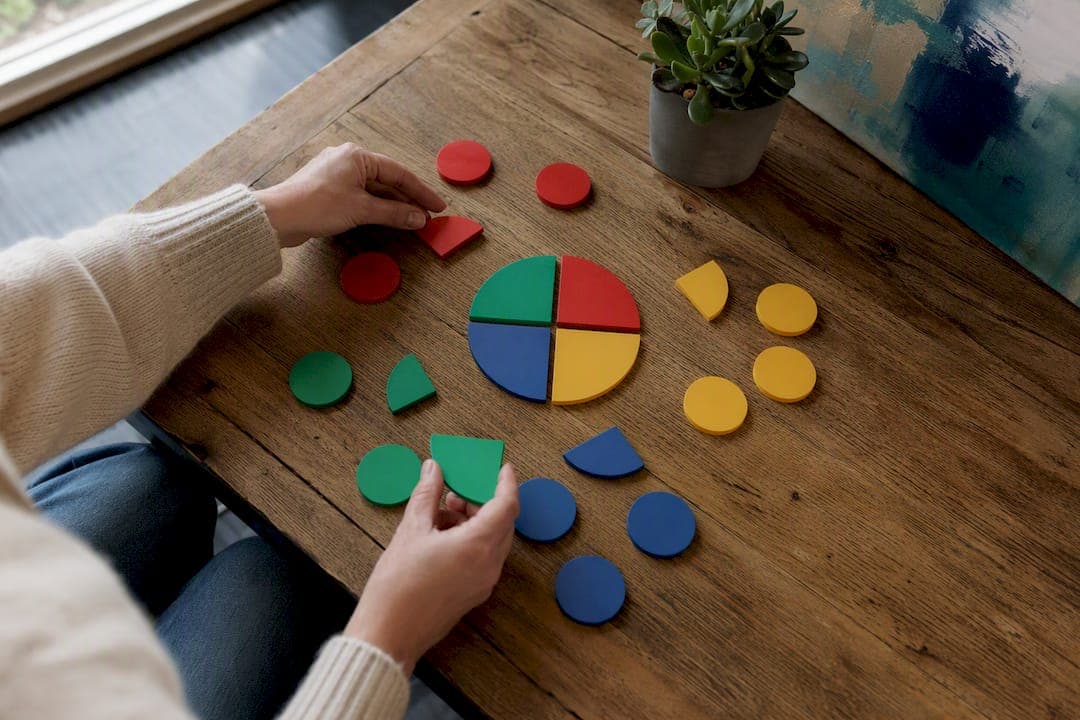
Yes, DISC can improve your career performance when you apply it to specific, recurring work situations instead of treating it as a one-time personality quiz. Growth happens when you take what your report reveals about your Dominance, Influence, Steadiness, or Conscientiousness style and put it to work in the moments that matter most, like a performance review, a tense team meeting, or a delegation conversation you have been avoiding.
Start this week with three moves:
- Get your DISC report through Discassess if you have not already, so you have a baseline to work from.
- Pick one recurring scenario, such as your next performance review or a delegation conversation, and commit to applying DISC insight there first.
- Draft a style-specific script for that scenario and use it within the next seven days.
One case study on DISC and hiring alignment found that applying DISC insight to role fit and team composition helped stabilize a multi-dealership sales organization and reduce turnover. Self-awareness alone does not move the needle. Applied self-awareness does.
Key Takeaways
DISC improves career performance most reliably when applied to specific recurring scenarios and reinforced through six to eight weeks of deliberate practice and peer feedback.
| Point | Details |
|---|---|
| Apply DISC to real scenarios | Use your style insight in specific recurring moments like reviews or delegation, not as an abstract label. |
| Learn all four styles | Recognize D, I, S, and C preferences in others so you can adjust delivery in real time. |
| Practice flexing for 6 to 8 weeks | Run scripted scenarios with two checkpoints to measurably build behavioral flexibility. |
| Protect trust with consent | Get permission before sharing results and never use DISC as a sole hiring filter. |
| Start with Discassess | Get an individual or team DISC report through Discassess as your practical starting point. |
Table of Contents
- How Understanding Your DISC Style Supports Career Development
- What DISC Actually Measures at Work
- A Scenario Playbook: Scripts for Recurring Career Moments
- Building the Flexibility to "Flex" Your Style
- Getting Your DISC Report and Planning Your Next Steps
- Using DISC Responsibly: Consent and Fair Use
- An Editorial Perspective on Using DISC as a Career Tool
- Get Your DISC Report and Start Applying It This Week
- Frequently Asked Questions
- Sources
How Understanding Your DISC Style Supports Career Development
DISC does not hand you a promotion. It hands you a mirror, and what you do with that reflection determines whether your career actually moves. When professionals connect their D/I/S/C tendencies to specific outcomes, a few benefits show up consistently across coaching engagements.
- Clearer feedback conversations. You learn to ask for feedback in the format your manager can actually deliver well, rather than the format you wish they'd use.
- Better role alignment. You start noticing when your daily tasks fight against your natural style, which is often the root cause of quiet burnout.
- Faster onboarding into new teams. Knowing your own style lets you name your working preferences early instead of letting colleagues guess.
- Stronger relationship-building. You adjust your pace and tone to match a colleague's style instead of assuming everyone processes information the way you do.
- Reduced day-to-day conflict. Most friction at work is a style mismatch dressed up as a personality clash.
- Improved promotion readiness. Leaders who can read a room and flex their approach get trusted with bigger, messier problems sooner.
Take feedback conversations as an example. A high D employee who wants results-first, no-fluff coaching will disengage during a rambling, relationship-heavy check-in, even if the manager means well. Once that employee tells their manager how they prefer to receive feedback, review conversations shorten and improve. On the interview side, a candidate who understands their own S style can prepare a stronger answer to "tell me about a time you led change" by anticipating the parts of that story that will feel uncomfortable to describe. For team collaboration, watch what you can actually measure: conversation quality, manager ratings after check-ins, and whether you're getting looped into higher-stakes projects.
What DISC Actually Measures at Work
DISC is a behavioral framework, not a box you get sealed into. It describes how you tend to act under pressure, communicate, and make decisions. It does not diagnose who you are as a person, and it is not a substitute for skill or character. Treating it as a fixed label is the single most common misuse of the tool, a point Maximum Potential's implementation guide makes clearly when it frames DISC as decision support rather than verdict.
Here's the shorthand for each style:
- Dominance (D): Wants results and options fast. Give bottom-line answers first, details only on request.
- Influence (I): Wants connection and enthusiasm. Lead with the relationship, then the plan.
- Steadiness (S): Wants stability and process. Give advance notice before changes, not surprise announcements.
- Conscientiousness (C): Wants accuracy and logic. Bring data before you bring opinions.
Listen for pace and priority in conversation. Fast and blunt usually signals D. Fast and warm usually signals I. Steady and process-oriented usually signals S. Slow and detail-checking usually signals C.
A Scenario Playbook: Scripts for Recurring Career Moments
Applied correctly, DISC works best on situations you face over and over, not one dramatic conversation a year. LeadershipStrength's implementation guide calls a mismatched delivery style a "silent drain" on productivity, and that drain shows up most in these six moments.
1. Performance reviews. Goal: leave with a clear action plan, not just a rating.
- To a D manager: "Here are my top three results this quarter, and here's what I want to own next."
- To an I manager: "I'd love to talk through how this role has grown me, and where you see room for me to stretch."
- To an S manager: "Can we walk through my goals step by step so I know exactly what's expected before next quarter?"
- To a C manager: "I've documented my metrics against last year's targets, can we review the data together?"
2. Asking for stretch work. Goal: get a yes by matching how the decision-maker actually evaluates risk.
- D: "I want the lead on this project and I'm confident I can deliver by [date]."
- I: "I think I'd bring real energy to this project, and I'd love your support in pitching it."
- S: "I'd like to take this on gradually, starting with a smaller piece so we can build trust in the plan."
- C: "Here's my case for taking this on, backed by the results from my last two projects."
3. Delegating to a peer. Goal: hand off work cleanly without triggering resistance.
- D: "Here's the outcome I need. You decide how to get there."
- I: "I trust your instincts on this, let's check in weekly so I can cheer you on."
- S: "Here's the full process, and I'm available anytime you want to talk it through."
- C: "Here's the spec sheet and the deadline. Let me know if anything is unclear."
4. Leading a project kickoff. Goal: get buy-in from a mixed-style room in one meeting.
Thomas Management Systems' framework on mapping tasks to styles suggests opening with the bottom line for D's, the team vision for I's, the timeline for S's, and the documentation plan for C's, in roughly that order, so everyone hears their priority addressed early.
5. Handling conflict. Goal: de-escalate instead of triggering defensiveness. Lead with outcomes for a D, empathy for an I, reassurance for an S, and facts for a C, before you bring up the disagreement itself.
6. Interview answers. Goal: frame your story so the interviewer's own style hears it as credible. A C-style interviewer wants specifics and numbers in your answer. An I-style interviewer wants to feel your enthusiasm for the team.
If you misread someone's style, don't overcorrect mid-conversation. Ask one clarifying question ("Do you want the summary first or the full context?") and adjust from their answer.
Building the Flexibility to "Flex" Your Style
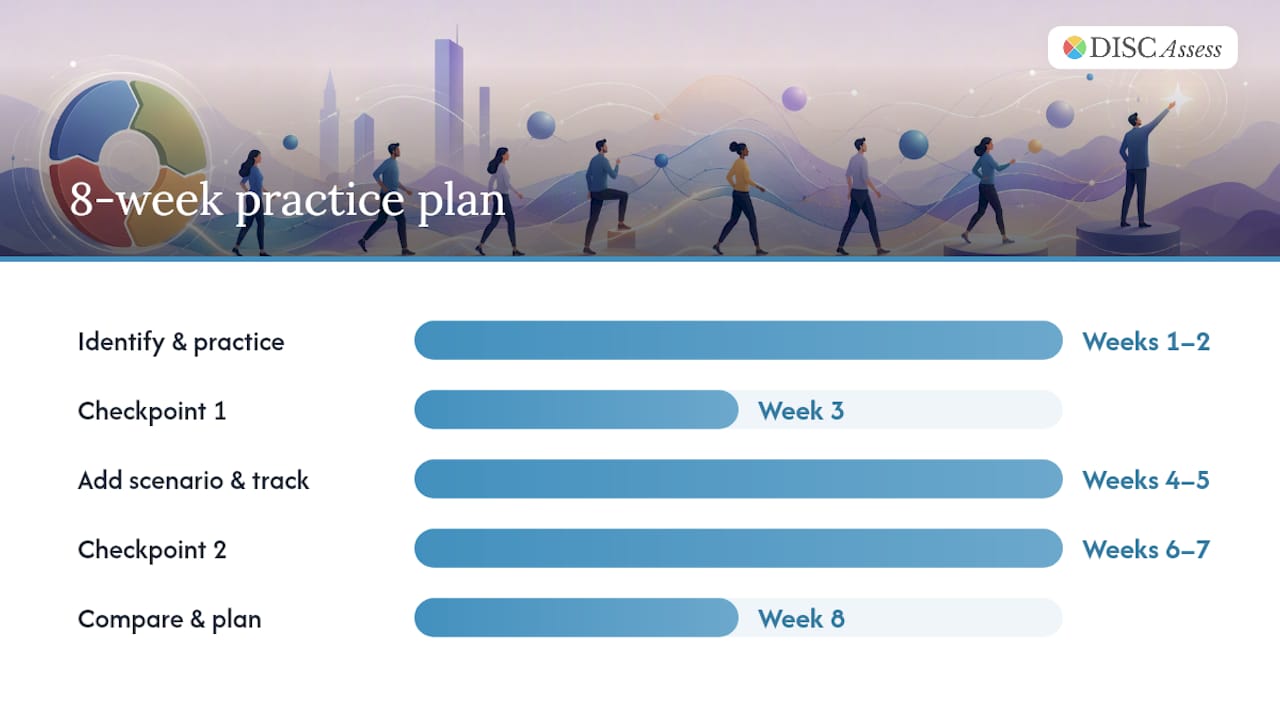
Your core DISC tendencies stay fairly stable, but your ability to flex into a different style on demand is a trainable skill. MBA Schools' resource guide on DISC and careers confirms that deliberate practice and peer feedback meaningfully improve this ability over time, which is good news if your natural style clashes with your manager's or your team's.
A practical six to eight-week plan looks like this:
- Weeks 1 to 2: Identify one recurring meeting or relationship where your style clashes with someone else's. Practice one adapted script per week.
- Week 3 (checkpoint): Rate your own flexibility from 1 to 10 and ask one trusted colleague for quick feedback on what they noticed changing.
- Weeks 4 to 5: Add a second scenario. Start tracking one specific behavior, like "asked for data before deciding" for a C-style colleague or "led with the big picture" for a D.
- Weeks 6 to 7 (checkpoint): Request structured peer feedback using start, stop, continue. What should you start doing, stop doing, and keep doing in how you flex your style?
- Week 8: Compare your self-rating to week 3 and set your next stretch scenario.
Pro Tip: Ask your peer feedback partner to tie their start/stop/continue comments directly to a DISC style ("start giving me the summary before the detail") instead of vague feedback like "communicate better." Specific, style-linked feedback is far easier to act on.
Getting Your DISC Report and Planning Your Next Steps
An individual report gives you a personal baseline fast, while a team package layers in comparison data so you can see exactly where your style creates friction with specific colleagues. Either path works for career development, but if your goal is workplace application rather than personal curiosity alone, a team or group option gives you more to work with.
Expect real behavior change to take six to twelve months of consistent application, not six to twelve days. Delivery formats vary from a self-guided report you interpret on your own to a facilitated workshop with coaching add ons for deeper individual support, and running assessments during hiring or onboarding followed by a retest in that same window is one of the clearest ways to see documented development.
Your next-steps checklist:
- Get your report and read it against real scenarios, not in the abstract.
- Pick one recurring situation to apply it to first.
- Set a six to eight week practice plan with two checkpoints.
- Schedule a peer check-in before you start, so the feedback loop is already in place.
If you manage others, DISC for workplace teams covers how to fold these same principles into hiring and coaching conversations.
Using DISC Responsibly: Consent and Fair Use
DISC builds trust when it is used transparently. It breaks trust fast when it is not.
- Always get consent before sharing someone's results with a team.
- Never use DISC scores as a sole hiring filter or promotion gatekeeper.
- Avoid public labeling ("she's just a C, she'll slow this down") in meetings or reviews.
- Store reports securely and follow your organization's existing privacy practices; ask HR if you are unsure.
A common misuse looks like this: a manager announces each team member's style in an open meeting, and colleagues start joking about who is "the difficult D." The corrective action is simple. Keep results private unless someone chooses to share, and reframe every DISC conversation around growth, not diagnosis.
An Editorial Perspective on Using DISC as a Career Tool
The professionals who get the most out of DISC treat it as an ongoing practice, not a one-time report they file away. In coaching conversations, the pattern is consistent: people who revisit their style every few months, alongside real feedback from peers, grow measurably in how they communicate and lead. That's the whole point of a tool like this. It's not a label; it's a mirror you're supposed to keep checking. For more on applying this to leadership growth specifically, see the role of DISC in personal leadership growth.
Get Your DISC Report and Start Applying It This Week
Discassess gives you a fast, affordable path to a real DISC report, without the certification requirements or enterprise pricing that traditional providers demand. You get your individual results with a practical breakdown of your style, plus resources built for immediate use in the scenarios covered above, not a dense academic report you'll never open twice.
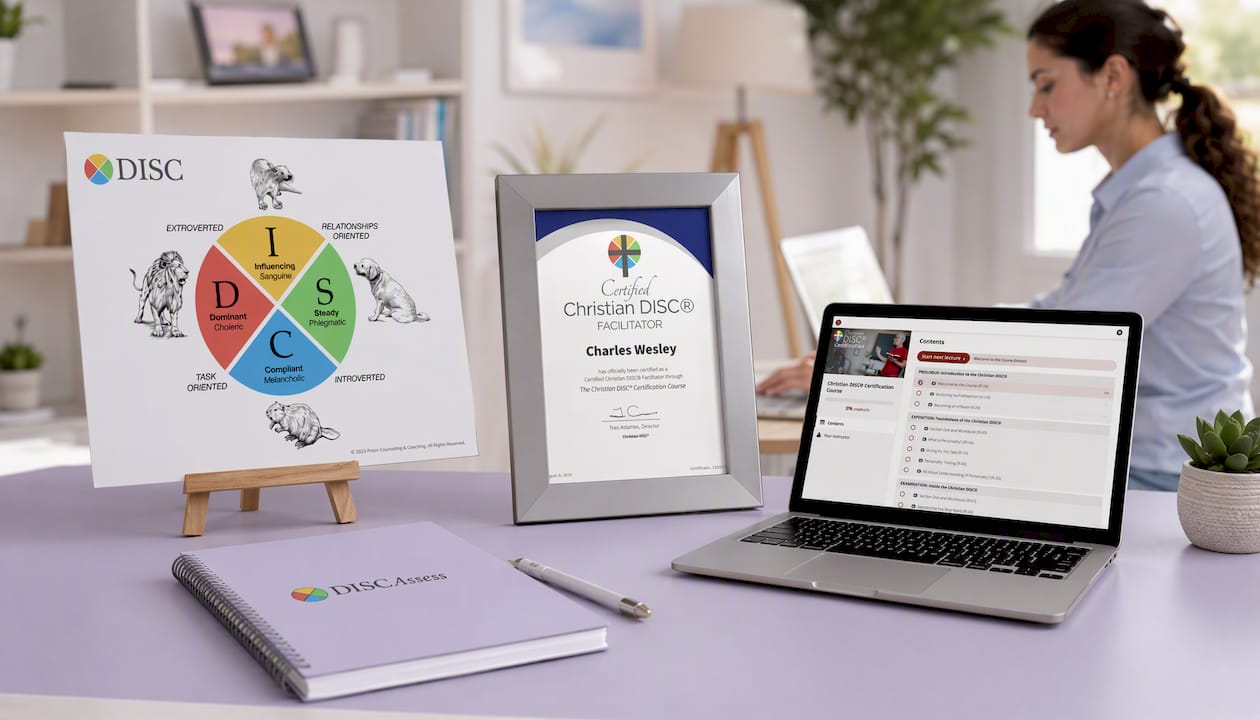
If you want a physical reference to keep at your desk while you practice flexing your style in real conversations, the Poster of the DISC Wheel is a simple visual anchor for the four styles. Professionals who want to go deeper, including coaches supporting others through this same process, can pursue the Christian DISC® Certification Course, and organizations rolling DISC out at scale across multiple teams should look at the White Label DISC System for a branded, repeatable option. Start with your own individual assessment, apply it to one scenario this week, and build from there.
Frequently Asked Questions
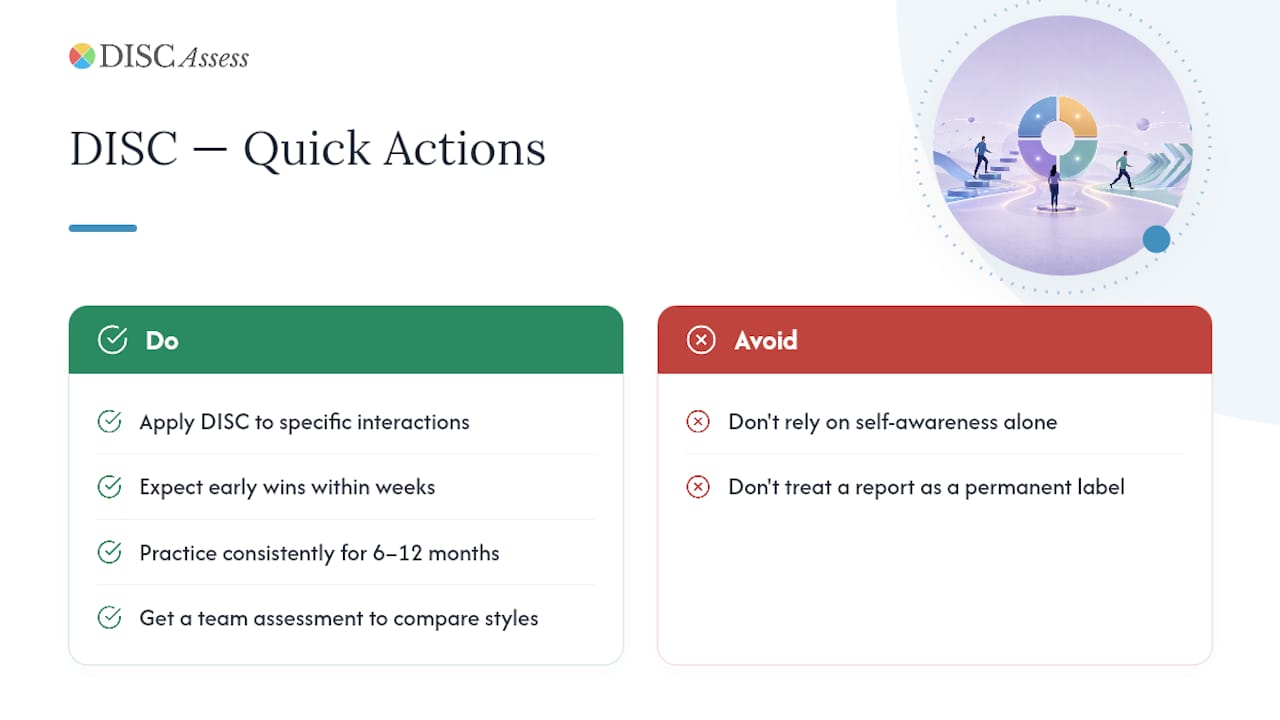
Can DISC really improve career performance, or is it just self-awareness? It improves performance when you apply it to specific interactions, like matching your delivery style to your manager's preferences in a review. Self-awareness alone does not change outcomes; applied practice does.
How long does it take to see results from using DISC at work? Expect early wins within a few weeks on individual scripts and conversations, with more durable behavior change over six to twelve months of consistent practice.
Is DISC the same as a personality test that labels who I am? No. DISC measures behavioral tendencies and preferences, not fixed traits. Treating a report as a permanent label is a common misuse the tool was never designed for.
Should I get an individual DISC report or a team assessment? An individual report gives you a personal baseline. A team package adds comparison data so you can see exactly where your style creates friction with specific colleagues.
Can DISC help with a promotion or interview prep? Yes. Understanding your own style helps you frame your interview stories more effectively, and understanding the interviewer's likely style helps you deliver those stories in a way they'll find credible.
Sources
- Leadershipstrength
- How to Use DISC Profiles at Work • Maximum Potential
- Beyond the Personality Test: How to Weaponize DISC Data for High Performance
- DISC Assessment for Teams: Proven Communication Guide
- DISC assessment usage for careers — MBA resource guide