

Personality profiles improve salary negotiations by making your predictable tendencies visible before you sit down at the table, so you can plan around them rather than be surprised by them. Knowing that you tend to concede quickly under social pressure, or that you anchor too low because assertiveness feels uncomfortable, gives you something concrete to work with. That self-awareness is the foundation of every effective salary negotiation strategy.
Start here — four actions you can take right now:
- Take a validated personality assessment (the Big Five or a DISC profile) and read the negotiation-relevant sections carefully.
- Write down three tendencies from your report that could hurt your outcome: low anchoring, early concession, or avoiding the conversation entirely.
- Pull market-rate data from sources like the Bureau of Labor Statistics or LinkedIn Salary before your next conversation, so your opening number is anchored externally, not emotionally.
- Script two responses to the most likely pushback you will face, and rehearse them aloud at least twice.
The core mechanisms are straightforward: profiles increase self-visibility (you see the pattern before it plays out), support better framing (market-rate language instead of personal requests), enable scripted responses (so pressure does not trigger instinct), and provide external anchors that reduce the social cost of asking for more.
Table of Contents
- Why personality shapes negotiation behavior and outcomes
- How your Big Five traits map to negotiation tendencies
- How do you convert a personality report into a negotiation plan?
- What does the research actually say about personality and pay?
- Common negotiation mistakes driven by personality, and how to fix them
- Key Takeaways
- The part most negotiation guides miss
- How Discassess DISC assessments support your negotiation preparation
- Useful sources and further reading
Why personality shapes negotiation behavior and outcomes
Your personality does not just color how you feel during a negotiation. It changes what you ask for, how you frame the ask, and how quickly you back down when the other side pushes. Research from the Program on Negotiation at Harvard Law School shows that consistent individual differences—including personality—can explain nearly half of the variation in negotiation scoring across round-robin studies. That is a substantial share of the outcome sitting inside you before the conversation even begins.

The mechanism works through three channels. First, personality shapes your goal-setting: agreeable people tend to set lower targets because they weight the relationship more than the outcome. Second, it changes threat perception: high-neuroticism negotiators read neutral responses as hostile, triggering defensive concessions. Third, it governs concession behavior: conscientious professionals often over-prepare but then accept the first reasonable offer because they have already mentally closed the deal.
None of this is deterministic. Harvard PON's synthesis is clear that preparation, context, and strategy remain major moderators. A profile does not fix your ceiling; rather, it reveals the floor you are likely to accept without intervention. That distinction matters for how you use the information.
How your Big Five traits map to negotiation tendencies
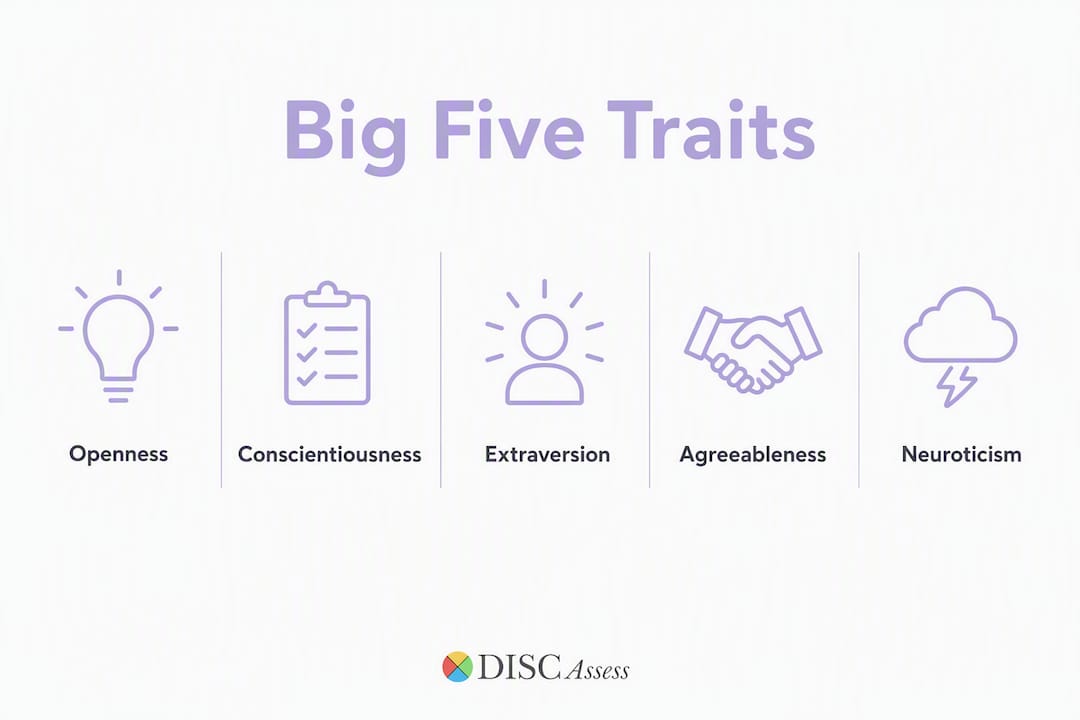
The Big Five personality model (Openness, Conscientiousness, Extraversion, Agreeableness, and Neuroticism) is the most research-supported framework for understanding how personality affects pay and negotiation behavior. DISC and MBTI users can translate easily: D (Dominance) maps roughly to low Agreeableness and high Extraversion; I (Influence) to high Extraversion; S (Steadiness) to high Agreeableness; C (Conscientiousness) to high Conscientiousness and low Extraversion. MBTI's T/F axis closely mirrors the Agreeableness dimension.
| Trait | Typical negotiation tendency | Earnings effect | One-line tactic |
|---|---|---|---|
| High Extraversion | Visible, confident opener; strong network | Higher starting offers via visibility | Pair confidence with market data so the anchor is defensible, not just assertive |
| High Agreeableness | Accepts first offer; avoids conflict | a substantial earnings gap for high-agreeableness men versus low-agreeableness men | Use external market anchors so the ask feels impersonal, not confrontational |
| High Conscientiousness | Over-prepares; accepts early closure | Positive long-term earnings effect | Set a written floor before the meeting and commit to not accepting below it |
| High Neuroticism | Reads neutral cues as hostile; concedes under pressure | Negative earnings correlation | Script a pause phrase ("Let me think on that overnight") to interrupt the concession reflex |
| High Openness | Creative framing; builds integrative packages | Modest positive earnings effect; stronger in multi-issue deals | Propose a package (salary + equity + development budget) rather than a single number |
A meta-analysis of the Big Five and earnings found that Openness and Conscientiousness correlate positively with earnings, while Agreeableness and Neuroticism correlate negatively, with effect sizes that are modest but statistically significant (roughly 1.9% per standard deviation for Openness and 1.6% for Conscientiousness). Small per-conversation effects compound across a career.
Tactics by trait
High Agreeableness. The financial liability here is real. Assertive bargaining feels socially costly, so the instinct is to soften the ask or drop it entirely. The fix is to remove the personal element: "Based on current market data for this role in this region, the range is $X–$Y" is a factual statement, not a confrontation. Rehearse that sentence until it feels neutral.
High Extraversion. Visibility and network effects give extroverts a genuine starting-offer advantage, but extraversion alone does not guarantee better results. Preparation and emotional intelligence are the moderators. Extroverts sometimes over-talk and reveal their floor too early; a scripted pause after stating the anchor prevents that.
Pro Tip: If you score high on Agreeableness or Neuroticism, write your opening number and your walk-away floor on a card and keep it in front of you during the call. Physical documentation interrupts the social-pressure reflex before it overrides your plan.
High Conscientiousness. These professionals often have the best-prepared case and then accept the first reasonable counter because the preparation felt like the hard part. Set a written commitment the night before: "I will not accept below $X without sleeping on it." That pre-commitment is the tactic.
High Openness. Multi-issue packages are where this trait earns its keep. Instead of negotiating salary alone, propose a bundle: base salary, a professional development budget, a remote-work arrangement, or an early performance review. Research shows that openness correlates with better integrative outcomes in multi-issue bargaining; play to that strength.
Pro Tip: Introverted professionals can close a visibility gap before the negotiation even starts. Document contributions in writing, request explicit career-development conversations, and build presence through personality awareness so your value is on record before you name a number.
How do you convert a personality report into a negotiation plan?
Reading a report is not the same as using it. Here is a repeatable five-step process for turning assessment output into a concrete salary negotiation strategy.
- Read the report and highlight negotiation-relevant language. Look for phrases like "avoids conflict," "seeks consensus," "prefers deliberation," or "comfortable with ambiguity." These are behavioral predictions, not fixed limits.
- Extract three tendencies that could cost you money. Be specific: "I tend to accept the first offer," "I lower my ask when I sense discomfort," or "I over-explain and undermine my own position." Write them down.
- Set an anchor and a floor using external market data. Your opening number should come from Bureau of Labor Statistics wage data, LinkedIn Salary, or Glassdoor, not from what feels comfortable. The anchor is your opening ask; the floor is the number below which you decline or pause.
- Script responses to the three most likely objections. Common ones: "That's above our budget range," "We need to check with HR," and silence. Write one sentence for each. Practice saying them aloud.
- Build a pause-and-recalibrate rule. Decide in advance: if you feel pressure to concede immediately, you will say, "I appreciate that. Can I follow up with you by end of day tomorrow?" That sentence buys time and prevents reactive concessions.
Preparation checklist:
- Current market salary data for your role, level, and geography
- Your three negotiation-risk tendencies from the report
- Written anchor number and written floor number
- Two scripted responses to common pushback
- A pause phrase memorized and ready
- One trusted colleague or coach to rehearse with
Roleplay prompts by trait:
- High Agreeableness: Practice saying your anchor number to a mirror, then to a friend, until the social discomfort drops below the point where it triggers a retreat.
- High Neuroticism: Rehearse reading neutral silence as thinking time, not rejection. Ask your practice partner to pause for ten seconds after you name your number.
- High Conscientiousness: Role-play stopping after you state your case. Resist the urge to fill silence with justifications that soften your position.
What does the research actually say about personality and pay?
The evidence base is solid enough to act on, and honest enough to acknowledge its limits.
A meta-analysis combining 65 peer-reviewed studies published between 2001 and 2020 confirmed that Openness, Conscientiousness, and Extraversion correlate positively with earnings, while Agreeableness and Neuroticism correlate negatively. Effect sizes are modest per standard deviation but meaningful across a career. A separate longitudinal analysis found an approximately 18% earnings gap between high-agreeableness and low-agreeableness men after controlling for other factors, a figure large enough to justify deliberate compensatory tactics.
Research from The Conversation using Socio-Economic Panel data found that personality differences, particularly higher average agreeableness, can materially influence wage gaps across gender lines. This is not a fixed outcome; it is a pattern that preparation and scripting can interrupt.
Key findings worth quoting in a market-data anchored request:
- Extraversion raises starting offers through visibility and network effects.
- Conscientiousness compounds earnings over time through performance and strategic job moves.
- Agreeableness is the single trait most consistently associated with lower negotiated outcomes.
Limitations to keep in mind: Most studies measure earnings broadly, not negotiation outcomes specifically. Publication bias may inflate effect sizes. Cultural context matters: assertiveness norms vary significantly across U.S. industries and regions, and tactics that work in tech may land differently in nonprofit or government settings. Use the research as directional guidance, not a precise prediction.
Common negotiation mistakes driven by personality, and how to fix them
Most salary negotiation failures are not random. They follow predictable trait-driven patterns, which means they are also predictable to fix.
- Accepting the first offer (high Agreeableness, high Conscientiousness). Fix: Write "I will counter at least once" on your preparation sheet. The counter does not need to be aggressive: "Thank you. Based on market data, I was expecting something closer to $X. Is there flexibility there?"
- Anchoring too low (high Agreeableness, high Neuroticism). Fix: Pull your anchor from an external source and state it as a market fact, not a personal wish.
- Over-explaining and softening the ask (high Agreeableness, high Conscientiousness). Fix: State the number, then stop. Silence is not rejection.
- Emotional concession under pressure (high Neuroticism). Fix: Use your pause phrase. "Let me think on that and follow up by tomorrow" is a complete sentence.
- Visibility gap before the conversation starts (high Introversion / low Extraversion). Fix: Document your contributions in writing before the negotiation. A written record of impact is a stronger anchor than a verbal summary delivered under pressure. Personality awareness in daily work can help you build that habit systematically.
- Treating the negotiation as a single moment (all traits). Fix: Salary negotiation is a process. An early performance review clause, a six-month check-in, or a documented development plan are all negotiable and often easier to secure than a higher base.
Pro Tip: Before any salary conversation, send a brief written summary of your recent contributions to your manager. This is not self-promotion; it is context-setting. It shifts the conversation from "what do you want" to "here is what the data supports," which reduces the social cost for both sides.
Key Takeaways
Personality profiles improve salary negotiations most when they reveal specific compensatory tactics, not when they are used to predict a fixed outcome.
| Point | Details |
|---|---|
| Profiles reveal predictable blind spots | Knowing your trait-driven tendencies lets you script around them before pressure triggers instinct. |
| Agreeableness carries the highest financial risk | Research documents a significant earnings gap for high-agreeableness individuals; external anchoring is the primary fix. |
| External market data is your best anchor | Bureau of Labor Statistics or LinkedIn Salary data frames your ask as factual, reducing social cost for any trait profile. |
| Preparation steps are trait-specific | Set a written floor, script two objection responses, and rehearse a pause phrase matched to your profile's risk pattern. |
| Discassess DISC reports map directly to tactics | The Individual Classic DISC Assessment surfaces the exact tendencies covered here, giving you a ready-made negotiation preparation tool. |
The part most negotiation guides miss
There is a version of this advice that gets repeated everywhere: "Know your worth, do your research, and be confident." That is not wrong, but it skips the harder truth. Confidence is not a decision you make in the moment. It is a product of preparation that is specific enough to override the instincts your personality has been building for decades.
What I find most useful about personality profiling in negotiation contexts is not the trait labels themselves. It is the permission structure they create. When a professional sees in writing that they tend to concede under social pressure, they stop treating that concession as a reasonable response and start treating it as a reflex to manage. That reframe is worth more than any negotiation script.
The other thing guides understate: profiles are most valuable when they point toward compensatory practices, not toward personality change. You are not trying to become a different person at the table. You are trying to build a preparation system that accounts for who you already are. A high-agreeableness professional who walks in with a written anchor, two scripted responses, and a pause phrase has already done the work that a naturally assertive negotiator does instinctively. The outcome can be identical.
Discassess DISC assessments are built for exactly this kind of practical self-awareness. They surface the tendencies that matter for communication and negotiation without requiring a certification or a consultant to interpret them.
How Discassess DISC assessments support your negotiation preparation
Knowing your profile is step one. Having a report you can actually work with is step two, and that is where Discassess makes the process concrete.
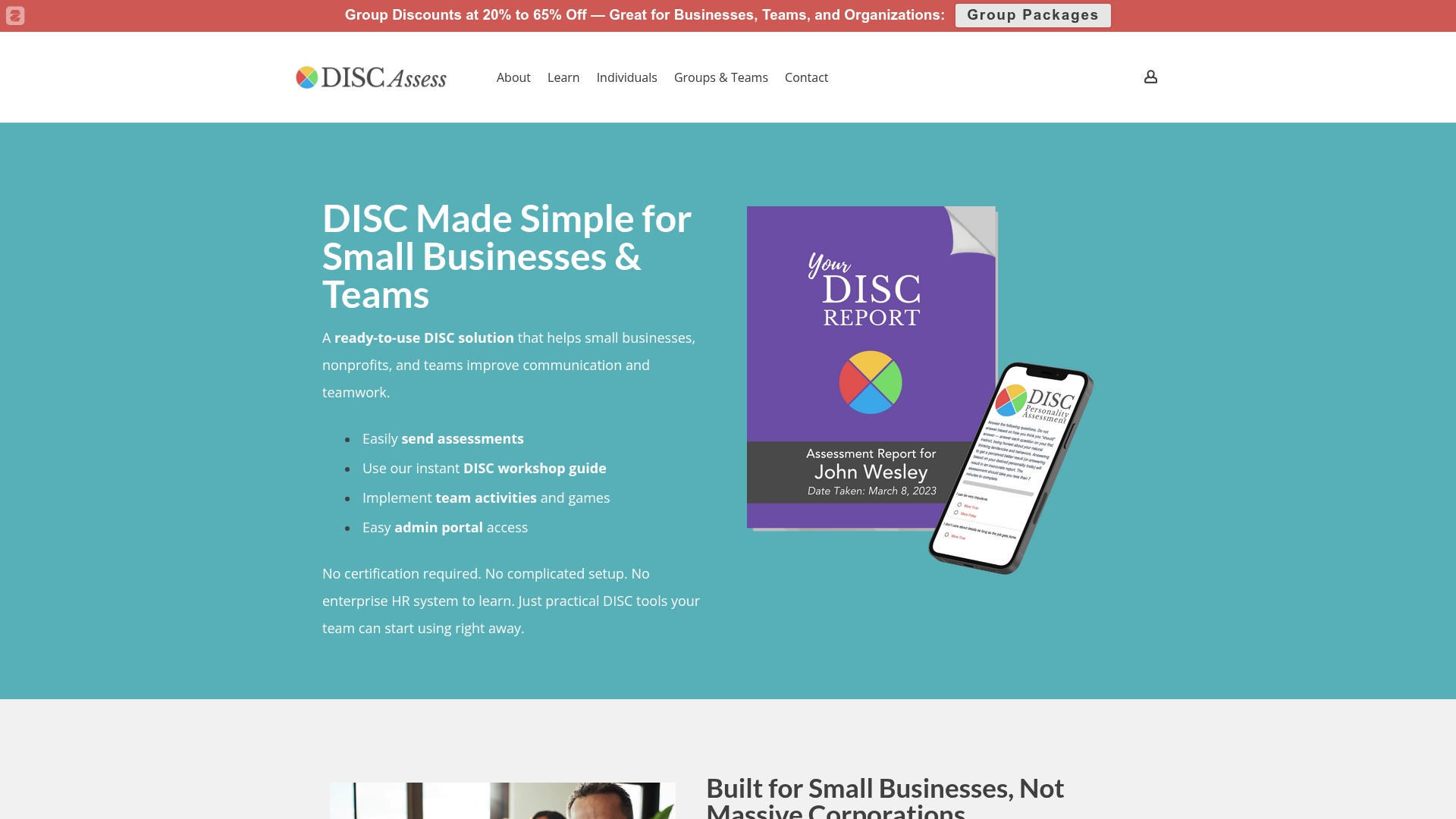
The Individual Classic DISC Personality Assessment gives you an instant, detailed report that maps directly to the preparation steps in this guide. You can identify your dominant style, extract your three negotiation-risk tendencies, and build your script from the report's behavioral descriptions, all without a consultant or a certification.
For teams, coaches, or managers running negotiation preparation workshops, the DISC Group Package includes an admin account and assessment credits so you can run multiple profiles, compare styles, and set up structured roleplay sessions where participants practice responding to different negotiation counterparts. The White Label DISC System extends that capability for coaches and organizations that want to deliver branded negotiation training under their own name.
Every Discassess report is designed for immediate usability: clear language, practical behavioral descriptions, and no jargon that requires a specialist to decode. Start with the individual assessment, work through the preparation checklist in this guide, and you will walk into your next salary conversation with a plan that fits how you actually think and respond under pressure.
Useful sources and further reading
- In Negotiation, How Much Do Personality and Other Individual Differences Matter? — PON, Harvard Law School: The foundational synthesis on how individual differences explain negotiation outcome variance; essential reading for the research behind this guide.
- The Relationship Between the Big Five Personality Traits and Earnings: Evidence from a Meta-Analysis — ISER, University of Essex: Combines 65 peer-reviewed studies to quantify the earnings effects of each Big Five trait; the source for the Openness and Conscientiousness effect sizes cited above.
- How to Negotiate Salary After a Job Offer — Indeed: Practitioner-facing guide supporting the scripting and external anchoring tactics recommended throughout this article.