

Personality awareness is the conscious understanding of your natural work tendencies, communication preferences, and emotional triggers. This self-knowledge shapes how you perform, collaborate, and lead every single day. Research from organizational psychologist Tasha Eurich reveals a striking gap: only 10–15% of people actually possess high self-awareness, despite 95% believing they do. That gap costs teams real productivity, real relationships, and real results. The role of personality awareness in daily work is not a soft skill add-on. It is the foundation of effective communication, sound decision-making, and lasting team trust.
How does personality awareness affect individual work performance?
Self-awareness improves emotional regulation, and emotional regulation directly improves work performance. When you understand your natural tendencies, you recognize when stress is distorting your behavior before it damages a relationship or a decision. That recognition is the difference between reacting and responding.
The impact of self-awareness at work shows up in concrete ways:
- Emotional regulation: You catch frustration early and choose a measured response instead of a reactive one.
- Decision-making: You recognize your cognitive biases, such as a tendency to rush decisions or avoid conflict, and correct for them.
- Communication style: You adapt how you deliver feedback based on what the other person actually needs to hear, not just what feels natural to you.
- Stress management: You identify your personal stress triggers and build routines that reduce their frequency and intensity.
- Active listening: You notice when your own assumptions are blocking genuine understanding of what a colleague is saying.
Personality awareness enhances communication by enabling professionals to tailor feedback and adapt interactions to others' preferences. That is not a minor adjustment. It changes the entire quality of a working relationship.
Pro Tip: Keep a brief daily log of moments when your emotional response felt disproportionate to the situation. Patterns in that log reveal your most active blind spots faster than any single assessment.

Self-regulation does not mean suppressing who you are. It means learning to extend your behavioral range so you can meet the demands of each situation. That skill, built through daily practice, compounds over time into a measurable performance advantage.
How does personality awareness improve team dynamics and collaboration?
Teams fail at collaboration not because people lack skill, but because they misread each other's work styles. Personality awareness gives teams a shared language for those differences, which reduces friction and builds trust.
Sharing blind spots openly within teams eliminates blame and builds psychological safety. When a team member says, "I tend to move fast and miss details under pressure," that honesty shifts the conversation from fault to function. The team can then design around that tendency rather than resent it.
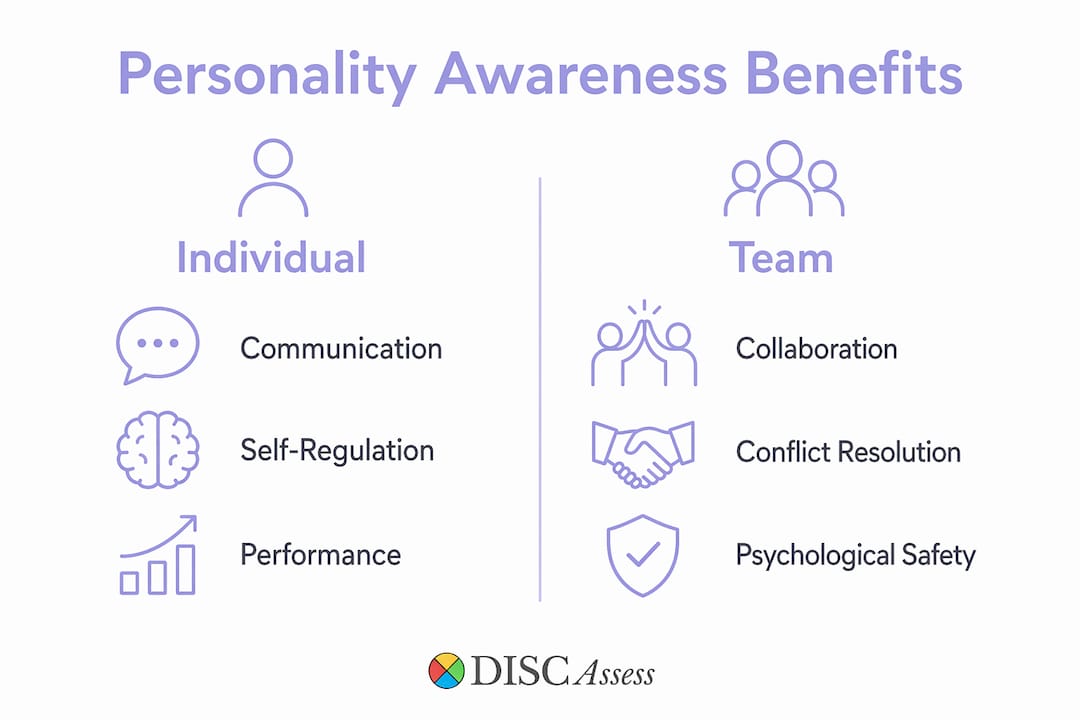
The importance of personality in teamwork becomes clearest when you look at how complementary personalities balance each other. A team with only high-urgency, results-driven members will move fast but overlook people and process. A team with only relationship-focused members will feel safe but struggle to make hard calls. Balance is not accidental. It requires awareness.
Practical approaches for leaders to build that awareness include:
- Team mapping: Have each member identify their natural work style preferences and share them openly in a group setting.
- Preference conversations: Create structured time for team members to explain how they prefer to receive feedback, handle conflict, and process information.
- Role alignment: Assign tasks that match natural strengths where possible, and flag mismatches before they become performance problems.
| Team behavior | Without personality awareness | With personality awareness |
|---|---|---|
| Conflict resolution | Blame-focused, personal | Style-focused, functional |
| Feedback delivery | One-size-fits-all | Adapted to receiver's preference |
| Role assignment | Based on availability | Aligned to natural strengths |
| Psychological safety | Inconsistent | Built through shared self-disclosure |
The table above shows that personality awareness does not just improve relationships. It changes the operating system of the team.
What leadership benefits come from personality awareness?
Self-aware leaders produce measurably better outcomes. Teams led by highly self-aware leaders show 30% higher employee engagement, 25% better financial performance, and 40% lower turnover. Those numbers reflect a direct return on the investment of knowing yourself well.
| Leadership outcome | Impact of high self-awareness |
|---|---|
| Employee engagement | 30% higher |
| Financial performance | 25% better |
| Team turnover | 40% lower |
| Career advancement | 2.5x more frequent promotions |
High self-aware professionals are promoted 2.5 times more frequently than their less self-aware peers. The reason is straightforward: they navigate social complexity better and perform under leadership pressure without losing their judgment.
Self-aware leaders also manage their blind spots more effectively. Every leader has them. Most professionals have blind spots that impact 80% of people around them. A leader who knows their blind spots can ask for checks and balances. A leader who does not know them will repeat the same costly mistakes.
Pro Tip: Ask three trusted colleagues to name one behavior of yours that sometimes gets in the way of the team. Their answers will surface your most impactful blind spots faster than self-reflection alone.
Continuous feedback is the mechanism that keeps self-awareness accurate. Honest, multi-source feedback closes the gap between how leaders see themselves and how their teams experience them. Without that feedback loop, self-perception drifts further from reality over time. Personality-based leadership development gives leaders a structured framework for understanding those gaps and acting on them.
Practical steps to develop personality awareness for daily work
Building personality awareness is a practice, not a one-time event. The most effective approach combines validated assessment, structured reflection, and deliberate feedback.
-
Take a validated personality assessment. Tools like the DISC model or MBTI provide a structured starting point for understanding your natural work style. The DISC framework, for example, maps behavior across four dimensions: Dominance, Influence, Steadiness, and Conscientiousness. A personal growth assessment gives you a baseline to work from, not a label to hide behind.
-
Practice daily emotion check-ins. Pause twice a day and name what you are feeling and why. This habit builds the neural pathways that support real-time self-regulation. It takes less than two minutes and produces compounding returns over weeks.
-
Keep a reflection journal. Write three sentences at the end of each workday: what went well, what felt hard, and what you would do differently. Patterns emerge within two weeks that no single assessment can reveal.
-
Request focused feedback. Ask specific questions rather than general ones. "Did my communication style in that meeting help or hinder the discussion?" produces more useful data than "How am I doing?"
-
Align tasks to your natural strengths. Identify the two or three work activities that feel energizing rather than draining. Advocate for more of those in your role. This is sometimes called job crafting, and it reduces friction without requiring a personality change.
Improving self-awareness produces results that are both personal and organizational. Research by the Niagara Institute found that 100% of employees who improved self-awareness reported increased workplace effectiveness, and 79% reported improved relationships. Those are not marginal gains.
What are the common misconceptions about personality flaws at work?
The most damaging misconception in workplace psychology is that personality flaws are fixed defects. They are not. Perceived personality flaws are often natural strengths over-applied or used in the wrong context. A person who is highly detail-oriented becomes a bottleneck only when the situation demands speed. The trait itself is not the problem.
Common misconceptions that hold professionals back include:
- "I need to change who I am." Growth comes from expanding your behavioral range, not from erasing your natural tendencies.
- "My stress response is a character flaw." Stress responses are predictable patterns tied to personality type. Naming them reduces their power.
- "Being well-rounded is the goal." The pressure to be well-rounded is unrealistic. Success comes from understanding your natural preferences and building teams that complement them.
- "Awareness alone is enough." Insight without behavior change produces no results. Awareness must connect to specific, repeated practice.
True professional growth arises from expanding behavioral flexibility and learning to self-regulate based on situational needs. That is a learnable skill, not a personality transplant. The goal is not to become someone else. The goal is to become a more conscious version of yourself.
Key Takeaways
Personality awareness is the single most transferable skill a professional or leader can develop, because it improves performance, relationships, and team outcomes simultaneously.
| Point | Details |
|---|---|
| Self-awareness gap is real | Only 10–15% of professionals are truly self-aware, despite 95% believing they are. |
| Leadership results are measurable | Self-aware leaders produce 30% higher engagement, 25% better financial results, and 40% lower turnover. |
| Flaws are often misapplied strengths | Perceived weaknesses are usually natural strengths used in the wrong context or at the wrong intensity. |
| Feedback closes the gap | Multi-source, honest feedback is the most reliable way to align self-perception with reality. |
| Practice builds the skill | Daily check-ins, reflection journals, and validated assessments turn awareness into lasting behavior change. |
Why I believe personality awareness is the most underused leadership tool
Most leadership development programs focus on skills: communication frameworks, decision models, conflict scripts. Those tools matter. But they sit on top of a foundation that most programs never address directly, and that foundation is self-knowledge.
In my experience working with teams and leaders, the professionals who grow fastest are not the ones with the most talent. They are the ones willing to be honest about how they show up under pressure. That kind of honesty requires vulnerability, and vulnerability requires safety. Personality awareness creates that safety because it gives people a non-judgmental language for behavior.
What I have observed consistently is that teams who discuss their personality tendencies openly resolve conflict faster and recover from setbacks more cleanly. They are not more harmonious because they agree on everything. They are more functional because they understand each other's defaults. That understanding is built, not inherited.
The most encouraging truth in organizational psychology is that self-awareness is not fixed. Personality awareness acts as a career accelerator precisely because it is a skill, not a trait. You can develop it at any stage of your career. The professionals who commit to that development do not just perform better. They lead better, relate better, and find more meaning in their work.
Start small. One honest conversation. One reflection journal entry. One feedback question asked with genuine curiosity. Those small acts, repeated daily, build the self-knowledge that changes everything.
— Tres
Personality assessment tools that support your team's growth
Understanding personality awareness in the workplace is one thing. Putting it into practice with your team is another. Discassess makes that step straightforward.
Discassess offers individual DISC assessments and DISC group packages designed for teams of any size, including small businesses, nonprofits, and leadership groups. Each assessment delivers a detailed, readable report that your team can act on immediately, without needing an HR department or a certification. The platform is backed by Prism Counseling & Coaching, with over a decade of experience helping teams grow through self-understanding. Whether you are starting with one person or rolling out assessments across your whole staff, Discassess gives you the tools to make personality awareness a daily practice, not a one-time event. Take an individual assessment and see what your results reveal about how you work best.
FAQ
What is personality awareness in the workplace?
Personality awareness is the conscious understanding of your natural work tendencies, emotional triggers, and communication preferences. It enables professionals to regulate their behavior and adapt to the needs of their team and role.
How does self-awareness affect job performance?
Research shows that 100% of employees who improved self-awareness reported increased workplace effectiveness. Self-awareness improves decision-making, emotional regulation, and communication quality.
Can personality awareness reduce team conflict?
Yes. When team members openly share their work style preferences and blind spots, conflict shifts from personal blame to functional problem-solving. Psychological safety increases as a result.
How do I start building personality awareness?
Begin with a validated assessment like DISC or MBTI to identify your natural tendencies. Pair that with daily emotion check-ins and regular feedback from trusted colleagues to close the gap between self-perception and reality.
Are personality flaws permanent?
Perceived personality flaws are usually natural strengths applied in the wrong context or at the wrong intensity. Growth comes from expanding behavioral flexibility, not from changing your core personality.