
What does personality compatibility mean for your team?
Personality compatibility in team dynamics refers to how individual personality traits interact within a group to shape collaboration, communication, and overall performance. When team members' traits align or complement each other well, the result tends to be smoother communication, higher job satisfaction, and stronger output. When they clash without awareness or management, conflict and stress rise, and performance suffers.
Research links mismatched personalities with higher conflict and stress, while complementary styles improve task efficiency and communication. That connection runs deeper than surface-level "getting along." Personality compatibility touches how decisions get made, how disagreements are handled, and whether people feel genuinely engaged in their work.
Here is what personality compatibility in team dynamics actually involves:
- Trait interaction: How each person's tendencies, whether dominant, agreeable, conscientious, or open, shape the group's collective behavior
- Team-environment fit: The degree to which a team's personality profile aligns with the demands of its role and organizational culture
- Complementarity vs. similarity: Whether team members benefit more from shared traits or from differences that fill each other's gaps
- The "too much of a good thing" effect: Even beneficial traits like extraversion or agreeableness can disrupt teamwork when present at extreme levels; optimal contributions tend to occur at moderate levels
- Job satisfaction as a bridge: Team job satisfaction mediates the relationship between personality compatibility and team performance, meaning fit affects morale before it affects results
Understanding these dynamics is the first step toward building teams that don't just function, but genuinely thrive.
Table of Contents
- Which personality models help you understand team compatibility?
- How to use personality insights when hiring and forming teams
- How awareness and feedback improve ongoing team dynamics
- Which assessment tools help you measure and improve team compatibility?
- How personality compatibility shapes collaboration and communication
- Common personality models used in team dynamics
- Discassess makes personality assessment practical for your team
- Key Takeaways
Which personality models help you understand team compatibility?
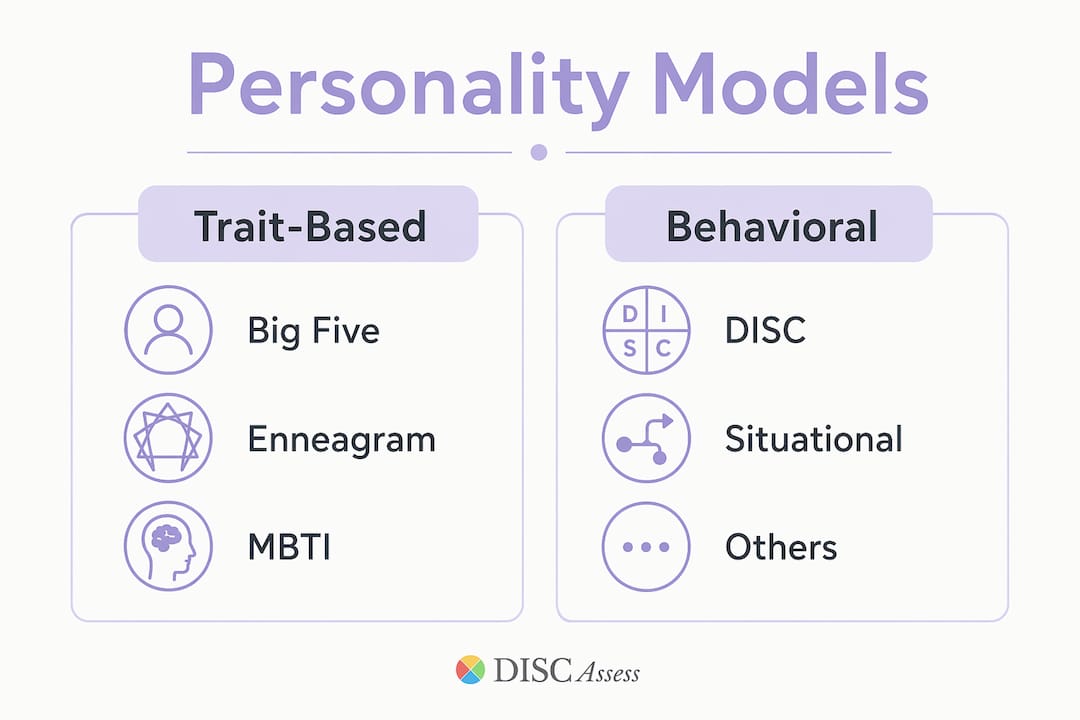
Several well-established frameworks give managers and HR professionals a structured way to analyze how personality traits interact at the team level. Each model offers a different lens, and knowing which one fits your context makes all the difference.
The Big Five (OCEAN)
The Big Five model, which measures Openness, Conscientiousness, Extraversion, Agreeableness, and Neuroticism, is the most extensively researched framework in organizational psychology. Studies show that conscientiousness and openness to experience are common antecedents of team personality and reliably predict both team job satisfaction and performance. Conscientiousness, in particular, follows what researchers call the "floor" effect: the least conscientious member often limits the whole team's output, which means targeted coaching for that individual can lift group performance.

DISC
DISC organizes personality into four behavioral styles: Dominance, Influence, Steadiness, and Compliance. Research supports using DISC to construct balanced, high-performing teams, where complementary types improve both communication and task completion. It's especially practical for managers who want a straightforward, actionable framework without a steep learning curve.
Myers-Briggs Type Indicator (MBTI)
The MBTI sorts people into 16 types based on four dichotomies: Introversion/Extraversion, Sensing/Intuition, Thinking/Feeling, and Judging/Perceiving. While its scientific reliability is debated in academic circles, it remains widely used in corporate team-building contexts because it gives people an accessible vocabulary for discussing their working styles.
Enneagram
The Enneagram describes nine core personality types, each with distinct motivations and fears. Research shows that certain types, particularly the loyalist (Type 6), significantly improve team performance through trustworthiness and a strong sense of responsibility. Teams that account for Enneagram composition tend to see reduced conflict and higher efficiency.
Similarity vs. complementarity
One of the more nuanced findings in this field is that the "right" kind of diversity depends on the trait. Similarity fosters cohesion in traits like agreeableness, while diversity in traits like extraversion tends to enhance creativity and problem-solving. The best team composition is task-dependent, not universal.
A critical insight from organizational psychology is that team personality is an emergent property: the collective behavior of a team cannot be predicted simply by averaging individual scores. Group-level interaction effects shape dynamics in ways that individual profiles alone won't reveal.
How to use personality insights when hiring and forming teams
Integrating personality compatibility into hiring and team formation is less about finding identical people and more about building a group whose traits balance and reinforce each other. Here is a practical sequence for doing that well.
-
Define the role's personality demands first. Before assessing candidates, identify which traits the position genuinely requires. A role demanding rapid decision-making under pressure calls for different trait profiles than one requiring sustained, detail-oriented analysis.
-
Use validated assessments early in the process. Introduce a structured personality assessment, such as DISC or the Big Five, during the screening phase. This gives you comparable data across candidates rather than relying on interview impressions alone.
-
Map candidates against your existing team profile. Knowing your current team's trait distribution helps you identify gaps. If your team skews heavily toward high Dominance, adding another high-D personality may amplify conflict rather than strengthen output.
-
Prioritize complementarity over similarity. Hiring for cultural "fit" often defaults to similarity, which can quietly reduce the range of perspectives your team brings to problems. Aim instead for trait balance, where different styles cover each other's blind spots.
-
Align personality profiles with organizational culture. Person-environment fit theory holds that the match between a team's personality and its organizational context shapes both satisfaction and performance. A highly autonomous culture, for example, tends to suit teams with higher openness and lower need for structure.
-
Avoid overweighting any single trait. The "too much of a good thing" effect applies here directly. A team of uniformly high-conscientiousness members may execute flawlessly but struggle to adapt when circumstances shift.
-
Use personality data to structure onboarding. Once a new hire joins, share relevant personality insights with the team. Understanding a new colleague's communication style from day one reduces the friction that typically accompanies the adjustment period.
-
Revisit team composition after major role changes. When a key member leaves or a team's mandate shifts, reassess the group's personality balance. What worked before may no longer fit the new context.
Personality-based hiring works best when it informs decisions rather than dictating them. It's one input among several, and it's most powerful when paired with skills assessment and cultural context. For a deeper look at how this plays out in practice, the role of personality in team building offers useful strategic framing.
How awareness and feedback improve ongoing team dynamics
Building a compatible team is not a one-time event. Personality dynamics shift as teams grow, lose members, take on new challenges, and move through different seasons of work. Ongoing awareness and structured feedback are what keep those dynamics healthy.
Organizational psychology treats personality as a dynamic variable, not a fixed label. That means leaders can actively use personality insights to adjust communication strategies, restructure workflows, and address friction before it becomes entrenched conflict. A few practical methods for doing this well:
- Periodic personality reviews: Schedule brief team discussions, perhaps quarterly, where members revisit their profiles and reflect on how their tendencies are showing up in current projects. A staff meeting personality review structured around DISC or Big Five data gives these conversations a clear framework.
- Feedback tied to trait awareness: When giving performance feedback, connect behavioral observations to personality tendencies rather than character judgments. "Your Steadiness style means you prefer time to process before responding, and that's valuable, but in fast-moving meetings it can read as hesitation" lands very differently than "you're too slow to speak up."
- Identifying personality faultlines: Recurring subgroup clashes often follow personality patterns. Recognizing these faultlines helps managers address systemic tension rather than treating each conflict as an isolated incident.
- Encouraging constructive disagreement: Teams with high average agreeableness risk groupthink, where the desire for harmony suppresses the critical debate that drives good decisions. Naming this risk openly and creating structured space for dissent, such as designated devil's advocate roles in meetings, counteracts it.
Pro Tip: When reviewing team personality data, look for the trait where your team scores most uniformly. That uniformity, whether it's high agreeableness or low openness, is often where your team's blind spot lives. Deliberately invite outside perspectives or rotate roles to compensate.
Personality assessments also improve in accuracy when the right tools are used. Forced-choice assessments reduce social desirability bias more effectively than Likert-scale formats, producing more trustworthy data for management decisions. That distinction matters most when you're using personality data to make consequential choices about team structure or leadership development.
Which assessment tools help you measure and improve team compatibility?
Technology has made personality assessment far more accessible and actionable for teams of all sizes. The right platform does more than generate individual reports; it helps you visualize group dynamics, track changes over time, and make informed decisions about team structure.
Key products from Discassess
DISC Group Package is designed for managers who need to assess an entire team efficiently. It includes an admin account with assessment credits, group management features, and detailed reports that show how individual DISC profiles combine at the team level. For leaders who want a clear picture of their team's collective personality without a complex setup, this is a practical starting point.
White Label DISC System suits coaches, consultants, and HR professionals who work with multiple organizations. It allows you to deliver branded DISC assessments under your own identity, with full administrative control over reporting and group management.
Individual Classic DISC Personality Assessment provides a single-user assessment with a full report, making it ideal for onboarding a new hire, coaching a team member, or giving an individual a clear framework for understanding their own communication style.
What to look for in any assessment platform
- Group-level reporting: Individual scores matter less than how they combine. Look for platforms that visualize team composition, not just individual profiles.
- Forced-choice question formats: These reduce the social desirability bias that inflates scores on Likert-scale tools, giving you more accurate data.
- Floor-based scoring for conscientiousness: Interpreting team personality scores using the weakest member's score, rather than the team average, predicts performance constraints more accurately.
- Ease of administration: Platforms that require minimal technical setup get used consistently; complex ones get abandoned.
- Integration with feedback processes: The best tools connect assessment data to ongoing coaching and development, not just a one-time report.
| Feature | Why it matters |
|---|---|
| Group-level personality reports | Reveals team composition patterns individual scores miss |
| Forced-choice question format | Reduces bias, improves data accuracy |
| Floor-based conscientiousness scoring | Identifies the team member most likely to limit group output |
| Admin portal with credit management | Simplifies bulk assessments for HR teams |
| Printable and shareable reports | Supports team discussions and coaching sessions |
For teams measuring the downstream impact of these assessments, resources on team building effectiveness offer useful frameworks for evaluating whether your investment in personality tools is translating into real performance gains.
How personality compatibility shapes collaboration and communication
The most immediate place personality compatibility shows up is in how people talk to each other, and how they don't. A team where one member processes information slowly and deliberately while another thinks out loud and moves fast will struggle in meetings unless both styles are understood and respected.
High-Dominance personalities tend to drive toward decisions quickly, which can feel dismissive to high-Steadiness colleagues who need time to consider implications. High-Influence types communicate with energy and enthusiasm, which can overwhelm more reserved, Compliance-oriented teammates who prefer precision over persuasion. These aren't character flaws on either side. They're predictable patterns that become friction when they're invisible and become strengths when they're named.
Personality compatibility also shapes how teams handle disagreement. Research on team-environment fit shows that when team members recognize their work and feel their personality fits their role, they work harder and report higher satisfaction, which in turn drives performance. That sense of fit is partly relational: people who feel understood by their teammates are more willing to raise concerns, admit mistakes, and engage in the kind of honest dialogue that moves work forward.
Communication breakdowns in teams are rarely about information. They're almost always about style. When you understand how personality assessments improve collaboration, you gain a practical tool for translating those style differences into shared understanding rather than recurring conflict.
Common personality models used in team dynamics
Most managers encounter several personality frameworks over the course of their careers, and it helps to know what each one is actually measuring and where it's most useful.
Big Five (OCEAN) is the gold standard in academic research. Its five dimensions, Openness, Conscientiousness, Extraversion, Agreeableness, and Neuroticism, have been validated across cultures and industries. For HR professionals making data-driven decisions about team composition, the Big Five offers the strongest predictive validity.
DISC is the most widely used framework in workplace settings, valued for its simplicity and direct applicability to communication and behavior. Because it focuses on observable tendencies rather than deep psychological constructs, it's easier for teams to discuss and apply without specialized training. Discassess is built around this model precisely because it translates so naturally into practical team conversations.
Myers-Briggs Type Indicator (MBTI) remains popular in corporate training contexts. Its 16 types give people a memorable framework for understanding their own preferences and those of their colleagues. While its predictive validity for job performance is more limited than the Big Five, its value as a communication tool and team-building catalyst is well established.
Enneagram adds a motivational layer that the other models don't fully capture. Understanding why someone behaves a certain way, not just how, opens up a different kind of team conversation. Its growing use in organizational settings reflects a broader recognition that effective teams need emotional intelligence, not just behavioral awareness.
No single model is universally superior. The right choice depends on your team's size, the depth of insight you need, and how much time you can invest in training and interpretation. For many small teams and nonprofits, DISC offers the best balance of accessibility and practical value. Exploring how nonprofits use DISC with volunteers illustrates how the model adapts across very different team contexts.
Discassess makes personality assessment practical for your team
Most personality assessment platforms are built for large enterprises with dedicated HR departments and significant budgets. Discassess takes a different approach, one that's worth considering if you're leading a small business, a nonprofit, or a team that needs real insight without a complex implementation.
Backed by Prism Counseling & Coaching with over a decade of experience, Discassess offers DISC assessments that are affordable, immediately usable, and designed for teams without extensive technical or HR backgrounds. The DISC Group Package gives you admin control, group reporting, and assessment credits in one straightforward purchase. The Individual Classic DISC Assessment works for onboarding, coaching, or simply helping a team member understand their own style. For coaches and consultants, the White Label DISC System lets you deliver branded assessments across multiple clients. Start with a single assessment or assess your whole team today at discassess.com.
Key Takeaways
Personality compatibility shapes team performance through job satisfaction, communication style, and trait balance, making it one of the most practical levers available to managers and HR professionals.
| Point | Details |
|---|---|
| Compatibility drives satisfaction and performance | Team job satisfaction mediates the link between personality fit and team performance, making it a key outcome to monitor. |
| Balance matters more than similarity | Complementary traits, not identical ones, tend to produce stronger teams; diversity in extraversion enhances creativity while similarity in agreeableness builds cohesion. |
| Extreme traits create risk | Even beneficial traits like agreeableness and conscientiousness disrupt teamwork at extreme levels; moderate, balanced profiles perform best. |
| Assessment accuracy depends on tool design | Forced-choice assessments reduce social desirability bias more effectively than Likert scales, producing more reliable team personality data. |
| Discassess for practical team assessment | Discassess offers affordable DISC Group Packages and individual assessments designed for small teams, nonprofits, and leaders without large HR budgets. |