
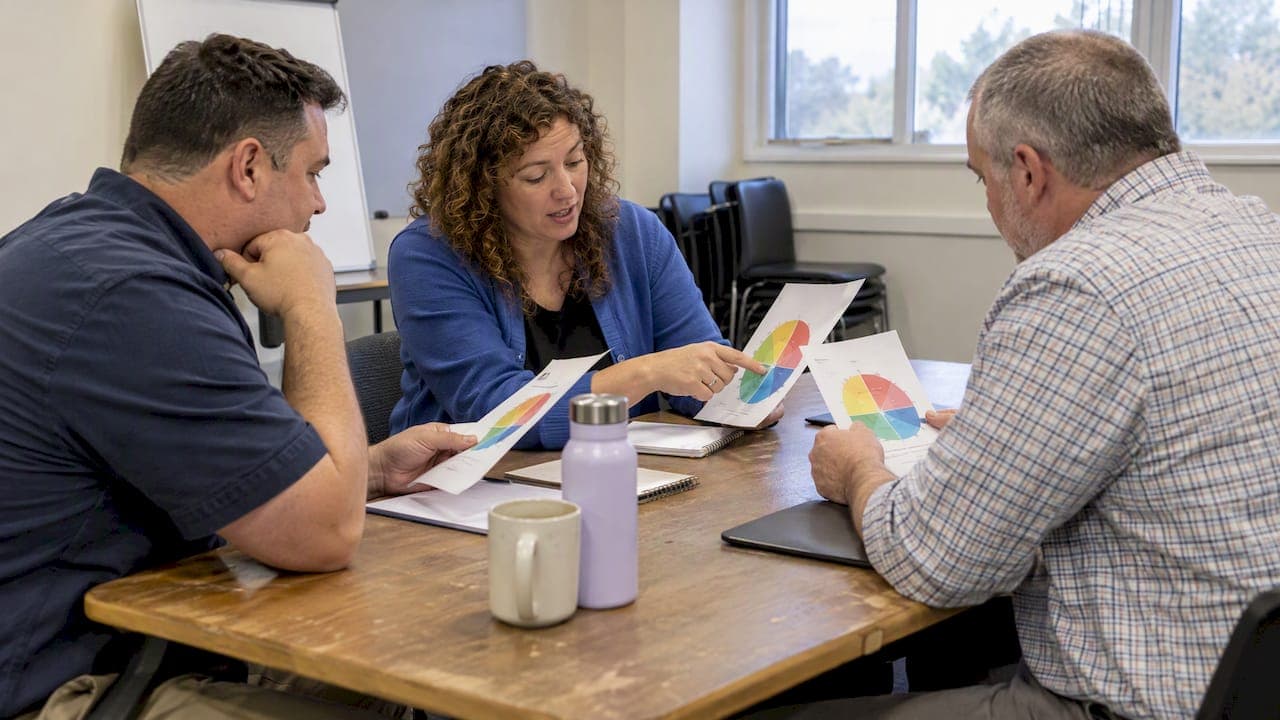
Start with a short DISC assessment, then run one focused activity tied to your team's biggest concern: communication, conflict, or collaboration. Send the assessment link to your group today, and schedule a 15 to 30 minute starter activity, such as the Style Spectrum Line-Up below. We offer DISC Assess as a low-friction way to begin right now.
TL;DR:
- Choose a hands on activity over a lecture: experiential teamwork training improves teamwork and performance, while purely didactic lectures tend not to help.
- Ask people to name their own DISC styles before discussing them, since self identification builds trust and prevents the framework from becoming a label.
- Use a 15 to 30 minute pilot for any group; reserve 90 minutes for 6 to 15 people, and use weekly sessions to build habits.
- Track satisfaction, on time decisions, and monthly unresolved conflict counts, then end each session with one action plan, a role agreement, and a small experiment.
Table of Contents
- Why does DISC help teams work together better?
- What do the DISC styles look like in a meeting?
- Which DISC team-building activities can you run tomorrow?
- How do you design a DISC workshop that runs smoothly?
- How do you measure whether DISC is working?
- What small teams get right when they adopt DISC
- Which DISC Assess packages fit your team?
- FAQ
- Sources
Why does DISC help teams work together better?
DISC gives a team a shared, neutral language. When a quiet colleague is "high C" and a fast-moving one is "high D," the disagreement becomes about working preferences, not character. That keeps conversations on the task and away from personal friction.
How you run the session matters as much as the assessment. A systematic review of teamwork training found that experiential and workshop-style methods produced positive effects on teamwork and performance, while purely didactic lectures tended not to help.
Interactive beats passive: Controlled teamwork interventions show positive effects, and interactive methods rank among the most effective.
How a team handles disagreement also predicts results. Research on conflict processes finds that collaborative approaches relate to better performance, while competing and avoiding relate to worse outcomes. DISC gives you a structure for the collaborative route.
What do the DISC styles look like in a meeting?
Think of each style as a tendency, not a label. Most people blend two or more. Use these cues to draw out every voice:
- D (Dominance): Direct and decisive, pushes for results and may cut discussion short. Cue: "Give us your bottom line first, then we'll hear the options."
- I (Influence): Energetic and people-focused, fills silence with ideas. Cue: "Share the big idea, then help us pin down the next step."
- S (Steadiness): Calm, loyal, and supportive, may hold back concerns to keep peace. Cue: "Take a moment and tell us what would make this change feel workable."
- C (Conscientiousness): Careful and analytical, wants data and time to check details. Cue: "Send the agenda ahead so you can prepare questions."
Pro Tip: Ask each person to name their own style before you name it for them. Self-identification builds trust, and it keeps the framework a tool for understanding, not a box.
Which DISC team-building activities can you run tomorrow?
Match the activity to your goal. Each one needs little prep and ends with two debrief questions.
- Style Spectrum Line-Up (self-awareness). Mark corners of the room for D, I, S, and C. Everyone stands where they think they fit, then explains why. Debrief: What surprised you? Which corner felt least like you?
- Message Rewrite (communication). Give pairs one blunt email. They rewrite it for a different style. Debrief: What changed in tone? Which version would you rather receive?
- Meeting Role Swap (communication, 30 minutes). Run a short agenda where each person speaks in the way their opposite style would. Debrief: What was hard? What did you learn about others' habits?
- Conflict Roleplay (conflict). Pairs act out a real but low-stakes disagreement with mismatched styles, then replay it using a collaborative approach. Debrief: What shifted? What phrase helped most?
- Shared Constraints Build (collaboration, 30 minutes). Teams complete a simple build or planning task, with each member assigned a role that suits a different style. Debrief: Who led, and was that the best fit?
- Strengths Gap Map (collaboration). Chart your team's styles on a whiteboard and name the missing perspective. Debrief: Where do we skip steps? Who can cover that gap?
For remote teams, use breakout rooms and a shared whiteboard in place of the room corners. Remote work is common, since many U.S. workers work remotely.
A simple session sequence:
- 15 minutes: introduce the four styles
- Style Spectrum Line-Up
- 30 minutes: one goal activity
- 15 minutes: debrief
- 10 minutes: commitments
How do you design a DISC workshop that runs smoothly?
Choose the format by group size and goal:
- Micro session (15 to 30 minutes): Any size, ideal for a pilot. See our 10 to 15 minute onboarding approach.
- Single 90-minute session: Best for 6 to 15 people.
- Extended session: Suits leadership teams who need deeper practice.
- Series: Short weekly sessions work well for teams that need habits to stick.
Prepare a simple materials checklist: completed assessments, one-page style cheat sheets, breakout prompts, and role cards. Assign three facilitator roles: a lead, a timekeeper, and a note-taker. Share materials ahead of time, use captions and readable fonts for remote sessions, and invite people to opt out of any roleplay. Accommodations matter, and a tool like Omniprism can help professionals think through neurodiversity-aware adjustments.
Pro Tip: Run your first session with a small pilot group, gather feedback, then widen the rollout. Our nonprofit board pilot checklist shows how.
How do you measure whether DISC is working?
Pick a few simple measures and track them over time:
- Team satisfaction: a one-question pulse, such as "I feel understood by my teammates."
- Meeting efficiency: whether decisions are made on time.
- Unresolved conflicts: a simple count each month.
- Cadence: a brief check-in each week.
Keep the research in view. Evidence on conflict management strategies shows that teams who handle style differences collaboratively turn task disagreements into better performance, while friction that turns personal harms satisfaction and commitment.
To keep momentum, close each session with one action plan, a short role agreement, and a short micro-experiment, such as "we will send agendas early." Our guide to conflict styles can help you read what the numbers show.

What small teams get right when they adopt DISC
We see the same pattern again and again. Small teams succeed when they start with a short pilot, hand out a one-page cheat sheet, and let the manager model the language first. The common pitfalls are loading people with too much content and skipping follow-up. The fix is simple: teach one idea at a time and book a check-in before the session ends. Teams that want more structure often do well with live facilitation, while self-guided groups need a clear calendar to stay on track.
— Tres
Which DISC Assess packages fit your team?
Our tools include DISC assessments and group management features. Our Starter Group Package suits a small team running its first pilot, while our Pro Group Package fits leaders who want fuller group management. If you train others, our White Label DISC System lets you deliver DISC under your own banner.

Picture a small nonprofit team: each person takes the assessment, and you run the Style Spectrum Line-Up in a staff meeting. Individual assessments start at $29, and you can see all our options and begin your pilot today.
FAQ
What does DISC training stand for?
DISC stands for Dominance, Influence, Steadiness, and Conscientiousness, the four behavior styles the model describes. DISC training teaches people to recognize these styles in themselves and others so they can communicate and work together more smoothly.
How do you build collaboration in a team?
Start by giving people a shared language for their differences, then practice together. Interactive, experiential training has the strongest evidence, so pair a short DISC assessment with a hands-on activity rather than a lecture.
How long should a DISC team session last?
It depends on your goal. A micro session of 15 to 30 minutes can introduce the styles, while a 90-minute session lets you add a goal-focused activity and a debrief.
Can DISC work for remote teams?
Yes. Use breakout rooms, a shared whiteboard, and sent-ahead cheat sheets in place of room-based activities. The same debrief questions work on video.
Sources
- The Effectiveness of Teamwork Training on Teamwork Behaviors and Team Performance: A Systematic Review and Meta-Analysis of Controlled Interventions
- Web
- Moving Beyond Relationship and Task Conflict:
- The Effectiveness of Teamwork Training on Teamwork Behaviors and Team Performance: A Systematic Review and Meta-Analysis of Controlled Interventions