
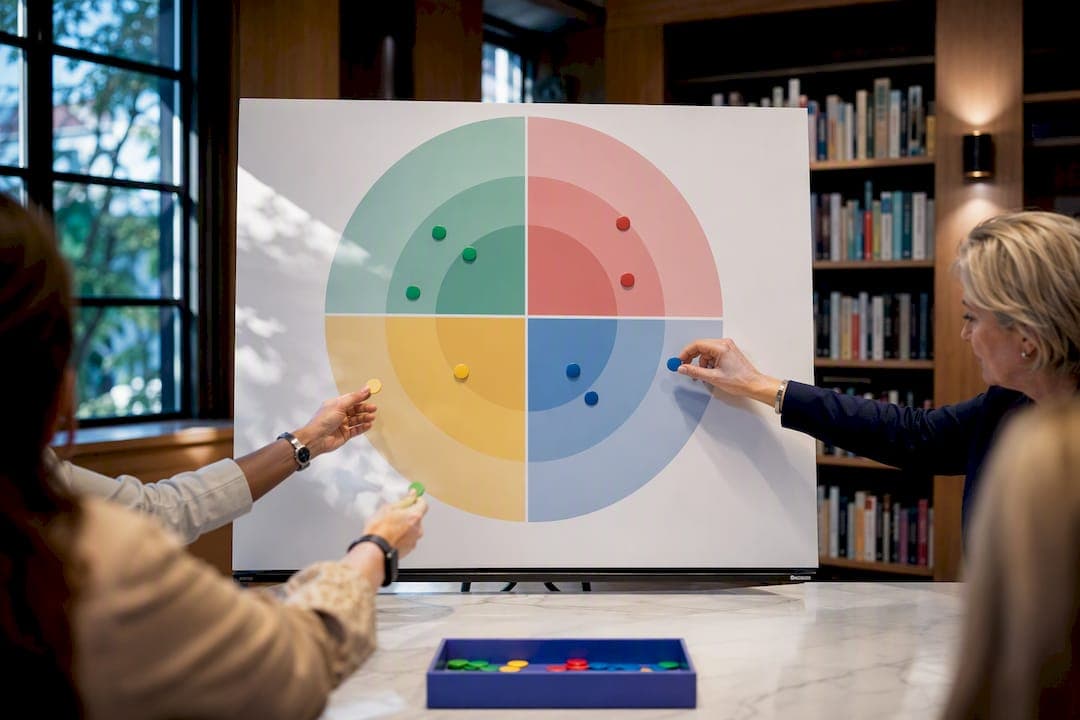
Start with a short DISC icebreaker like Bingo or Four Corners, run one or two applied exercises such as Role-play, Team Mapping, or QuikDISC cards, then close every session with a structured debrief tied to your team's DISC map. That last part is not optional. The activity you choose matters far less than whether it addresses a real gap you can already see on your team's map, which is why the selection rule comes before the activity list, not after it.
TL;DR:
- Conduct a DISC map first to identify team style gaps before selecting activities for targeted engagement.
- Use team mapping and pace-focused exercises for clusters at opposite ends of the style spectrum to promote growth and understanding.
- Repeated, brief activities over time prove more effective than single long sessions for lasting behavioral change.
- Virtual workshops should adapt activities to online tools, shortening sessions and focusing on clear, frequent debriefs.
- Focus on neutral, behavior-based language during debriefs to foster growth and reduce defensiveness within the team.
Table of Contents
- Disc Workshop Ideas That Match Real Team Gaps
- How to Pick the Right Activity from Your Team Map
- Facilitator Tips: Observation Cues and Debrief Scripts
- Materials, Timing, and Group-Size Cheat Sheet
- Running DiSC Workshops with Remote Teams
- What Actually Works for Small Teams: Notes from the Field
- Customizing DiSC Workshops by Industry and Role
- Reading DiSC Results Without Overreacting to a Label
- Combining DiSC with Other Team Development Tools
- Why Most DISC Workshops Underdeliver, and What to Do Instead
- Getting Workshop Materials Without the Prep Work
- Facilitator Kits Worth Bookmarking
- Sources
Disc Workshop Ideas That Match Real Team Gaps
Most facilitators pick an activity because it looks fun on a training site, then hope it lands. A better approach borrows from how experienced trainers build sessions: read the team's DISC map first, then choose the exercise that speaks directly to what the map reveals. A free facilitator kit from Seemypersonality organizes twelve activities this way, pairing each one to a specific map finding rather than a generic "team building" label.
This matters spiritually as much as practically. Scripture describes the body of Christ as many parts working together, each with a distinct function (1 Corinthians 12). A DISC map is simply a modern lens on that same truth: some people bring pace and decisiveness, others bring warmth and steadiness, others bring precision. A workshop that ignores those differences trains people to perform sameness. One built around the map trains people to become more Christlike in how they honor each other's design.
The activities below work whether you're leading a church staff, a small business team, or a nonprofit board. Choose based on your map, not your mood.
Seven ready-to-run activities
-
DISC Bingo. Objective: build quick style vocabulary before deeper work begins. Give each participant a bingo card with behavior descriptions instead of numbers ("finishes sentences for others," "asks for the data first"). Participants mingle for 10 minutes, finding coworkers who match each square. Group size: 6 to 30. Timebox: 15 minutes. Materials: printed bingo cards, pens. Debrief: "Which square was hardest to fill, and what does that tell us about who's in the room?"
-
Four Corners. Objective: a fast, physical self-sort that gets quiet people moving. Label four corners of the room D, i, S, and C. Ask participants to walk to the corner that feels most like them, then discuss in small clusters for five minutes. Group size: 8 to 40. Timebox: 10 minutes. Materials: four printed signs. Debrief: "What surprised you about who stood where?"
-
Team Mapping. Objective: create a shared, visual record of the whole team's styles. Plot every person's primary style on a printed or drawn DISC quadrant, using sticky dots or markers. Group size: 5 to 15 (best run live, not virtually, for the first pass). Timebox: 20 to 30 minutes. Materials: a poster of the DISC wheel, sticky dots, markers. Debrief: "Where are we clustered? Where are we empty?"
-
Role-play scenarios. Objective: rehearse a real workplace tension using assigned styles. Hand out short scenario cards (a missed deadline, a disagreement over process) and assign participants a style to play, even if it isn't their own. Group size: 4 to 12, in pairs or trios. Timebox: 20 minutes. Materials: scenario cards. Debrief: "What did the S-style character need that the D-style character skipped over?"
-
QuikDISC cards. Objective: low-pressure style-spotting practice. Deal cards printed with behavior clues; players guess the style before flipping the answer. Group size: 4 to 8 per table. Timebox: 15 minutes. Materials: QuikDISC card sets, as described in Success's activity roundup. Debrief: "Which clues tricked you, and why?"
-
Missing-style advocate. Objective: force attention onto a style your team lacks. If your map shows nobody landing in Conscientiousness, assign a volunteer to argue every decision from that style's perspective for the rest of the meeting. Group size: any. Timebox: ongoing for the session. Materials: none. Debrief: "What did we almost miss without this voice?"
-
Collaborative puzzle challenge. Objective: watch real behavior under mild pressure. Give small groups a short escape-room style puzzle or build challenge with a time limit. Group size: 4 to 6 per group. Timebox: 20 minutes. Materials: puzzle kit or printed challenge. Debrief: "Who set the pace? Who caught the details? Who kept the group calm?"
Pro Tip: Run Team Mapping before any other applied exercise. Every other activity gets sharper once the group can see, in one picture, where the gaps actually are.
How to Pick the Right Activity from Your Team Map
Sketch the map fast: draw a DISC quadrant on a whiteboard or use a printed poster of the DISC wheel, then have each person place a sticky dot where their primary style falls. Read the pattern before choosing anything else.
- No one lands in a quadrant → run the missing-style advocate activity so that perspective still gets heard.
- Styles cluster at opposite ends of the pace line (fast D/i versus steady S/C) → run a pacing exercise like the puzzle challenge and debrief how speed differences played out.
- Feedback conversations keep stalling → run a role-play scenario built around the exact friction point, not a generic conflict script.
A twelve-activity facilitator kit recommends one longer "first read" session, then short monthly follow-ups rather than a single marathon day.
Pro Tip: One well-chosen 15-minute activity, repeated monthly, changes behavior more reliably than a single all-day retreat that everyone forgets by Friday.
Facilitator Tips: Observation Cues and Debrief Scripts
Watch four things while an activity runs: pace (fast decisions or slow deliberation), directness (blunt statements or softened language), detail focus (big picture or fine print), and reaction to sudden change (energized or unsettled). These four cues map almost directly onto the DISC model itself: Dominance, Influence, Steadiness, and Conscientiousness.
A simple three-step debrief script keeps every activity anchored to real learning:
- What happened?
- What style cues did we notice?
- What's one specific change we'll try before our next meeting?
Tailor the questions by activity. For Bingo, ask which square was hardest to fill. For Role-play, ask what the assigned style needed that the scene skipped. For Team Mapping, ask where the team is clustered or empty. For QuikDISC, ask which clues were misleading and why.
- Describe behavior, not people, to keep defensiveness low: "the group moved fast on this decision" lands better than "you're too impulsive."
- Frame every result as neutral data about how someone operates, not a verdict on their character.
Facilitators using this exact language see fewer shutdowns, because nobody feels labeled. The MTa activity kit built around exercises like the Helium Stick uses this same neutral framing to surface planning gaps and conflict without anyone feeling exposed.
Materials, Timing, and Group-Size Cheat Sheet
Keep a simple checklist by activity so setup takes minutes, not an hour of hunting for supplies.
- Bingo: printed cards, pens.
- Four Corners: four signs, open floor space.
- Team Mapping: DISC wheel poster, sticky dots, markers.
- Role-play: printed scenario cards.
- QuikDISC: card decks, one per small table.
Three templates cover most needs. A 45-minute session fits one icebreaker plus one debrief. A 90-minute session fits Team Mapping plus one applied activity and a full debrief. A half-day session (three to four hours) fits a full map read, two applied activities, and a written action commitment from each participant.
For groups over 20, split into breakout tables of 5 to 6 for Team Mapping so every dot placement gets real discussion. For remote or physically limited participants, swap Four Corners for a hand-raise poll and Helium Stick for a shared drawing challenge.
Running DiSC Workshops with Remote Teams
A virtual DiSC workshop needs the same map-first logic, just translated to digital tools. Use a shared whiteboard tool like Jamboard or Miro for Team Mapping, letting each person drop a colored sticky note where their style lands instead of a physical dot. Zoom or Teams breakout rooms handle Role-play cleanly, especially with scenario cards shared as a screen or PDF ahead of time. Swap physical Bingo cards for a poll-based version using your video platform's native polling feature.
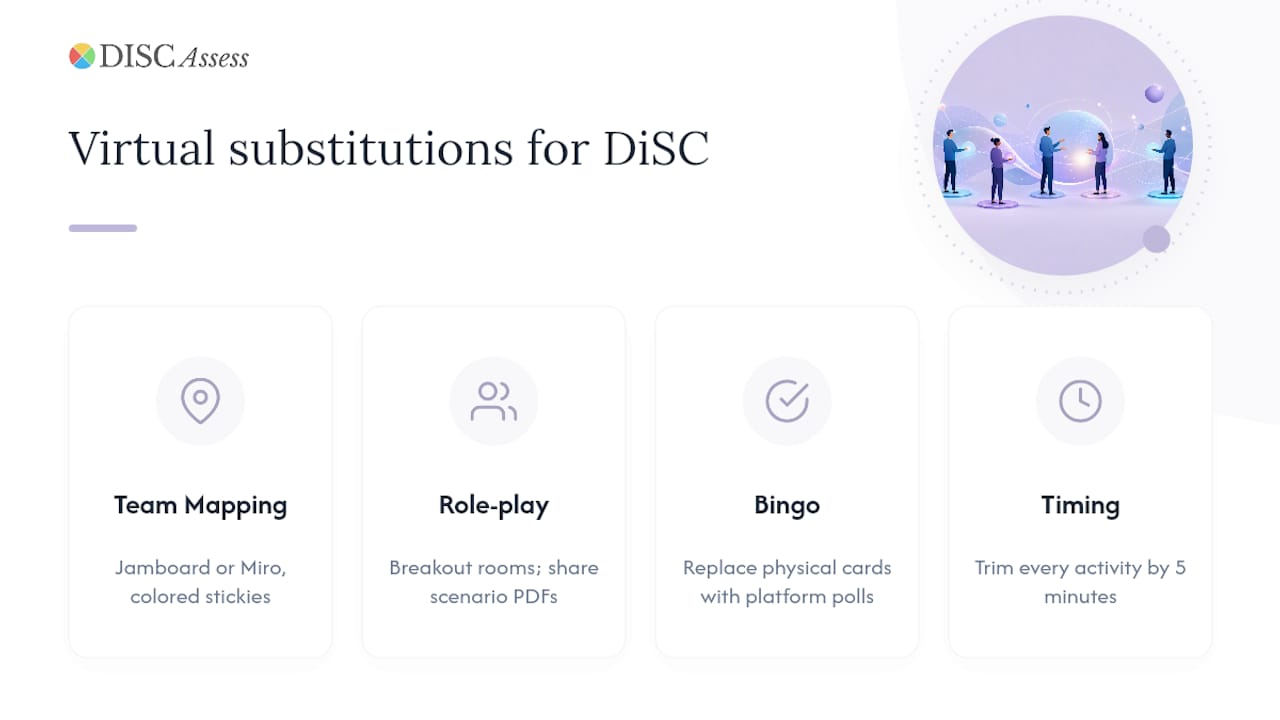
Trim every activity by 5 minutes for virtual delivery. Attention drops faster on screen, and debrief questions land better in shorter, more frequent bursts than in one long block.
What Actually Works for Small Teams: Notes from the Field
Small teams (5 to 15 people) get the most out of a single Team Mapping session paired with one applied activity, repeated quarterly. The most common mistake facilitators make is treating a DISC workshop as a one-time event rather than a recurring practice.
- Some DISC platforms provide instant group reports, printable team maps, and admin portals that keep past session results in one place for facilitators to reference.
.
Customizing DiSC Workshops by Industry and Role
A DISC workshop for a nonprofit board looks different from one for a retail management team, even though the underlying model stays the same. Nonprofits and volunteer-heavy organizations often benefit from shorter, lower-cost sessions that respect limited paid staff time. A guide on using DISC with volunteers recommends trimming activities down to 15 or 20 minutes and folding the debrief into an existing staff meeting rather than scheduling a separate event.
For leadership teams and managers, the emphasis shifts toward decision-making patterns and delegation. A manager's practical guide to DISC suggests running the Missing-Style Advocate activity specifically around budget or hiring decisions, since those are the moments where a missing Conscientiousness voice causes the most damage.
Front-line and customer-facing teams benefit most from Role-play scenarios pulled directly from real customer interactions rather than generic conflict scripts. Church staff and ministry teams often find the most value in pairing DISC language with existing language about spiritual gifts, since both frameworks describe how someone serves rather than whether they're serving well.
Whatever the setting, the customization decision is really just the map-first rule applied to context: read the room's actual constraints (time, budget, comfort with vulnerability), then pick from the same activity set rather than inventing a new one for every audience.
Reading DiSC Results Without Overreacting to a Label
A DISC style is a description of behavioral tendencies, not a fixed identity or a ceiling on someone's growth. Someone who scores high in Dominance isn't destined to stay blunt forever; someone high in Steadiness isn't incapable of speaking up. Results describe tendencies under normal conditions, which is why the debrief language matters so much: framing a result as "this is how you tend to operate" invites growth, while framing it as "this is who you are" invites defensiveness.
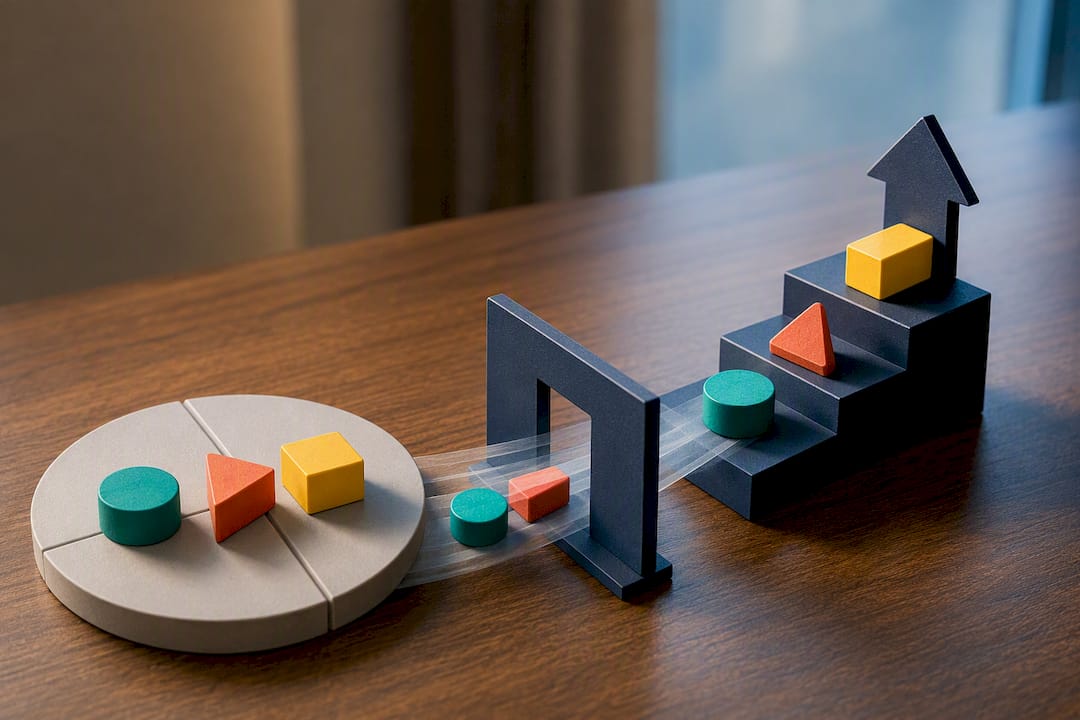
For individual development, the most useful next step is naming one specific behavior to practice, not a personality trait to overcome. A high-D leader might practice pausing three seconds before responding in a meeting. A high-S team member might practice stating a disagreement out loud once per meeting instead of waiting to be asked.
For team development, the map matters more than any single score. A team full of high-i communicators with no Conscientiousness representation will generate exciting ideas and miss deadlines, not because anyone is careless, but because nobody on the team naturally slows down to check the details. That's a team-level finding, not an individual flaw, and it should shape how tasks get assigned rather than how any one person gets evaluated.
Sanctification works the same way in a team context: growth happens through awareness plus practice, not through a report alone. The report just tells you where to aim the practice.
Combining DiSC with Other Team Development Tools
DISC works best as one layer in a broader team development approach, not a stand-alone diagnostic. Pairing it with a values or strengths assessment adds a second dimension: DISC explains how someone tends to communicate and make decisions, while a values-based tool explains why those behaviors matter to that person.
Conflict-specific frameworks pair especially well with DISC once a team has its map in hand. A conflict resolution conversation from Isi Brotherhood explores practical language for handling workplace friction, which slots naturally into the Role-play debrief once you know which styles are colliding.
For teams already using 360-degree feedback or performance review tools, DISC results give managers a vocabulary for delivering that feedback in language the recipient can actually hear. A high-D employee receiving feedback about being too blunt will respond better to specific behavioral examples than to a vague character critique, and DISC gives you the shared language to make that distinction clear.
The goal isn't to stack assessments for their own sake. It's to give the team enough shared vocabulary that a hard conversation about performance, pace, or conflict becomes a conversation about behavior patterns everyone already recognizes, rather than a surprise.
Why Most DISC Workshops Underdeliver, and What to Do Instead
Most DISC workshops fail not because the model is wrong, but because facilitators treat the activities as the point instead of the map. A fun exercise with no debrief teaches nothing lasting. A single all-day retreat, however well run, fades within a month if it isn't followed by anything.
The conventional advice, "run a fun team-building day once a year," gets the sequencing backward. The evidence from experienced facilitator kits points the other way: read the map first, choose one or two activities that speak directly to what the map shows, debrief with specific behavior language, then repeat something small every quarter. That rhythm builds durable change. A single big event builds a nice memory.
If you lead a small team and only have time to do one thing well, do Team Mapping and commit to reading it again in three months. Everything else on this list is a supporting activity, not the main event. And when a result surfaces something uncomfortable, whether it's a missing style or a pace mismatch, treat it the way Scripture treats a body with many parts: not a defect to fix, but a design to steward well.
— Tres
Getting Workshop Materials Without the Prep Work
Building a DISC workshop from scratch means designing scenario cards, printing a wheel diagram, and tracking who's taken the assessment, all before the session even starts. Some DISC providers offer group packages built to simplify setup for sessions like these.
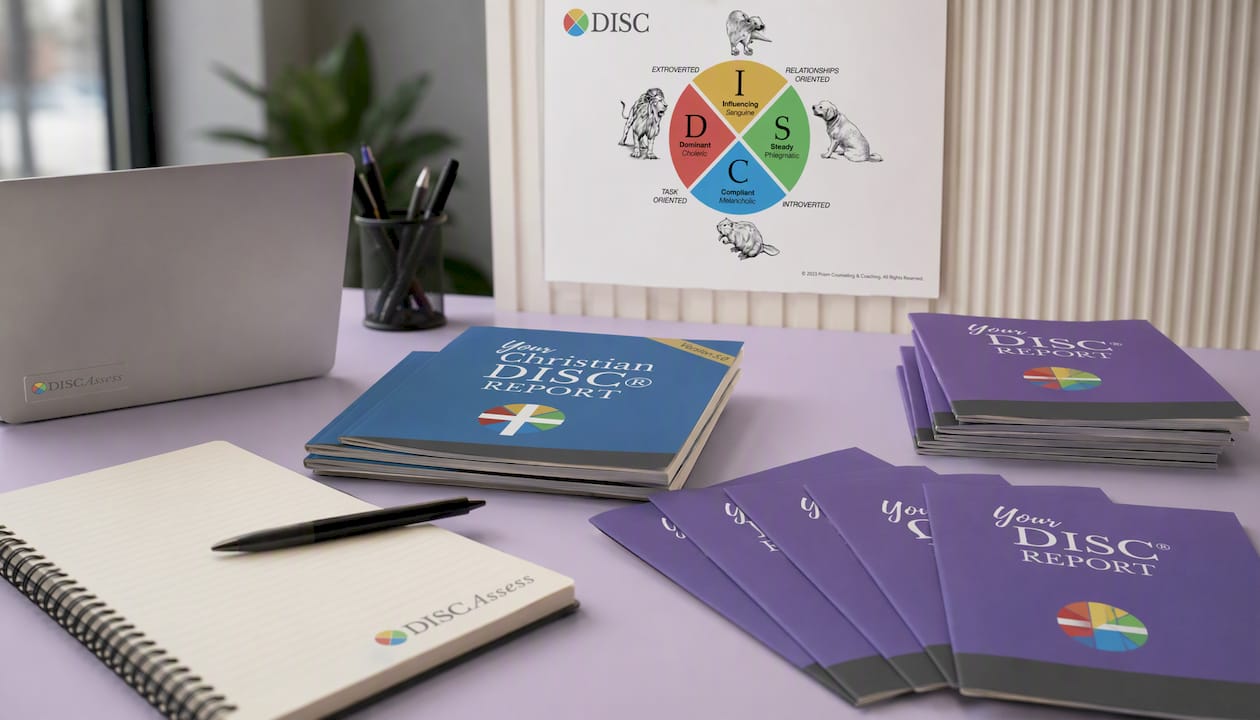
The Starter Group Package gives smaller teams instant assessments plus a shared results view, ready before your next meeting. The Pro Group Package adds deeper reporting and admin tools for leadership teams running sessions across multiple groups or departments. For the Team Mapping activity itself, the physical poster of the DISC wheel gives you a durable, reusable visual instead of a hand-drawn quadrant that gets erased after one use.
Facilitators choosing group packages can save time normally spent building materials from scratch, and may access printable resources plus admin portals that keep team maps on file for future check-ins. Browse the group package options to find the fit for your team's size and start your next session with the map already built.
Facilitator Kits Worth Bookmarking
For deeper scripts beyond this list, the MTa activity kit covers Helium Stick and Back-to-Basics exercises in detail. Seemypersonality's twelve-activity facilitator kit offers a free, map-keyed activity set. Success's DISC activity roundup documents Bingo, Role-play, and QuikDISC with step-by-step instructions.
Sources
- MTa + DISC: Effective Workshop Ideas & Activities
- 12 DISC Team Building Activities (Free Facilitator Kit)
- DISC activities for team building — Success