

An effective opening question is short, inclusive, connected to the meeting's real purpose, and built so no one can answer it with a flat "yes" or "no." That's the whole definition. What separates a question that lands from one that gets a room full of blank stares comes down to format. Three formats work almost every time: an image-building prompt ("Imagine your ideal Monday. What's happening in it?"), a would-you-rather choice that forces a quick pick between two concrete options, and a concise open-ended check-in ("What's got your attention this week?"). Effective openers stay inclusive, concise, and tied to the meeting's aim rather than testing knowledge or making anyone feel exposed.
Try this in your next meeting:
- Pick one format above based on your group's size and familiarity level.
- Answer it yourself first, out loud, before asking anyone else.
- Wait 15 to 30 seconds after asking. Don't jump in to rephrase or fill the silence.
Key Takeaways
An opening question works when it's concise, inclusive, tied to the meeting's purpose, and paired with real silence for people to respond.
| Point | Details |
|---|---|
| Answer first | Leaders who respond before anyone else set the tone and lower the pressure on the group. |
| Use image-building formats | Prompts that create a vivid scene get faster, richer answers than abstract questions. |
| Wait 15 to 30 seconds | Give real processing time instead of rephrasing the question immediately. |
| Match format to group size | Would-you-rather and preference prompts work best for larger or newer groups. |
| Know your team's wiring | Discassess assessments and group reports help leaders pick prompts suited to how each person actually communicates. |
Table of Contents
- Five Facilitation Tips That Turn a Question Into a Discussion
- What Categories of Opening Questions Should You Keep on Hand?
- Copy-Ready Opening Questions by Setting
- How Do You Choose the Right Opening Question?
- How DISC Assess Turns Good Questions Into Better Meetings
- Start Building Your Own Question Bank With DISC Assess
- Frequently Asked Questions
- Sources
Five Facilitation Tips That Turn a Question Into a Discussion
The question itself matters less than how you deliver it. A well-written prompt still falls flat if the facilitator rushes it, and a simple one can spark real conversation if handled with a little skill. Here are five habits worth building into your routine.
- Answer first. When you model vulnerability by responding before anyone else, you set the tone for honesty and take the pressure off the first volunteer.
- Favor image-building prompts. Questions that ask someone to picture a scene ("Think about the last time you felt proud of this team...") pull faster, richer answers than abstract ones, because image-building formats create a vivid scenario people can answer from immediately.
- Give it real silence. Fifteen to thirty seconds of quiet after you ask gives people processing time, especially those who think before they speak. Rewording the question too soon usually just resets everyone's confusion.
- Use structured choices for bigger or newer groups. Preference prompts and would-you-rather formats lower the mental load of inventing an answer from scratch, which matters most when people don't know each other yet.
- Have a follow-up ready. A good opener can die on the vine without a bridge question. Decide in advance whether you'll ask "why" or "what would that look like here" if the first answer is thin.
Pro Tip: If a question falls flat and you're met with silence past 30 seconds, don't repeat it louder. Switch formats entirely, try a quick poll or a 30-second pair-share instead. Facilitators who change format rather than reword tend to recover momentum faster.
What Categories of Opening Questions Should You Keep on Hand?
Having one good question memorized isn't enough. Every meeting, every group size, and every mood in the room calls for something different. Building a small mental library organized by purpose means you're never scrambling five minutes before a call starts.
Questions for team check-ins
These work when the goal is surfacing what's actually going on beneath the surface. They tend to run a little deeper than pure icebreakers because the group already has some trust built.
- "What's one thing that's been weighing on you this week?"
- "What's a win, big or small, you haven't mentioned yet?"
- "If you could get one thing off your plate today, what would it be?"
- "What's something you're grateful for right now, work or otherwise?"
Rapport-building icebreakers
Use these with newer groups or when the goal is simply warming the room before diving into agenda items. Nobody feels exposed answering a food or travel question, which is exactly the point.
- "What's a meal you could eat every week and never get tired of?"
- "What's the best trip you've ever taken, and what made it memorable?"
- "What song instantly puts you in a good mood?"
- "What's a hobby you wish you had more time for?"
Curated lists organized around a specific purpose, whether team-focused, funny, or reflective, remain one of the most practical formats facilitators reach for because they cut decision time to almost nothing.
Would-you-rather and preference prompts
These are the fastest way to get full participation from a group, including the quiet members who dread open-ended questions. Would-you-rather formats reduce cognitive load by handing respondents two concrete choices instead of a blank page, which is why they tend to move fast even in groups of fifteen or more.
- "Would you rather have unlimited vacation days or a permanent four-day workweek?"
- "Would you rather every meeting start 10 minutes late or end 10 minutes early?"
- "Would you rather work from a beach with spotty WiFi or a quiet office with perfect WiFi?"
Structured either-or prompts also help quieter team members, since they only have to pick a side rather than invent both the content and the framing of an answer from scratch.
Thought-provoking prompts to prime deeper thinking
Save these for meetings where you actually want debate or creative friction, not just warmth. A prompt that's a little unexpected does more work than a comfortable one. Questions that challenge an intuitive assumption tend to generate sharper engagement than generic small talk, as long as they never tip into something manipulative or leading.
- "What's a belief you've changed your mind about in the last year?"
- "If our team had to solve one problem publicly, which one would build the most trust?"
- "What's something everyone on this team assumes, but nobody's said out loud?"
Virtual and remote-friendly prompts
Video calls kill some of the spontaneity that makes in-person openers work, so these need to be built for chat boxes and quick round-robins rather than free-flowing conversation.
- "Drop one emoji in the chat that describes your week."
- "Type your answer, don't say it out loud: coffee or tea?"
- "In one sentence, what's on your mind right now?"
Pair-and-recall works particularly well on video, where you send people into breakout rooms of two, have them trade answers, and then ask each person to recall their partner's response to the group. That kind of structured exchange increases both listening and retention compared to a straight open-mic round, and it doubles as a light accountability check that everyone was actually paying attention.
Copy-Ready Opening Questions by Setting
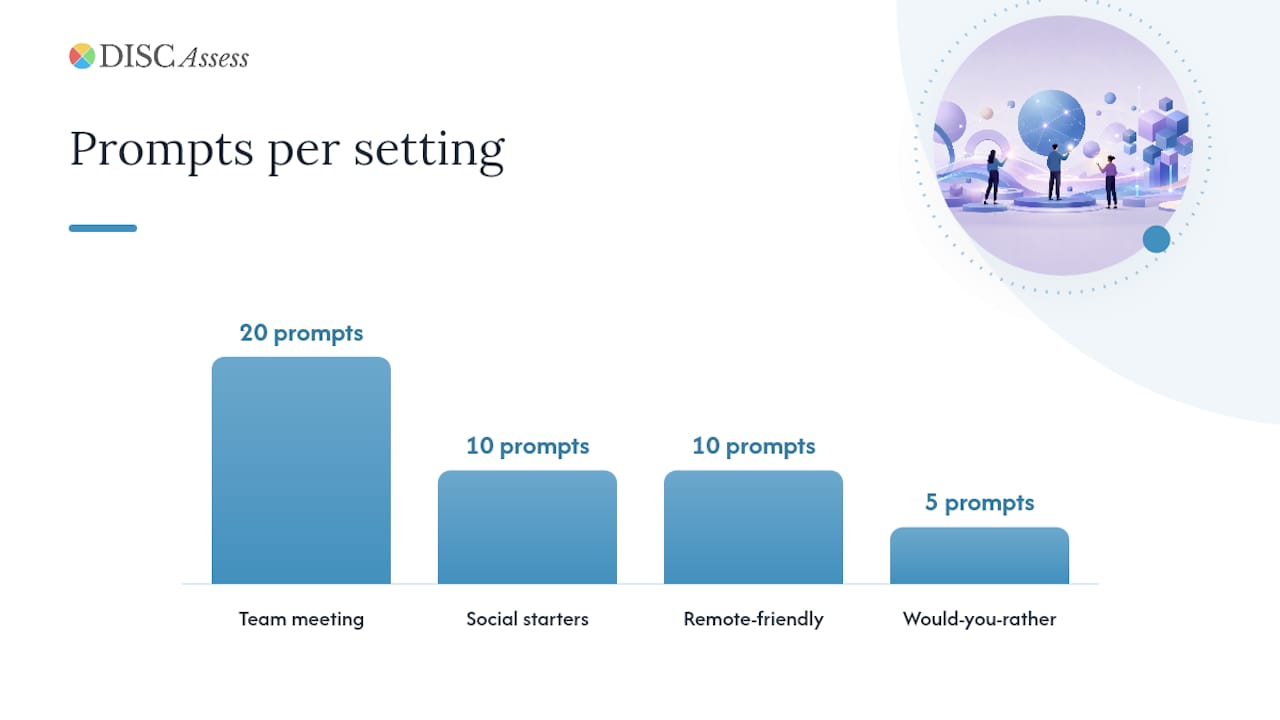
Sometimes you just need the list, not the theory. Here are ready-to-use prompts grouped by where you're actually using them.
Team meeting check-ins and issue-mining (pick any five):
- What's the one thing you need from this team today?
- What's been the biggest bottleneck this week?
- What's a small win worth celebrating before we dive in?
- What's something you learned recently that changed how you work?
- On a scale of one to ten, how's your energy today, and why?
- What's one thing that would make this meeting a success for you?
- What's a decision you're stuck on that we could help unstick?
- What's something you're proud of that nobody's asked about yet?
- What's the most useful thing someone told you this week?
- If this meeting solved one problem, what should it be?
- What's something on your plate that's competing for attention right now?
- What's a recent customer or client moment worth sharing?
- What's one thing you'd change about how we run these meetings?
- What's a risk we're not talking about enough?
- What's something you need clarity on before you leave today?
- What's the best idea you've heard this month that hasn't gone anywhere?
- What's one thing you're looking forward to this week?
- Who on this team deserves a shoutout right now?
- What's a mistake you made recently that taught you something?
- What's the one metric you're watching most closely right now?
Social conversation starters for small groups:
- What's a skill you have that most people wouldn't guess?
- What's the last thing that made you laugh out loud?
- What's a place you've never been but really want to visit?
- What's your go-to comfort food?
- What's a show or book you've recommended to everyone lately?
- What's something you collected as a kid?
- What's the best piece of advice you've ever ignored?
- What's a small ritual that starts your day off right?
- What's a talent you gave up on and sometimes miss?
- What's the most spontaneous thing you've ever done?
Remote-friendly prompts for chat and quick rounds:
- Type one word describing your current mood.
- Coffee, tea, or neither, answer in the chat.
- What's the view from your window right now?
- One-word answer: what's your energy level today?
- Drop a GIF that matches how this week is going.
- What's the last thing you Googled?
- Morning person or night owl?
- What app do you check first every morning?
- What's playing in your headphones lately?
- If today had a theme song, what would it be?
Would-you-rather and light, funny prompts:
- Would you rather answer every email in rhyme or lose autocorrect forever?
- Would you rather have a two-hour lunch or a two-hour earlier Friday?
- Would you rather present without slides or attend a meeting with no agenda?
- What's the most useless talent you're proud of?
- If your job had a mascot, what animal would it be?
How Do You Choose the Right Opening Question?
Not every question fits every room. Run through a short mental checklist before you pick one, and you'll avoid the awkward pause that comes from misjudging the moment.
- Read the safety level. A new or mixed-seniority group needs lighter, more structured prompts. A tight-knit team that trusts each other can handle something more personal.
- Decide your goal. Are you taking a quick pulse, or trying to spark actual discussion? A pulse check needs a fast, low-effort question. A discussion starter needs something with more texture.
- Match structure to group size. Larger or newer groups do better with would-you-rather or preference formats, since structured either-or choices lower the burden of inventing both content and framing.
- Plan the bridge. Decide upfront whether the opener needs to connect directly into today's agenda or if it's just meant to warm the room before you pivot.
- Skip anything manipulative or loaded. A question designed to steer people toward a predetermined answer erodes trust fast, even if it feels clever on paper.
Sharp opening questions frame the entire discussion that follows, and one linked clearly to the session's real objective tends to prime the group's thinking in the right direction before the agenda even starts.
How DISC Assess Turns Good Questions Into Better Meetings
Picking a great opening question gets you halfway there. The other half is understanding why certain people answer certain prompts the way they do, and that's where personality insight changes the game. A DISC-driven team already knows who needs a structured either-or prompt and who thrives on an open, reflective one, because DISC-based staff development tools map communication tendencies before you ever walk into the room.
Discassess supports this with tools built for exactly this kind of facilitation work:
- DISC Group Package (Admin Account + Assessment Credits) for teams running assessments and check-ins together.
- Custom Group Report + Video Analysis for leaders who want a facilitator to walk through group tendencies and suggest talking points.
- White Label DISC System for coaches building their own branded question and assessment experience for clients.
- Individual Classic DISC Personality Assessment (Online) and Report and Individual Christian DISC® Spiritual Personality Assessment (Online) and Report for one-on-one prep before a group session.
A team that understands its own communication wiring doesn't need to guess which opening question will land. The right prompt becomes obvious once you know whether you're facing a room full of Ds who want brevity or Ss who need warmth first.
Group workshop facilitation built on DISC insight turns a one-off icebreaker into a repeatable habit your whole team can rely on.
One meeting an opening question actually saved
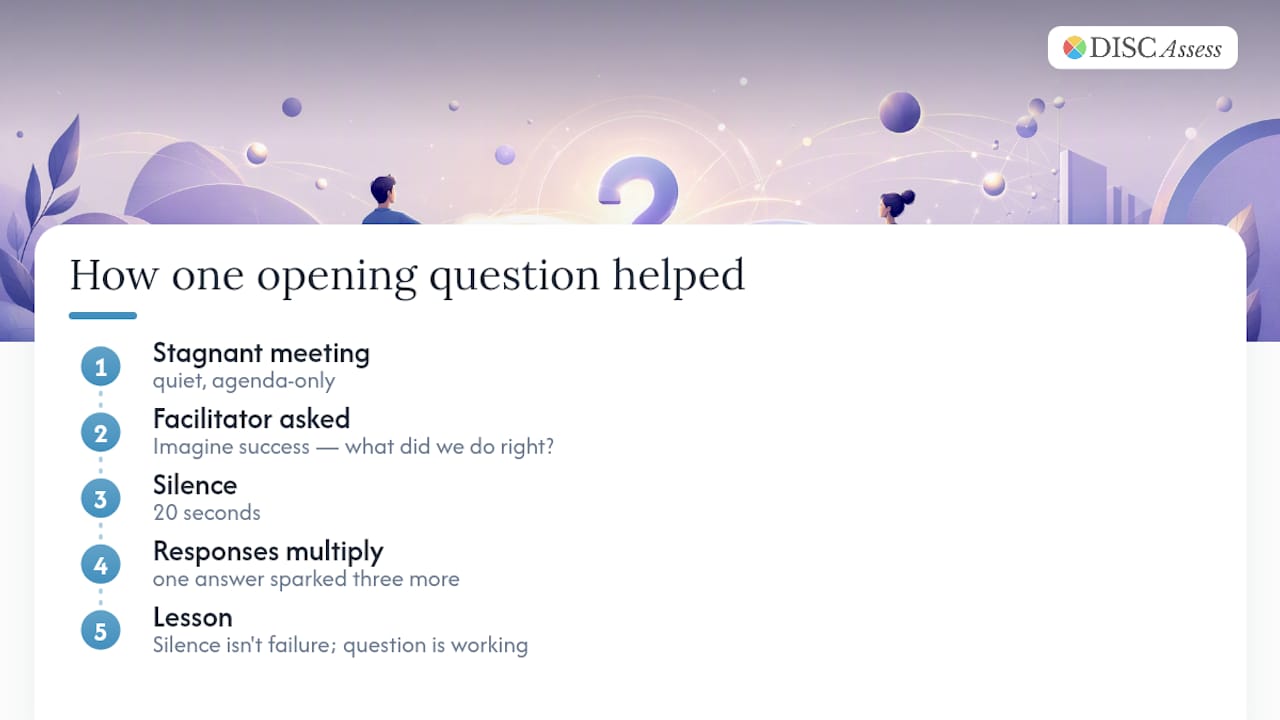
A staff meeting I sat in on had gone flat for weeks, quiet, agenda-only, nobody volunteering anything. The facilitator opened with, "Imagine this project succeeded beyond every expectation. What did we do right?" Silence for twenty seconds, then one answer sparked three more. The tip that stuck with me: silence isn't failure, it's the question doing its work.
Start Building Your Own Question Bank With DISC Assess
Reading a list of prompts helps for one meeting. Knowing which prompt fits which person on your team helps for every meeting after that. That's the real gap between a generic icebreaker list and a facilitation approach built on actual insight into how your group communicates, processes, and responds.
Discassess gives small teams and nonprofits a way to close that gap without hiring a consultant or sitting through a certification course. A quick DISC Personality Assessment (Online) and Report tells you who in the room needs a structured prompt and who's ready for something reflective. Groups running recurring check-ins often start with the Starter Group Package, which bundles assessments for a whole team at once. If you're leading trainings or church groups specifically, the Individual Christian DISC® Spiritual Personality Assessment (Online) and Report pairs personality insight with a faith-based framework. Ready to try it with your own team? Start with the DISC Group Package and bring your next opening question with real intel behind it.
Frequently Asked Questions
What is a good opening question?
A good opening question is short, inclusive, and connected to the meeting's real purpose. It avoids yes-or-no phrasing and gives the group something concrete to respond to, whether that's an image to picture or a choice between two options.
What are some examples of first question examples for a team meeting?
Try "What's one thing that would make this meeting a success for you?" or "What's a win worth celebrating before we dive in?" Both invite a real answer without asking for anything too personal.
What's a simple list of open questions to keep on hand?
Keep a short mix ready: one check-in question, one would-you-rather, and one lighter icebreaker. That covers most situations, whether the room needs warming up or already trusts each other enough to go deeper.
How is an icebreaker question different from a discussion opener?
An icebreaker question is built to build rapport and lower tension, usually with a light, low-stakes topic. A discussion opener is built to prime thinking toward the meeting's actual objective, often using a sharper or more unexpected angle to spark real engagement.
Sources
- Question Opener — Changing Minds
- The perfect opening question — Harvard Business School Publishing (Inspiring Minds)
- Master the secret of the starting question — LeadStrat
- Opening Questions — Thiagi Group
- 100 icebreaker questions to get the conversation started — MURAL