

Behavioral profiles reduce micromanagement by replacing a manager's subjective anxiety with objective data about each team member's working style, decision-making pace, and need for structure. That shift makes it rational, not risky, to extend autonomy. Here are three things you can do this week:
- Run one quick assessment. Invite each team member to complete an individual DISC assessment_with_Report.html) before your next one-on-one.
- Set a single check-in cadence. Based on what you learn, agree on one recurring touchpoint per person rather than ad-hoc check-ins.
- Delegate one outcome fully. Choose a low-stakes deliverable, define the outcome and deadline, and step back completely.
The practical rollout and measurement plan below will show you exactly how to build on those three steps.
Table of Contents
- Why do managers micromanage in the first place?
- How behavioral profiles actually reduce micromanagement
- What does a practical rollout look like for a small team?
- How does Discassess fit this workflow for small teams?
- How do you measure success and avoid common pitfalls?
- Key Takeaways
- The anxiety trap most managers never name
- A practical next step for your small team
- Useful sources and further reading
Why do managers micromanage in the first place?
Close management and micromanagement are not the same thing. Close management means clear expectations, defined outcomes, and regular check-ins. Micromanagement means dictating how the work gets done and hovering until it does. The line between them is thinner than most managers want to admit.
Three psychological drivers push good managers across that line. First, anxiety about outcomes turns into a control reflex: the manager believes staying close is what keeps things from falling apart. Second, an identity gap forms when a leader's sense of worth is tied to being the person who catches every mistake. Delegation then feels like a threat to relevance, not a sign of trust. Third, poor system design leaves everyone guessing about who decides what, so the manager fills the vacuum by deciding everything.
Behavioral profiles interrupt all three drivers. When you can see, in a structured report, that a team member prefers autonomy, processes information methodically, and escalates only when genuinely stuck, the anxiety loses its grip. The profile turns a subjective fear into an objective signal.
Pro Tip: Before your next team meeting, write down one decision you made this week that a team member could have made without you. Ask yourself honestly: what would have had to be true for you to let them make it? That gap is your identity work.
How behavioral profiles actually reduce micromanagement

The mechanism is straightforward: profiles give you a reliable map of each person's behavioral tendencies, so you can calibrate your management approach to their actual needs rather than your worst-case assumptions.
Five concrete changes follow from that map:
- Objective signal. A DISC-style assessment replaces "I'm not sure I can trust this person" with a documented behavioral pattern. That documentation is what makes trust a rational choice rather than a leap of faith.
- Calibrated decision rights. Once you know a team member's risk tolerance and need for structure, you can assign decision authority that matches their profile rather than defaulting to "run everything by me."
- Reporting cadence matched to preference. A high-C (conscientious) team member may want a structured weekly update; a high-D (dominant) team member may prefer a brief bi-weekly check-in focused on outcomes only. Matching cadence to preference reduces ad-hoc monitoring without sacrificing visibility.
- Clearer escalation triggers. Profiles reveal when someone is likely to get stuck and go quiet rather than ask for help. You can build a simple escalation rule into their workflow: "If you're blocked for more than two hours, flag it." That rule replaces hovering.
- Outcome focus over process enforcement. Profiles make it easier to separate standards from preferences. The standard is the deliverable quality; the preference is how they get there.
Mini-example: A high-S (steady) team member on your customer service team values consistency and dislikes sudden changes. You agree on a Monday morning 15-minute check-in focused on the week's priorities, give her full authority over routine client responses, and set one escalation trigger: any complaint above a defined severity level comes to you. That single structure replaces five or six unplanned interruptions per week.
What does a practical rollout look like for a small team?
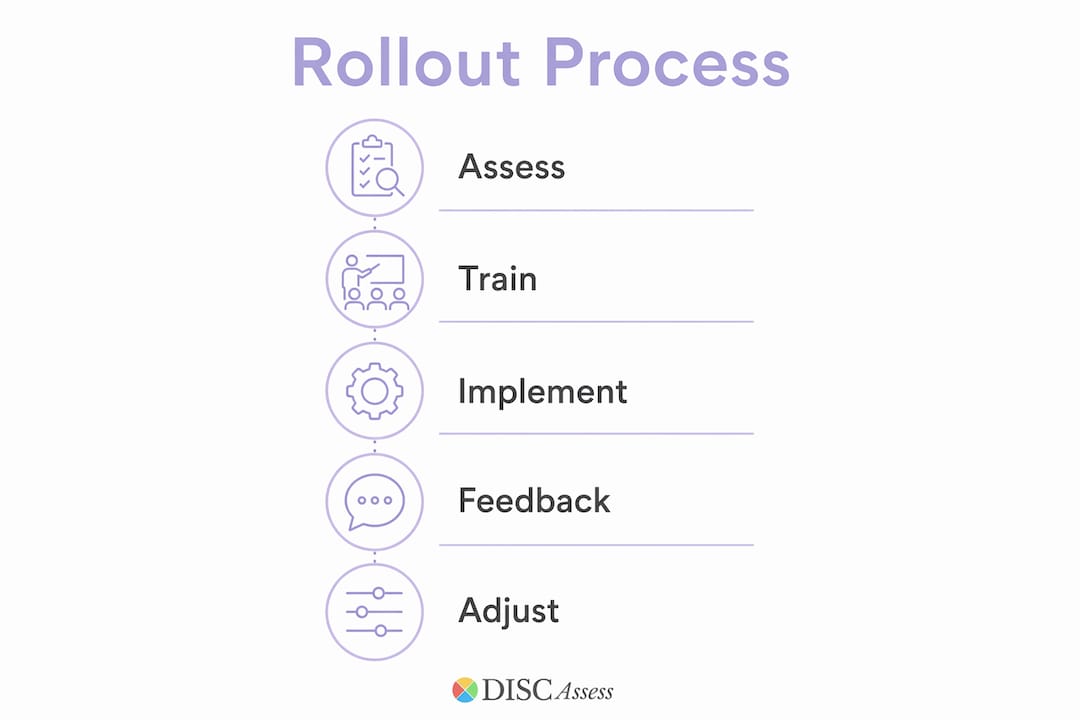
You do not need an HR department or a consultant to run this. The rollout fits inside eight weeks and requires nothing more than the assessments, a shared document, and honest one-on-ones.
-
Week 0–1: Run assessments. Invite each team member individually. Frame it simply: "I want to understand how each of us works best so I can support you better." Use the team assessment workflow to send invitations and collect reports through an admin portal. Before the debrief, write down your assumptions about each person's working style. After, compare your assumptions to the report. The gaps are where your micromanagement risk is highest.
-
Weeks 2–4: Map profiles to decision rights. For each team member, create a simple decision-rights note: decisions they own fully, decisions they make and inform you of, and decisions that require your sign-off. Set a recurring check-in cadence based on their profile. A high-I (influential) team member may thrive with a brief weekly conversation; a high-C may prefer written updates with a monthly face-to-face.
-
Weeks 5–8: Practice coached delegation. Assign one meaningful outcome per person using this language: "The outcome I need is [X]. The deadline is [Y]. The constraints are [Z]. How you get there is yours." Collect feedback at week 6 and adjust cadences where needed.
| Phase | Weeks | Primary Action | Expected Outcome |
|---|---|---|---|
| Assess | 0–1 | Run individual DISC assessments | Baseline behavioral map per person |
| Map | 2–4 | Assign decision rights, set cadences | Fewer ad-hoc check-ins |
| Delegate | 5–8 | Coached delegation with outcome language | Increased autonomous decisions |
When resistance comes up, it usually sounds like "this feels like a personality test that boxes people in." Address it directly: profiles describe tendencies, not ceilings. They are a starting point for conversation, not a verdict. Keep all reports confidential between you and each team member unless they choose to share.
Pro Tip: If a team member is skeptical, invite them to read their own report first and tell you what resonates. Letting them lead that conversation builds trust faster than any explanation you can give.
How does Discassess fit this workflow for small teams?
Discassess, backed by Prism Counseling & Coaching with over a decade of experience, is built specifically for small teams that want practical results without heavy infrastructure. The platform's reports surface exactly the data points this rollout requires: preferred working pace, need for structure, communication style, and escalation sensitivity.
Three product options map directly to team size:
- Individual Classic DISC Assessment: Best for teams of 1–5, or for managers who want to start with themselves before rolling out to the team. The classic DISC assessment delivers an instant report with actionable behavioral data.
- DISC Group Package: Designed for teams of 6–15. The group package includes an admin account and assessment credits, so you can manage invitations, track completion, and compare profiles across the team from one portal.
- Admin Account / Demo Portal: For teams of 15 or more, or for managers who want to run ongoing assessments, the admin demo portal provides group management features and the option to add live group training.
In a one-on-one, cite the report's "preferred communication style" and "pace" sections when setting the check-in cadence. In your team cadence document, use the "decision-making" and "need for structure" sections to assign decision rights. The live group training option is worth adding at the week-4 mark if the team needs a facilitated debrief to make the profile data feel real and shared.
How do you measure success and avoid common pitfalls?
The primary metric is simple: count how many times per week you intervene in a task that was delegated. That number should drop. Supporting metrics give you a fuller picture.
| Metric | Baseline (Week 0) | 4-Week Target | 8-Week Target |
|---|---|---|---|
| Manager interventions per week | Count and record | Aim to reduce over time | Aim for significant reduction |
| Decision latency (hours to decide) | Measure per person | Aim to improve decision speed | Aim for further improvement |
| Employee-reported autonomy | Survey (1–5 scale) | Seek to increase sense of autonomy | Seek continued improvement in autonomy |
| Task rework rate | Track per deliverable | Maintain or improve quality | Aim to reduce task rework |
| Unsolicited check-ins from manager | Count weekly | Aim to reduce interruptions | Aim for minimal unsolicited check-ins |
Collect anonymous team feedback at week 4 using a three-question pulse: Did you feel trusted this week? Did you have the information you needed to decide? Was the check-in cadence right for you?
Two pitfalls are worth naming. First, using dashboards to monitor activity rather than outcomes recreates micromanagement in digital form. Track deliverables, not hours. Second, skipping the identity work and jumping straight to delegation frameworks rarely sticks. The behavioral profile is most useful when the manager reads their own report alongside the team's.
Key Takeaways
Behavioral profiles give managers the objective data they need to replace anxiety-driven control with structured autonomy, and the eight-week rollout above makes that shift practical for any small team.
| Point | Details |
|---|---|
| Profiles replace anxiety with data | Objective behavioral reports make trust a rational choice, not a leap of faith. |
| Decision rights and cadences are the levers | Match check-in frequency and decision authority to each person's behavioral profile. |
| Delegation language matters | Use outcome, deadline, and constraints to hand off work cleanly and reduce the urge to intervene. |
| Measure interventions, not effort | Track manager interventions per week as your primary metric; target a reduction by week 8. |
| Discassess fits small teams immediately | The group package and admin portal give you assessments, reports, and group management with no HR team required. |
The anxiety trap most managers never name
Micromanagement is almost never about distrust of the team. It is about a manager's unexamined fear that something will go wrong on their watch. Behavioral profiles do something quietly powerful: they give that fear a productive outlet. Instead of hovering, you study the data. Instead of assuming the worst, you build a system that matches each person's actual needs. The managers I have seen make the most progress with this approach are not the ones who white-knuckle their way through delegation. They are the ones who got curious about their own profile first, saw where their tendencies toward control were showing up, and used that awareness as the starting point. The rollout and measurement plan above are not just tools for managing your team better. They are an invitation to grow as a leader, gradually and with grace.
A practical next step for your small team
Discassess offers a lower-friction path to behavioral profiling than most managers expect. No certification, no consultant, and no long-term contract required. For a team of 1–5, a single classic DISC assessment per person gives you everything you need to set cadences and decision rights this week. For a team of 6–15, the DISC Group Package includes an admin account and bulk credits so you can run the full rollout from one place. Consider the time you spend on unplanned check-ins each week, multiply that by your hourly rate, and the cost of a group package pays for itself in the first month.
Backed by Prism Counseling & Coaching, Discassess also offers a live group training session to help your team debrief their profiles together, which accelerates buy-in and makes the cadence changes feel collaborative rather than top-down. Visit the admin demo portal to explore the group management features and start your team's rollout today.
Useful sources and further reading
- Individual Classic DISC Assessment — The starting point for managers who want to run a single-use assessment before committing to a group package.
- DISC Group Package — Bulk assessment credits with an admin account for teams of 6–15; the most practical option for the rollout described above.
- Discassess Admin Demo Portal — Explore the group management features and see how the admin portal supports the full eight-week rollout.
- Managers' Work Behavioral Styles field study — Decades of field research on DISC-style instruments and their practical value for predicting managerial tendencies.
- Micromanagement Is Not About Control — It's About Anxiety — Explains the system-design and psychological roots of micromanagement; useful background for the "why it happens" section.
- Leadership Skills for Managers: The 2026 Guide — A practical partner resource on leadership development that complements the identity-work dimension of this rollout.
- Team dynamics assessment workflow — Step-by-step guidance for running assessments and integrating results into one-on-ones and team cadences.